Scene Description
Image Symbolism
Reading the Picture
Xiao Chu is small taming: strength that is held back for a while by something gentle, like heavy clouds that gather but have not yet rained.
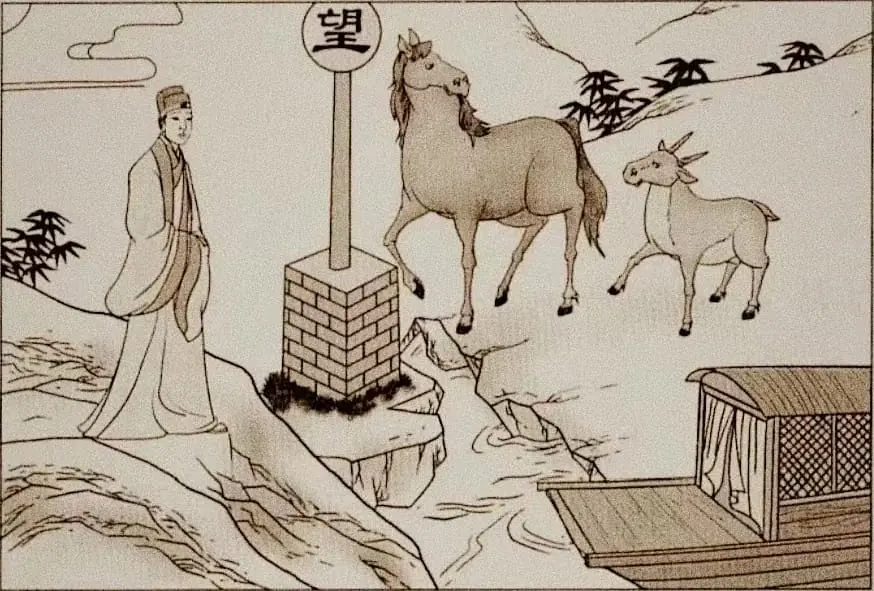
Start with the man on the rocky ledge at the left, looking out but not moving. The Image Symbolism reads him as someone who has climbed as far as he can alone and now stands uncertain, the way ahead blocked. Beside him a pole marked 望 (to look out, to hope) rises from a brick base in the grass: he is waiting for news. The symbolism adds a sound play: 望 wàng recalls 亡 wáng, loss, a reminder that waiting can tip into worry.
Across the stream a horse leads a goat-like sheep over the water, read as help arriving from someone else rather than through one’s own effort. At the lower right a boat rests at the bank, ready but not yet moving: the mood of the whole hexagram. The trigrams fit this: Heaven ☰ below is strength, Wind ☴ above is soft and light, yet the wind still moves across the sky and holds the strength back for now. The picture best illustrates the opening words, dense clouds without rain, and the fifth line’s sincerity that binds people together.
- Work
- If a plan is ready but stalled, consider what small, patient steps you can take while you wait. Building up skills and goodwill now is the kind of gain this hexagram favors.
- Relationships
- If tension is building between partners, ask whether either side is pushing too hard to steer the other. Gentleness can hold things together, but only if it is sincere and knows when to stop.
- Timing
- The rain is not here yet. If you are waiting for word from someone, keep the boat ready but do not force the crossing; help may come from an unexpected direction.
Line Statements
Listed from the bottom line to the top line.
- First nine: Return by one's own path. What blame could there be? Good fortune.
- Nine in the second place: Drawn back together. Good fortune.
- Nine in the third place: The carriage loses its wheel spokes. Husband and wife turn against each other.
- Six in the fourth place: With sincerity, blood departs and fear recedes. No blame.
- Nine in the fifth place: Bound together in sincerity, sharing wealth with one's neighbors.
- Top nine: Rain has fallen and rest has come. Esteem virtue accumulated; a woman's steadfastness is dangerous. The moon is nearly full; for the noble person, advancing brings misfortune.
Meaning of the Hexagram
Translated from the Chinese 人间道 commentary with AI assistance; translator notes appear in brackets.
“Xiao Chu: success. Dense clouds but no rain, coming from our western outskirts.”
This says that although the clouds gather densely, they cannot become rain; it is like people who have gathered together but cannot be in harmony.
“Xiao Chu: the yielding attains its position, and those above and below respond to it; this is called Small Taming.”
In the hexagram Xiao Chu (Small Taming), the fourth line is yin and sits in the position close to the ruler. With the soft, compliant nature of Xun (wind), it lets the firm yang lines above and below communicate with one another; but it can only hold them together, not make them strong and secure. Hence it is called Small Taming.
“Strong and gentle; the firm is central and its will is carried out: thus there is success.”
In terms of the trigram images, it is firm and strong within and able to be soft and compliant without; so although the taming is small, there can be success.
“Dense clouds but no rain: they are still moving on. Coming from our western outskirts: the bounty is not yet bestowed.”
This says that dense clouds cannot become rain, just as small taming cannot become great. The reason is that the yang below goes upward and the yang above goes downward, and the two energies are not in harmony.
“The wind moves across the sky: Small Taming. The noble person accordingly refines the beauty of his cultured virtue.”
Even against the firm strength of Qian (The Creative), the wind can still move above it; so the firm and strong can be tamed and restrained only by the soft and yielding. For the noble person, the small form of this is learning and artistic accomplishment; the great form is the sagely talent of morality and statecraft. These two ways are what is meant by the talent that is stored up.
“Return by one’s own path. What blame could there be? Good fortune.”
The first line is the place of first entry. With its firm, strong nature, and having in the position above a line of the same nature, its advance will surely go upward; how could there be disaster? So the first line’s yang firmness is free from disaster because it shares the nature of the yang firmness above.
“Return by one’s own path: its meaning is good fortune.”
The first and fourth lines are corresponding positions. So in the time of taming, with yin in the fourth and yang in the first, yin and yang respond to each other, and there is good fortune.
“Drawn back together. Good fortune.”
The second nine is in the position of a general. Because it corresponds to the yang fifth line, and both are firm and strong, then although the fourth line lies between them, they share yang firmness. As the old saying goes, “those with the same troubles feel for each other” [the source adds in brackets “those with the same desires hate each other”]. This is the way of good fortune, the time for the general.
“Drawn back together, it stays in the centre and does not lose itself.”
The first line is yang and firm, and the second is also yang and firm, so their force is strong. But because at this time it occupies the central position, the general’s position, even when strong it does not become excessively hard; to be excessively hard is to fail, and this is the way of heaven. So we should understand the beauty of being central yet firm: because its principle is correct, it can be strong and firm. When the noble person holds to principle, even firmness is not excessive.
“The carriage loses its wheel spokes. Husband and wife turn against each other.” (说 here means 脱, to come off.)
The third nine is the top line of the lower trigram and is closest to the yin fourth position, so it relates to it with the feelings between yin and yang, like husband and wife. Yin is by nature controlled by yang; now it sits in the fourth place, above the yang, and instead controls the yang, like husband and wife turning against each other. So it is like a carriage whose wheels have come off: it cannot move. When the wife leads the husband astray and controls him instead, it is because the husband has strayed from the right way. Never has a wife been able to control a husband who has not lost his way.
“Husband and wife turn against each other: he cannot set his household right.”
Because the husband, in a firm yang position, is excessively hard and loses the way of conducting himself, he cannot look after his household, and so husband and wife turn against each other. Therefore the way of a husband is to set his household right; this is the correct way.
“With sincerity, blood departs and fear recedes. No blame.”
The fourth six is in the position close to the ruler. It is able to tame the ruler, so that the majesty of the ruler in the fifth position can, through it, restrain his desires. This is all because the fourth six has sincerity (孚 means sincerity and trust within), and the ruler is moved by it.
“With sincerity, fear recedes: its will is in accord with the one above.”
Because the fourth position is sincere and soft outwardly, the ruler in the fifth trusts it, and they share the same purpose. Because the person in the fourth position can join with the fifth, all the yang lines follow; so fear recedes and blood departs, and there is no calamity of war.
“Bound together in sincerity, sharing wealth with one’s neighbors.”
The time of Small Taming is a time when all the yang lines are tamed by the single yin among them. It is like a ruler whose ministers are all, like him, hard and unyielding toward one another (dense clouds but no rain); but the person at the ruler’s side happens to be soft and compliant, and this person becomes the channel of communication between above and below. This is the time of Small Taming.
The fifth nine is the ruler’s position. If it occupies the most honoured position with centrality and correctness, and has sincerity within, then everyone attaches to it and responds, just as a rich man shares his wealth with his neighbours. From this line we know that when the noble person is beset by petty people, and upright people are pressed by the treacherous, then without mutual help between the upright yang lines above and below, one person alone can hardly cope with the time; there must be mutual help to drive out petty people.
“Bound together in sincerity: not wealthy alone.”
Therefore when the noble person is in hardship and danger, only through utmost sincerity can he gain the help of many, and then he will be safe. (“Bound together,” 挛如, means drawing others along so that they follow.)
“Rain has fallen and rest has come. Esteem virtue accumulated; a woman’s steadfastness is dangerous. The moon is nearly full; for the noble person to set out brings misfortune.”
The top nine is the end of this hexagram, at the end of taming. To be harmonious and yet able to stop is the way of taming. The ability of the soft to tame the firm is built up by accumulation and is not gained in a morning or an evening; the warning applies in ordinary times. If one relies solely on using the soft to control the firm and does not know when to stop, then, like a woman holding firmly to this way, there will be misfortune. In the world, has there ever been stability where a wife controls her husband or a minister controls his ruler?
When the moon is full, it is the time of the full moon, and it stands opposite the sun as a rival. If the noble person waits until the wife is about to become a rival, any action will surely bring misfortune, and warning will no longer help; so the warning must come before the moon is full.
“Rain has fallen and rest has come: virtue has accumulated to fullness. For the noble person to set out brings misfortune: there is cause for doubt.”
This is the way of Small Taming accumulated to fullness and complete; its image is of yin about to flourish, and if the noble person moves there is misfortune. When petty people resist the noble person, they are bound to harm him. The way to deal with yin at its height is for the noble person to be doubtful and know to be on guard, not to act rashly, and to seek out the reason why he is being controlled; then he will not come to misfortune.
Show the Chinese original (人间道)
小畜,亨。密云不雨,自我西郊。 此言云之畜聚虽密,却不能成雨,犹人虽聚,却不能和之义。
小畜,柔得位而上下应之,曰小畜。 小畜之卦,因第四爻阴,居近君主之位,以巽之柔顺本性,使上下之阳刚相互沟通,但只 能维系,却不能强固,故曰小畜。 健而巽,刚中而志行,乃亨。 以卦象而言,内刚健而外能柔顺,虽为小畜,但能亨也。 密云不雨,尚往也。自我西郊,施未行也。
此言密云不能成雨,犹小畜无法成大也,其因下阳往上,上阳往下,二气不和。
风行天上,小畜,君子以懿文德。以干之刚健,风仍能在上而行,故刚健之性,唯柔顺能畜止之,君子以小则文章才艺,大 则道德经纶之圣才,以此二道为所畜之才义。
复自道,何其咎,吉。 初入之地为初爻,以其刚健之性,又得上 位之同性,进必上,何来灾也。故初之阳刚, 乃因上位之阳刚性同,故无灾也。
复自道,其义吉也。 初爻与第四爻本为对应之位,故在畜时, 阴在四,阳在初,阴阳相应,故吉。
牵复,吉。 九二居将位,因与第五爻阳爻相对应,同 为刚健,虽中有四爻,但因同为阳刚,自古『同 患相忧』〔同欲相憎〕,吉之道,此时为将时。
牵复在中,亦不自失也。 初爻为阳刚,复二爻亦阳刚,其势乃强, 但因此时乃居中位,将位,故即强亦不会过刚, 过刚乃失,此天道。故吾人须知居中而阳刚之 美,因理正,故能强刚,君子持之以理,虽刚 亦不为过矣。
舆说辐,夫妻反目。 ( 说即 脱 ) 九三为下卦之上爻,最亲密于四爻阴位, 故乃阴阳之情相处也。犹如夫妻。阴本受制于 阳,今居四位居阳之上,即反制阳,如夫妻之 反目,故如车舆脱去轮轴,不能行也。妻为夫 所惑,反制于夫,乃因夫不正道。未有夫不失 道,而妻能制之也。
夫妻反目,不能正室也。 因阳刚位之夫,过刚而失自处之道,不能 顾家室,以致夫妻反目。故为夫之道,须正室 其家,方为正道。
有孚,血去惕出,无咎。 六四乃处近君之位,其能畜君,使五位君 之威严能因之而止其欲,皆因六四有孚信(孚, 乃内有诚信也〕而受其感也。
有孚惕出,上合志也。 因四位有诚信且外柔,使五之君位信任 之,乃合同志。五因四位之人能与之合,众阳 从之,故惕出则血去,不见兵祸矣。
有孚挛如,富以其邻。 小畜之时,乃众阳皆为其中一阴所畜之 时。犹如一国之君,与臣下皆刚而不容(密云 不雨〕,但近君侧之人,适得柔顺之人,而此 人为上下沟通之管道,此时乃即小畜之时也。 九五为君位,如以中正居至尊之位,又内有诚 信,则所有皆附应之。就好像富人出其财力与 邻共享之也。
从此爻则知当君子为小人所困, 正人为艰邪所逼,此时如无上下正阳之互援, 则独力难助于此时,须有互助方可去小人也。
有孚挛如,不独富也。 是故君子处之艰危,唯其至诚,能得众力 之助,则平安矣。(挛如即牵连使相从之。)
既雨既处,尚德载,妇贞厉。 月几望,君子征凶。 上九为此卦之终极,乃处畜之终。和而能 止乃畜之道,阴柔之能畜刚,由累积而成,非 朝夕可得,此戒之在平时,如专任以柔制刚, 不知止,如妇之坚守此道则乃凶矣,天下无妇 制其夫,臣制其君,尚能安稳者乎?月满之时 为月望,与日相敌状。
若君子待妇将成敌时, 动之必凶,不须戒也,故须戒之于月未满时。
既雨既处,德积载也;君子 征凶,有所疑也。 此小畜之道积满而成,其象为阴将盛样, 君子动则有凶也。小人抗君子,必有害于君子, 制阴极盛之道,则为君子有疑而知警惕,不妄 动,求其所以制君子之因,则不至凶也。