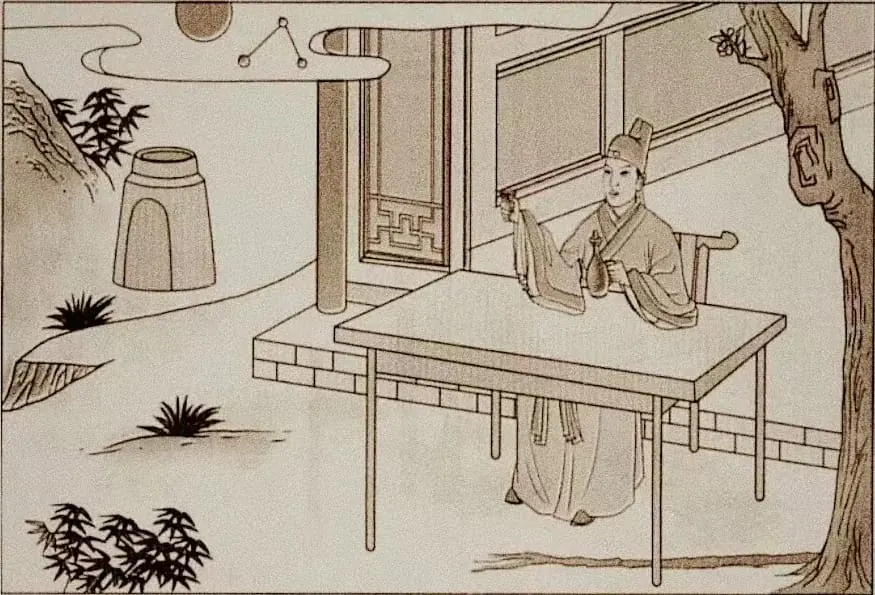
Scene Description
Image Symbolism
Reading the Picture
Bi is holding together: people drawn to a clear, steady centre, the way water settles naturally onto the earth.
Look first at the top of the picture. A round moon sits among drifting clouds, and next to it three small stars are linked by lines. The Image Symbolism reads the full moon as clear, enlightened leadership and the three stars as capable people gathering to support it, which matches the fifth line, “manifest joining”: a centre so plain and fair that others come to it of their own accord. Below, a scholar sits alone at a table on the terrace, holding a wine flask and pouring for himself. He is not anxious or chasing anyone; that ease reflects the second line, joining from within, without losing oneself.
On the slope to the left stands a medicine stove, set high and unused, read as an absence of trouble. At the right, an old, bare tree has put out a single small flowering sprig: something long thought finished coming back to life, a picture of success that arrives late. The trigrams give the setting: Earth ☷ below and Water ☵ above, water resting on the ground and filling every hollow, as close as two things can be. The top line warns that a bond without a good beginning has nothing to end with; here the beginning is sincere and unhurried.
- Work
- If you want support for a project, consider whether your aims are clear and fair enough that people would choose to join you. Pressure and flattery rarely build lasting backing.
- Relationships
- If you are deciding whom to grow close to, ask whether the bond starts from sincerity on both sides. Let those who drift away go, and welcome those who come.
- Timing
- Joining early, with a good beginning, matters more than joining loudly. If you have been holding back, consider whether waiting longer will leave you as the latecomer.
Line Statements
Listed from the bottom line to the top line.
- First six: With sincerity, join with others. No blame. Sincerity fills the earthen jar; in the end good fortune comes from elsewhere.
- Six in the second place: Joining from within. Steadfastness brings good fortune.
- Six in the third place: Joining with the wrong people.
- Six in the fourth place: Joining outwardly. Steadfastness brings good fortune.
- Nine in the fifth place: Manifest joining. The king drives game from three sides and lets the animals in front escape. The townspeople need no warning. Good fortune.
- Top six: Joining without a head. Misfortune.
Meaning of the Hexagram
Translated from the Chinese 人间道 commentary with AI assistance; translator notes appear in brackets.
“Bi: good fortune. Examine the divination again: if there is greatness, constancy and steadfastness, there is no blame. Those who are not at peace come only now; the latecomer meets misfortune.”
Bi (Holding Together) is a way of good fortune. When people draw close to one another there must be a right way of doing it: one must look at whether someone is fit to join with before deciding to join; to join with one who is not fit brings misfortune. If one waits until one can no longer keep oneself safe and at peace before starting to seek closeness, then, if one is lucky enough to find someone to hold to, one may still have peace. But if one goes on standing alone, and the wish to seek closeness lags behind instead of coming forward, then even the closest of kin, a husband, meets misfortune.
Therefore the ruler gently embraces the realm, and those below live in harmony with those above, since none can stand alone. One must have this intention in ordinary times as well: between heaven and earth, nothing can survive on its own without holding together with others.
The way of holding together requires that two wills seek each other; if they do not seek each other, the result is Kui (Opposition). Hence the Strategies of the Warring States (“Strategies of Zhongshan”) speaks of the principle that “those with the same desires hate each other; those with the same worries draw close.” So a good system gives people something to rely on and follow, and so they can live in harmony with one another.
“Bi is good fortune. Bi means support: those below comply and follow.”
Because drawing close to one another is a way of good fortune, it carries the sense of supporting and completing one another. But the way of seeking closeness must be like ministers complying with their ruler: whether people are of the same standing or differ as superior and inferior, one must never rely on one’s own high position and forget the way of compliance. This is the true way of holding together.
“‘Examine the divination again: if there is greatness, constancy and steadfastness, there is no blame’: because it is firm and central.”
Greatness, constancy and steadfastness are the way of holding together. Greatness is the way of a ruler and leader; constancy means being able to last; steadfastness means attaining the correct way and holding firmly to one’s will. When a person has these three virtues, and with yang firmness occupies the ruler’s position, this is the virtue of a ruler. Such a ruler can be without disaster.
“‘Those who are not at peace come only now’: above and below respond to each other.”
Those in high position should understand that the ruler cannot stand alone and must protect the people in order to be secure. The people below know they cannot protect themselves and must support the ruler in order to seek peace. This is the principle of above and below responding to each other. If the king acts from private interest and does not seek the agreement of the people below, misfortune and danger arrive at once.
“‘The latecomer meets misfortune’: his way is exhausted.”
If the wills of the many are in harmony and close, nothing fails to go well; this is the way of heaven and earth. If harmony and closeness among people do not prevail, then even a husband meets misfortune.
“On the earth there is water: Holding Together. The former kings accordingly established the ten thousand states and kept close to the feudal lords.”
Between heaven and earth, nothing holds to another as closely as water upon the earth. Observing the image of Bi, the sages accordingly established the ten thousand states, drew near to the feudal lords and kept close to the people; this is the highest way of holding together.
“With sincerity, joining brings no blame. Sincerity fills the earthen jar; in the end others come, and there is good fortune.”
This is the beginning of holding together. Sincerity (孚) is trustworthiness at the centre, so the way of holding together is rooted in sincerity and trust; if one’s outside and inside do not match, who will draw near? When sincerity and trust fill one within, like a jar filled to the brim, and nothing is added outwardly for show (“others,” 它, means the outside), and one treats people with utmost sincerity, then there is no one who will not trust.
“The first six of Holding Together: others come, and there is good fortune.”
This means that the way of holding together lies in the beginning. If at the start one is solid within, sincere and trustworthy, the end is good fortune; if at the start there is no sincerity, the end is misfortune.
“Joining from within. Steadfastness brings good fortune.”
“From within” means that the initiative lies with oneself. To attain the correct way and be in accord with the way of the ruler: this is good fortune. That is, to meet what the one above seeks by means of the central and correct way is called “from within.” People today who rush eagerly after connections are not following the noble person’s way of self-respect; it is a way of losing oneself.
“Joining from within: one does not lose oneself.”
To hold firmly to one’s own central and correct way and wait for those above to seek one out is not to lose oneself. This is the warning of the Changes. So a scholar cultivates himself, and only then seeks the way to advance. To lower one’s aims and disgrace oneself is by no means the way of self-respect. Our wish to save the world is not lacking in urgency; it is that we must wait for proper courtesy to arrive before coming forward.
“Joining with the wrong people.”
If the person one draws close to is not a proper person, that is “the wrong people,” and it invites misfortune.
“Joining with the wrong people: is this not harmful?”
Drawing close to the wrong people will surely bring regret and blame; the harm is great. The noble person must be very careful about whom he draws close to.
“Joining outwardly. Steadfastness brings good fortune.”
The fourth six is the position close to the ruler. A person in this position draws close to the ruler with a soft nature and the virtue of Kun (The Receptive), and complies with a firm heart; there is good fortune.
“Joining outwardly with the worthy: so as to follow the one above.”
The fourth position follows the ruler in the fifth; this is joining outwardly. Because the firm, clear-sighted worthy in the fifth position is central and correct, it attaches itself to him and follows. This is the way of following one’s superior, but it must never be blind obedience.
“Manifest joining. The king drives game from three sides and lets the animals in front escape. The townspeople need no warning. Good fortune.”
The way for a ruler to draw the realm close is to treat all things with sincerity, to extend to others the understanding he gives himself, to carry out government with benevolence, to like what the people like and dislike what the people dislike, and to work for the people’s benefit so that the whole realm receives his bounty; this is perfect goodness. Then the whole realm draws close to the one above. If instead he shows off his small achievements, displays his power, goes against morality and people’s hearts, and acts by force, so that people no longer trust, society becomes showy and shallow, and people grow dishonest and fall to ruin, then it is impossible to seek the closeness of the realm.
It is like a king going hunting who surrounds the game on only three sides and leaves one side open: the animals that run off ahead are spared. This is “letting the animals in front escape”; he takes only those that come toward him. This is the kingly way. “Town” means the place where people live; “warning” (诫) means an agreement made in advance.
This means that a minister serves his ruler with complete loyalty and all his ability, so as to show the way of holding close to the ruler; this is the correct way. Whether he is employed or not is the ruler’s decision; he must never flatter or fawn, or seek the ruler’s closeness improperly. It is the same with friends: one must cultivate oneself and treat others sincerely; whether they wish to be close to one is up to them. One must never use clever words and an ingratiating manner, or bend and go along with them, in order to win their closeness. “This is the way of manifest joining.”
“The good fortune of manifest joining: its position is correct and central. Letting go of those that turn away and taking those that come: letting the animals in front escape. The townspeople need no warning: the one above employs them with centrality.”
So manifest joining is fortunate because of the position it holds: it has found the method of the mean. And the way of holding together requires letting go of those who turn away and accepting those who come, as in Mencius’ way of taking students: “Those who leave are not pursued; those who come are not refused.” With the net drawn on three sides, only the animals in front are lost; this is the principle of caring for those who come and not pursuing those who leave.
“Joining without a head. Misfortune.”
The top six is the very end of holding together. Whenever the head, the beginning, of holding together is good, its end will surely be good too. Most people have a beginning but no end; but no one has ever had a good end without a beginning. So this says that holding together without a head (“head” means beginning) will surely end in misfortune. Today most people, when they first draw close, do not do so by the correct way, and in the end there is sure to be estrangement; such people are the majority.
“Joining without a head: there is nothing to end with.”
That is, if the beginning is not according to the Way, the end will surely be misfortune. So the way of friendship is give and take: if you do not come, why should I go? If I go, I must be seeking something, and it must be done rightly; otherwise there will in the end be a rift, and each will look on the other with hostility.
Show the Chinese original (人间道)
比:吉,原筮,元永贞,无咎。不宁方来,后夫凶。 比为吉之道。人相亲比,必有其道,须视可比而决定比之,不可比而比,凶。如果等到不 能自保安宁之时,方开始求亲比,幸运的得所亲比,可得平安。但如仍独立自持,求亲比之想 法不前反后,即使是丈夫之亲人,亦招凶矣。 是故君王亦怀柔天下,下位之人亦和亲其上,未能独立也,平日即须有此志,天地之间, 没有不相亲比而能独立生存的。
相比之道,须两志相求,如互不相求则为睽卦,故战国策〈中山策〕有同欲相憎,同忧相 亲之理。所以好的制度,能使人有所依从,故能互相亲和也。
比,吉也。比,辅也,下顺从也。 因相亲比为吉之道,有相辅相成之意。但求比之道,须如臣下顺从君上一样,即使地位相 同,或上下有别,决不可因持于己之高位,而忘顺从之道,此乃真比之道。 原筮,元永贞,无咎,以刚中也。元、永、贞为相比之道。元为君长之道,永为可以长久,贞谓得正道且坚其心志,人有此 三德性,再以阳刚当君主之位,此为君之德也。
如此之君主可以无灾矣。 不宁方来,上下应也。 上位之念,应知君不能独立,须保民以此为安。下民知己不能自保,须拥君以求宁,此上 下相应之理。如以王之私而行为之,不求下民之附和,凶危立至矣。 后夫凶,其道穷矣。 若众人之志相和亲,则无有不遂,此天地之道,若人之和亲不行,则虽夫亦凶矣。
地上有水,比。先王以建万国,亲诸侯。 天地之间,物相亲比,莫如水在地上,圣人观比之象,以此建万国,近诸侯,亲近人民, 此比之极道。
有孚,比之无咎。有孚盈缶, 终来有它,吉。 此为比之始。孚为中信,故相比之道,以 诚信为本,表里不一致,人谁近之。诚信充实 于内,如于缶中之满,且外不加修饰(它,外 也〕,至诚以待之,则无不信。
比之初六,有它吉也。 此即比之道在乎始也。始即能中实诚信, 终吉,始无诚信,终凶。
比之自内,贞吉。 自内言主之在己也。得正道,而与君道相 合,此吉也。即以中正之道,合于上位之所求, 乃曰自内。今人汲汲以求比者,非君子自重之 道,乃自失之道也。
比之自内,不自失也。 坚守己中正之道,以待上求,乃不自失也。 此易之戒。故士人修己,方求上进之道。降志 辱身此絶非自重之道。吾人救天下之心,并非 不急切,乃因须待礼遇之至方出也。
比之匪人。 相亲比之人,如为不正当之人,即为匪人, 招凶也。
比之匪人,不亦伤乎。 相亲于匪人,必将得悔咎,伤之大矣,君 子须深戒所亲比之人。
外比之,贞吉。 六四之位,为近君之位。居此位之人,以 柔性坤德向君主亲比,且坚心顺从,吉也。
外比于贤,以从上也。 六四之位从于五君之位,为外比。因五位 刚明之贤为中正,故附从之,此从上之道,絶 不可盲从。
显比,王用三驱,失前禽,邑人不诫,吉。 人君亲比天下之道,须诚意以待物,恕已以及人,发政施仁,民之所好好之,民之所恶恶 之,为民图利,使天下蒙其泽,此尽善也。则天下亦尽亲于上也。如表彰己之小功,展示自己 的权力,违反道德人心,强力施为,致人心不信,社会浮华,人偷败亡,如此而求天下亲比是 不可能的。
就好比君王出猎,只围三面开一面,禽兽前去者,免矣,此曰失前禽,只取来者, 此王道也。邑者,居邑,诫,期约也。此意臣之效于君,竭尽忠诚,用尽才能,以彰显亲君之 道,此为正道。至于用之与否,决定在君,万不可阿谀奉承,妄求君之亲比也。朋友亦然,须 修身诚意待人,至于是否愿意与己相亲,在人而己,千万不可巧言令色,曲从苟合,以求人之 相比。
『此显比之道』。
显比之吉,位正中也。舍逆取顺,失前禽也。邑人不诫,上使中 也。 故显比之所以吉,以其所在之位,得适中之法也。且比之道,须舍逆取顺,孟子收徒之道: 往者不追,来者不拒也。三面围网,所失唯前禽,即言此来者抚之,去者不追之理。
比之无首,凶。 上六乃比之终极处。凡比之首,其始善, 终亦必善矣。多数人皆有其始,而无其终,但 从未有人没有开始,而有终善也。故此言,比 之无首(首,始也〕,至终必凶矣。今天下之 人,始亲和比之时不以正道,至终必有隔阂, 此类人居多数。
比之无首,无所终也。 此即始不以道,则至终必也凶矣。是故交 友之道,你来我往,你不来,我何往。如我往, 必有求,须以正,否则终将隔隙,互相仇视也。