Scene Description
Image Symbolism
Reading the Picture
Da You is great possession held well: abundance that comes when what you have is offered openly, received with trust, and not hoarded or flaunted.
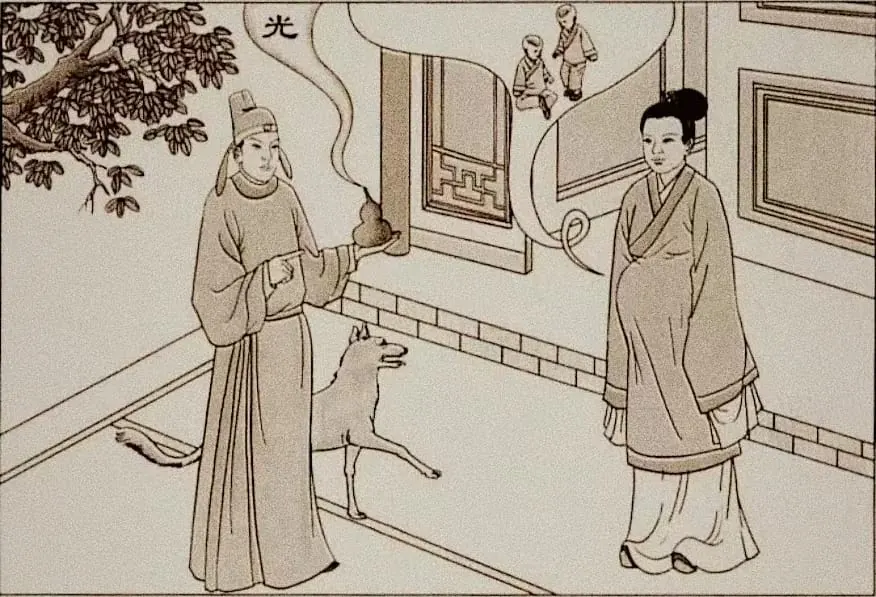
Begin with the official on the left. He holds out a gourd, and from it rises a wisp of vapour marked 光, light: something of real worth, a remedy that shines. The Image Symbolism calls him a Medicine King, a good helper arriving in time. Across from him stands an expectant woman, the source’s image of something already growing within, not yet visible to the world. Above her a ribbon of qi carries two small children, read as a double blessing, or as two people closely matched.
The dog between them is character play. 犬 (dog) sits at the foot of 哭 (to cry), and the source sees a similar shape under 笑 (to laugh), so the dog marks a moment that could turn to tears or to laughter. The woman has not yet taken what is offered; the Image Symbolism says she seems doubtful outwardly but listens inwardly.
The trigrams set the tone: Heaven ☰ below and Fire ☲ above, the sun high in the sky lighting everything. The scene most clearly echoes the fifth line, sincerity in mutual dealings joined with dignity: a gift offered in good faith and received with trust. The top line adds that such openness draws help from heaven.
- Work
- If you have resources or skills others need, consider offering them openly rather than guarding them. The fourth line warns against showing off what you have.
- Relationships
- If someone offers you help, ask whether doubt is keeping you from accepting it. Trust given both ways settles hearts.
- Timing
- Something may already be growing beneath the surface. If you feel ready to act, consider whether this is a time to carry the load steadily, like the great wagon, rather than to rush.
Line Statements
Listed from the bottom line to the top line.
- First nine: No involvement in harm. No blame; hardship brings no blame.
- Nine in the second place: A great wagon carries the load. Having somewhere to go brings no blame.
- Nine in the third place: A duke offers to the Son of Heaven. Petty people cannot do so.
- Nine in the fourth place: Not boasting of abundance. No blame.
- Six in the fifth place: Sincerity in mutual dealings, joined with dignity. Good fortune.
- Top nine: Help from Heaven. Good fortune; nothing is unfavorable.
Meaning of the Hexagram
Translated from the Chinese 人间道 commentary with AI assistance; translator notes appear in brackets.
“Great Possession: supreme success.”
This speaks of the hexagram’s capacities. It does not name all four virtues, origin, success, benefit and steadfastness, for fear of confusion with the two hexagrams Qian and Kun; saying only “supreme success” (yuan heng) exhausts the meaning of yuan. Yuan is the beginning of things: at the first coming into being of all things, everything is greatly good, because each must have its use. This is the beginning of great goodness.
In the Book of Changes only four hexagrams, Da You (Great Possession), Gu, Sheng and Ding, have “supreme success.” They differ from Qian and Kun: in Qian, yuan is the image of first bringing forth all things, the origin; in these four hexagrams it means only that the highest good is great.
“Great Possession: the soft obtains the honoured position, great and central, and above and below respond to it; this is called Great Possession. Its virtue is firm and strong, cultured and bright; it responds to heaven and acts in accordance with the time. Therefore there is supreme success.”
This hexagram is Great Possession because the fifth line, soft yin, occupies the honoured position and keeps to the great central way of the mean, so that all the yang lines turn to it and rely on it, and above and below respond to one another. Occupying the place of honour while holding to softness, it has the image of an empty, receptive centre. The hexagram’s virtue is firm and strong within and clear in principle without; it handles affairs in accord with heaven and in response to people. This is why there is supreme success.
Only after a matter is completed can success or failure be seen; failure does not show itself before the event. So it is only after gaining that there can be loss; without gaining, how could one speak of losing?
“Fire above heaven: Great Possession. The noble person accordingly curbs evil and promotes good, complying with heaven’s blessed mandate.”
Because fire is above heaven, it can illuminate all things. The noble person observes the image of Great Possession and so knows the way of governing the multitude: only by curbing evil and promoting good can one comply with the mandate of heaven and settle the hearts of the people. The way of the Son of Heaven is just this.
“No involvement in harm. No blame; hardship brings no blame.”
With a firm yang nature it is in a low, humble position. Because it has not yet reached fullness, there is no worry of arrogance or excess, and because it has no dealings with others, there is no harm.
When people are rich in wealth or in talent, few escape harm. Being rich is not a crime in itself, yet people all invite harm through being rich, because when they are rich they do not think of hardship or guard against fullness; then hearts of arrogance and extravagance arise, and this is how harm is born.
“The first nine of Great Possession: no involvement in harm.”
That is, at the very beginning of Great Possession one becomes watchful and constantly remembers times of hardship. This is the source of “in safety, think of danger.” If one can do this, then even dealings with others bring no harm. So when dealing with others, being arrogant because of one’s riches is sure to bring harm.
“A great wagon carries the load. Having somewhere to go brings no blame.”
This line has firm and strong ability, occupies a soft yin position, and is trusted by the ruler in the fifth position, so there is no disaster. It is like the timber of a great wagon, strong enough to carry heavy loads: it can bear great responsibility and travel far, and go without disaster.
“A great wagon carries the load: the load is gathered in the middle and it does not fail.”
A great wagon can carry heavy things; the load is gathered in the centre and does not come to ruin. This speaks of the strength of the second nine’s ability, able to bear the heavy charge of Great Possession.
“A duke offers to the Son of Heaven. Petty people cannot do so.”
The third nine is at the top of the lower trigram, the position of a feudal lord. Although a lord enjoys the wealth of his lands and the multitude of his people, they still belong to the Son of Heaven; this is the duty of a subject. But when a petty person holds this position, he monopolises the wealth for himself and does not know the way of serving the one above for the common good.
“A duke offers to the Son of Heaven: for petty people it is harmful.”
A lord who keeps a subject’s integrity serves the one above loyally and obediently and carefully nurtures his people, to be called upon by the king. If a petty person holds this position, he does not know the way of serving the one above and treats what he has as private property; so when a petty person holds this position, there is great harm.
“Not boasting of abundance. No blame.”
The fourth nine is firm yang in the time of Great Possession. Because it is close to the ruler’s position, if it conducts itself too grandly, misfortune results. 彭 (peng) means grand abundance. One must be humble and diminish oneself; this is the way of good fortune.
“Not boasting of abundance, no blame: clear discernment.”
A wise person, in this time of the grand abundance of Great Possession, takes care that blame is approaching and responds with a humble, self-effacing attitude, not daring to go to the extreme fullness that invites misfortune. Therefore there is no disaster.
“Sincerity in mutual dealings, joined with dignity. Good fortune.”
The ruler’s position is held with yin softness, and he treats those below with sincerity and trust; those below in turn treat the one above with sincerity and trust. When above and below interact, people’s hearts are easily settled. But if he relies only on soft compliance, a contemptuous attitude is sure to arise [among those below]. So he uses dignity and trust: the noble person has dignity within his softness, so that subordinates hold him in awe. That there is good fortune can be known.
“Sincerity in mutual dealings: trust awakens their aims. The good fortune of dignity: [without it, people grow] easy and unprepared.”
Above and below interact with sincerity and trust and answer one another. If the one above has no dignity, subordinates easily become disrespectful and contemptuous. So the ruler must beware of lacking dignity.
“Help from Heaven. Good fortune; nothing is unfavorable.”
This position is the very end of the hexagram Great Possession, and it also expresses the utmost of brightness. Only one who is supremely clear-sighted does not cling to what he has. Holding the greatest position without treating it as his own, he has no disaster of overfullness. When a ruler can reach this, he accords with the way of heaven and receives heaven’s help, and wherever he goes there is good fortune. The age of great unity will have come.
“The top line of Great Possession is fortunate: help comes from heaven.”
At the extreme of Great Possession there would naturally be change, but because everything he does complies with heaven and accords with the way, this noble person is full without overflowing, and so heaven helps him. He honours worthy people and esteems trust and righteousness; therefore it is supremely fortunate.
Show the Chinese original (人间道)
大有:元亨。 此乃以卦才而言,不言元亨利贞四德,乃恐与乾坤二卦相混淆,只言元亨乃尽元之义,元 乃物之始,万物生成之初皆为大善,因必有功用。此为大善之初,易经唯四卦,大有、蛊、升、 鼎有元亨。其不与乾坤同,在干为首出万物,元始之象,在此四卦唯至善为大而已。
大有,柔得尊位,大中而上下应之,曰大有。其德刚健而文明, 应乎天而时行,是以元亨。 此卦之所以为大有,乃因五以阴柔居尊位,又处以中庸大中之道,为诸阳所依归,上下相 应,此居尊执柔,有虚中之象,卦德内刚健而外明理,处事顺乎天应乎人,此所以元亨。事于 成后,方可见成败,败非先现于事前也。
故有得后乃有所失,非得则何言有失乎?
火在天上,大有,君子以遏恶扬善,顺天休命。 火因在天上,故能照见万物,君子观大有之象,故知治众之道,唯遏恶扬善,此能顺天命 而安众民心,天子之道即如是。
无交害,匪咎,艰则无咎。 以阳刚之性处卑下之位,因未至于盛,故 不有骄盈之虑,因无交往,故无害。人之富有 于财或才,鲜不有害,富有本无罪,但人却皆 因富有而招害,乃因处富有而不知思艰戒盛, 则生骄侈之心,此所以生害也。
大有初九,无交害也。 此即在大有之初始,即生戒心,须时思念 艰难之时,此居安思危之来源,故能如此,则 交亦无害也。故与人交往,持富有而骄,必生 害也。
大车以载,有攸往,无咎。 此位以刚健之才,居于阴柔之位,而为六 五君位所信任,故无灾。就如大车之材,强壮 能载重物,可以任重行远,往而无灾。
大车以载,积中不败也。 大车能载重物,重物集中而不损败,言九 二才力之强,能胜大有之重任。
公用亨于天子,小人弗克。 九三居下卦之上位,为诸侯之位,诸侯虽 享有土地之富,人民之众,但仍属天子所有, 此人臣之义。但小人居此位则专其富有以为 私,不知奉上以公之道。
公用亨于天子,小人害也。 诸侯能守臣节,忠顺奉上,慎养其众,为 王之征用。若小人处此位,则不知奉上之道, 以所有为私有,故小人居此位,则有大害也。
匪其彭,无咎。 九四阳刚居大有之时,因近君位,如处之 太盛,则致凶,彭为盛大之义,须谦损,方为 吉道。
匪其彭,无咎,明辩皙也。 明智之人,处此大有盛大之时,戒在咎之 将至,以谦损态度应之,不敢至于极满招凶之 道也。故无灾。
厥孚交如,威如,吉。
人君之位,以阴柔守之,以诚信待于下, 下亦诚信待上,上下相交,此人心易安,但若 专以柔顺,则必生悔慢之心,故以威信,故君 子柔中有威,使下属有畏,其吉可知也。
厥孚交如,信以发志也;威 如之吉,易而无备也。 上下相交以诚信,互相呼应,上位如无威 严,则下属易生毁谩,故君须戒无威。
自天祐之,吉,无不利。 此位乃大有卦之终极,仍明之极意。人唯 至明,故不居于已有,有极大之位,而不为已 有,则无盈满之灾,君能至此,则合于天道, 得天之祐,则无往不吉。大同之世来矣。
大有上吉,自天祐也。 大有至极处,本有变化,但由所为皆顺天 合道,此君子满而不溢,故天祐之。尊尚贤人, 崇尚信义,故为上吉。