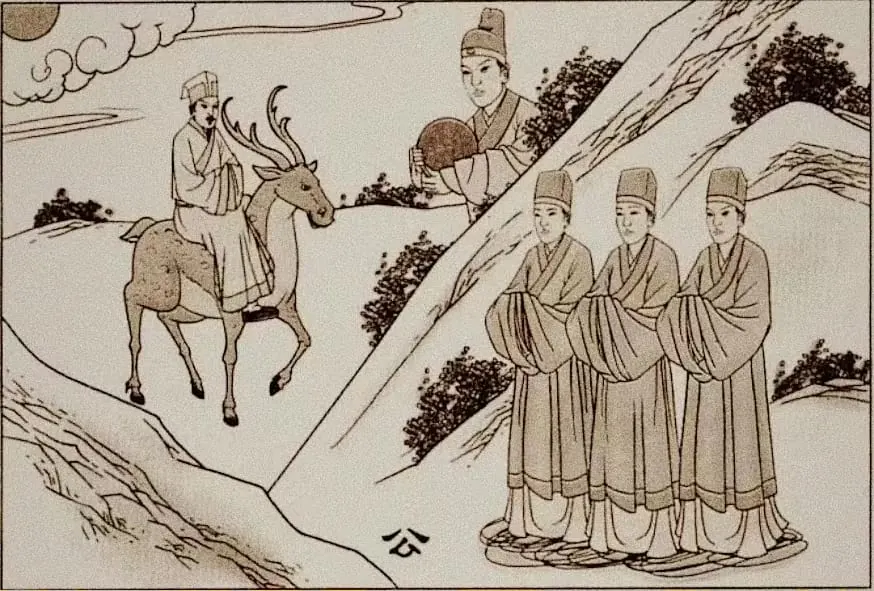
Scene Description
Image Symbolism
Reading the Picture
Qian (Modesty, 谦) shows a mountain hidden inside the earth: real substance that does not show off, set against people who only wear modesty as a disguise.
Start at the top left, where the moon shines through the clouds. The Image Symbolism reads it as clear, honest government arriving. Below it an official rides a deer: 鹿 lù sounds like 禄 lù, reward, so he has both ability and the means to use it, and he rides calmly rather than racing. On the ridge a distinguished figure holds up a round mirror, a bright mirror hung high, the image of fair judgment that shows things as they are.
Now look at the three officials standing together on the right, hands folded in their sleeves, faint tangles at their feet. The written description places them behind the mountain with tangled threads underfoot: people who hide behind a show of humility while their plans are in knots. In the picture they stand in plain view, and that is part of the lesson; a mirror makes posturing visible. The character 公, public and fair, lies on the ground near them: matters are settled by fairness, not by appearances.
The trigrams give the core image: Mountain ☶ below, Earth ☷ above, height kept beneath a level surface. The rider on the deer best illustrates the third line, labouring with modesty: the one who works hard and does not claim credit carries things through.
- Work
- If you have done good work, consider letting results speak rather than announcing them. Ask whether anyone near you is using humility as cover.
- Relationships
- If you tend to give way, check that your modesty is real and not avoidance; the source says it should come with quiet firmness inside.
- Timing
- Clarity is coming. If a situation feels murky, consider waiting for the mirror rather than arguing your case loudly now.
Line Statements
Listed from the bottom line to the top line.
- First six: The modest, modest noble person. Crossing the great river brings good fortune.
- Six in the second place: Sounding modesty. Steadfastness brings good fortune.
- Nine in the third place: Laboring with modesty; the noble person brings matters to completion. Good fortune.
- Six in the fourth place: Nothing is unfavorable. Display modesty.
- Six in the fifth place: Not wealthy, with one's neighbors. It is beneficial to invade and subdue. Nothing is unfavorable.
- Top six: Sounding modesty. It is beneficial to employ the army and campaign against towns and states.
Meaning of the Hexagram
Translated from the Chinese 人间道 commentary with AI assistance; translator notes appear in brackets.
“Modesty: success. The noble person carries things through to the end.”
To have virtue without laying claim to it is modesty. If a person can conduct himself with modesty and humility, there is nowhere he goes that is not favorable. The noble person’s aim is to attain understanding of principle; he delights in heaven’s mandate and has no heart for competing. He seeks only inner fullness, yields and steps back, and is not self-important. He can rest in modesty and does not change it all his life.
Petty people, when they desire something, must compete for it. Such people, when they see someone with virtue, are sure to attack him; even if someone urges modesty on them, in the end they cannot practise it broadly or hold to it firmly. So petty people can never carry things through to the end.
“Modesty: success. The way of heaven descends to help below and is bright and clear; the way of earth is low and moves upward.”
The noble person understands the way of modesty and so can have success. Because heaven’s qi can descend to help below, it can give birth to and nurture all things; therefore its way is bright and clear. So the noble person knows modesty and can let his way help all the people of the realm. The way of earth is the same as heaven’s: because it places itself low, it can rise to meet heaven. Thus heaven and earth both achieve success in the end because they can lower themselves.
“The way of heaven diminishes the full and increases the modest.”
The way of heaven has the sun, the moon and the five planets, which wax and wane with the seasons; therefore it can send down its qi to the earth and give life to and nourish all things.
“The way of earth overturns the full and flows toward the modest.”
If the lie of the land becomes overfull, it must topple and change and sink down.
“Ghosts and spirits harm the full and bless the modest.”
The way of heaven and earth is a study of what is above form; we can seek it through reasoning. Ghosts, spirits and the human way are a study of what is below form; we can see them at first hand. Everything in the world has its use. Whatever is full is sure to meet calamity, and whatever can be modest and diminish itself is sure to be blessed. It is like Western medicine today, which knows only how to remove tumours and use toxic drugs, not how great the damage is; so there are many after-effects, which it does not itself see.
“The way of humans hates the full and loves the modest.”
Human feeling is sure to dislike people who are full of themselves and to like people who are modest; so the sage warns against fullness and urges people to be modest.
“Modesty: honoured, it shines; lowly, it cannot be surpassed. This is the end of the noble person.”
The way of the noble person becomes bright and great through modesty and humility; a mind of utmost sincerity is like this to the end.
“Within the earth there is a mountain: Modesty. The noble person accordingly reduces what is too much and increases what is too little, weighing things and distributing evenly.”
A high, great mountain lies beneath the earth, showing people the image of modesty: outwardly low, inwardly truly high and great. When there is excess, the noble person reduces it; when there is lack, he increases it. Applying this to affairs, he brings all things into balance.
“The modest, modest noble person. Crossing the great river brings good fortune.”
In the lowest position, it conducts itself with softness and is also yielding. One who can be like this is a noble person. Even crossing danger and hardship, there will be no misfortune.
“The modest, modest noble person: lowly, he tends himself.”
The noble person conducts himself by the way of modesty and humility when he first enters the world.
“Sounding modesty. Steadfastness brings good fortune.”
The second position is held with soft compliance in the centre. When the virtue of modesty reaches this point, it must be openly expressed outwardly, seen in one’s voice and bearing. Holding firmly to this brings good fortune.
“Sounding modesty, steadfastness brings good fortune: it is attained in the heart.”
Because the heart within is content in itself. The mountain is supremely great and yet knows modesty; so we must have substantial strength, high and deep, for true modesty is not something forced.
“Laboring with modesty; the noble person brings matters to completion. Good fortune.”
The third is the position of a chief minister, held by firm yang. He is entrusted by the ruler above and followed by the people below. He knows how to labour without claiming credit and treats others with modesty; the noble person can carry this out to the end, so there is good fortune.
Today those who hold power in high positions all show the people what their achievements are and do not know the beauty of labouring with modesty; this is a time when the way of petty people grows. Conversely, one who can fully practise the way of labouring with modesty is sure to be a noble person.
“The noble person who labours with modesty: the myriad people submit to him.”
This noble person who labours with modesty can win the submission of all the people.
“Nothing is unfavorable. Display modesty.”
The fourth sits in a position close to the ruler. At this time the ruler in the fifth position conducts himself with modesty and softness, and the chief minister in the third position is employed by the one above for his great merit and virtue. This line should serve the ruler with reverence and awe and humbly yield to the minister who labours with modesty. All that it gives out should be modest; it must never fail to favour modesty.
“Nothing is unfavorable, display modesty: it does not go against the rule.”
Because the fourth six is close to the ruler and also sits above the minister who labours with modesty, it must never fail to favour the way of modesty; this is the fitting method.
“Not wealthy, with one’s neighbors. It is beneficial to invade and subdue. Nothing is unfavorable.”
Wealth and rank are what everyone longs for, and wealth is used to gather people. Now the fifth, a king in the honoured position, wins people’s closeness without using wealth, all because he knows modesty and compliance; so he can win the realm.
Yet the way of a ruler must be guarded: he must on no account rely only on modesty and compliance. He must combine authority and gentleness to win the submission of the realm; therefore the Changes says, “It is beneficial to invade and subdue.” Giving equal weight to authority and virtue is the way of a ruler.
“It is beneficial to invade and subdue: to punish those who do not submit.”
The way of a king must use punitive campaigns against those whom the virtue of modesty cannot win over; otherwise he cannot govern the realm, and this would be an excess of modesty.
“Sounding modesty. It is beneficial to employ the army and campaign against towns and states.”
The top six is at the extreme of Modesty. Being extremely modest yet occupying a high position, it is too modest. To make its modesty known, it can only use the way of firm force, campaigning within its own territory. This comes about because of excessive modesty.
“Sounding modesty: the aim is not yet attained. One may employ the army to campaign against towns and states.”
Because it is extremely modest yet sits at the top, modesty does not suit it, so its aim cannot be fulfilled and it sounds out. It should only use firm force to put its own domain in order.
Show the Chinese original (人间道)
谦:亨,君子有终。 有德而不居,为谦,人能以谦逊自处,无往不利。君子之志在达理,乐天命而无竞之心, 但求内充,退让而不衿持。能安于谦,终身不易。小人则有欲必竞,此种人见有德之人必攻之, 即令有人告之谦逊,但终不能宽行固守。故小人,必不能有终也。
谦,亨,天道下济而光明,地道卑而上行。 君子明谦之道而能亨。天之道因其气能下济,故能生育万物,故道乃光明,故君子知谦而 能使其道济天下万民,地之道亦同天,因自处卑地,故能上交于天,是故天地二者,皆因能卑 降而终亨通也。 天道亏盈而益谦。 天之道有日月五星,其随时盈晦,故能降气于地,生养万物。
地道变盈而流谦。 地势如盈满,则必倾变而下陷。鬼神害盈而福谦。 天地之道乃形而上之学,吾人可推理求之。鬼神人道乃形而下之学,吾人可亲而见之,世 间万物必有其用,凡盈满者,必有祸害,能谦损者,必有福祐之,犹今之西医,其但知能如何 除瘤用毒,不知损害之大,故后遗症之多,而自不见之。
人道恶盈而好谦。 人情必恶人之盈满,好人之谦损,故圣人戒盈而劝人为谦也。 谦尊而光,卑而不可喻,君子之终也。 君子之道因谦卑而光大,至诚之念如是而终。
地中有山,谦。君子以裒多益寡,称物平施。 高大之山在地下,故示人外卑下,内实高大乃谦象。君子有过则损之,不足则益之,以之 用于事,使万物皆平衡也。
谦谦君子,用涉大川,吉。 最卑下之位以柔态处之,又谦让也。能如 是,君子也。即涉险难,必无凶也。
谦谦君子,卑以自牧也。 君子以谦卑之道,于初入世间而自处之。
呜谦,贞吉。 二位以柔顺居中,谦之德至此,则须明倡 于外,见诸声色,坚心如此,吉也。
鸣谦贞吉,中心得也。 因中心能自得,山至大又能知谦,故吾人 须有高厚实力,乃真谦非勉力为之也。
劳谦,君子有终,吉。 三为相位,以阳刚居之,上为君所任,下 为民所从,能知劳而不居功,谦下待人,君子 能行之至终,故吉。今上位掌权之人,尽皆示 民其功勋为何,不知劳谦之美,此为小人之道 长之时也。反之,能尽劳谦之道,必为君子。
劳谦君子,万民服也。 此劳谦君子,能服万民也。
无不利,撝谦。 四体居近君主之位,此时因六五之君,以 谦柔自处,九三之相位,又因大功德为上所用, 此当恭畏侍君,卑谦以让劳谦之臣,所有布施, 均为谦也,切不可不利于谦。
无不利,撝谦,不达则也。 六四因近君之位,又居劳谦臣之上,絶不 可不利谦道,此得宜之法也。
不富以其邻,利用侵伐,无 不利。 富贵,众人之所向往,以财来聚人。今五 以居尊之君王,不以富而能得人亲,皆因知谦 顺,乃能得天下。然须戒君道,切不可专尚谦 顺,必须威柔并济,才能服天下,故易曰:「利 用侵伐」。威德并重,方为君道。
利用侵伐,征不服也。 君王之道,须用征伐,其用谦德所不能服 者,否则不能治天下,则为谦之过也。
鸣谦,利用行师,征邑国。
上六处谦之极也,因极谦反居高位,为太 过于谦,为倡明其谦,只有用刚武之道,于已 之私有地,征之。此因谦之太过而致如此。
鸣谦,志未得也。可用行师, 征邑国也。 因极谦又居上,其不适谦,故志不得伸, 则鸣,唯宜以刚武自治其国内。