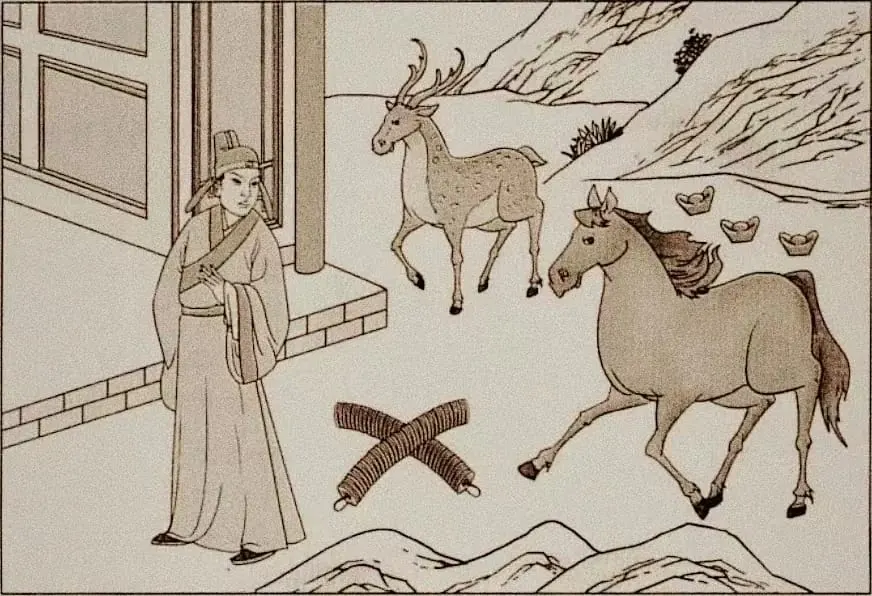
Scene Description
Image Symbolism
Reading the Picture
Yu is the stir of thunder coming out of the earth: energy and good spirits gathering behind a clear purpose, and the need to keep your footing while everything around you is lively.
Begin with the deer and the horse approaching from the open hills toward the official at the doorway. Read together they make the old phrase 禄马, reward and the horse of travel: 鹿 lù echoes 禄 lù, emolument, and the horse stands for movement and a new posting. The Image Symbolism reads the pair as means arriving for someone ready to set out, perhaps in a different line of work.
Now look at the ground. Silver ingots lie scattered on the slope, and two strings of coins lie crossed in front of the official. Plenty is on the ground, yet the source reads the coins as quiet worry within, and the hills behind and in front as distance and obstacles without. The official himself stands still, hand at his chest, as if weighing whether to go.
The trigrams give the hexagram’s energy: Earth ☷ below, compliant, and Thunder ☳ above, moving. The animals converging on one man echo the fourth line, the single firm line that is the source of enthusiasm, where friends gather like hair held in a clasp. His stillness amid the bustle recalls the second line, firm as stone, seeing the turn early.
- Work
- If an opportunity or a move is arriving, consider whether the people around you share the purpose; Yu works when hearts are in tune, not when one person shouts.
- Relationships
- If things feel exciting, ask whether you are both enjoying it or one of you is carried along. The first line warns against broadcasting good fortune.
- Timing
- Momentum is building. If you feel swept up, the second line suggests leaving at the first sign of trouble rather than waiting out the day.
Line Statements
Listed from the bottom line to the top line.
- First six: Proclaiming enthusiasm. Misfortune.
- Six in the second place: Firm as stone, not waiting out the day. Steadfastness brings good fortune.
- Six in the third place: Looking upward for enjoyment brings regret. Hesitation brings regret.
- Nine in the fourth place: The source of enthusiasm; great gains. Do not doubt. Friends gather like a hair-clasp binding hair.
- Six in the fifth place: Persistent illness, yet never dying.
- Top six: Darkened enthusiasm. Once formed, if it changes, no blame.
Meaning of the Hexagram
Translated from the Chinese 人间道 commentary with AI assistance; translator notes appear in brackets.
“Enthusiasm: it is beneficial to establish lords and to set armies in motion.”
The sage embodies the way of enthusiasm and delight. He knows that raising armies and enfeoffing lords can succeed only when the hearts of the multitude are in harmony and joy. So to rule over the ten thousand states and to gather the great multitude, only harmony and delight will do. This is the time of Yu (Enthusiasm).
“Enthusiasm: the firm finds response and its aims are carried out; compliant, it moves: this is Enthusiasm.”
When movement accords with principle, the multitude complies and responds, and one’s aims are carried out. So Enthusiasm is movement to which the multitude complies.
“Enthusiasm is compliant and moves; therefore heaven and earth are like it. How much more so the establishing of lords and setting armies in motion!”
Movement in accord with principle: the way of heaven and earth is also like this, so how much more the establishing of lords and the raising of armies.
“Heaven and earth move in compliance, so the sun and moon do not err and the four seasons do not deviate. The sage moves in compliance, so punishments are clear and the people submit.”
Heaven and earth move in compliance: we can observe the progress of the four seasons and the never-erring revolution of the sun and moon. The sage takes this as his endowment and knows that, through correctness, the people will vie with one another in doing good; punishments become clear and penalties simple, and all the people submit.
“Great indeed is the meaning of the time of Enthusiasm!”
The sage understands Enthusiasm and embodies and applies its way, so his grasp of timing is great. Under this hexagram there are eleven hexagrams [whose commentaries praise the time]: Yu, Dun, Gou and Lü all speak of the meaning of the time; Kan, Kui and Jian all speak of the use of the time; Yi, Da Guo, Xie and Ge all speak of the greatness of the time.
“Thunder comes out of the earth with force: Enthusiasm. The former kings accordingly made music to honour virtue, offering it in abundance to the Supreme Lord, together with their ancestors.”
Thunder moves, comes out of the earth and shakes with force: the image of delight. The former kings composed music to praise merit and virtue and offered it to the Supreme Lord and to their ancestors. This says that if one can understand and embody the way of Enthusiasm, it flourishes and becomes supremely great.
“Proclaiming enthusiasm. Misfortune.”
The first six is a low position occupied by a soft yin line: a petty person who is neither central nor correct. In the time of Enthusiasm he is favoured by the one above, becomes complacent and self-satisfied, and even proclaims it aloud. Such is the shallowness of a petty person; it must lead to misfortune.
“The first six proclaims enthusiasm: its aims are exhausted, misfortune.”
The first six is at the bottom yet cries out arrogantly. Although it dresses itself in outward delight, in truth it has reached the end of its resources, and there is misfortune.
“Firm as stone, not waiting out the day. Steadfastness brings good fortune.”
The way of enthusiasm and delight easily slides into indulgence; in excess it loses the correct way and is out of keeping with the time. The second is by nature a yin position, and now a yin line occupies it, so it is central and correct: the image of keeping oneself in check. In the time of Enthusiasm, the noble person alone can hold himself with centrality and correctness, showing that his integrity is as firm as stone; therefore there is good fortune.
To be able to see affairs at their subtlest beginnings is called spiritual insight. The noble person does not flatter those above or treat those below with disrespect, because he can perceive the subtle: the beginnings of good and bad fortune can first be seen here. Holding firm as stone, he is not confused and sees clearly.
“Not waiting out the day, steadfastness brings good fortune: because it is central and correct.”
A person who is central and correct and holds firm can discern things early. This is the noble person’s way of conducting himself in the time of Enthusiasm.
“Looking upward for enjoyment. Regret. Delay brings regret.”
The third six is yin in a yang position: a person neither central nor correct occupying the position of a chief minister. Moving in this way brings regret. 盱 (xu) means looking upward: in his movements he looks up to those around the ruler; so he is neither central nor correct, and this is the beginning of regret.
Therefore the noble person understands that when one’s conduct is not upright, both advancing and retreating bring regret. The way to conduct oneself lies simply in correcting oneself, governing the heart with propriety; then, even in the time of Enthusiasm, one does not lose centrality and correctness, and there is no regret.
“Looking upward for enjoyment brings regret: the position is not appropriate.”
Because one conducts oneself inappropriately and loses centrality and correctness, both advancing and retreating bring regret: one occupies an unsuitable position.
“The source of enthusiasm; great gains. Do not doubt. Friends gather like a hair-clasp binding hair.”
The fourth nine is the position beside the ruler. When it moves, all the yin lines comply with delight; this is the meaning of Enthusiasm. It is the source of the delight: with yang firmness it holds this position and carries out its aims in full, and the whole realm is delighted. If a person is wholly sincere, there is no doubt; above and below trust one another through perfect sincerity and are brought together. A clasp (簪) is the thing that gathers the hair.
“The source of enthusiasm, great gains: its aims are carried out in full.”
Its aims are carried out in full throughout the realm, all because of gathering those who are delighted.
“Persistent illness, yet never dying.”
The six in the fifth place holds the ruler’s position. In the time of Enthusiasm, yin softness has the image of sinking into indulgence: weak and unable to stand on its own, absorbed in the pleasures of wine and women, and controlled by a minister who monopolises power. Because it is controlled from below, there is suffering. Rulers past and present have brought themselves into danger in many ways, but mostly by giving free rein to pleasure; how could they not die?
“The six in the fifth place has persistent illness: it rides upon the firm. It never dies: its centre is not yet lost.”
The ruler’s position is afflicted because the person beside him who monopolises power holds him down. If he does not die, it is because the firm one beside him is central and correct, and so he does not come to ruin.
“Darkened enthusiasm. Once formed, if it changes, no blame.”
At the extreme of Enthusiasm, occupied by a soft yin line: here the sage shows that whatever a person’s faults, if he can change himself, there can still be no blame; such a person is a noble person. If he stays befuddled and does not reflect on himself, he will surely invite misfortune.
“Darkened enthusiasm at the top: how could it last long?”
Being benighted in enjoyment until one reaches the very end brings disaster; it cannot last long. The noble person should change quickly.
Show the Chinese original (人间道)
豫:利建侯,行师。 圣人体豫悦之道,知兵师之兴,诸侯之封,必众心和悦方成,故能君临万邦,能群聚大众, 唯和悦可也,此豫之时也。
豫,刚应而志行,顺以动,豫。 动之顺理,众顺而回应,其志乃行,故豫乃动而众顺。 豫顺以动,故天地如之,而况建侯行师乎。 顺理而动,天地之道亦如是,更何况立建诸侯,兴兵之师。 天地以顺动,故日月不爲过,而四时不忒;圣人以顺动,则刑罚清, 而民服。 天地之顺而动,吾人可视四季之行,日月运转永不为过,圣人禀此,而知因正而民相争于 行善,刑清罚简,万民皆服。
豫之时义大矣哉。圣人知豫而体用豫之道,故于时机之掌握大矣,此卦之下有十一卦,豫、遯、姤、旅,皆 言时之义。坎、睽、蹇,皆言时之用。颐、大过、解、革,皆言时之大也。
雷出地奋,豫。先王以作乐崇德,殷荐之上帝,以配祖考。 雷动出于地而奋震,悦之象也。先王作声乐以褒扬功德,归之上帝、祖先,此言,豫之道, 能知,能体,则盛而至大也。
鸣豫,凶。 初六乃下位,阴柔处之,是意不中正之小 人,处豫时,为上所宠,志得意满,乃至于发 声,小人之轻浅如是,必至凶也。
初六鸣豫,志穷凶也。 初六处下而骄鸣,虽外饰喜悦,实乃穷极 而凶。
介于石,不终日,贞吉。 豫悦之道,易流放纵,过则失正道,乃不 合于时。此六二本阴位,今阴爻居位,乃处中 正,为自守之象,君子处豫之时,独其能以中 正自守,示出其节介如石之坚也,故吉。能见 事于几微者,谓之神妙。君子之人上交不谄, 下交不渎,因能知微,吉凶之始,可先见于此 也。
守坚如石,则能不惑而明。
不终日贞吉,以中正也。 人能中正,且守坚,故能辨之于早,此君 子处豫之道。
盱豫,悔。迟有悔。 六三乃以阴而居阳位,为不中不正之人居 相位也。如此动则有悔,盱为上视也,其动竟 上视君侧之人,故不中不正,悔之始也。是故 君子明处身不正,进退皆有悔矣。处已之道, 在正本身而已,以礼制心,即处豫却不失中正, 则无悔矣。
盱豫有悔,位不当也。 因自处不当,失却中正,造成进退有悔, 处不当位也。
由豫,大有得,勿疑,朋盍 簪。 九四乃君侧之位,动则众阴悦顺,此豫之 义。豫悦之由,以阳刚而任此位,大行其志, 而天下皆悦。人能尽诚则无疑,上下因至诚而 信,合而聚之,簪,乃聚髪之物。
由豫,大有得,志大行也。 志得大行于天下,乃皆由聚所悦也。
贞疾,恒不死。 六五为君位,当豫悦之时,阴柔有沉溺之 象,故乃柔弱不能自立且耽于酒色之豫道,受 制于专权之臣,因受制于下,故有疾苦,古今 人君致危之道很多,但以纵情于乐居多,岂有 不死乎?
六五贞疾,乘刚也;恒不死, 中未亡也。 君位有疾,乃因侧位专权之人压制也,如 能不死,乃因侧位之刚为中正,方不致于亡。
冥豫,成有渝,无咎。 豫之极,而以阴柔居之,乃圣人示意,凡 人之失,苟能自变,则亦可以无咎,此乃为君 子。如昏迷不知反省,必招凶。
冥豫在上,何可长也。 昏冥于豫悦,乃至于终极,灾难至矣,不 可长久,君子当速变。