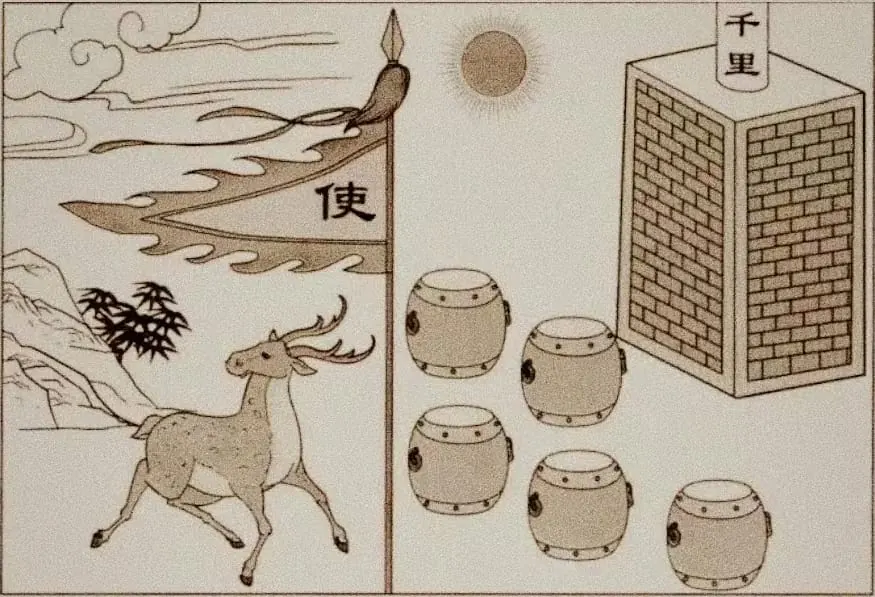
Scene Description
Image Symbolism
Reading the Picture
Jian is obstruction: danger ahead and an obstacle underfoot. The picture answers with a signal flag, an envoy’s mission and a long road, suggesting that help and a way round come to those who pause and reach out.
Look first at the sun high overhead, a clear-sighted ruler, and the tall flag bearing 使, envoy: a sign of peace and of going out on a mission. Below it stand five drums, which the Image Symbolism ties to the fifth watch of the night, just before dawn.
On the right rises a brick watch-mound marked 千里, a thousand li: a long journey, perhaps an appointment far away. There is wordplay here: 千 stacked over 里 makes 重, again, so good fortune may come on a second attempt. On the left a deer runs past mountains. Its name 鹿 lù sounds like 禄 lù, reward, and the text reads it as a traveller or merchant arriving with wealth. The text places it among the drums; the artist set it apart beyond the flagpole.
The trigrams set the scene: Mountain ☶ below, Water ☵ above, an obstacle with danger on top of it. The picture most clearly illustrates the fifth line, great obstruction with friends arriving, and the top line’s advice to see a great person.
- Work
- If a project is blocked, consider pausing to check your own preparation before pushing on. Ask who could carry a message or open a door for you.
- Relationships
- If things feel stuck between you and someone else, consider reaching out through a calm go-between, or simply looking first at your own part in it.
- Timing
- This favours waiting and gathering support over a direct push. If the first attempt fails, the picture hints that a second, better-prepared one may go further.
Line Statements
Listed from the bottom line to the top line.
- First six: Going brings obstruction; coming brings praise.
- Six in the second place: The king's minister faces repeated obstruction, not for personal reasons.
- Nine in the third place: Going brings obstruction; coming brings return.
- Six in the fourth place: Going brings obstruction; coming brings connection.
- Nine in the fifth place: Great obstruction; friends arrive.
- Top six: Going brings obstruction; coming brings greatness. Good fortune. It is beneficial to see a great person.
Meaning of the Hexagram
Translated from the Chinese 人间道 commentary with AI assistance; translator notes appear in brackets.
“Obstruction: the southwest is beneficial, the northeast is not. It is beneficial to see a great person. Steadfastness brings good fortune.”
The southwest is Kun, whose body is compliant; the northeast is Gen, whose body is dangerous and still. This says that in a time of Jian (Obstruction) it is beneficial to be on level, easy ground, and not beneficial to stop amid danger. People today meet danger and stop, not knowing that stopping because of danger makes it even more dangerous. [The sentence is translated as written; its logic is unclear and may be garbled.]
“Obstruction means difficulty: danger lies ahead. To see danger and be able to stop: that is wisdom!”
Jian is the difficulty of danger and obstruction. Because danger lies ahead, one stops and does not advance. The way to deal with obstruction is to be able to see danger and stop; this is understanding the difficulty of obstruction. This stopping is not a true stop; it means not advancing into danger.
“Obstruction: the southwest is beneficial, for going there one attains the centre. The northeast is not beneficial, for there the way comes to an end.”
In a time of obstruction it is only beneficial to be on level, easy ground; there one attains the central and correct position. The northeast is the mountain: danger and obstruction lie ahead, and if one advances into danger the way will surely come to an end.
“It is beneficial to see a great person: going brings achievement. Being in the proper place, steadfastness brings good fortune, so as to set the state right. Great indeed is the use of the time of Obstruction!”
In a time of obstruction and difficulty, only sages and worthies can relieve the obstruction of the world. So by employing worthy people, one can go and seek and succeed. If those in office hold firmly to this with resolve, they will surely be able to set family and state right. This is to know, in a time of obstruction, to employ worthy people, to move when the time is right and to act after measuring the danger, so that the great and most correct way can relieve the obstruction of the world. Those who govern today do not know the difficulty of a time of obstruction because they do not know the wisdom of the ancient sages and philosophers.
“Water on the mountain: Obstruction. The noble person accordingly turns back to himself and cultivates his virtue.”
The mountain is already an obstacle, and above it there is also water, so there is danger and obstruction above and below: this is Jian. Observing the image of Jian, the noble person knows that this is the time to turn back and look to himself, cultivate himself and advance in virtue. So he must examine himself while he waits for the time to come.
“Going brings obstruction; coming brings praise.”
This is the beginning of obstruction. To seek to advance with yin softness and no help is the height of obstruction. So one knows to stop and not advance, and praise comes from knowing when to advance and when to withdraw.
“Going brings obstruction, coming brings praise: it is fitting to wait.”
At the beginning of obstruction, advancing only makes the obstruction worse. One should see the first signs and stop, wait for the right time and then advance, and must not advance rashly.
“The king’s minister faces repeated obstruction, not for personal reasons.”
The second place is a yin place, and a yin line in it is in its correct place; it signifies a central and correct minister, who also shares virtue with the ruler in the fifth place above and is trusted by him: this is the king’s minister. Now, in a time of obstruction and difficulty, even a central and correct person, with the quality of yin softness, is not equal to the task, hence the image of obstruction within obstruction. Because he is central and correct, what he does is surely loyal to the ruler and not for himself; so even if he does not succeed, he deserves praise and encouragement for his loyalty.
“The king’s minister faces repeated obstruction: in the end there is no fault.”
What a central and correct minister does is surely for his ruler, not for himself. So in a time of obstruction, although he has not succeeded, in the end he is without fault.
“Going brings obstruction; coming brings return.”
This is firmness at the top of the lower trigram in a time of obstruction. The people in the lower places are all soft and rely on the one above. If it wanted to advance further, it would again meet yin softness and could get no help, hence ‘coming brings return’: it goes back and returns to its own place.
“Going brings obstruction, coming brings return: those within rejoice in it.”
The yin soft lines below cannot stand on their own and must rely on the yang firmness of the third nine. So we know that in a time of obstruction one must win the hearts of those below in order to find security; this is seeking within, and those within rejoice in it.
“Going brings obstruction; coming brings connection.”
In a time of obstruction, to go with yin softness into the depths of the danger of Kan is ‘going brings obstruction’. If one can join with like-minded people and unite the many so that they attach themselves to one, that is ‘coming brings connection’, and this truly is the way to deal with obstruction.
“Going brings obstruction, coming brings connection: it is in its proper place and is genuine.”
Dealing with obstruction from an upper position, it does not go down to those below, yet the many come to it: this is winning the will of the many. Whoever wins the will of the many must begin by treating those below with sincerity and honesty.
“Great obstruction; friends arrive.”
When the ruler is in a time of obstruction and difficulty, the whole world must be in difficulty, hence it is called great obstruction. At this time, if one can have friends come to help, they must be people of yang firm, central and correct talent coming to assist; only then is it effective.
“Great obstruction, friends arrive: because of central restraint.”
In a time of great obstruction, talent that is yang firm, central and correct is needed. If a minister’s talent is not enough to relieve the obstruction and he merely keeps to restraint and duty, he cannot save the age. Many politicians today are of this kind: not knowing that their talent is insufficient, they push forward anyway, and only show their incompetence.
“Going brings obstruction; coming brings greatness. Good fortune. It is beneficial to see a great person.”
The sixth line, with yin softness, is at the very extreme of obstruction, and the extreme of obstruction has the appearance of being about to leave obstruction. With yin softness alone, one will surely not get out; one must have the help of yang firmness, and with a broad and generous capacity go to see a person of virtue; only then can there be good fortune.
“Going brings obstruction, coming brings greatness: the will is directed inward. It is beneficial to see a great person: in order to follow the noble.”
The sixth line is yin soft and at the extreme of obstruction, but it is close to the ruler, who is yang firm, central and correct, and comes to seek its own relief. This is the meaning of following the noble, and it is fortunate.
Show the Chinese original (人间道)
蹇:利西南,不利东北,利见大人,贞吉。 西南为坤,坤体顺,东北为艮,艮体险止,此言于蹇难之时,利处平易之地,不利止于危 险,今人遇险而止,不知因险而止,乃更险也。
蹇,难也,险在前也。见险而能止,知矣哉! 蹇有险阻之难也,因险在前,止而不进状。处蹇之道,乃能见险而止,此知蹇难也,此止 非真止也,乃不犯险而进之意。 蹇:利西南,往得中也:不利东北,其道穷也。 蹇之时,唯利处平易之地,乃得中正之位,东北为山,险阻在前,犯险而进,道必穷。
利见大人,往有功也,当位贞吉,以正邦也。蹇之时用大矣哉! 蹇难之时,唯圣贤能济天下之蹇,故用贤人能往求而成功,在位之人坚心执意如此,必能 正家邦,此即知蹇之时任用贤人,适时而动,量险而行,使至正之大道能济天下之蹇。今之为 政者,不知蹇之时难,乃因不知古圣先哲之智慧也。
山上有水,蹇;君子以反身修德。 山已为险阻,上又有水,故有上下险阻状,为蹇,君子观蹇象,知此时乃反求于己修身进 德,故必省自身,以待时之至也。
往蹇,来誉。 此蹇之初,以阴柔无助而求进,蹇之甚也, 是知止而不进,乃因知进退而成誉也。
往蹇来誉,宜待也。 于蹇之初,进必愈蹇,宜见几而止,待时 而进,不可燥进。
王臣蹇蹇,匪躬之故。 二爻为阴位,阴居之为正位,乃意为中正 之臣,又与上五君同德而受信任,此即王臣, 今处蹇难时,即令中正之人,以阴柔之质,不 能胜任,故有蹇中之蹇状,因为中正之人,其 所为必忠于君,非为私己,故即令不胜,亦因
其能忠而可嘉勉。
王臣蹇蹇,终无尤也。 中正之臣所为必为其君,不为私,故于蹇 难时,虽未成功,但终无过也。
往蹇,来反。 以刚居下卦之上,处蹇时,下位之人皆柔, 依附于上状。欲再上进,又逄阴柔,无法相济, 故有来反,即还归也,反回其所。
往蹇来反,内喜之也。 下之阴柔无法独立,必附于九三之阳刚。 故吾人知,于处蹇之时,必得下之心可以求安, 此求内而喜之也。
往蹇,来连。 蹇之时以阴柔而往入坎险之深处为往蹇, 如能与同志之人,使合众而附之,此即来连, 乃真得处蹇之道也。
往蹇来连,当位实也。 处蹇,居于上位,能不与下往而众来,乃 得众志也,能得众志之人,必始之于诚实待下 方可得也。
大蹇,朋来。 君处蹇难之时,必天下处难也,故名大蹇, 此时如能得朋来助,且须为阳刚中正之才来相 辅方有效。
大蹇朋来,以中节也。 大蹇之时,须阳刚中正之才,如臣之才不 足济蹇,只守于节义,不能济世也,今之政客, 多属此类,不知己之才不济,而力进,徒显其 无能也。
往蹇,来硕,吉,利见大人。
六以阴柔居蹇之极处,蹇之极有将离蹇之 态,如以阴柔必不得出,须有阳刚之助,以寛 裕之大量,见有德之人,方可为吉。
往蹇来硕,志在内也,利见 大人,以从贵也。 六位阴柔又处蹇之极,能近阳刚中正之 君,来求自济,此以从贵之义,吉也。