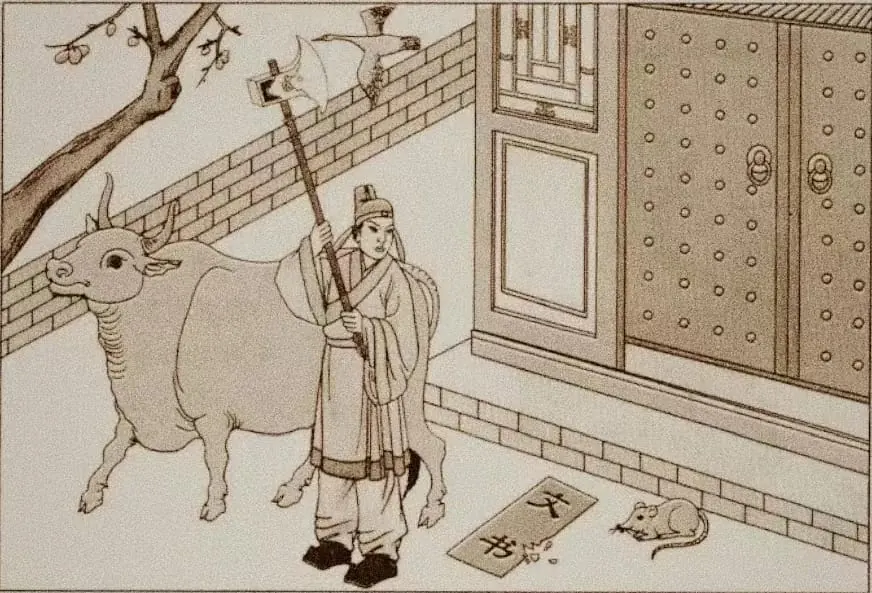
Scene Description
Image Symbolism
Reading the Picture
Kui is opposition: two things that cannot pull the same way at present. The picture shows a person with authority, a torn agreement and a shut gate, and asks how much can still be saved in small matters.
Begin with the man holding a long axe upright: someone with authority, an enforcer, also someone wanting quick results. At his feet lies a document with a corner torn away, a broken agreement or hope lost. Beside him stands an ox, and near the document a rat; the text pairs them as favourable in autumn and winter, less so in spring and summer.
Behind him a heavy studded gate is shut: separation or confinement. Above the wall a goose flies, read as loneliness or news of sorrow. The tree at the upper left is the peach in the description; 桃 táo (peach) sounds like 逃 táo (escape), so its opening means getting away. Its drawn buds are not yet clearly open.
The trigrams explain the tension: Fire ☲ above burns upward, Lake ☱ below flows downward, so the two move apart. The ox and the torn document echo the third line, the carriage dragged back and its ox held fast. Yet the top line turns the story: the bow is drawn and then lowered, and the supposed robbers prove to be suitors.
- Work
- If an agreement has broken down, consider settling small points rather than forcing a large one. Quick, heavy-handed action may widen the gap.
- Relationships
- If you and someone close disagree, ask whether you are reading hostility into what may be misunderstanding. Meeting a difficult person can prevent more resentment than avoiding them.
- Timing
- This is a time of separation; large unions are hard now. If a door is shut, consider waiting for suspicion to clear, as rain comes once yin and yang meet.
Line Statements
Listed from the bottom line to the top line.
- First nine: Regret disappears. Do not pursue a lost horse; it returns itself. See an evil person; no blame.
- Nine in the second place: Meet the master in an alley. No blame.
- Six in the third place: See a carriage dragged back, its ox restrained, its person's head marked and nose cut off. No good beginning, but an ending.
- Nine in the fourth place: Isolated in opposition, meeting a principal man and exchanging trust. Danger, no blame.
- Six in the fifth place: Regret disappears. One's clan bites through skin. What blame in going?
- Top nine: Isolated in opposition, seeing a pig covered in mud and a carriage full of ghosts. First drawing the bow, then loosening it. Not robbers but suitors. Going and meeting rain brings good fortune.
Meaning of the Hexagram
Translated from the Chinese 人间道 commentary with AI assistance; translator notes appear in brackets.
“Opposition: in small matters, good fortune.”
The way of Kui (Opposition) can be called fortunate in small matters, such as parting from bad people and turning away from wrong affairs.
“Opposition: fire moves and goes upward, the lake moves and goes downward. Two women live together, but their wills do not go the same way.”
Speaking of the hexagram’s components, in Kui fire is above and moves, while the lake is in the lower place. The natures of these two things run opposite. The meaning is like two or three sisters, whose original wishes are the same while they live together, but who, when grown, marry into different homes: their wills are no longer the same.
“Joyous and clinging to brightness; the soft advances and moves upward, attains the centre and responds to the firm: therefore, in small matters, good fortune.”
Inwardly joyous and compliant, it also responds to the brightness outside; clinging to brightness and placed above, it seeks to advance by softness, and it attains the way of the centre and correctness and finds a response. In a time of opposition, although one cannot remove the opposition of the whole world, in small matters there is good fortune.
“Heaven and earth are opposed, yet their work is the same. Man and woman are opposed, yet their wills meet. The myriad things are opposed, yet their workings are alike. Great indeed is the use of the time of Opposition!”
Heaven is above and earth below; though they are opposed, yang from heaven descends and yin from earth rises, and so the myriad things are formed: their work is fundamentally the same. Man and woman differ in nature, but the will to seek each other is the same. The myriad things of the world differ, and that is opposition; yet all are formed by receiving the qi of heaven and earth, and in that they are the same. So although things differ, their root is the same. The sage uses the way of opposition to unite the world’s different multitudes into one; this is why the matter is great indeed.
“Fire above, the lake below: Opposition. The noble person accordingly is one with others and yet distinct.”
Fire is above and the lake below; the natures of the two things run counter to each other, which is the image of opposition. Observing opposition, the noble person knows that while he shares much with the common world, at times he must stand apart from others. The Doctrine of the Mean says, “in harmony but not swept along”; that is exactly this meaning.
“Regret disappears. Do not pursue a lost horse; it returns itself. See an evil person; no blame.”
This is the beginning of the hexagram, the first moment of opposition, and here firmness moves at the bottom in a time of opposition, so its regret can be imagined. At this time, because one cannot go forward, one loses one’s horse; if one does not chase it, the horse comes back by itself.
In a time of opposition there are surely many petty people. If one casts them all off, will not the whole world become one’s enemy? One would lose the broad, embracing capacity of Kun’s virtue and end in a place of misfortune. One could not transform them toward good, let alone unite with them. Hence the counsel that one must see evil people. That is why, since ancient times, those who could turn the treacherous into good people and turn enemies into subjects all did so because they did not refuse to see them.
“Seeing an evil person: in order to avoid blame.”
In a time of opposition, people’s feelings are at odds. To seek harmony and union, if the noble person avoids people because they are evil, he creates a host of enemies for himself. So seeing evil people is a way to avoid the regret of resentment and blame.
“Meet the master in an alley. No blame.”
A time of opposition is one when yin and yang do not unite, and firmness and harshness stand against each other. Even a central minister of yang firmness should approach his lord by a good way that is patient, indirect and tactful, hoping to bring about union; this is certainly not seeking to attach himself to the ruler by bending the way.
“Meeting the master in an alley: he has not lost the way.”
This means that one should move the ruler’s heart with utmost sincerity, so that he understands what is right and reasonable and can seek union; one must not bend the way to flatter and accommodate. That is truly not losing the way. Today’s petty people know full well what is wrong, yet in times of discord they know only how to flatter and fawn for their own profit, disregarding the right way. So those who change their purpose with the times are true petty people.
“See a carriage dragged back, its ox restrained, its person’s head marked and nose cut off. No good beginning, but an ending.”
The third line is at the top of the lower trigram; it means to leave the lower trigram and seek to advance upward. Now it meets the firmness of the fourth line as an obstacle, while the yang firmness of the second line is behind it. And at this time it also meets discord and disharmony. It is like an ox-cart on the road: the ox is restrained in front and the carriage is behind. In such a situation, if one still tries to force one’s way forward, one will surely be badly hurt by what is above. One should firmly keep to the way of centrality and correctness in responding, and wait for the time when opposition reaches its end, when there will surely be union. That is the good way to conduct oneself.
“Seeing the carriage dragged back: the position is not proper. No good beginning, but an ending: it meets the firm.”
Seeing the cart and ox held back and dragged along, one knows the position is not proper. The sage knows to follow principle, knows the time and holds firm, and waits until he meets the firm and can unite with it.
“Isolated in opposition, meeting a principal man and exchanging trust. Danger, no blame.”
The fourth line is near the ruler’s place, but the ruler does not respond to it; it is a time of opposition, hence it is isolated. It can only seek to unite with someone of the same virtue and associate with him in utmost sincerity. If it can do this, then although it is in danger, there can still be no blame.
“Exchanging trust, no blame: the will is carried out.”
In a time of opposition, when those above and below associate in utmost sincerity, there is not only no blame; their will can surely be carried out. So the way to remedy opposition lies only in noble people with yang firm talent helping one another in utmost sincerity; what then could they not accomplish?
“Regret disappears. One’s clan bites through skin. What blame in going?”
This is yin softness in the honoured place, in a time of opposition; its danger can be imagined. But it has the yang firm worthy of the second line to assist it, so regret can disappear. And the yang firm worthy can form a bond with it and enter deeply, so going forward brings blessing. It is like the mediocre Liu Shan, who, with Kongming (Zhuge Liang) assisting him, achieved the appearance of a revival.
“One’s clan bites through skin: going brings blessing.”
If a ruler whose talent is insufficient knows to trust worthy helpers and lets their way enter deeply into himself, things can still be done. People today do not know that their talent is insufficient and think that being a learned scholar is enough [the sense of 以为博士就是好的 is unclear]. Not only do they fail to accomplish anything, they make the discord worse, and the outcome will surely be misfortune.
“Isolated in opposition, seeing a pig covered in mud and a carriage full of ghosts. First drawing the bow, then loosening it. Not robbers but suitors. Going and meeting rain brings good fortune.”
At the extreme of opposition there is surely a return to the right way. It is like a person who sees a filthy pig covered all over in mud, and a cart carrying a crowd of evil ghosts; disgusted in his heart, he wants to draw his bow and shoot them. Then, thinking it over, he realises that acting would surely bring a backlash, and he does not shoot. Enemies and robbers are turned into marriage partners; yin and yang unite and become rain.
So at first there is opposition because of suspicion, and when opposition reaches its extreme there is union because suspicion is gone, just as yin and yang of heaven and earth [meet] to make rain. Going and meeting it brings good fortune.
“The good fortune of meeting rain: all suspicions vanish.”
Rain forms because of the harmony of yin and yang. So harmony and union can come about because doubts and suspicions have entirely vanished.
Show the Chinese original (人间道)
睽:小事吉。 睽违之道于小之事,可言吉。如与不良之人乖离,与不正之事违背也。
睽,火动而上,泽动而下,二女同居,其志不同行。 睽,以卦才言火在上而动,泽在下位,此二物性反,其义犹二女三女其本志同而共处,及 长所归各异,其志不同也。 说而丽乎明,柔进而上行,得中而应乎刚,是以小事吉。 内悦顺而又应乎外明,丽明居上,以柔求进,又能得中正之道相应,处睽之时虽无法去天 下之睽,但于小处则吉矣。
天地睽而其事同也,男女睽而其志通也,万物睽而其事类也,睽之 时用大矣哉! 天上地下虽睽然天阳下降地阴上升而成万物,其事本同也。男女之质不同,但互相求之志 却同也。天下万物不同是暌,然皆禀天地之气而成,则相同也。是故物虽异而其本同,圣人用 睽之道,能令天下不同之群众,合而为一,故其事大矣哉。
上火下泽,睽,君子以同而异。 火在上,泽在下,二物之性相违,为睽象,君子观睽而知于世俗所同者,有时须独异于世 人,中庸曰和而不流,即义此也。
悔亡,丧马勿逐,自复;见 恶人,无咎。 卦之初,即睽之始时,于睽时又刚动于下, 其悔可知,于此时因不能行而丧其马如勿逐则 马自复回。因睽时小人必众,若弃之,则必天 下而仇己乎?就会丧失坤德之含弘功能,乃致 凶地。不但无法使之化善,更遑论能合之,故 有必见恶人之议,所以自古以来能化奸邪为善 良,去仇敌而为臣民者,皆因不拒絶见之。
见恶人,以辟咎也?
于睽时人情乖违,为求和合,若因其恶人 而避之,则生众仇于君子,故见恶人乃为避免 怨咎之悔也。
遇主于巷,无咎。 睽违之时乃阴阳不合,且刚戾相对,即令 为阳刚之中臣,当以委曲而婉转之善道将就于 主,期使之合,絶非求附君主而屈道相向也。
遇主于巷,未失道也。 此意即当以至诚以动君心,使明义理而能 求相合,不可屈道迎逢,乃真未失道。今之小 人明知不正,然于乖违,之时,只知迎合奉承, 为求己利,枉顾正道,故因时局而恋志之人乃 真小人也。
见舆曳,其牛掣,其人天且 劓,无初有终。 三爻位为下卦之上,本离下卦而求进于 上,今逢四之刚为阻,而下二爻之阳刚于后, 处此之时又逢乖违不和,犹牛车之行具,牛受 掣阻于前,后有车舆在后,如以此状况,又求 力进,则必重伤于上,宜刚守中正之道与其对
应,待睽终极之时必合,方为善处之道。
见舆曳,位不当也,无初有 终,遇刚也。 见车牛之负掣后拖曳而行,知位所不当, 圣人知理顺行,知时而守,待遇刚而能合。
睽孤,遇元夫,交孚,厉无咎。 四爻近君位,君不与应,乃睽乖之时,故 为孤,唯求与同德之人相合,且至诚相与交往, 能如此,虽处危,但仍可无咎也。
交孚无咎,志行也。 睽乖之时,上下至诚相交,不止无咎,且 其志必可行,故救睽之道,唯君子以阳刚之才, 至诚相辅,何所不能济也。
悔亡,厥宗噬肤,往何咎。 阴柔又居尊位,于睽时,其危可知,然有 九二阳刚之贤相辅,可以悔亡,且阳刚之贤又 能成党,且深入之,则往而有庆也,如刘襌之 庸,有孔明之辅,乃成中兴之态势。
厥宗噬肤,往有庆也。 人君之才不足,如知信任贤辅,使其道能 深入于己,亦可为也。今人不知己之才不足, 以为博士就是好的,不但不能成事,且造成乖 违之势愈烈,果必凶。
暌孤,见豕负涂,载鬼一车, 先张之弧,后说之弧,匪寇 婚媾,往遇雨则吉。 睽极之时,必反复正道,犹人见污浊之豕, 且全身烂泥,又车载一群恶鬼,心厌恶之乃欲 张弓射之,后思之如动必反,而弗射,化仇寇 为婚媾,阴阳交合而成雨,故始因疑而睽,睽 至极因不疑而合,犹天地阴阳上为雨,往而遇 之,则吉也。
遇雨之吉,群疑亡也。
雨之成,乃因阴阳之和,故所以合和能成, 乃因疑虑尽消亡也。