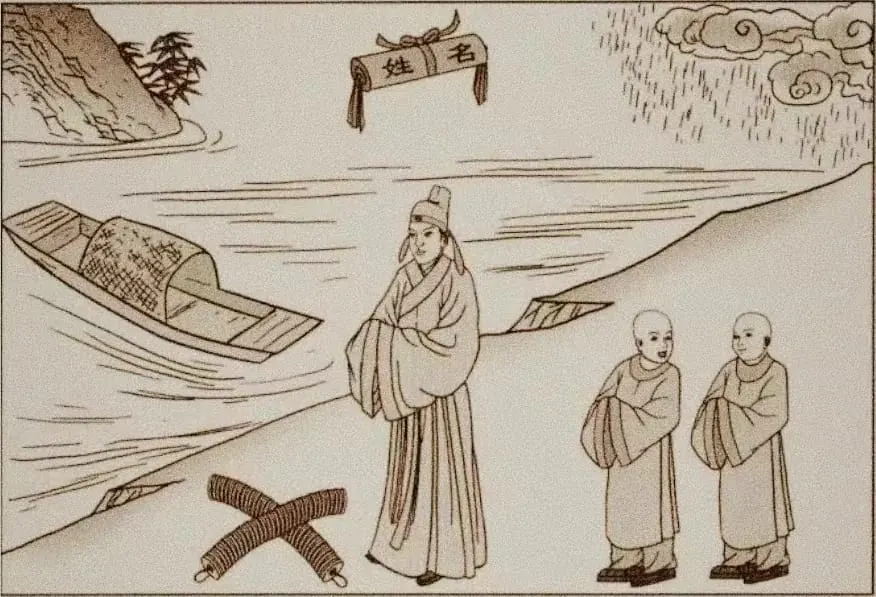
Scene Description
Image Symbolism
Reading the Picture
Ji Ji is after completion: the crossing has been made and everything stands in its place, which is exactly when to start guarding against what could go wrong.
Begin with the man on the bank. A covered boat has just come in to the shore beside him, the Image Symbolism’s sign that conveyance or guidance has arrived. The river is behind him; the hard part is done. At his feet lie two crossed strings of coins, which the symbolism reads not as a prize but as wealth that brings worry and can be lost. Above him floats a scroll marked 姓名, name, a document such as credentials or an order: his name is on the list.
To the right stand two young boys with shaven heads, which the symbolism takes as joy and as two people together. In the far corner rain falls from clouds; the description says the children walk in the rain, though here they stand clear of it.
Water ☵ is above and Fire ☲ below, like a pot over a flame, and every line sits in its proper place. That balance does not hold by itself. The boat recalls the fourth line, which keeps rags ready to plug leaks and stays on guard all day; the first line drags its wheels and holds back once the goal is reached. The top line, wetting the head, shows what happens to whoever keeps wading on.
- Work
- If a project has just succeeded, consider what small leak could sink it now. Put maintenance and checks in place before chasing the next win.
- Relationships
- When things feel settled, ask whether small courtesies are still being kept. A modest, sincere gesture counts for more than a lavish one.
- Timing
- Good fortune at the beginning, disorder at the end. If everything is going well, this is the moment to slow down and think ahead, not to press further.
Line Statements
Listed from the bottom line to the top line.
- First nine: Dragging the wheels, wetting the tail. No blame.
- Six in the second place: A woman loses her carriage screen. Do not pursue; in seven days it is regained.
- Nine in the third place: Gaozong campaigns against the Demon Region, conquering in three years. Do not employ petty people.
- Six in the fourth place: Fine silk turns to rags; be on guard all day.
- Nine in the fifth place: The eastern neighbor sacrifices an ox, but this is less than the western neighbor's simple offering, which truly receives blessing.
- Top six: Wetting the head. Danger.
Meaning of the Hexagram
Translated from the Chinese 人间道 commentary with AI assistance; translator notes appear in brackets.
“Ji Ji: success in small matters. It is beneficial to be steadfast. Good fortune at the beginning, disorder at the end.”
At the time of Ji Ji (After Completion), great matters will surely go well; but one must understand that small matters too must go well, and only then is there good fortune. Everything must be fortunate; otherwise, when completion reaches its extreme, there will in the end be disorder.
“Ji Ji, success: the small succeed. Beneficial to be steadfast: the firm and the yielding are correct and their positions fitting.”
Yin and yang have all found their proper positions, hence After Completion. But there must be success in everything, and only then is it right; and one must hold to it steadfastly.
“Good fortune at the beginning: the yielding holds the center. Stopping at the end brings disorder: its way is exhausted.”
Because it follows the middle way of soft compliance, refinement and brightness, it can achieve the work of completion. When completion reaches its extreme, if one does not know how to adapt, disorder will surely arise; and disorder arises because the way has run to exhaustion.
“Water above fire: After Completion. The noble person accordingly thinks about trouble and guards against it in advance.”
Water and fire have already met; each has its use, and they help each other. The time is that of completion. Observing the image, the noble person knows that in a time of completion he must first think about how trouble may arise, so that it does not grow into calamity. Since ancient times, whenever the world has passed from order into disorder, it has always been because those living in times of order did not heed the warning to think of disorder.
“Dragging the wheels, wetting the tail. No blame.”
Dragging the wheels backward keeps the cart from advancing further. When an animal fords water, it must hold its tail high and keep it dry; only then can it go forward, and no disaster comes.
“Dragging the wheels: by rights there is no blame.”
In a time of completion and great good fortune, if one knows to stop advancing, one will surely not reach the extreme, and so there will surely be no blame.
“A woman loses her carriage screen. Do not pursue; in seven days it is regained.”
A yin line in its correct place, it has the response of the ruler in the fifth, so its aims will surely be carried out. But the way of centrality and correctness must not be abandoned. It is like a woman who hides behind a carriage screen when she goes out: having lost her screen, she does not go. If she can keep to herself and not lose herself, the way will surely return. She waits for the time to come.
“Regained in seven days: through the middle way.”
It is not that the way of centrality and correctness cannot be used; it is that the time has not yet come. If at such a time one keeps to the center, then when the time comes one will surely be able to act.
“Gaozong campaigns against the Demon Region, conquering in three years. Do not employ petty people.”
A firm line in a firm position, at a time of completion: the ruler’s martial might will surely command the people’s submission. But if he relies on martial might alone, the people will surely be resentful and not submit; he will injure them and covet their wealth. Hence the warning not to employ petty people, for petty people will surely use martial might to satisfy their private desires. The noble person guards against this.
“Conquering in three years: exhaustion.”
In a time of completion one must bring relief to the whole world. For Gaozong this was acceptable, because his heart was for the people and his way was surely right. If it were done for one’s own private desires, then after three years the people would surely be exhausted and in the end resentful.
“Fine silk, and rags kept ready for leaks. Be on guard all day.”
The fourth place is near the ruler, and a soft yin line occupies it, which suits the task. At a time of completion one must be like someone sailing a boat, watching for leaks; when a leak begins, it is stopped up with clothing. If one stays watchful and wary all day without slackening, one will surely avoid trouble.
“Be on guard all day: there is something to suspect.”
At a time of completion one must suspect that trouble is about to come. Such is the watchful, wary heart, and such is its caution.
“The eastern neighbor sacrifices an ox; it is less than the western neighbor’s simple offering, which truly receives blessing.”
The nine in the fifth place is the ruler’s most honoured position, and a person of yang firmness occupies it. At a time of completion one must have perfect sincerity and trust, like the sincerity of a sacrifice; then even a sacrifice with meagre offerings can surpass a lavish one, because of the perfectly sincere heart.
The Changes value not the form but the spirit; this is plain to see. So in discussing the Changes one must understand time; only then can one grasp the spirit of the Changes.
“The eastern neighbor’s sacrifice of an ox is less than the western neighbor’s timeliness; truly receiving blessing, great good fortune comes.”
In a time of completion, whoever grasps the time can receive the blessing of great good fortune even with a meagre sacrifice. This speaks of how precious timeliness is.
“Wetting the head. Danger.”
When completion reaches its extreme, there will surely be unease and danger. Now a soft yin line occupies this place, on top of the danger of the Water trigram: this is the end of completion, held by a petty person, and its ruin will surely be seen at once.
“Wetting the head, danger: how could it last long?”
When things have run to exhaustion and water drenches one’s head, it surely cannot last long.
Show the Chinese original (人间道)
既济:亨小,利贞,初吉,终乱。 既济之时大事必能亨通,然须知小事亦须亨通,方可为吉,必须所有事皆吉,否则济至极 时,终乱。
既济亨,小者亨也。利贞,刚柔正而位当也。 阴阳能皆得位,故为既济,但须无所不亨,乃可也,且贞固守之。 初吉,柔得中也。终止则乱,其道穷也。 其以柔顺文明之中道,故可成既济之功,至既济之极,若不知变通,必生乱,其乱之生乃 因道至尽穷。
水在火上,既济,君子以思患而豫防之。 水火即交,各有其用,为互济,时当既济,君子观象知于既济之时,必先思虑患害之生, 使不至成祸患也。自古以来,天下由治而乱,乃皆因居治不思乱时之戒。
曳其轮,濡其尾,无咎。 倒曳轮,使不再进。兽之涉水,必举高其 尾,使尾不湿方可进,无灾至。
曳其轮,义无咎也。 于既济大吉之时,能知止进,则必不至极 时,故必无咎也。
妇丧其茀,勿逐,七日得。 阴居正位,得五君位应,其志必得遂行, 但中正之道,不可废也,犹妇人出门用茀遮己 今丧其茀,则不行,能自守不失,道必复也。 待时之至。
七日得,以中道也。 因中正之道非不可用,乃时之未至,于此 时自守其中,俟时至必能行矣。
高宗伐鬼方,三年克之,小 人勿用。 以刚居刚位,居既济时,其君主威武必令 民心服。但若专肆威武,必令民心忿而不服, 残害人民,贪人民之富,故有小人勿用之戒, 因惟小人其威武必为满足其私欲,君子戒之。
三年克之,惫也。
既济之时,必济天下,于高宗可也,乃因 其心为民,道必正,如为己之私欲,则三年民 必疲惫而终忿矣。
繻 繻 繻 繻有衣袽 袽 袽 袽,终日戒。 四近君位,阴柔居之,乃适其任,当既济 之时,须如行舟,戒之渗漏,始漏则塞以衣物, 且终日戒惧不怠,则必可免患。
终日戒,有所疑也。 当既济之时,必疑其患之将至,其戒惧之 心如此,谨慎如此。
柬邻杀牛,不如西邻之禴 禴 禴 禴 祭,实受其福。 九五至尊君位,阳刚人居此,当既济之时, 必以至诚信孚如祭祀之诚,则即令薄礼之祭, 也可胜于丰厚之祭,由其至诚之心使然也。易 之不重形,而重神,此明而显矣,故论易须知
时,方可得易之神明矣。
东邻杀牛,不如西邻之时 也,实受其福,吉大来也。 既济之时,能得时者,即令薄祭,亦可有 大吉之福至,此言时之可贵也。
濡其首,厉。 既济至极时,必不安而危,今阴柔居之, 居坎险之上,即既济之终,小人居之,其败坏 必立可见矣。
濡其首厉,何可久也。 藭尽之须以水淋其首,其必不可长久也。