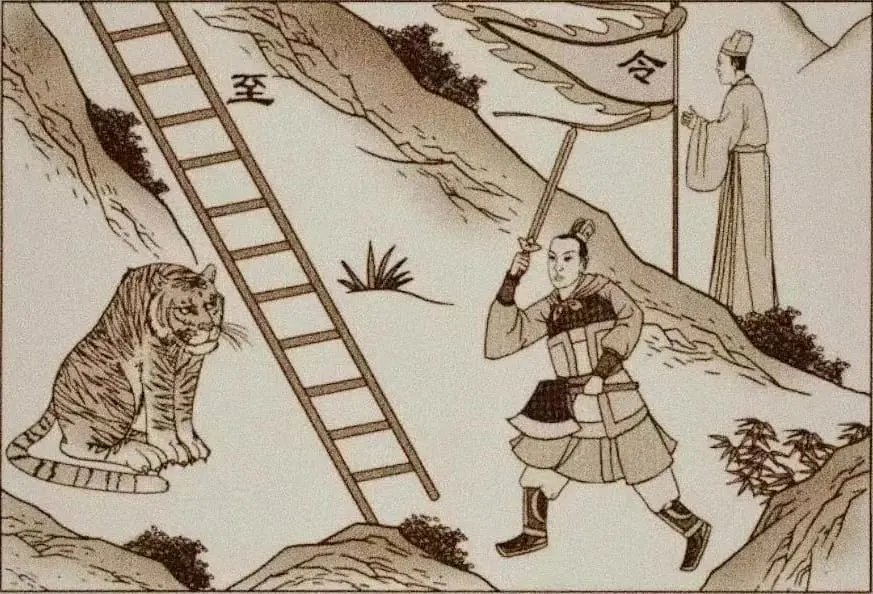
Scene Description
Image Symbolism
Reading the Picture
Wei Ji is before completion: the last stretch of the crossing is still ahead, and the picture asks you to see where authority really lies before you make your move.
Begin with the tiger on the left. It sits quietly instead of prowling, which the Image Symbolism reads as power without its usual force. Beside it stands a ladder marked 至, arrival. The description writes 到, but the symbolism explains the drawn form: take the blade 刀 away from 到 and 至 is left, which sounds like 桎 zhì, fetters. You are close to arriving, but something still holds you back.
In the middle an armored man strides forward with a raised blade, a figure with real authority. Up on the slope a flag marked 令, command, stands on its pole, and a robed man reaches toward it. The symbolism reads the raised flag as a righteous force rising and the man taking it as someone stepping in to replace another. Who will hold the command is still undecided.
Fire ☲ is above and Water ☵ below, each going its own way, so nothing is cooked yet. The Image asks the noble person to distinguish things carefully and put each in its place. The striding soldier recalls the fourth line, campaigning against the Demon Region and rewarded after three years; the second line’s dragged wheels and the little fox’s wet tail warn against rushing the last stretch.
- Work
- If a role or decision is still unsettled, consider whether you are measuring your strength honestly. Steady preparation now counts for more than a bold leap.
- Relationships
- If things are not yet settled between you, consider which matters belong to whom before forcing a conclusion. Trust given sincerely, as in the fifth line, helps.
- Timing
- The goal is near but not reached. If you feel the urge to finish everything at once, ask whether waiting a little would keep your tail dry.
Line Statements
Listed from the bottom line to the top line.
- First six: Wetting the tail. Regret.
- Nine in the second place: Dragging the wheels. Steadfastness brings good fortune.
- Six in the third place: Not yet completed. Going forward is inauspicious; crossing the great river is beneficial.
- Nine in the fourth place: Steadfastness brings good fortune, regret disappears. Stirring to campaign against the Demon Region, in three years rewarded by the great state.
- Six in the fifth place: Steadfastness brings good fortune, no regret. The noble person's light, with sincerity. Good fortune.
- Top nine: Sincerity in drinking wine. No blame. Wetting the head, sincerity loses what is right.
Meaning of the Hexagram
Translated from the Chinese 人间道 commentary with AI assistance; translator notes appear in brackets.
“Wei Ji: success. The little fox, nearly across, wets its tail. Nothing is beneficial.”
Even in a time of Wei Ji (Before Completion) there is a way to success. If the little fox is not careful, but shows off its strength and courage and crosses the river carelessly, in the end it surely cannot get across; hence nothing is beneficial.
“Wei Ji, success: the yielding holds the center. The little fox nearly across: it has not yet come out of the middle.”
In a time of Before Completion there can be success because the yielding line holds the center and meets its time; if one acts carefully at such a time, one can succeed. The little fox is bold in crossing the river, but if it does not worry about its tail getting wet, it surely cannot escape danger.
“It wets its tail; nothing is beneficial: it does not carry through to the end. Though the positions are not fitting, the firm and the yielding respond to each other.”
Though it advances bravely, it cannot go on because its tail is wet, so it is not beneficial to go. If one handles things with care and combines firmness and softness, then, although the positions are not fitting, there is still a way to get across.
“Fire above water: Before Completion. The noble person accordingly takes care to distinguish things and keeps each in its place.”
Fire is above water, and the two do not meet: this is Before Completion. Observing the image, the noble person knows it is an image of things out of place, and that he should handle affairs with care, distinguish what is fitting for each, let each occupy its place, and stop where it belongs.
“Wetting the tail. Regret.”
A soft yin line in a low place, in a time of Before Completion, tries to push forward. It is like an animal crossing a river, which must hold up its tail to get across. This says that a person who advances without measuring his own talent will in the end surely not get across, and will finally incur humiliation.
“Wetting the tail: it does not know its limit.”
To push forward without measuring one’s talent is not to know where the limit lies.
“Dragging the wheels. Steadfastness brings good fortune.”
A firm yang line in a general’s position has the image of wanting to move. Now, in a time of Before Completion, there is the image of the firm overriding the soft, of water coming to overcome fire, so it must know when to stop, like dragging a cart’s wheels to keep it from advancing. In this way there can be good fortune. The warning is against excessive firmness, which would mean offending those above and would surely end in misfortune.
“Nine in the second, steadfastness brings good fortune: it is central and so acts correctly.”
The nine in the second place can have good fortune because it attains the middle way and acts correctly, without excessive firmness and without offending those above.
“Not yet completed. Going forward is inauspicious; crossing the great river is beneficial.”
In a time of Before Completion, a soft line occupies a minister’s position at the top of the lower trigram, which gives it the image of leadership. But its talent is not enough to bring about completion: it is in danger and lacks the ability to get out. If it acts like this, it will surely bring on misfortune. Only by waiting for the right time, and for the talent in the upper position to respond, can it then cross the danger and come out of it.
“Not yet completed, going forward is inauspicious: the position is not fitting.”
A soft yin line without ability occupies the leading minister’s position. In a time of Before Completion, any movement will surely meet misfortune, because the position does not suit it.
“Steadfastness brings good fortune, regret disappears. Stirring to campaign against the Demon Region, in three years rewarded by the great state.”
A worthy talent of yang firmness is at the ruler’s side, and above it is a ruler who is empty at the center, bright and compliant. So it can relieve the hardships of the world. That it can campaign against the Demon Region shows how great its strength is; after three years it achieves great merit and is rewarded by the state.
“Steadfastness brings good fortune, regret disappears: the will is carried out.”
A worthy minister whose talent can accord with the time, and whose will is held firm, will surely have good fortune and need not worry: regret disappears.
“Steadfastness brings good fortune, no regret. The noble person’s light, with sincerity. Good fortune.”
A talent that is empty at the center and bright occupies the ruler’s honoured position. It can empty its heart and appoint a firm, worthy minister to assist it, trusting him without regret. This is the best way to handle the situation. Even if its own talent is insufficient, because of the sincerity at its center it will in the end surely have great good fortune.
“The noble person’s light: its radiance is fortunate.”
If the noble person can be like this, the light of his achievement will surely be bright and clear; its light is abundant and fortunate.
“Sincerity in drinking wine. No blame. Wetting the head, sincerity loses what is right.”
A yang firm line at the extreme, at the top of the trigram that is empty at the center, shows that it is firm and bright. Being so, it will surely not become restless, and it decides things by clarity: clarity can see through the principles of things, and firmness can carry things out. But in a time of Before Completion, since there is no way to bring about completion, it can only rejoice in heaven and accept its fate, and so be without disaster.
If it goes beyond ritual propriety and wets its head, in such disorder it surely does not know to examine itself, which shows that it is not at peace where it is.
“Drinking wine and wetting the head: it does not know restraint.”
To drink wine until one’s head is wet is excessive pleasure, and one surely cannot be at peace with one’s fate. Not knowing one’s fate or restraint, one will surely lose the normal principle. A person who can live at peace in an unfavourable position will surely be able to keep his resolve. This principle holds without exception.
Show the Chinese original (人间道)
未济:亨。小狐汔济,濡其尾,无攸利。 未济之时,亦有亨通之道。假如小狐不知慎,逞其壮勇,渡河不知慎,其终必不能济,故 无所利矣。
未济亨,柔得中也。小狐汔济,未出中也。 未济之时,能亨通,乃因其柔居中得其时,慎处之于未济时,可以亨通也。如小狐之果敢 于渡河,如不忧其尾湿,必不可脱险也。 濡其尾,无攸利,不续终也。虽不当位,刚柔应也。 其进虽勇,因尾濡而不能进,故不利往也。若能慎重处之,刚柔并济则虽不当位,亦有可 济之理处。
火在水上,未济,君子以愼辨物居方。 火在水上,互不相交,此为未济,君子观象知,乃处不当之象,应慎处事物,辨其所当, 各居其位,止于其所。
濡其尾,吝。 阴柔居下位,居未济之时,求力进犹兽之 渡河,必揭其尾,方可渡,此言人不度量其才 而进,终必不济,终招吝鄙也。
濡其尾,亦不知极也。 不度其才而力进,乃不知至极点也。
曳其轮,贞吉。 阳刚居将位,有欲动之象,今居未济之时, 有以刚凌柔水来胜火之象,故须知止,如曳车 之轮使其止进,如此可吉。戒之在刚过,如此 则犯上,其终必凶。
九二贞吉,中以行正也。 九二能吉,乃因其能得中道,行之正,不 过刚,犯上,故也。
未济,征凶,利涉大川。 居未济之时,柔居相位,在下卦之上,有 领导之象,但才不足济,居险而无才足以出险, 如此而行,其必招凶致。惟俟时至,俟上位之 才相应,再涉险而出,乃可出险。
未济征凶,位不当也。 阴柔无能之才居领导之相位,处未济时, 动必有凶,仍因其位不适。
贞吉 ,悔亡,震用伐鬼方, 三年有赏于大国。 阳刚之贤才,居于君侧,上为中虚明顺之 君,故能济天下之艰困,能伐鬼方示其力之大, 三年后乃有大功受国封赏。
贞吉悔亡,志行也。
贤相之才,能与时合,且贞固心志,必能 吉而不虑悔亡也。
贞吉 ,无悔,君子之光, 有孚,吉。 中虚而明之才居君之尊位,能虚其心任刚 贤之相为辅佐,且信任之而不悔,此处之至善, 即令己才不足,但亦由中心孚诚,终必大吉。
君子之光,其晖吉也。
君子之能如是,则其功之光必明且亮,其 光盛而吉也。
有孚于饮酒,无咎,濡其首, 有孚失是。 阳刚居极,在中虚卦之上,乃示其刚且明, 能如此,则必不生燥,决之以明,明能洞察事 理,刚能行事,然居未济之时,因无可济之理, 故成乐天顺命而已,可以无灾。如过于礼法, 濡其首,乱如是,其必不知反省,则示不安于 所居也。
饮酒濡首,亦不知节也。
饮酒而至于弄湿其首,乃过乐也,必不能 安于命,此不知命节制,必失其常理,人能安 处劣势,必能守其心志。此理之至然。