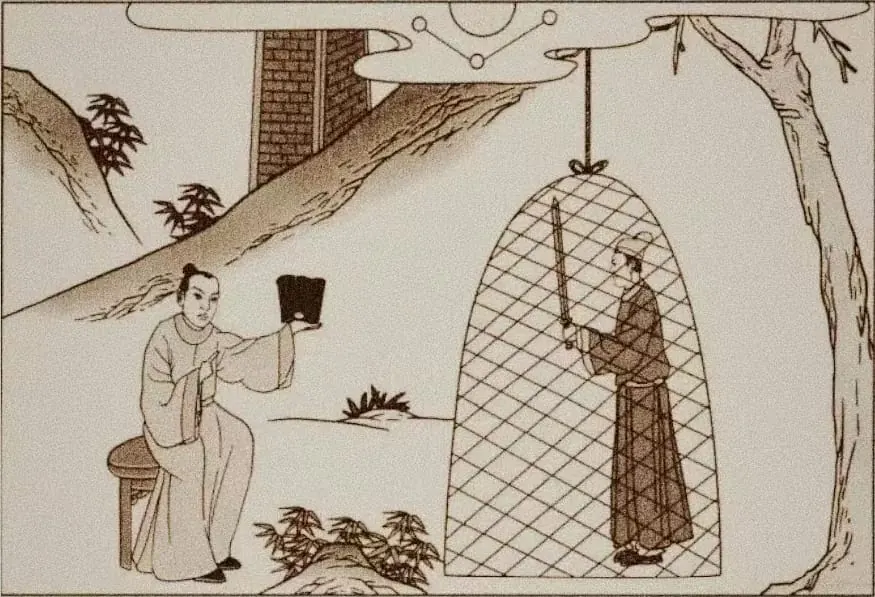
Scene Description
Image Symbolism
Reading the Picture
Xiao Guo is small excess: a time to go a little beyond the usual in small things, while staying low and not overreaching.
Start with the net hanging from a cloud on the right. A man stands inside it, bound in, the Image Symbolism’s picture of being unable to get free. Here he holds a sword and is cutting the net himself. The description gives the cutting to a second figure, a helper who comes to the rescue, but in this drawing there is only one man. Either way the point is the same: this trap can be cut through.
On the left a man sits holding up an official cap. Dusting off a cap is a gesture of wanting to leave one’s post, but the symbolism notes the irony: outwardly he seeks to go, inwardly he is still bound, so inside and outside do not match. Above, a disc in the clouds stands for the bright moon of the description, a clear light over the whole matter. The monkey that the description places on the summit, a sign of starting over, is not drawn.
Thunder ☳ above Mountain ☶ below: thunder rolls over the peak and its sound arrives after it has passed. The judgment’s flying bird makes the same point: it is not fitting to go up, it is fitting to go down. The third line’s warning to take extra precautions fits the man with the sword.
- Work
- If you feel caught in an arrangement, consider which small, concrete step would cut one strand. Keep ambitions modest for now.
- Relationships
- If you say you want to leave but keep holding on, ask which is true. Saying one thing while feeling another keeps the net closed.
- Timing
- Good for small adjustments, not big launches. If a plan depends on climbing high quickly, consider coming down a level first.
Line Statements
Listed from the bottom line to the top line.
- First six: A flying bird brings misfortune.
- Six in the second place: Passing the grandfather, meeting the grandmother; not reaching the ruler, meeting the minister. No blame.
- Nine in the third place: Without taking extra precautions, someone following may kill. Misfortune.
- Nine in the fourth place: No blame. Not passing beyond, but meeting. Going is dangerous; be on guard. Do not persist forever.
- Six in the fifth place: Dense clouds without rain from our western outskirts. The duke shoots with a corded arrow, taking one in the cave.
- Top six: Not meeting but passing beyond; the flying bird leaves. Misfortune. This is called calamity.
Meaning of the Hexagram
Translated from the Chinese 人间道 commentary with AI assistance; translator notes appear in brackets.
“Xiao Guo: success. It is beneficial to be steadfast.”
The meaning of exceeding lies in going beyond the ordinary. As when a crooked thing is bent past straight in order to straighten it, this exceeding is meant to make things right. When the times are not right, one uses the way of exceeding to set them right; this is where exceeding is fortunate. We must understand the way of exceeding and know the right moment to use it; only then can it work like this.
“Small matters may be done; great matters may not. The flying bird leaves its call behind. It is not fitting to go up; it is fitting to go down. Great good fortune.”
The way of exceeding is used in seeking centrality and correctness. Its limit is that it may be used in small matters; in great matters one may not exceed. Hence it says it is not fitting to go up but fitting to go down. To comply with this is fortunate: when exceeding accords with reason, the good fortune is all the greater.
“Xiao Guo: the small exceed, and there is success. Exceeding, with benefit in steadfastness: it moves with the time.”
The way of Xiao Guo (Small Preponderance) lies in exceeding in small ways. There are times when one should exceed, and when exceeding brings success, exceeding is fortunate. But the way of exceeding must match the moment: when one should exceed, one exceeds. This is not true excess; it is using excess to nurture what is right.
“The yielding holds the center, so small matters are fortunate. The firm has lost its position and is not central, so great matters may not be done. There is the image of a flying bird.”
In the way of Xiao Guo, exceeding in small matters can bring good fortune. But one must not undertake great matters, because the firm has lost its position and does not hold the center, so the way cannot be applied to great matters. Hence the image of a flying bird: a bird’s flight is a small thing; it passes by and its call lingers, but there is no disaster.
“The flying bird leaves its call behind; it is not fitting to go up, it is fitting to go down; great good fortune: going up is against the flow, going down is with it.”
When there is excess in affairs, one should follow what is fitting. A person may be excessively courteous, excessively grieving, excessively frugal; but if it goes too far, it is not acceptable. Exceeding should be like the call left behind by a flying bird: the sound comes out when the body has already passed. If exceeding in affairs is like this, it is fortunate and fitting, because it is exceeding that goes along with the way.
“Thunder above the mountain: Small Preponderance. The noble person accordingly, in conduct, exceeds in courtesy; in mourning, exceeds in grief; in spending, exceeds in thrift.”
Thunder shakes above the mountain; its sound arrives when the thunder has already passed, hence small exceeding. Observing the image, the noble person knows that in the affairs of the world there are times when one should exceed, but one must not exceed too much. That is why it is small exceeding: to exceed when one should exceed is what is fitting.
“A flying bird brings misfortune.”
A soft yin line in a low position is the image of a petty person. Petty people are by nature restless and easily stirred. Now, meeting a time of small exceeding, they become unforgiving once they think they are in the right, and their conduct goes too far. It will surely go fast and far, beyond any rescue; hence misfortune.
“A flying bird brings misfortune: nothing can be done about it.”
Excess that moves as swiftly as a bird is surely beyond rescue; nothing can be done.
“Passing the grandfather, meeting the grandmother; not reaching the ruler, meeting the minister. No blame.”
The second and fifth positions correspond, and the fifth is like the image of the grandfather. Now a soft yin line occupies the second place and passes over the third and fourth to respond directly to the fifth, which carries a warning against overstepping one’s place. But now, at a time when exceeding is called for, if it oversteps its place without losing the way of a minister, it can also be without blame.
In other hexagrams, overstepping one’s own position is unfortunate; but in Xiao Guo it means that when the time calls for exceeding, one may exceed without disaster. Above all one must not lose the proper relation of ruler and minister, nor exceed too far, which would instead bring misfortune.
“Not reaching the ruler: a minister must not overstep.”
When a minister meets a time when exceeding is needed, he may pass beyond those above him, but must not reach the ruler’s position. To come all the way before the ruler is too much; to pass beyond by one line can be without blame.
“Without taking extra precautions, someone following may kill. Misfortune.”
A yang line in its correct position, at a time of small exceeding, means that those under it are incompetent and that it is also being deceived by petty, yin people. At this time it must take extra precautions; if it does not strengthen its defences, it will surely bring harm on itself. The noble person’s way of guarding against petty people is first to correct himself and to hold firmly to the right way.
“Someone following may kill: what misfortune!”
When the way of petty people flourishes, it will surely harm the noble person. To fail to guard when one should will surely bring injury.
“No blame. Not passing beyond, but meeting. Going is dangerous; be on guard. Do not persist forever.”
A firm line in a soft position uses softness although it is firm, so its firmness will surely not go too far; hence there is no disaster or blame. When the firm yang way finds itself in a time of small exceeding, it must take care to adapt as is fitting and must not hold rigidly without change. So the noble person goes along with the time and does not cling to his usual ways.
“Not passing beyond, but meeting: the position is not fitting. Going is dangerous; be on guard: in the end it cannot last.”
A yang firm line in a soft position is not in its proper place. At a time when exceeding is called for, if it can avoid excessive firmness and turn to softness, it has found what is fitting, and this is enough to protect itself; but in the end it cannot grow to fullness. So going forward is dangerous, and one must be on guard.
“Dense clouds without rain from our western outskirts. The duke shoots with a corded arrow, taking one in the cave.”
Here a soft yin line occupies the ruler’s place at a time when exceeding is called for, but it is not yang and firm enough. So, although it wishes to exceed, it cannot succeed, like dense clouds that do not become rain. In this failure, even if it oversteps its place to seek a response from the second line, the third and fourth lines do not respond, and it is again like clouds gathering densely without being able to make rain.
“Dense clouds without rain: it has already gone above.”
When yang is below and yin above, their union makes rain. Now yin is already above; however dense the clouds, without yang there is no rain, and in the end nothing is achieved.
“Not meeting but passing beyond; the flying bird leaves. Misfortune. This is called calamity.”
The six is at the extreme of small exceeding. At the extreme of exceeding it disregards right principle and will surely depart far from the normal way; hence misfortune. It will surely bring on calamity caused by people. This holds alike for the principle of heaven and for human affairs.
“Not meeting but passing beyond: it has already gone too high.”
At the end of exceeding, it has badly lost right principle; exceeding has reached the extreme of overreach, and so it brings misfortune.
Show the Chinese original (人间道)
小过:亨,利,贞。 过之意在过其正常也。如矫枉过正,此过为就正意。时不正,用过之道使正,此过之吉处, 吾人须知过之道,知用过之时机方如是。 可小事,不可大事,飞鸟遗之音,不宜上,宜下,大吉。 用过之道,乃为求中正。其过之限,可用小事,于大事不可用过。故曰不宜上,宜下,顺 之则吉,乃过能顺理,吉反更大也。
小过,小者过而亨也。过以利贞,与时行也。 小过之道,在过之小,有时当过,过而能致亨,过之能吉矣。但用过之道,须配合时机, 乃意当过则过,此非真过矣,此为以过养正也。 柔得中,是以小事吉也,刚失位而不中,是以不可大事也,有飞鸟 之象焉。 小过之道,处小事之过,可得吉。
但不可做大事,因刚失位又不得中,故不可以用在大事 上,故有飞鸟之象,鸟飞之事小,过而余音,但无灾也。 飞鸟遗之音,不宜上宜下,大吉,上逆而下顺也。 事之有过,当从其宜。如人之过恭,过哀,过俭,其太过,则不可。其过当如飞鸟之遗音,其声出,而身己过,事之过当如是,则吉宜。
此顺道之过,故也。
山上有雷,小过。君子以行过乎恭,丧过乎哀,用过乎俭。 雷震于山上,其声至,而雷已过,故为小过,君子观象,知天下事,有时当过,但不可过 甚。故为小过,当过而过,乃其宜也。
飞鸟以凶。 阴柔居下位,为小人之象,小人本躁易动, 今逢小过时,乃得理不饶人,其行为之过。必 速且远,救之莫及也,故凶。
飞鸟以凶,不可如何也。 过之疾,如鸟之速,必救之不及,无有作 为也。
过其祖,遇其妣,不及其君, 遇其臣,无咎。 二与五爻位,其犹祖之象,今阴柔居其位, 越过三,四位,直与五相应,有越位之戒,今 逢该过之时,如过越位,仍不失臣道,亦可无 咎。于其他之卦,越过本位凶,但今于小过, 乃意当过之时,可过,无灾,切忌失君臣之道, 及过之太过,反凶。
不及其君,臣不可过也。 下臣遇须过之时,可过越其上位,但不可 至君位,至君前,则太过,过一爻可无咎。
弗过防之,从或戕之,凶。 阳居正位,于小过之时,意味手下无能, 又为阴之小人蒙蔽。此时须过防之。如不加强 防范,必招害。君子防小人之道,以正己为先, 坚守正道也。
从或戕之,凶如何也。 小人道盛,必害于君子。当防而不防,必 伤矣。
无咎,弗过遇之,往厉必戒, 勿用永贞。 刚居柔位,以刚而用柔,其刚必不过也。 故无灾咎。刚阳之道居小过时,须戒之随宜, 不可固守不变,故君子随时顺处,不固守其常 也。
弗过遇之,位不当也,往厉 必戒,终不可长也。 阳刚居柔位,不当位时,于当过之时,能 不过刚反柔,乃得其宜,于自保可也,但终不 可成长至盛,故往则有危,须戒之。
密云不雨,自我西郊,公弋 取彼在穴。 此阴柔居君位,居当过之时,乃不够阳刚, 故虽欲过,但不能成功。故犹如密云而不成雨, 其不成功,即令越过其位向二爻相应,三、四 爻位不应,亦如同密云集中,而无法成雨
密云不雨,已上也。 阳下阴上,合则成雨,今阴已在上,即令 云再密,无阳而不成雨,终无功也。
弗遇过之,飞鸟离之,凶, 是谓灾眚。 六居小过之极,居过之极,不顾正理,必 违常道,远矣,故凶,必招人为灾害也,此于 天理人事皆同。
弗遇过之,已亢也。 居过之终,失正理之甚,乃过至亢极,故 招凶致。