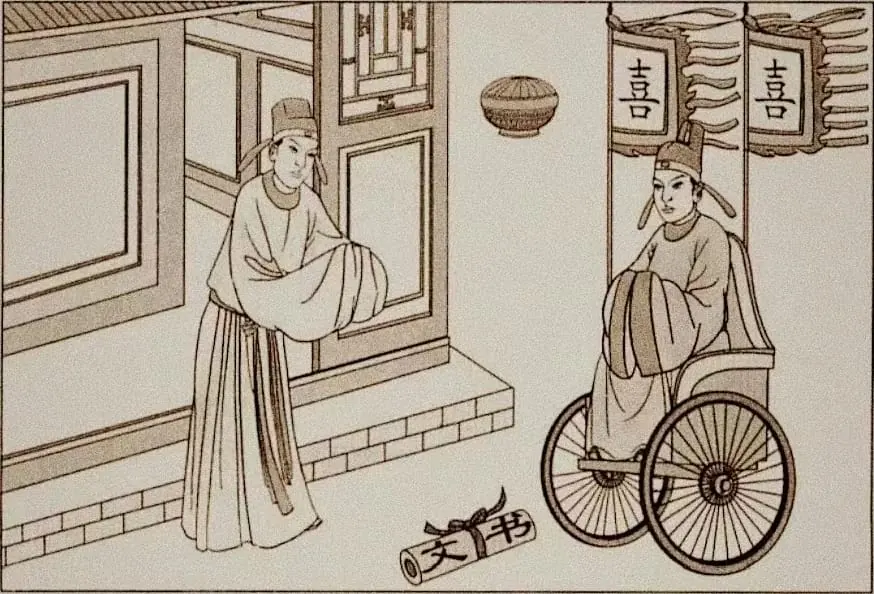
Scene Description
Image Symbolism
Reading the Picture
Da Guo is a load heavier than its supports: strength massed in the middle, weakness at both ends.
Begin with the official in the two-wheeled carriage, two banners behind him, each bearing 喜, joy. Split across two flags, the joy reads in the Image Symbolism as happiness damaged or a marriage set aside. Facing him, a distinguished man stands by the doorway of a large house. The text has the carriage entering a vermilion gate; in the drawing it waits outside, and the standing man looks like someone left outside.
On the ground lies a tied scroll labelled 文书: an agreement nobody has picked up. Above floats a lidded box, the symbol of something completed first and broken later. The lesson title mentions a cold tree flowering; no tree is drawn, but the withered poplar of the line statements carries the idea.
The trigrams are Lake ☱ over Wind ☴, and Wind also stands for wood: water rising until it covers the trees. Four strong lines crowd the middle, a weak one at each end: a heavy ridgepole on frail supports. The split joy and the dropped contract echo the third line most clearly: the ridgepole bends, because strength that no one supports cannot carry the weight.
- Work
- If you carry more than your team can bear, consider who could share the load before something bends. Ask whether the agreement on the table is truly settled or only looks festive.
- Relationships
- If a match looks splendid from outside, consider whether both people are actually inside the gate together. Care and courtesy, like the first line’s matting of white grass, protect what is fragile.
- Timing
- This is a time of excess. Before a bold move, check your supports: standing alone without fear is admirable, wading in over your head is not.
Line Statements
Listed from the bottom line to the top line.
- First six: Matting with white grass. No blame.
- Nine in the second place: A withered poplar puts out shoots. An old man gains a young wife. Nothing is unfavorable.
- Nine in the third place: The ridgepole bends. Misfortune.
- Nine in the fourth place: The ridgepole rises. Good fortune. Other concerns bring regret.
- Nine in the fifth place: A withered poplar flowers. An old woman gains a young husband. Neither blame nor praise.
- Top six: Wading too far, the water passes over the head. Misfortune, no blame.
Meaning of the Hexagram
Translated from the Chinese 人间道 commentary with AI assistance; translator notes appear in brackets.
“Da Guo: the ridgepole bends. It is beneficial to have somewhere to go; success.”
The difference between Xiao Guo (Small Preponderance) and Da Guo (Great Preponderance) is this: in Xiao Guo the yin is excessive above and below, while in Da Guo the yang is excessive in the middle and both ends are weak, hence the image of a bending ridgepole. In this hexagram four yang lines sit in the middle; this is the image of a ridgepole, able to bear a heavy load. That is, the noble person flourishes and the petty person declines, so it is beneficial to have somewhere to go, and there can be success.
“Da Guo: the great exceeds.”
This covers both committing a great fault and accomplishing deeds that greatly exceed other people.
“The ridgepole bends: root and tip are weak.”
The root and the tip are yin while the middle is doubled yang; hence the bending ridgepole.
“The firm is excessive yet central; gentle and joyful in its action. It is beneficial to have somewhere to go, and then there is success.”
Although there is excess because of yang firmness, its conduct does not lose the middle way. It is gentle, compliant, harmonious and joyful, without selfish intent, so going forward will surely be beneficial, and therefore there is success.
“Great indeed is the time of Da Guo!”
When a person can establish an extraordinary undertaking and achieve merit unmatched in his generation, that is truly “great exceeding”; to handle it at the fitting time is what makes it great.
“The lake submerges the trees: Great Preponderance. The noble person accordingly stands alone without fear and withdraws from the world without gloom.”
By nature a lake moistens and nourishes the trees; now it has come to submerge them. This is excess at its extreme, an image drawn from heaven and earth. The noble person (a person of talent), observing the image of Da Guo, establishes conduct that greatly exceeds others. What enables him to exceed others is that he can stand alone without fear: even if the whole world slanders him, his heart is not moved; even if no one in the world recognises him, he has no regret; living withdrawn from the world, he is not gloomy. Only in this way can he hold to himself, and this is how he can greatly exceed others.
“Matting with white grass. No blame.”
Here yin softness sits in a low place. Thatch grass is the flimsiest of things, yet it is used with great care; this is reverence and caution at their utmost, and so there can be no harm.
“Matting with white grass: the soft is below.”
This shows yin softness in a low place, being exceedingly reverent and careful. This is the way of utmost caution.
“A withered poplar puts out shoots [the source writes 阳 for 杨]. An old man gains a young wife. Nothing is unfavorable.”
The second is a soft position. A yang firm line in a soft position is a person of excessive firmness who can still conduct himself by the middle and balance himself with softness. The result is like an old man gaining a young wife: he too can achieve the work of bringing forth offspring.
“The old man and the young wife: in excess, they join together.”
The match of an old man and a young wife goes beyond the usual measure, but because the old man can delight in the young woman and the young woman can accommodate the old man, there is no harm.
“The ridgepole bends. Misfortune.”
The third nine holds itself with overly great yang firmness and does not attain the middle way. This is firmness in great excess: its every action will go against harmony and the mean and run counter to the feelings of the many. So even with the talent to be a ridgepole, with no one to support it, how could it bear the task of a time of great preponderance? Hence misfortune.
When the noble person lives in a time of great preponderance and seeks to achieve merit beyond the ordinary, it cannot be done unless firmness and softness are well balanced and he gains the support of others.
“The misfortune of the bending ridgepole: no one can support it.”
This is excess of firmness and strength. Such a person cannot draw on others, and others have no way to support him; this is the misfortune.
“The ridgepole rises. Good fortune. Other concerns bring regret.”
This is the position near the ruler, and it bears the task of a time of great preponderance. Firmness in a soft position can balance itself, and this is good fortune. But if there are divided intentions, the firmness will lose the middle, adding a burden to yang firmness; though this does not lead to great harm, there is still cause for regret.
“The good fortune of the rising ridgepole: it does not bend toward what is below.”
If the ridgepole can rise up, there is good fortune; it must not bend and sag downward.
“A withered poplar flowers. An old woman gains a young husband. Neither blame nor praise.”
The ruler’s position in a time of great preponderance has no help from below. It is like a withered poplar that grows no roots but only puts out an outward show: the outward bloom can be seen, yet it does nothing to cure the withering. It is like an old woman with a young husband: though there is no blame, it is not admirable; indeed, may it not even be thought shameful?
“A withered poplar flowers: how can it last long? An old woman and a young husband: this too is shameful.”
A withered poplar [again written 阳] that grows no roots but only outward flowers cannot last long. An old woman who gains a young husband cannot achieve the work of bringing forth offspring.
“Wading too far, the water passes over the head. Misfortune, no blame.”
This line is yin softness at the extreme of excess: the petty person at the extreme of excess. The petty person’s great excess is not a matter of doing things far beyond others. It is merely going beyond what is reasonable, paying no heed to danger and ruin, braving risks and causing trouble, like wading into water until it closes over one’s head. This is surely misfortune. One brings the disgrace on oneself and has no one else to blame.
“The misfortune of wading too far: there is no one to blame.”
Wading too far until one drowns is entirely one’s own doing; there is nothing to complain of.
Show the Chinese original (人间道)
大过:栋桡,利有攸往,亨。 小过与大过之分,乃小过为阴过于上下,大过乃阳过于中,上下皆弱,故有栋桡之象。此 卦四阳居中,乃栋象,能任重也。即君子盛而小人衰,故利有攸往可亨。
大过,大者过也。 犯过之大与成大过于人之事。 栋桡,本末弱也。 本末为阴而中为重阳,故为楝桡。 刚过而中,巽而说行,利有攸往,乃亨。 虽因阳刚有过,但处不失中道,巽顺和悦,无以私心,必利攸往,所以亨。 大过之时大矣哉! 人能立非常之大事,立不世之大功,乃真大过,处之时得宜乃大哉。
泽灭木,大过。君子以独立不惧,遯世无闷。 泽本润养于木,今至灭没于木,此过之甚矣,为天地之象。君子(人才)观大过之象,以 立其大过于人之行,其所以能大过于人者,乃其能独立不惧,天下诽之亦无动其心,举世不见知而不悔,隐世而不忧闷,如此方能自守,此为其能大过于人也。
藉用白茅,无咎。 此以阴柔而处卑下,易藉用茅为至薄之 物,但用之亦很慎重,此为敬慎之至也,故可 以无灾。
藉用白茅,柔在下也。 此示意阴柔而居卑下,过于敬慎之意,此 至慎之道。
枯阳生稊,老夫得其女妻, 无不利。 二为柔位,阳刚居柔,是过刚之人而能以 中自处,与柔相济,其功如老夫之得女妻,则 亦能成生育之功。
老夫女妻,过以相与也。 老夫少妻之配,虽过于常份,但老夫能悦 少女,而少女能顺老夫,亦无灾。
栋桡,凶。 九三以太过之阳刚自居,又不得中道,此 刚过之甚,其动必违和于中,拂逆众心,故即 以栋梁之才,而无人自辅,安能当大过之任 乎?故凶。君子居大过之时,立大过之功,非 刚柔适中,得人之辅,则不能也。
栋桡之凶,不可以有辅也。 此即刚强之过,必不能取于人,人亦无法 辅之,此其凶也。
栋隆,吉 ,有它吝。 此近君之位,又当大过之任,以刚处柔则 能相济,是吉也。但如有异志,则刚必失中, 此加累于阳刚,虽不致有大害,但亦可吝也。
栋隆之吉,不桡乎下也。 栋能隆起则吉,不可曲桡就下。
枯杨生华,老妇得其士夫, 无咎无誉。 君位处大过之时,下无助援,就如枯杨不 生根而生外表,其表秀虽可见,但却无益于枯 也。犹如老妇之与士夫,此虽无咎,但非美也, 其可丑乎。
枯杨生华,何可久也?老妇 士夫,亦可丑也。 枯阳不生根而生华秀之外表,必不能长 久。老妇得士夫,必不能成生育之功也。
过涉灭顶,凶,无咎。 此阴柔又处过之极者,乃小人过之极也, 小人之大过,并非能做大过于人之事也,而是 过越常理,不体恤危亡,犯险闯祸而已,如涉 水而至灭顶,必凶。此自取其辱,无所怨尤。
过涉之凶,不可咎也。 过涉水以至于溺水,皆咎由自取,无可抱 怨也。