Scene Description
Image Symbolism
Reading the Picture
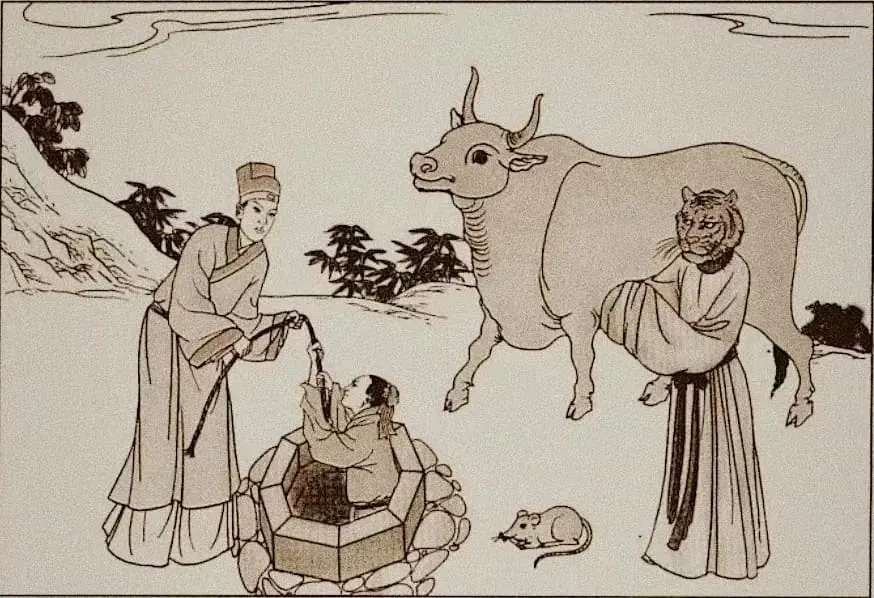
Kan is danger doubled, a pit inside a pit. The picture shows someone already down in it, and asks what actually gets a person out.
Start at the well. A figure inside the stone ring grips a rope, only head and shoulders above the rim, while an official in a tall hat pulls the other end. The Image Symbolism reads the well as a lawsuit or a hole one has fallen into, and the rope as someone reaching out to help. The first line’s “entering the pit” is the figure inside; the second line’s “seek small gains” fits the slow work of the rope: not yet out, but no longer sinking.
To the right stand a large ox, an image of toil, and a figure with a human body and a tiger’s head, read as a person of authority who can help. On the ground a small rat creeps along: the hidden schemer working out of sight.
Both trigrams are Water ☵: one solid line held between two broken ones, yielding outside and firm within. That is the commentary’s sincerity at the core, and also the scene’s shape: a person enclosed by stone, help arriving from outside. The lesson title mentions a boat crossing repeated shoals, though no boat is drawn.
- Work
- If you are stuck, consider whether you have actually asked for the rope. Plain, honest dealing, like the fourth line’s wine in earthenware, may persuade better than polish.
- Relationships
- If trust has been shaken, ask what truly sits at the centre of your intentions. Watch for quiet undermining, but do not let suspicion of the rat hide the person offering help.
- Timing
- This is a time of repeated danger, when small, steady gains count. If you are not yet out, hold to what is constant instead of thrashing.
Line Statements
Listed from the bottom line to the top line.
- First six: Repeated danger; entering the pit within the pit. Misfortune.
- Nine in the second place: Danger in the pit. Seek small gains.
- Six in the third place: Coming and going, danger upon danger; peril and no support; entering the pit within the pit. Do not act.
- Six in the fourth place: A vessel of wine, two food vessels, earthenware; offer the simple gift through the window. No blame in the end.
- Nine in the fifth place: The pit is not full; it is only filled to the level. No blame.
- Top six: Bound with cords and placed among thorns. For three years no release. Misfortune.
Meaning of the Hexagram
Translated from the Chinese 人间道 commentary with AI assistance; translator notes appear in brackets.
“Repeated Kan: there is sincerity; only the heart has success; going on brings honour.”
Yang solidity in the middle means there is sincere trust within. If only the heart is sincere, upright and single, there can be success. As the saying goes, utmost sincerity can pierce metal and stone and pass through water and fire; what danger or hardship could it not get through? So the way out of danger lies in acting with sincere singleness of mind; otherwise one remains in danger.
“Repeated Kan: doubled danger. Water flows and does not fill up; it moves through danger without losing its trustworthiness.”
习 carries the meaning of repetition: above and below are both Kan, that is, danger within danger. “Water flows and does not fill up” means moving within danger at a time when one has not yet escaped it. When we pass through danger we must not lose our trustworthiness; then there can be good fortune.
“Only the heart has success: this is because of firm centrality. Going on brings honour: going forward has merit.”
With the way of firm centrality, holding fast to the inner solidity of utmost sincerity, what in the world could not be passed through? But if one stops and does not act, one remains in danger always; so in the danger of Kan, the merit lies in being able to move.
“The danger of heaven cannot be climbed; the dangers of earth are mountains, rivers and hills. Kings and lords set up dangers to guard their states. Great indeed is the use of danger in its time!”
Heaven’s danger is that it is too high to be climbed; earth’s dangers are mountains, rivers and hills. The kings and lords, observing the image of Kan, knew that danger cannot be overstepped, so they set up high walls and deep moats as defences, to guard their states and protect their people. This is the use of danger in its time.
Human affairs are the same. All learning about knowing people, distinguishing the honoured from the humble and the noble from the base, and separating petty people from noble ones, serves to cut off calamity and to set boundaries between above and below. All of this comes from understanding the use of danger.
“Water flows on and on: Repeated Kan. The noble person accordingly keeps his virtue constant and practises the work of teaching.”
Water tends downward, growing from small to great and never changing over time. Observing the image of the water of Kan, the noble person takes its constancy: not changing one’s virtuous nature is what is genuine. If a person’s virtue and conduct keep changing, they are false.
In government, when orders are issued and teaching is carried out, the people must become thoroughly familiar with them, so that everyone follows. The saying “three orders and five repetitions” expresses this.
“Repeated danger; entering the pit within the pit. Misfortune.”
The first line, with yin softness, sits at the bottom of the danger of Kan. Without help and not properly placed, it cannot get out of the danger and only sinks deeper; hence misfortune.
“Repeated danger, entering the pit: losing the way brings misfortune.”
To sink further into danger from within danger is to lose the right way, and misfortune is added.
“Danger in the pit. Seek small gains.”
In the second position a yang line is sunk between two yin lines: at the height of danger, with danger all around. But by nature it has the talent of firm centrality, so although it has not escaped the danger, it can save itself and does not fall deeper. So the noble person in hardship and danger can still be at ease with himself, and this is entirely because of firm centrality. Being firm, one has talent; holding to the middle, one’s actions do not lose what is fitting.
“Seeking small gains: not yet out of the middle.”
That is: although there are small gains and one does not sink into danger, one still has not got out of the dangerous situation.
“Coming and going, danger upon danger; peril and a resting place; entering the pit [the source writes 富]. Do not act.”
The third six, at a time of the danger of Kan, is yin softness in an incorrect position. Going down, it enters danger; going up, it meets doubled danger. So whether it advances or retreats it meets danger, and staying where it is is dangerous as well. 枕 (a pillow, a resting place) here describes a position in which one cannot rest easy. At this time the only right course is to heed the warning: do not act.
“Coming and going, danger upon danger: in the end there is no merit.”
Being yin and soft and in an incorrect place, any movement only increases the danger. To get out of danger one must have a way; if one has lost the way and merely tries to get away [the wording 但为能求去 is unclear], one only adds to one’s distress and exhaustion.
“A vessel of wine, two food vessels, earthenware; offer the simple gift through the window. No blame in the end.”
This speaks of a high minister at a time of danger and hardship. Only by being utterly sincere toward the ruler, never breaking off contact with him, and also being able to open the ruler’s mind so that it becomes clear, can he be kept free of harm. If a person seeks the firm trust of a superior, he need only seek plainness and substance; to multiply ceremonies and prize fine dress brings misfortune instead. One vessel of wine, two vessels of food, with earthenware for utensils: this expresses the wish for plain substance.
Then, from a place of light, he makes the ruler’s mind clear. Only in this way can he enter the ruler’s heart, and even in hardship and danger there can be no blame. Since ancient times, those who sought only to be blunt, upright, attacking and outspoken have mostly offended the ruler, while those who are warm, generous and clear in discernment have instead been able to enter the ruler’s heart and change him.
“A vessel of wine and two food vessels: the meeting of firm and soft.”
Seek only substance, and have softness within firm centrality, and there will surely be peace. What lets the bond between ruler and minister last is nothing other than sincerity and honesty.
“The pit is not full; only when it has been brought level is there no blame.”
This is the honoured fifth position, with the talent of firm centrality, able to relieve the danger. But there is no help from below, and relying on the ruler’s strength alone one cannot relieve the dangers of the whole world; then there is blame. One must wait until it is filled and level; only then is there no blame.
“The pit is not full: centrality is not yet great.”
A talent of firm centrality occupies the ruler’s position. The world is in danger and hardship, though not yet wholly so. It cannot yet level the danger because ruler and minister cannot work together and help each other. So the way of the ruler cannot yet rescue the world, and this is because there are no ministers; hence it is said that he does not live up to his position.
“Bound with black cords, placed among thorns; for three years no release. Misfortune.”
This means yin softness sunk deep in danger. The sage uses prison as a metaphor: bound with cords and held among thickets of thorns, unable to get out, for at least three years with no escape. Such is its misfortune.
“The top six has lost the way: misfortune for three years.”
The top six, with yin softness, is in a place of danger, and this comes from its having lost the way. Its calamity lasts three years without escape, meaning a long time.
Show the Chinese original (人间道)
习坎:有孚,维心亨,行有尚。 阳实在中,乃中有孚信,惟心诚正一,则能亨通,俗谓:至诚可以通金石,入水火,有何 险难不可亨?故出险之道在于诚一而行,否则常居险中也。
习坎,重险也,水流而不盈,行险而不失其信。 习有重覆之意,上下皆坎,即险中有险,水流而不盈,即动于险中仍未出险之时,吾人行 险须不失其信,乃可吉。 维心亨,乃以刚中也。行有尚,往有功也。 以刚中之道,抱持至诚之内实,天下何所不通,若止而不行,则常居险中也,故坎险以能 行为功。
天险不可升也,地险山川丘陵也,王公设险以守其国。险之时用大 矣哉! 天之险乃因高不可升,地之险为山川丘陵,诸王公观坎之象,知险不可陵越,故设高墙深 地为险,以守其国,保其人民,此用险之时也。人间亦然,凡知人之学,分尊卑,分贵贱,区 分小人与君子,皆为用于杜絶灾殃,限隔上下,此都是体悟了险之用也。
水洊至,习坎,君子以常德行,习敎事。 水势就下,由小而大,历久不变,君子观坎水之象,取其有常,不变其德性为真。如人之 德行常变,则伪也。政治上发令行教,必使民熟于闻,人人皆从之,故有谓三令五申,即此意。
习坎,入于坎窞 窞 窞 窞,凶。 初以阴柔居坎险之下,因无援,处不当, 不能出险,唯益陷深而已,故凶。
习坎入坎,失道凶也。 由险中而加陷入险,乃失正道,加凶。
坎有险,求小得。 二爻位,乃阳陷二阴之中,即至险而有险 状,但其本为刚中之才,故虽未出险,亦可自 救,不至于愈险,故君子处艰险而能自得,皆 因刚中而已。能刚则有才,能执中则动不失所 宜。
求小得,未出中也。 此即虽有小得,虽不致于陷险,然亦未能 出险状。
来之坎坎,险且枕,入于坎 富,勿用。 六三位在坎险之时,以阴柔居而处不正, 走下则入险,向上则重险,故有进与退皆遇险, 居又有险,枕乃处不安状,此时唯戒勿用方是。
来之坎坎,终无功也。
以阴柔又处不正,动则唯益险,人出险须 有道,如失道,但为能求去,只益增困穷而己。
樽酒,簋贰,用缶,纳约自 牖,终无咎。 此言大臣当险难之时,唯有至诚于君,不 可停交往,而又能打开使君能明之心,则可保 无灾。人欲求上之笃信,只有求质实而已,如 多礼仪而尚服饰,反凶。一樽之酒,二簋之饭, 以瓦缶为器,乃求质实之意。再处明之地以明 君之心,如此方能入君心,即令艰险,亦可无 咎。
自古以来,只求刚直攻讦直言不讳之人, 多忤逆君心,而属温厚明辨者,反而能入君心, 改变君主。
樽酒簋贰,刚柔际也。
但求实质,又刚中有柔,必平安。君臣之 交能长久,不外乎诚实而已。
坎不盈,衹。既平,无咎。 此即九五之尊,有刚中之才,可以济险, 但下无助,独依君之力无法济天下之险,则有 咎,必待盈平,方可无咎。
坎不盈,中未大也。 刚中之才得居君位,时天下险难,但未至 全险,其未能平险,乃因君臣无法协力相济之 故,故此君道未能救济天下,乃因无臣,故曰 不称其位。
系用徽纆 纆 纆 纆, , , ,寘 寘 寘 寘于丛棘,三岁 不得,凶。 此意阴柔而深陷险中,圣人以牢狱比喻, 缚以徽缠,囚置于丛棘之中,其不能出,至少 三年不可免,其凶如此。
上六失道,凶三岁也。
上六以阴柔而处险地,乃因其失道而成。 其灾延三年不得免,意久也。