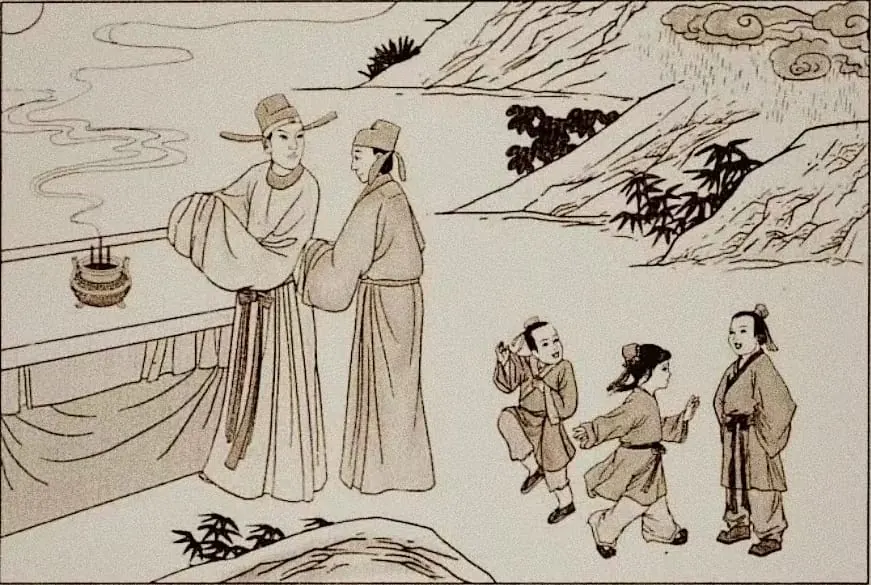
Scene Description
Image Symbolism
Reading the Picture
Yi is about nourishment: what feeds you, whom you feed, and whether what you take in, whether food, words or support, is sound.
Notice the shape of the hexagram first: a solid line at the bottom and at the top with four open lines between, like an open mouth between its jaws. In the picture, nourishment comes from above. On the right, clouds gather over the mountains and rain slants down onto the slopes, which the Image Symbolism reads as receiving grace. Mountain ☶ above and Thunder ☳ below give the scene its logic: thunder stirs beneath the mountain and new growth begins, provided something feeds it. A sun peeks in at the upper-left corner, read as clear-sighted leadership.
At the centre, an official in a tall hat stands beside a second man, drawing him forward. This is sponsorship. It recalls the fourth and fifth lines, where someone whose own strength is not enough does well by turning to a worthy helper, and the top line, where that helper becomes the source of nourishment for others. The incense burner on the balustrade marks the act of asking. The three children playing at the lower right show what good nourishment produces: shared spirit and easy growth.
- Work
- If you are seeking support or a mentor, consider whether that person shares your values; the second line warns against seeking from the wrong quarter. If you can sponsor someone, now is a good time.
- Relationships
- Consider what you feed a relationship with: careful words and steady care, or appetite and comparison. The first line’s warning is about envying others’ portion and neglecting your own.
- Timing
- This is a time for steady, honest nourishment rather than quick gains. If you need help, ask openly; if you feel the urge to grab, pause and moderate.
Line Statements
Listed from the bottom line to the top line.
- First nine: Abandoning your sacred turtle, you watch my moving jaws. Misfortune.
- Six in the second place: Reversed nourishment, departing from the normal way, seeking nourishment on the hill. Going forward is inauspicious.
- Six in the third place: Turning away from nourishment. Steadfastness is inauspicious. Do not act for ten years; nothing is beneficial.
- Six in the fourth place: Reversed nourishment. Good fortune. A tiger's intent gaze, desires pursuing one another. No blame.
- Six in the fifth place: Departing from the normal way. Remaining steadfast brings good fortune. Do not cross the great river.
- Top nine: The source of nourishment. Danger and good fortune. It is beneficial to cross the great river.
Meaning of the Hexagram
Translated from the Chinese 人间道 commentary with AI assistance; translator notes appear in brackets.
“Yi: steadfastness brings good fortune. Observe the nourishing; seek for yourself what fills the mouth.”
Yi (Nourishment) is what nourishes people. The noble person observes it: the way of seeking for oneself what fills the mouth is what nourishes the noble person. One whose mouth is not filled with substance, and who does not know how to nourish himself, is a petty person.
“Yi: steadfastness brings good fortune: nourishing what is correct brings good fortune. Observe the nourishing: observe what one nourishes. Seek for yourself what fills the mouth: observe how one nourishes oneself. Heaven and Earth nourish the myriad things; the sage nourishes the worthy and, through them, all the people. Great indeed is the time of Nourishment!”
Those whom we nourish, and the way we nourish our own lives, come down to nothing other than seeking for ourselves what fills the mouth, and in all of it correctness brings good fortune. The sage nourishes the worthy, placing them in the positions Heaven provides and letting them eat Heaven’s stipend, because he seeks talented and worthy people to spread benefit throughout the realm. Nourishing the worthy in this way is nourishing all the people.
“Beneath the mountain there is thunder: Nourishment. The noble person accordingly is careful in speech and moderate in eating and drinking.”
As an image, thunder shakes beneath the mountain, the roots of all things stir and they put forth shoots: this is the image of Heaven and Earth nourishing them. The noble person knows that the mouth is what nourishes the body; so he is careful in speech to nourish his virtue, and moderate in food and drink to nourish his body.
“Abandoning your sacred turtle, you watch my moving jaws. Misfortune.”
It is the nature of the turtle that it can hold its breath and go without eating; it need not seek nourishment from outside, and so it is called sacred, that is, wise. But once a person’s appetite for mouth and belly has been aroused, he will surely lose what nourishes him; therefore there is misfortune.
“Watching my moving jaws: this too is not worth esteeming.”
When people are moved, it is by desire. Even with firm and strong talent, and however wise one may be, in the end one will surely lose it; therefore it is not worth esteeming.
“Reversed nourishment, departing from the normal way, seeking nourishment on the hill. Going forward is inauspicious.”
The correct way of nourishment is for those above to nourish those below: the Son of Heaven nourishes the realm and nourishes his ministers, and ministers eat the ruler’s stipend; in every case the higher nourishes the lower. Now, as a woman cannot manage on her own and must follow a man, and yin cannot stand alone and must follow yang, this second line cannot nourish itself and instead seeks nourishment from the yang firmness below it. That is why it is called reversed: it goes against the normal principle, and so it must not act.
The hill is the top nine, something outside and high up; so going there will surely bring misfortune. This shows that when a person’s talent is not enough to nourish himself, and he sees someone in a high position with enough power to nourish others, and rashly goes to seek from him although that person is not a noble person of his own kind, he will surely bring humiliation on himself.
“The six in the second place: going forward is inauspicious: in acting, it loses its own kind.”
It goes forward to follow the one above, which is not of its kind. So when people seek from those who are not of their kind, they will surely meet misfortune.
“Turning away from nourishment. Steadfastness is inauspicious. Do not act for ten years; nothing is beneficial.”
Wayward and soft, and moving in a way that is not correct, it goes against the correct way of nourishment; therefore there is misfortune. Ten is the number at which counting ends; so it can never be used, and there is nowhere it can go with benefit.
“Do not act for ten years: the way is greatly contrary.”
This warns that it can never be used. Whenever a person is wayward and soft and yet wants to act, he goes greatly against the correct way; this is the warning.
“Reversed nourishment. Good fortune. A tiger’s intent gaze, desires pursuing one another. No blame.”
A yin, soft line occupies the position of a high minister. Yin softness is not even enough to nourish itself; how could it nourish the realm? Now if it corresponds with the firm yang first line and yields with soft compliance to that line’s worthiness and correctness, there is good fortune. So if one’s own talent is not enough to nourish the realm, but one knows to seek worthy people below and follow them, there can still be good fortune.
But one must cultivate one’s dignity, intent as a tiger’s gaze, so as not to be held in contempt because one’s soft talent is insufficient to nourish, which would lead to defiance of one’s superiors. One must also take care that what one needs to use comes in unbroken succession, one after another, without running short; if one only takes from others and cannot keep it going, hardship and exhaustion will arrive.
“The good fortune of reversed nourishment: the one above spreads light.”
When we can seek nourishment in reverse and still have good fortune, it is always because we obtain help from yang firmness in carrying out the task; thus we can spread brightness across the realm.
“Departing from the normal way. Remaining steadfast brings good fortune. Do not cross the great river.”
The ruler’s position is that of one who nourishes others. But if its nature is yin and soft, its talent is not enough to nourish the realm. If it can yield to the worthiness of the firm yang one (the teacher) and rely on him to aid the realm, it must have a heart that rests secure and trusts deeply, trusting him completely; then he can support the ruler, and the ruler’s virtue will benefit the realm. Therefore there is good fortune.
But one may rely on worthy and able people in this way only in ordinary times, not when hardship arises and things change; otherwise misfortune is invited.
“The good fortune of remaining steadfast: compliantly following the one above.”
The good fortune of the one in the high position comes from being able to trust deeply and entrust a firm and worthy person with nourishing the realm.
“The source of nourishment. Danger and good fortune. It is beneficial to cross the great river.”
Here, with the virtue of yang firmness, it holds the office of teacher; the ruler follows it and trusts it deeply, and the realm is nourished. But it must stay watchful in the evening as if in danger, cautious and fearful; only then can it rescue the realm from danger. Therefore it is beneficial to cross the great river.
“The source of nourishment; danger and good fortune: there is great blessing.”
If the one entrusted with the great office of the top nine can be careful in speech and prudent in action, rest content in his own position and not grasp rashly at power and profit, blessings will surely come.
Show the Chinese original (人间道)
颐:贞吉,观颐,自求口实。 颐之养人,君子观之,自求口实之道,乃养君子。口不实又不知养,小人。
颐,贞吉,养正则吉也,观颐,观其所养也,自求口实,观其自 养也。天地养万物,圣人养贤以及万民,颐之时大矣哉! 吾人所养之人及养生之道,皆不外自求口实,皆以正则吉。圣人养贤,使之为天位,使之 食天禄,为求贤才施惠于天下。此养贤即养万民也。
山下有雷,颐。君子以慎言语,节饮食。 以象言,雷震于山下,万物根动而萌芽,此天地养之象。君子知口所以养身,故慎言语以 养其德,节制饮食以养身。
舍尔灵龟,观我朵颐,凶。 龟之性,能咽息不食,可以不求养于外, 故为灵,即明智,而人口腹之欲既动,则必失 所养,故凶。
观我朵颐,亦不足贵也。 人之动为欲,即使有刚健之才,再明智, 终亦必失,故不足贵也。
顚颐,拂经,于丘颐,征凶。 养之道正,在以上养下,天子养天下,养 臣子,臣食君禄,皆以上养下。今女不能自处 必从男,阴不能独立必从于阳,此二爻不能自 养反求下之阳刚,故为颠倒,拂违常理,故不 可行。丘即上九,为在外而高之物,故往而必 凶,此即意示人之才不足以自养,见在上位势 足养人,即非同类之君子,妄往求之,取辱必 矣。
六二征凶,行失类也。 征而从上,又非其类,故人求非同类,必 得凶矣。
拂颐,贞凶,十年勿用,无 攸利。 邪柔又动之不正,违反颐之正道,故凶。
十为数之终,故终不可用,无所往而利。
十年勿用,道大悖也。 此戒之终不可用,凡人邪而柔,又欲动, 反正道大也,此戒之。
顚颐,吉,虎视眈眈,其欲 逐逐,无咎。 阴柔居大臣之位,阴柔不足以自养,如何 养天下?今如与初阳刚相应,而柔顺于初阳之 贤正,吉。故如己之才不足以养天下,但知求 在下之贤而顺从之,亦可吉也。但须养其威严, 眈眈如虎视,以免因己才之阴柔不足养,而受 人轻视,造成犯上。
但亦须注意所须用者,必 逐逐相继而不缺,若唯取于人又不能继,困穷
至矣。
顚颐之吉,上施光也。 吾人能颠倒求养而又吉者,皆得自阳刚以 济应其事,故能施光明于天下。
拂经,居贞吉,不可涉大川。 君位乃养人者,但其质如阴柔,即才不足 以养天下,而能顺从于阳刚(师)之贤,赖其 以济天下,必须有居安笃信之心,全般信赖, 则可辅其身,德泽天下,故吉。但此种状况可 依赖贤能之人于平时,不可于有困艰生变故之 时,否则招凶。
居贞之吉,顺以从上也。 居上位之吉处,乃因能笃信委任刚贤之 人,来养天下。
由颐,厉吉,利涉大川。 此以阳刚之德,任师之职,君位从而笃信, 天下得养也,但须夕惕若厉,戒慎恐惧,方能 济天下之危,故利涉大川。
由颐厉吉,大有庆也。 若上九之大任能谨言慎行,安居已位,不 妄图权利,则必福庆至矣。