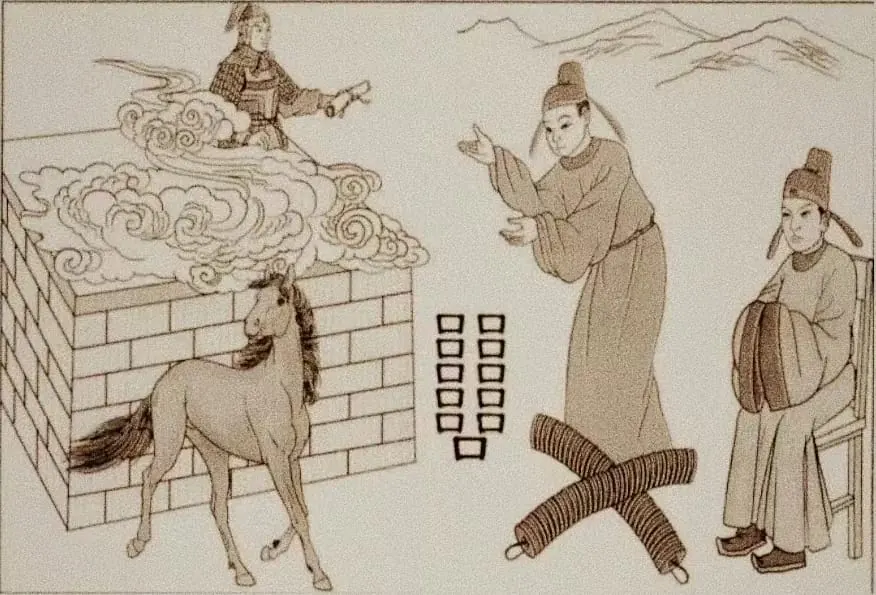
Scene Description
Image Symbolism
Reading the Picture
Kun is about receiving: a commission handed down from above, and the steady, compliant strength needed to carry it, rather than reaching for rewards that are not yours to take.
Begin with the two officials. One sits gazing at two strings of coins he wants but cannot take; the Image Symbolism reads his posture as anxious longing. The other stands and receives a document from a golden-armored figure who has come down on clouds from a platform. That handing-over is the center of the picture: office and responsibility conferred, backed by the popular support the divine figure represents. Nearby is a horse, an image of rank and of being moved to a new post, and an echo of the mare in Kun’s judgment, gentle yet tireless.
Both trigrams are Earth, ☷ over ☷, all broken lines: open, receptive, carrying. The eleven mouths suggest many voices and the role of speaking for others. The written description also mentions four dots on a mound forming 黑, black, a warning about hidden schemes; that detail is not drawn in this picture.
The standing official most clearly illustrates the third line: concealing one’s brilliance, perhaps serving the king, claiming no achievement but seeing the work through. The judgment adds that whoever rushes ahead goes astray, while whoever follows finds a master.
- Work
- If a role or task is being handed to you, consider accepting it fully and doing it well instead of watching for the reward.
- Relationships
- If you keep waiting for something the other person cannot give, consider what you can offer and carry instead. Notice, too, whether something is going unsaid.
- Timing
- This is a time to follow and support rather than lead. If you feel the urge to push ahead, ask whether you know the way yet, or whether patience will let the direction become clear.
Line Statements
Listed from the bottom line to the top line.
- First six: Treading on frost; solid ice is coming.
- Six in the second place: Straight, square and great. Without practice, nothing is unfavorable.
- Six in the third place: Conceal one's brilliance and remain steadfast. Perhaps serving the king; no claim to achievement, but bringing matters to completion.
- Six in the fourth place: Tie up the sack. No blame and no praise.
- Six in the fifth place: A yellow lower garment. Great good fortune.
- Top six: Dragons fight in the wilderness; their blood is dark and yellow.
Meaning of the Hexagram
Translated from the Chinese 人间道 commentary with AI assistance; translator notes appear in brackets.
“Kun: origin, success, benefit through the steadfastness of a mare.”
Kun (The Receptive) is the deep virtue of the earth. It shows people how to imitate the nature of the earth: like a mare, gentle and compliant yet strong in its going. “Steadfastness” means a firm heart, but unlike Qian, it is a heart firmly set on gentleness and compliance.
“The noble person has somewhere to go.”
Because the noble person acts with gentle compliance and is the same inside and out, he accords with the virtue of Kun, the earth.
“Going first, he goes astray; following after, he finds his master. There is benefit.”
Yin follows yang. That is, even without fully understanding, one knows that one must follow the central correctness of yang firmness. If one tries to advance without understanding, one goes astray and errs, and the loss is one’s own. One should stay behind; then there is benefit. It is like the relationship between ruler and minister: gentle compliance is the minister’s duty.
“Friends are gained in the southwest and lost in the northeast. Peaceful steadfastness brings good fortune.”
The southwest is a yin direction and the northeast a yang direction. Yin must follow yang; when yang is upright, yin is upright too. Through the central correctness of yang firmness, the weeds are cleared and the best is kept, and so the work of nurturing life can be accomplished.
“Perfect indeed is the originating power of Kun! All things owe their birth to it, and so it receives heaven in compliance. Kun is thick and carries things; its virtue matches the boundless.”
The way of Kun is great. All things begin through Qian and are born through Kun, as in the way of father and mother. Kun’s virtue is deep, so it can hold and carry all things.
“Embracing, broad, bright and great, it lets every kind of thing prosper. The mare belongs to the earth; it travels the earth without limit. Gentle and compliant, benefiting through steadfastness: this is how the noble person acts.”
The four terms embracing, broad, bright and great describe the way of Kun: “embracing” is inclusiveness; “broad” is generous spaciousness; “bright” is clear illumination; “great” is thickness, breadth and vastness. The sage has these four virtues, and so can complete heaven’s work. The mare can travel because it is gentle and compliant, and so it is strong.
“Going first, one goes astray and loses the way; following after, one complies and finds constancy. In the southwest one gains friends, travelling with one’s own kind; in the northeast one loses friends, but in the end there is cause for celebration. The good fortune of peaceful steadfastness answers to the boundlessness of the earth.”
Having gone astray at first and then followed the virtue of yang firmness, one is sure to grasp the principle later. The southwest is yin; travelling with one’s own kind, one gains friends. The northeast is the yang direction; leaving one’s kind, one loses friends. Because one leaves one’s kind to follow yang, one can accomplish the work of bringing things to completion. In the end there is sure to be good fortune; and because one can calmly and firmly hold to this way, there is nowhere one cannot go.
“The earth’s condition is receptive. The noble person accordingly carries all things with deep virtue.”
The way of Kun, the earth, is supremely great. The sage embodies it, and the noble person handles affairs with the earth’s virtue of being gentle, compliant, and thick enough to carry all things.
“Treading on frost; solid ice is coming.”
When yin first comes into being, the sage knows that it will grow and gives warning at this point, just as a person who treads on frost knows that solid ice will follow. So although petty people are very slight at first, they must never be allowed to grow; when they grow strong, there is misfortune.
“Treading on frost, solid ice: yin is beginning to congeal. Follow this course to its end and solid ice arrives.”
Yin first congeals into frost and, as it grows stronger, becomes solid ice. So the sage warns against petty people at the outset: if petty people are allowed to carry on unchecked, the end is misfortune. We must therefore guard against it from the beginning.
Petty people often appear pitiable on the surface, winning sympathy and showing weakness in order to be pitied, while inwardly they have designs. People today do not realise that helping the weak and indulging wrongdoers are separated by a thin line. They pride themselves blindly on helping the weak, not knowing that they are indulging wrongdoers, and so petty people flourish today.
“Straight, square and great. Without practice, nothing is unfavorable.”
The sage uses the earth’s three virtues — straightness, squareness and greatness — to express the whole way of the earth. Straight means direct, without detours or pretence. Square means principles that do not change with circumstances, and are upright. Great means a breadth of mind able to hold and carry all things. “Without practice” means following what is natural, so that wherever one goes there is benefit. One may also say that, being both straight and square, one’s bearing becomes great.
“The movement of the second six is straight and thereby square. Without practice, nothing is unfavorable: the way of the earth shines.”
The way of the earth shines forth through its being straight, square and great. When everyone follows what is natural, where can wrongdoers hide? Nothing is unfavorable.
“Conceal one’s brilliance and remain steadfast. Perhaps serving the king; no claim to achievement, but bringing matters to completion.”
The third six occupies the position of a chief minister: the way of a minister. If he has the beauty of concealed brilliance — that is, if he does not claim credit but attributes the good to the king — then, since the king has no cause for jealousy or resentment, the end will surely be fortunate.
“Conceal one’s brilliance and remain steadfast: bring it forth at the proper time.”
The way of a subordinate is not to claim credit, so as not to provoke the ruler’s suspicion. But when righteousness requires action at the proper time, one must act at once. Not claiming credit while not failing to do what is fitting — all this depends on the time. People today who conceal their abilities and do nothing are all disloyal.
“Perhaps serving the king: his understanding is bright and great.”
The sage understands how bright and great concealed brilliance is, so he can keep himself in obscurity. A petty person who does any good is afraid that others will not know of it. This is the dividing line between the noble person and the petty person.
“Tie up the sack. No blame and no praise.”
The fourth six sits in a position close beside the ruler. Keeping one’s mouth closed and revealing nothing brings safety and no disaster; this is the merit of silence.
“Tie up the sack, no blame: caution does no harm.”
To be able to watch one’s words at all times and not speak recklessly: caution is why there is no harm.
“A yellow lower garment. Great good fortune.”
Kun fundamentally discusses the way of a minister. When a minister occupies the place of honour, or a woman occupies the place of honour, there must be the caution of the yellow lower garment: one should keep to the middle and stay low, and not become overbearing and unrestrained. Otherwise some extraordinary upheaval is sure to follow.
“A yellow lower garment, great good fortune: refinement lies within.”
The beauty of the yellow garment is a supreme beauty accumulated within. Holding to the middle without excess, high in position yet humbly staying low — therefore there is good fortune.
“Dragons fight in the wilderness; their blood is dark and yellow.”
The sixth line is the position of utmost fullness. When yin reaches its extreme, yang arrives, and so there is a contest. Because the sixth keeps pressing forward without stopping, there must be a fight, and fighting brings wounds, so the colour of blood appears. Heaven’s blood is dark; earth’s blood is yellow.
“Dragons fight in the wilderness: the way has reached its end.”
Because yin has reached its extreme, the way is lost; hence the image of dragons fighting in the wilderness appears.
“It is beneficial to be steadfast for ever.”
This is the way of using yin, parallel to Qian’s way of “using nines.” The way of yin is soft and hard to keep constant; there is the worry of orders given in the morning and changed by evening. So the benefit lies in being constant and firm.
“Using sixes, lasting steadfastness: by this one comes to a great end.”
From this the sage realises that by remaining the same from beginning to end, with a firm and unchanging heart, one is sure to benefit, and the final outcome will be great. People today think differently morning and evening, think too highly of themselves and cannot see their roles clearly. Petty people act to excess, and ordinary people follow custom and see only a foolish kind of goodness, so that petty people grow extremely strong; repeated wrongs come to seem right, and what has built up is hard to change.
The Commentary on the Words of the Text (Wenyan) says: “Kun is supremely soft, yet in movement it is firm; it is supremely still, yet its virtue is square. By following after, it finds its master and has constancy. It embraces all things, and its transforming power is bright. Is not the way of Kun compliance? It receives heaven and moves with the seasons.”
Although the way of Kun is soft, its movement must also be firm; Kun’s body is supremely still, but its virtue must be square and upright, so that it moves without departing from squareness and uprightness. Further gaining the response of those who share its way, it achieves the bright and great work of bringing all things forth. So the greatness of Kun’s compliance depends entirely on the arrival of the right time.
“A family that accumulates goodness will surely have abundant blessings; a family that accumulates what is not good will surely have abundant calamities. When a minister murders his ruler or a son murders his father, the cause is not something of one morning or one evening; it has come about gradually, because it was not discerned early enough. The Changes says, ‘Treading on frost; solid ice is coming’: this speaks of things following their course.”
Students who read this passage will surely understand it for themselves. So the sage warns against petty people at the outset; this way is great.
“Straight means correct; square means righteous. The noble person is reverent in order to straighten what is within, and righteous in order to square what is without. When reverence and righteousness are established, virtue is not alone. ‘Straight, square and great; without practice, nothing is unfavorable’: then no one doubts what he does.”
The noble person is reverent outwardly and straight inwardly, and holds firmly to righteousness to square his outward conduct. So, with reverence and straightness within and righteousness and squareness without, his virtue is abundant; it follows what is natural and needs no adornment, and no one will doubt what he does.
“Though yin has beauty, it keeps it concealed in serving the king, and does not dare to claim completion. This is the way of the earth, the way of a wife, the way of a minister. The way of the earth is to claim no completion, but to bring things to their end on another’s behalf.”
The way of a subordinate is not to display his merit, but to remain in obscurity while acting for the king, and in the end not to dare to claim the merit. It is like the way of the earth, which completes all things on heaven’s behalf and returns the credit to heaven. The way of a wife is the same. What are wives like today? Let us ask ourselves.
“When heaven and earth change and transform, plants and trees flourish. When heaven and earth are closed off, worthy people go into hiding. The Changes says, ‘Tie up the sack. No blame and no praise’: this speaks of caution.”
When heaven and earth interact, plants and trees can flourish, and the realm prospers because ruler and minister interact. Now heaven and earth are cut off and nothing comes to completion, just as when ruler and minister have lost the way and worthy people withdraw. At such a time the way of the Changes is to close one’s mouth and keep things hidden; though there is no fame, there is no disaster, all because one is careful in speech.
“The noble person is yellow and central and penetrates principle. He stands in the correct position and keeps to his proper place. Beauty is within him; it flows out into his four limbs and is expressed in his undertakings. This is the height of beauty.”
The noble person knows the way of humility and keeping low and understands the principles of affairs. Holding the ruler’s position, beauty accumulates within him, flows through his four limbs and appears in his undertakings; this is the utmost beauty. This passage shows firmness within softness, which is supremely great and supremely beautiful. People today are soft and kind without firmness, or excessively firm without humaneness; neither is a complete beauty.
“When yin rivals yang there is sure to be a fight, because it resents the absence of yang; hence the text speaks of dragons. Yet it has not left its own kind; hence it speaks of blood. Dark and yellow are the mingling of heaven and earth: heaven is dark and earth is yellow.”
The highest principle of Chinese medicine lies here: yang is great and yin is small, and yin follows yang. That is why the classical-formula school uses yang medicines, and the same holds in human affairs. If yin is allowed to reach its fullest strength, yang is pressed by the excess of yin and driven outward; when they no longer follow each other, there must be a fight, with wounds and bloodshed. The colours of heaven and earth change, which also speaks of how great the injury is.
Show the Chinese original (人间道)
坤:元、亨、利牝马之贞。 坤乃地之厚德,示人效地之性,如牝马之柔顺而健行也,贞示坚心,但与干不同,乃坚心 于柔顺之念也。 君子有攸往。 君子因行柔顺,且表里一致,合乎坤地之德性。 先迷后得,主利。 阴从阳也,即不了解但知须从阳刚之中正,如不知而欲进,则迷错,损失在己,须居于后, 则利,如君臣之道,柔顺乃臣之职也。
西南得朋,东北丧朋,安贞吉。 西南为阴位,东北为阳位,阴必从于阳,阳之正而阴亦正,由阳刚之中正,去芜存菁,故 能成化育之功也。
至哉坤元!万物资生,乃顺承天,坤厚载物,德合无疆。 坤之道大也,万物因干而始,因坤而生,犹父母之道,坤之德厚,故能持载万物。含弘光大,品物咸亨,牝马地类,行地无彊,柔顺利贞,君子攸行。 含弘光大此四者,用来形容坤道,含,包容也,弘,宽裕也,光,昭明也,大,厚且博广。
圣人有此四德,故能成天之功,牝马因柔顺而能行,故健。 先迷失道,后顺得常。西南得朋,乃与类行;东北丧朋,乃终有庆, 安贞之吉,应地无疆。 因先迷而从阳刚之德,后必得理,西南为阴,同类而行,故得朋,东北阳方,离其类而丧 朋,因离其类而从阳,故能成物之功也。终必吉,又因能安心坚守此道,则无所不可往矣。
地势坤,君子以厚德载物。 坤地之道至大,圣人体之,君子以地之柔顺且厚能载物之德处事。
履霜,坚冰至。
圣人于阴之始生,知其将长,此时戒之, 犹人之履及霜,则知后必有坚冰,故小人始虽 甚微,但絶不可使其长,长盛则凶也。
履霜坚冰,阴始凝也,驯致 其道,至坚冰也。 阴始凝为霜,渐盛则至坚冰,故圣人戒小 人于初,如任小人因循不阻止,则终至凶。故 吾人须戒之于初,小人表面常有可怜,博人同 情,示弱以求悯恤,实则内心有所图,今人不 知济弱扶倾与姑息养奸乃一线之差,一昧以济 弱扶倾为自傲,殊不知其姑息养奸,而至今小 人才盛。
直方大,不习,无不利。
圣人以地之直、方、大三德以尽地之道。 直者,直来直往,不迂回作假。方者,原则不 因局势而改变,且正。大者,容载万物之胸襟 乃大也。不习,谓顺其自然,则无往不利。亦 可云,因又直且方,气势乃大也。
六二之动,直以方也,不习, 无不利,地道光也。 地道之光显,由其直且方大,人人顺其自 然,则奸人何所遁形,无往不利。
含章可贞,或从王事,无成 有终。 六三居相位,为臣之道,如有含章之美, 即不居其功,将善归于君王,乃可因王无忌恶 之心,终必吉。
含章可贞,以时发也。
处臣下之道,不当有功,免招君忌,但义 之当为时,须立行之,此因不有其功,不失其 宜,皆因时也。今人含而不为,皆不忠之人。
或从王事,知光大也。 圣人知含章之光大,故能养晦,小人有善唯恐人不知,此君子小人之分野。
括囊,无咎,无誉。 六四为居近君之侧位,藏口而不露,则平 安无灾,此沈默之功也。
括囊无咎,慎不害也。 能随时谨言,不妄言,此无害之因慎也。
黄裳,元吉。 坤本论为臣之道,今臣居尊位,或妇人居 尊位,须有黄裳之戒,应守中而居下,不可扬 溢无节制,否则必有非常之变。
黄裳元吉 ,文在中也。 因黄裳之美,乃内积至美,执中不过,位 高但谦居下,故吉。
龙战于野,其血玄黄。 六爻为极盛之位,阴至极则阳至,故有抗 争,因六又再进不已,故必战,战必有伤,故 血色现,天之血色为玄,地之血色为黄。
龙战于野,其道穷也。 道因阴至极而无道,故有龙战于野之象 现。
利永贞。 此为用阴之道,如干有(用九)之道同。 阴道柔而难常,有朝令夕改之忧。故利在常而 坚固。
用六永贞,以大终也。 圣人自此悟之,始终如一,坚心不变,必 利,其终极必大。今人朝夕所思不同,自视甚 重,角色不能认清,小人有太过之行为,常人 从俗只见愚善,致小人极盛,积非成是,故积 重难改。 文言曰:坤至柔而动也刚,至静而德方。后得主而有常,含万物而化光, 坤道其顺乎?
承天而时行。 坤之道虽柔,但如动亦须刚,坤之体至静,但其德也须方正。动而不违方正。再得同道之 呼应,成万物光大之功,故坤道之顺大,皆因王时之至也。 积善之家,必有余庆,积不善之家,必有余殃。臣弑其君,子弑其 父,非一朝一夕之故;其所由来者渐矣,由辨之不早辨也。
易曰:履霜 坚冰至,盖言顺也。 学者读此段,必可自悟矣。故圣人戒小人于初,其道大也。 直其正也,方其义也;君子敬以直内,义以方外,敬义立而德不孤, 直方大,不习无不利,则不疑其所行也。 君子外敬内直,坚守义以方其外,故内敬直,外义方,其德之盛,顺其自然,不须装饰, 无人会疑其所行也。
阴虽有美含之,以从王事,弗敢成也。地道也,妻道也,臣道也, 地道无成,而代有终也。 臣下之道,不表其功,含晦以为王行事,至终而不敢有其功,如地道代天终万物,而成功 又归之于天,妻之道同此。今之妻如何,吾人试自问之? 天地变化,草木蕃。天地闭,贤人隐。易曰:括囊,无咎无誉,盖 言谨也。
天地相交,则能兴发草木,天下因君臣相往而道亨。今天地隔絶,万物不成,犹君臣无道, 贤者隐退,此时易道为闭口含藏,虽无声誉,但无灾,皆因言论谨慎也。 君子黄中通理,正位居体,美在其中,而畅于四支,发于事业,美 之至也。 君子知谦守下之道而通于事理,居君王位故美积其中,畅于四体,现于事业,此美之极也。
此段乃示柔中有刚,乃至大至美,今人有柔善而无刚,或过刚而无仁,皆不足之美也。 阴疑于阳必战,爲其嫌于无阳也,故称龙焉; 犹未离其类也,故称 血焉。夫玄黄者,天地之杂也,天玄而地黄。 中医之至道在此,阳大阴小,阴乃从阳,故经方派乃用阳药,如人间亦然。如令阴到极盛, 阳受阴盛而外走,此不相从必战,伤而见血,天地之色变,亦言伤之大也。