Scene Description
Image Symbolism
Reading the Picture
Zhun is the difficulty of beginnings: things are starting to move, but the ground is soft, the view is unclear, and forcing your way forward only sinks the wheels deeper.
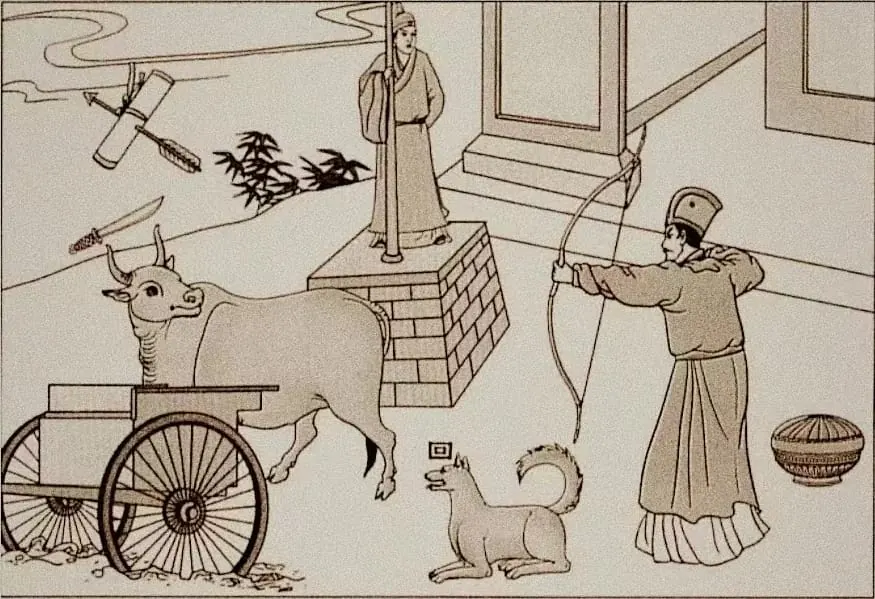
Look first at the cart stuck in the mud. It can go neither forward nor back, a picture of the line statements’ “horses and carriage circle”: movement that goes round without getting anywhere. Above it, a person stands atop a lookout pole. The Image Symbolism reads this as a time when the situation is not yet clear: climb up and look, but do not act rashly. That matches the first line, hesitation, with its advice to stay steady and establish helpers.
The trigrams explain the mood. Thunder ☳ below is the push of new growth; Water ☵ above is depth and danger. Movement within danger is exactly what the cart is doing. The knife above the ox is character wordplay: 刀 (knife) and 牛 (ox) are both parts of 解 jiě, to untie or release, and the ox stands for someone who can help. The person shooting at a document points to someone obstructing you, and the box is a reminder that what you build first can still break later if it is not protected.
- Work
- If a new project is stuck, ask whether you lack information, resources or support, and who could help pull the cart free. Protect early gains before racing to the next step.
- Relationships
- If a connection is new and uncertain, consider letting it unfold rather than pressing for an answer. In the second line the suitor waits a long time, and the waiting is part of the story.
- Timing
- This is an early, unsettled stage. If you cannot yet see the road, a pause to look around or a small, reversible step is wiser than a hard push.
Line Statements
Listed from the bottom line to the top line.
- First nine: Hesitation. It is beneficial to remain steadfast and establish lords.
- Six in the second place: Difficulty and turning back; horses and carriage circle. They are not robbers but suitors. The woman remains steadfast and does not wed; after ten years she weds.
- Six in the third place: Pursuing deer without a forester, entering only the woods. The noble person recognizes the signs and would do better to desist; going on brings regret.
- Six in the fourth place: Horses and carriage circle. Seeking marriage, going forward is fortunate; nothing is unfavorable.
- Nine in the fifth place: Storing up one's bounty. Steadfastness in small matters brings good fortune; in great matters, misfortune.
- Top six: Horses and carriage circle; tears of blood stream down.
Meaning of the Hexagram
Translated from the Chinese 人间道 commentary with AI assistance; translator notes appear in brackets.
“Zhun: origin, success, benefit, steadfastness. Do not set out to go anywhere. It is beneficial to establish lords.”
In a time of Zhun (Difficulty at the Beginning) one must be steadfast, that is, firm of heart. One must understand that one cannot succeed alone and must draw widely on help; this is the meaning of “beneficial to see lords” [sic: 见 for 建]. One should not set out; it is only beneficial to establish lords.
“Zhun: the firm and the yielding first meet, and difficulty is born; there is movement within danger.”
When the firm and the yielding have first met but do not yet flow freely, there is difficulty, and hardship arises. At such a time, to move and set out is to take the path of danger.
“Great success through steadfastness: the movement of thunder and rain fills everything.”
This says that Zhun contains a way to great success: when yin and yang meet and are in harmony, they become thunder and rain, filling all the space between heaven and earth. It is only through steadfast firmness that one can get out of the difficulty.
“Heaven creates in chaos and darkness; it is fitting to establish lords, and not to rest at ease.”
The season of heaven brings forth the grasses on the earth, tangled and without order. In such a dark and unclear time one must establish support, and then there will be help. This is the sage’s warning.
“Clouds and thunder: Difficulty at the Beginning. The noble person accordingly brings order, as one sorts threads into warp and weft.”
Water that has not yet become rain is the image of clouds. Observing the image of Zhun, the noble person knows that he must set up rules and standards to manage this time.
“Hesitation. It is beneficial to remain steadfast and establish lords.”
A yang line in the lowest place signifies a firm and clear-sighted talent at a time of difficulty, but in a low position. At this time it is not yet convenient to go out and resolve the difficulty, hence the hesitation. To advance hastily would be to run into danger and meet hardship. This shows people that in times of difficulty one must keep to what is right. Today few people keep to what is right in times of difficulty; the sage gives this warning for the time of Zhun.
“Although hesitating, one’s will is to act rightly.”
When a sage is in a time of difficulty, although he has the will to relieve it, he still hesitates and does not move, because the time has not come. This is the attitude of one in a low position.
“The noble placing himself beneath the humble greatly wins the people.”
The firm strength of the first yang line lies beneath the yin lines; this is the Changes’ image of the noble placing himself beneath the humble. In a time of difficulty, the soft and yielding cannot survive on their own; only one with yang firm talent is someone the many will turn to and follow. And because this person can place himself low, he greatly wins the hearts of the people.
“Difficulty and turning back; horses and carriage circle. They are not robbers but suitors. The woman remains steadfast and does not wed; after ten years she weds.”
This yin line, soft, lives in a time of difficulty and is pressed by the firm, strong first line. In a time of difficulty the soft cannot save itself, and it is further pressed by the yang firmness below; its position is hard. One who arrives without regard to what is right is a robber. The soft holds to centrality and correctness and does not casually join with the firm first line; only after ten long years do things come through.
“The difficulty of the second six: it rides upon the firm. After ten years she weds: a return to the normal course.”
The hardship of the second six comes from its softness, from the time of difficulty, and from being pressed by the yang firmness below; this hardship arises from softness. It takes ten years, and a long difficulty will surely pass. If it were to go against its usual soft nature and join with the yang firmness, it would save the ten years. Ten is the number at which counting ends.
“Pursuing deer without a forester, entering only the woods. The noble person recognizes the signs and would do better to desist; going on brings regret.”
This yin line occupies the yang third position: softness in a firm place, neither central nor correct. It is bound to act rashly, greedy for what it seeks, without the strength to help itself; this is the source of unease. It is like entering the mountain forest to shoot deer without a guide: this is unease. The noble person sees things in their first faint signs; he gives up and does not give chase. If he goes to take it, he only brings blame on himself.
“Pursuing deer without a forester: following the game. The noble person gives it up; going on brings regret and exhaustion.”
Acting rashly out of desire is being greedy for game. In a time of difficulty, to move when one should not move is unfortunate. If the noble person gives it up and does not follow, there is no blame; if he goes, he will surely end in distress.
“Horses and carriage circle. Seeking marriage, going forward is fortunate; nothing is unfavorable.”
Here a soft and compliant line occupies a place close to the ruler. It has gained this from above, but its talent is not enough to deal with a time of difficulty, and it must seek worthy people to assist it; then going forward is beneficial. This is someone in the position of a high minister whose own talent is not enough to relieve the difficulty of the time. If he can seek out worthy people below, draw close to them and use them, there will surely be safety and benefit.
“Seeking and going: this is clarity.”
To know that one’s own talent is insufficient and to go and seek worthy people to make up for it: this is true clarity.
“Storing up one’s bounty. Steadfastness in small matters brings good fortune; in great matters, misfortune.”
The fifth line occupies the place of honour and is correct. In a time of difficulty, if someone of firm and clear-sighted talent holds the position, it is beneficial. If not, the bounty is held back: because there are no good ministers, what the ruler does fails to reach the people, and the people do not receive the benefit of his virtue, because authority is no longer in his own hands.
Here the difficulty is that authority has already slipped away, and to hope to set it right in an instant is the way to invite misfortune. It must be corrected gradually; then there is good fortune. If this is not done, then, because nothing is changed in a time of difficulty, it will end in ruin.
“Storing up one’s bounty: its giving is not yet bright.”
The bounty does not reach those below. This is the ruler’s difficulty, an image of authority that is no longer in his hands.
“Horses and carriage circle; tears of blood stream down.”
Here the sixth line, with yin softness, sits at the end of the difficulty. This is the extreme of danger, without help; it is not at ease where it stays, and has nowhere to go if it moves. This is the [extreme] of distress and hardship. [The source breaks off mid-sentence here; its continuation appears at the end of the next block.]
“Tears of blood streaming down: how could this last long?”
If, at the extreme of difficulty, one does not know what to do, one comes to weeping blood and stumbling, and this surely cannot last long.
[Continuation of the commentary on the top line, displaced in the source:] …extreme. If one is yang and firm and has help, then even at the extreme of difficulty one can find safety, each helping the other.
Show the Chinese original (人间道)
0522330
屯:元、亨、利、贞,勿用有攸往,利建侯。 此义处屯之时必贞固(坚心),须明非独力能成,必广资助,此利见侯之义。不可往,唯 利建侯。
屯,刚柔始交而难生,动乎险中。 刚柔始交而未通畅,则难屯,难生,于此之时,如动即往,乃取险之道。 大亨贞,雷雨之动满盈。 此言屯有大亨之道,得阴阳交而和洽,则成雷雨,充满天地之间,此因贞固才能出屯。 天造草昧,宜建侯而不宁。 天时造出地上之草,乱而无序,此暗昧不明时,须建立辅助,可以有助矣,此圣人之戒。
云雷,屯。君子以经纶。 水未能成雨为云象,君子观屯象,知须立法规范来经营此时。
盘桓,利居贞,利建侯。 初而阳爻居下,意乃刚明之才,当屯难之 时,而居下位。此时未便往济,故盘桓。如遽 进,则犯险遇难。此即示人处屯难时,须守正 方是,现今之人,鲜少人于屯难之时守正。圣 人戒之于屯时。
虽盘桓,志行正也。 圣人处屯时,虽有济屯之志,仍盘桓不动, 因时未至也。此居下位之念。 以贵下贱,大得民也。 初阳之刚健,居阴之下,此易以贵下贱之象。即处屯之时,阴柔不能存,唯一阳刚之才, 则众所归从也。更加此人能自处卑下,所以大得民心。
屯如邅如,乘马班如,匪 寇,婚媾,女子贞不字,十年乃字。 此阴爻之柔居屯世。受逼于初刚健之人, 故柔处屯时,无法自济,又受下之阳刚所逼, 为难为也。非理而至者为寇,柔守中正不苟合 于初刚之意,须十年久久乃通。
六二之难,乘刚也。十年乃字,反常也。 此六二患难,因柔,又居屯时,又有下之 阳刚所逼,此患难乃因柔而生,须十年,难久 必过。如反其柔之常性,而与阳刚合,则省十 年,十为数之终也。
即鹿无虞,惟入于林中,君 子几,不如舍,往吝。 此阴爻居三之阳位,此意柔居刚而不中 正,则必妄动,贪于所求,必不足自济,此不 安之源。如入山林射鹿,又无向导,此不安也。 君子见事于微,舍而勿逐,如往取,徒取其咎 也。
即鹿无虞,以从禽也,君子 舍之,往吝穷也。 事因欲而妄动,此贪禽也。处屯之时,不 可动而动,凶也。君子舍之不从,则无咎,如 往必困穷也。
乘马班如,求婚媾,往吉, 无不利。 此以柔顺居近于君位,此得之于上者,而 才不足以济屯时,须求贤自辅,则往而利矣。 此即居公卿之位,己之才不足以济屯难之时, 若能求在下之贤人,亲而用之,则必平安有利。
求而往、明也。
知己才之不足,往而求贤,以济己之不足、 此乃真明也。
屯其膏,小贞吉,大贞凶。 五居尊位得正,当屯时,若有刚明之才为位,则利。如无,则屯其膏,此因无良臣,而 施为有所不下于民,民未得其德泽,乃因威权 不在己之故也。此屯因威权已去而妄想瞬间正 回,此求凶之道。须以渐正之,方吉,如不为 会因当屯时不改,以至于亡矣。
屯其膏,施未光也。 膏泽不下及,此人君之屯也,乃因威权不 在之象。
乘马班如,泣血涟如。 六此以阴柔居屯之终,此险之极而无援, 居之不安,动无所向,此穷厄之
泣血涟如,何可长也。 如于屯难穷极,而莫知所为,则至泣血颠沛,则必不长久。
极,若阳刚而有助,即屯至极,亦可平安互济 矣。