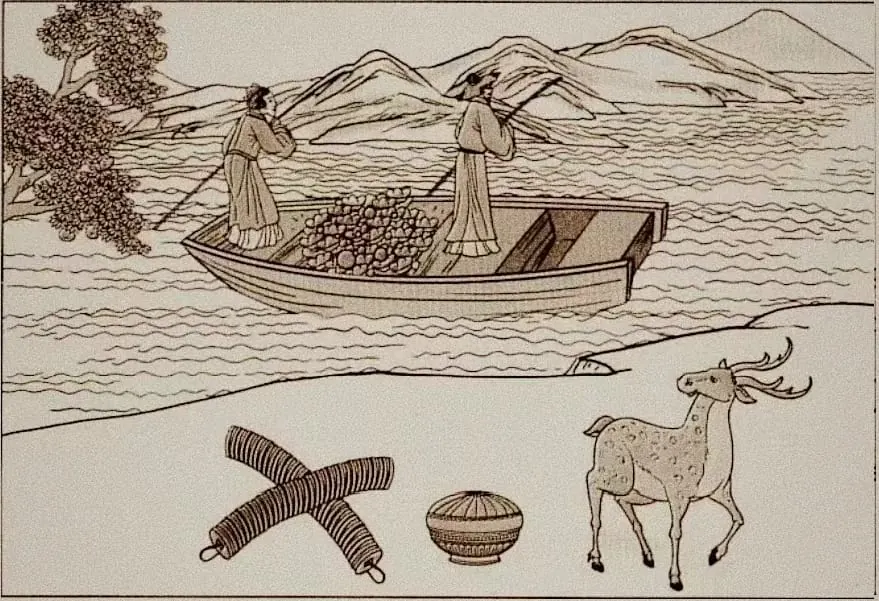
Scene Description
Image Symbolism
Reading the Picture
Meng is the time of not yet knowing: the mind is still clouded, and the way out is to learn honestly rather than reach for whatever glitters.
Start with the boat in the middle of the river. Two men pole it along, its hold heaped with treasure. The Image Symbolism reads the loaded boat as chasing wealth, and the open water as heading away from home. It echoes the third line, which warns against losing oneself on seeing a wealthy man: the shine of the cargo is exactly what clouds judgement. Behind the river rise the mountains, and the two trigrams sit right in the scene: Water ☵ below, the danger you are in, and Mountain ☶ above, the stillness that blocks the view.
Now look at the near bank. A deer stands on firm ground; 鹿 lù sounds like 禄 lù, a steady livelihood, so some modest good fortune is still close at hand. Beside it lie two crossed strings of coins, read as worry even when there is money, and a lidded box, read as gains won by concealment that succeed at first and break later. The description also mentions a plum tree with a broken branch; a tree is drawn at the left, but no broken branch is clearly visible.
- Work
- If a quick, shiny opportunity is pulling you away from steady ground, consider how much you actually understand about it. Ask your question once, sincerely, and listen to the answer.
- Relationships
- If you are dazzled by someone’s status or money, or tempted to keep someone in the dark, ask what that is really for. The second line favors patience and generosity toward people who are still learning.
- Timing
- This is a season for learning, not for big bets. If the view is blocked, gather knowledge first; the time to act comes once things are clearer.
Line Statements
Listed from the bottom line to the top line.
- First six: Dispel ignorance. It is beneficial to impose discipline and remove fetters; going further brings regret.
- Nine in the second place: Embracing the ignorant brings good fortune. Taking a wife brings good fortune. The son can manage the household.
- Six in the third place: Do not take a woman who, seeing a wealthy man, loses self-possession. Nothing is beneficial.
- Six in the fourth place: Confined in ignorance. Regret.
- Six in the fifth place: Youthful ignorance. Good fortune.
- Top nine: Strike at ignorance. It is not beneficial to act as a robber; it is beneficial to resist robbers.
Meaning of the Hexagram
Translated from the Chinese 人间道 commentary with AI assistance; translator notes appear in brackets.
“Meng: success. It is not I who seek the young and ignorant; the young and ignorant seek me. At the first divination I answer; asking again and again is importunity, and the importunate get no answer. Steadfastness is beneficial.”
A child’s ignorance has not yet been opened, but its will is single. This is youthful ignorance, and because of it one instructs. Because it is youthful ignorance, it must seek with utmost sincerity and singleness of mind to be sure of hitting the mark. The way of dispelling ignorance must be steadfast correctness; only then is there good fortune.
“Meng: below the mountain there is danger; danger, and then stopping: this is Meng. Meng brings success: it moves by way of success, in accord with the timely mean. ‘It is not I who seek the young and ignorant; the young and ignorant seek me’: their wills respond to each other.”
This is because a firm and worthy talent occupies the second line, in a low position, while the youthful ignorance of the fifth six occupies the ruler’s position. The worthy minister of the second nine must act according to the timely mean. The meaning of timeliness is that he must wait until the young and ignorant one comes, with utmost sincerity and a single mind, to ask, and only then tell him; this is the mean. If a worthy and able person in a low position seeks advancement on his own and goes to advise the ruler unasked, there is no way he will be trusted and used. Thus, when the method is right, it is not the second line seeking the ruler in the fifth position; it is truly the will of the fifth responding to the second below. This is the “timely mean.”
“‘At the first divination I give an answer’: because of firm centrality. ‘Asked a second and third time, it is importunity, and to the importunate I give no answer’: importunity sullies the ignorant.”
This says: if someone comes sincerely and single-mindedly seeking to resolve his ignorance, one should open it by the way of firm centrality. If he comes again and again without sincerity and singleness of mind, that is importunity, and at such a time one should not answer, because what is told will certainly not be believed or accepted; it would only be tiresome and of no benefit.
“Nourishing correctness in the time of ignorance is the work of a sage.”
This extends the meaning of “beneficial to be steadfast.” The method of nourishing the ignorant must follow the correct way. This is the time of youthful ignorance, pure, single and not yet opened, so nourishing correctness in ignorance is the highest good in learning. People today all “teach first and forbid afterwards,” so teaching can hardly prevail, and the customs of the age decline day by day.
“A spring comes forth beneath the mountain: Meng. The noble person accordingly is resolute in action and nurtures virtue.”
This is the image of Meng: like a person who is clouded over and does not know which way to go. At such a time the noble person must be resolute in his actions so that he can pass through without obstruction. If at the very beginning the method is wrong, he makes the nurturing of bright virtue his method of teaching.
“Dispel ignorance. It is beneficial to impose discipline and remove fetters; going further brings regret.”
The first six is the lowest position. This says that to dispel the ignorance of the common people, one must make the penal prohibitions clear and show them, so that they know fear, and then teach them. Therefore at the beginning of government, establishing laws comes first; at the beginning of treating ignorance, one uses the authority of punishment so as to make the people cast off the fetters of their dullness. If no law is set up to remove the fetters of ignorance, even good teaching cannot change it. So the sage makes the common people stand in awe of authority and comply, not daring to indulge the desires of their dullness; only then can they gradually come to know the good way. This is the only way to change customs and habits. But it may be used only at the beginning, at the first line; if one governs by punishment alone, the ignorant may fear, but their ignorance will never be opened.
“It is beneficial to impose discipline: so as to set the law right.”
This is the idea of establishing laws and penalties in order to teach people; one must never punish without first teaching. Those in later ages who discuss punishment no longer understand that moral teaching is contained within it, and talk only of punishment.
“Embracing the ignorant brings good fortune. Taking a wife brings good fortune. The son can manage the household.”
The second nine has firm and clear-sighted talent and corresponds to the ruler in the fifth six, and their wills are one. At such a time he must broaden his tolerance and embrace even the views of the old, of women and of children; then he can open the ignorance of the whole realm, and his achievement will be great. People today rely only on their own cleverness and take everything upon themselves recklessly; this is the way to misfortune. Thus Yao and Shun of old, whose sagely achievements no one in the world could match, still sought advice from the common people and took up whatever words were reasonable, and the people of the realm turned to them, just as a son is able to manage his household.
“The son can manage the household: the firm and the yielding meet.”
A son is able to manage the household because his father trusts him wholly. So the second nine can accomplish the work of dispelling ignorance because of the fifth line’s complete trust. This is the meaning of the firm and the yielding meeting.
“Do not take a woman who, seeing a wealthy man, loses self-possession. Nothing is beneficial.”
The third position is occupied by a yin line. At this time it properly corresponds to the top line, yet it cannot follow what is far away and looks to what is near; the second nine is covered by the crowd of the ignorant. [This sentence is garbled in the source.] In such a position, it is beneficial only if it goes nowhere. It is like a woman marrying a husband: it should be by proper rites. If, seeing a man with much money, she is pleased and follows him, she is not to be taken.
“Do not take the woman: her conduct is not in order.”
This woman is not to be taken because her conduct is not in order.
“Confined in ignorance. Regret.”
Because the fourth six is a yin line and is the farthest from the firm and worthy lines, there is no one to come and open its ignorance; it remains confined in darkness to the end and will never be sufficient.
“The regret of being confined in ignorance: alone, it is far from the solid.”
This means that a person in darkness who cannot draw near to the worthy is thereby confined and will never become clear. “The solid” means yang firmness.
“Youthful ignorance. Good fortune.”
This shows a soft and compliant person in the ruler’s position who responds below to the second line. It shows the virtue of soft centrality, entrusting affairs to firm, clear-sighted talent; in this way one can remedy the ignorance of the realm, and there is good fortune. If a ruler employs worthy people with complete sincerity, and their success benefits the people, then that success is as good as his own. Why should he worry that a subordinate’s great achievements might overshadow the ruler?
“The good fortune of youthful ignorance: compliant and gentle.”
To accept others’ words whenever they are reasonable is compliance. To come down from the honoured position and seek from those below is gentleness. If a ruler can do this, the realm will be well governed.
“Strike at ignorance. It is not beneficial to act as a robber; it is beneficial to resist robbers.”
A yang firm line at the extreme of ignorance, at the end of the lines. It shows us that when people’s folly reaches its extreme and they become robbers and rebels, they should be struck down; hence the warning that it is not beneficial to act as a robber.
“It is beneficial to resist robbers: those above and those below are in accord.”
The limit in resisting robbers: those above do not go as far as violence, and those below have their ignorance struck away; then both above and below are in accord.
Show the Chinese original (人间道)
蒙:亨,匪我求童蒙,童蒙求我。初筮告,再三渎,渎则不告,利贞。 儿童之蒙,其未发蒙,而志则专一,此为童蒙,因有童蒙,则告之。因其童蒙,故必至诚 一意以求必中。而发蒙之道,必以贞正方吉。
蒙,山下有险,险而止,蒙。蒙亨,以亨行,时中也。匪我求童 蒙,童蒙求我,志应也。 此因刚贤之才居九二爻位,处于下位。六五之童蒙,处于君位。九二之贤臣,必以时中也。 时之义,必待其至诚一心之童蒙求问,方以告之,乃中与。如贤能之人处下,而自求为进,主 动告以君,则必无被信用之理。
故如方法正确,非二求于王君位,实为五之志应于下二也。此 为「时中」也。 初筮告,以刚中也,再三渎,渍则不告,渎蒙也。 此言,如诚一而来求决其蒙,当以刚中之道开发之,如烦数不能诚一,则乃渎蒙,此时, 不当告。因告之必不能信受,徒以烦渎,无益矣。 蒙以养正,圣功也。
此申利贞之义,养蒙之法,必以正道,此时乃纯一未发之童蒙时,故养正于蒙,乃学之至 善也。现今人类皆「教而后禁」,故难以教胜,故时风日下。
山下出泉,蒙,君子以果行育德。 此蒙之象也,如人蒙蔽,未知所适从状。君子此时,必以果决其行,使通行无阻。如始生 而方法不对,则以养育其明德为教法。
发蒙,利用刑人,用说桎梏, 以往吝。 初六之爻属最下位,此言,发下民之蒙, 须明刑禁以示之,使之知惧,从而教之。是故 为政之始,立法居先,治蒙之初,威以刑者, 是以使民去其昏蒙之桎梏。不设法去其蒙之桎 梏,即善教亦无法改变其蒙,故圣人使下民畏 威以从,不敢任意其昏蒙之欲,然后才能渐知 善道,此为移风易俗之唯一法门。
但只有初爻 之始可用之,如专用刑以为治,则蒙虽畏,终 不能发。
利用刑人,以正法也。 此即用立法制刑,以教人之意,万不可不 教而诛。后世之论刑者,不复知教化孕其中, 只一昧的论刑。
包蒙吉,纳妇吉,子克家。 九二有刚明之才,与六五之君相对应,其 志又一同,当其时,必广其包容,老人妇孺之 见,皆包容,则能啓天下之蒙,功大矣。今人 专持其明,漫用自任,致凶之道。是故古之尧 舜,其圣功天下莫及,尚能请教下民,取合理 之言,天下之民归之,就如儿子能治其家一样
子克家,刚柔接也。 儿子之能治家,其因父之信任专一也。是 故九二能成啓蒙之功,乃由五之信任专一也。 此刚柔相接之义也。
勿用,取女见金夫,不有躬, 无攸利。 三爻之位阴居之,此时机正应上位不能远 从近见,九二为群蒙所蔽,居此之时,无所往 则利矣。犹女之嫁夫,当由正礼,如见人多金, 悦而相从,不可取也。
勿用取女,行不顺也。 此女不可取,因行不顺故也。
困蒙,吝。 因六四之阴爻,离刚贤最远,无由来发其 蒙,终困于昏蒙也,其永不足矣。
困蒙之吝,独远实也。 此义昏蒙之人,不能亲贤以致困,终不得 明矣。实,阳刚也。
童蒙,吉。 此示柔顺之人居君位,下应于二,乃示柔中之 德,任刚明之才,如此能治天下之蒙,吉也。 为人君者,如至诚用贤,以成功惠于百姓,此 功亦犹如己出一样,何须顾忌手下,功高震主。
童蒙之吉,顺以巽也。 从人之言,只要合理,都能接受,顺也。 降尊位下求,巽也。君能如此,天下治矣。
击蒙,不利爲寇,利御寇。 阳刚居蒙之极,爻之终,示吾人知,人之 愚蒙至极,而为宼为乱者,当击伐之,故戒不 利为寇。
利用御寇,上下顺也。 御寇之限度,上不过暴,下得撃去其蒙, 则上下皆得顺矣。