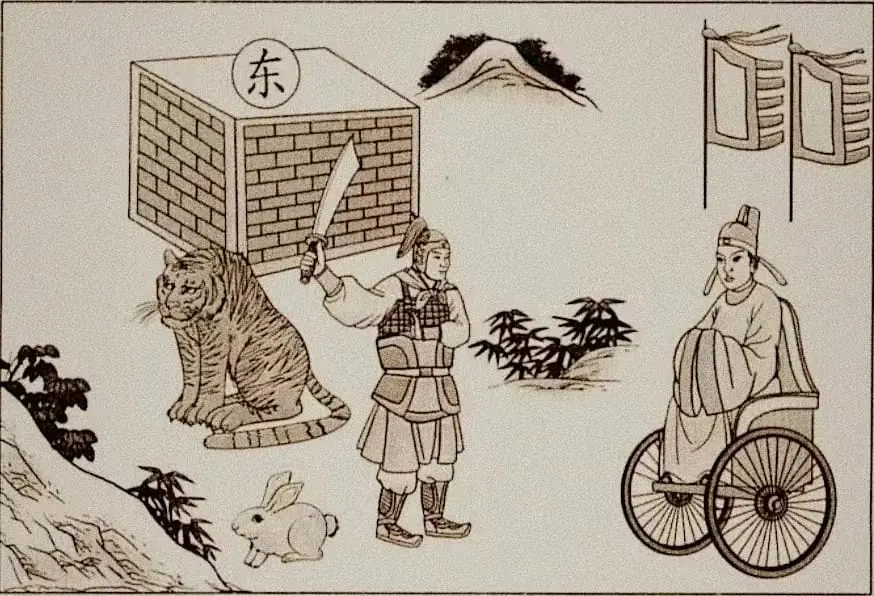
Scene Description
Image Symbolism
Reading the Picture
Fu is the turning point: after a long decline the first yang line returns at the bottom, and the task is to welcome it calmly and let it grow.
Start on the right with the official riding in a carriage, two flags standing behind him. The Image Symbolism reads him as an envoy or someone being reassigned, and the flags as command: authority is moving again. Across from him an armoured general raises his blade, a figure of discipline, in front of a brick watch-mound marked 东, east, where the sun returns each morning. A watch-mound is a 堠 hòu, which sounds like 侯 hóu, a lord, so the mound is read as recognition to come.
Beside it sit a tiger and, lower down, a rabbit: strength and gentleness side by side, the returning yang still sharing ground with what it must eventually overcome. At first the noble way cannot win alone; it must wait for companions to gather. The trigrams say the same: Thunder ☳ below Earth ☷, thunder still inside the ground, movement begun but not yet broken out. So the former kings closed the passes at the solstice to let the new yang rest.
The picture’s readiness fits the first line, returning before going far: turn back early and there is no need for regret.
- Work
- If something is starting to recover, consider steady, quiet effort and gathering allies before any bold push. Ask what you could correct now while the mistake is still small.
- Relationships
- If you have drifted from someone, a sincere step back toward them may be welcome. The second line’s fine return is gentle, not forceful.
- Timing
- Things are turning, but the new energy is young. Let it build; and if you have lost your way, as the top line warns, turn back sooner rather than later.
Line Statements
Listed from the bottom line to the top line.
- First nine: Returning before going far. No need for regret. Great good fortune.
- Six in the second place: A fine return. Good fortune.
- Six in the third place: Repeated return. Danger, no blame.
- Six in the fourth place: Walking among others, returning alone.
- Six in the fifth place: Wholehearted return. No regret.
- Top six: Losing the way in return. Misfortune and calamity. Employing the army ends in great defeat, disastrous for the ruler; for ten years unable to campaign.
Meaning of the Hexagram
Translated from the Chinese 人间道 commentary with AI assistance; translator notes appear in brackets.
“Fu: success. Going out and coming in without harm; friends come, no blame.”
Once all things return, there must be success. When the way of the noble person is about to return, although it is still faint, its own kind will gradually advance; hence there is success and flourishing. Yet when the time of Fu (Return) arrives, it cannot overcome the petty people at once; it must wait for its companions to follow one after another, and then, by joining forces, it can prevail.
“Returning and returning along its way; in seven days comes the return. It is beneficial to have somewhere to go.”
This is the way of waning and growing. The Changes uses numbers to set standards: in small cases the return comes after seven days, in large cases only after seven years. This is the way of return.
“Fu, success: the firm comes back; it moves and acts in compliance, so going out and coming in are without harm, and friends come without blame.”
This discusses return in terms of the hexagram’s capacities. In the way of return, yang firmness, having waned to the extreme, comes back; its method is to move by way of compliance, so that going out and coming in are both without disaster, and the friends who come also come through compliant movement.
“Returning and returning along its way, in seven days comes the return: this is the course of heaven. It is beneficial to have somewhere to go: the firm is growing. In Return, do we not see the heart of heaven and earth!”
The coming back of return follows the movement of heaven; hence it speaks of seven days. Because the way of the noble person is growing, it is beneficial to go forward. Yang is reborn below: this is the heart of heaven and earth that gives birth to things, taken as the beginning of movement. So movement appears outwardly, but it begins to be born within.
“Thunder within the earth: Return. The former kings accordingly closed the passes on the day of the solstice; merchants and travellers did not journey, and the ruler did not inspect the regions.”
In terms of the image, thunder is the sound made as yin and yang clash, but at this time yang is still faint and cannot yet break forth. So the sage follows the way of heaven: when the sun’s yang is first born, he nourishes it quietly by closing the passes, so that merchants and travellers cannot journey and the ruler does not inspect the four quarters. This is following heaven. For people too, quietly nourishing their yang in this way is the way to recover.
“Returning before going far. No need for regret. Great good fortune.”
There is first a loss and then a return. This is the beginning of return; because one has not strayed far, the return will surely not come to regret; hence good fortune.
“Returning before going far: by this one cultivates oneself.”
This means knowing what is not good and correcting it quickly, which is the noble person’s way of cultivating himself. The way of learning lies right here: one who knows he is wrong and corrects it at once is a noble person.
“A fine return. Good fortune.”
The second is the position closest to the first, yang line. The way of the noble person begins to be born below; the second line’s will is directed toward the yang, and now that the yang is below, it follows it. To be able to humble oneself toward the one below is benevolence. Good fortune.
“The good fortune of a fine return: it humbles itself toward the benevolent below.”
Benevolence is what is shared by all under heaven and is the source of goodness. To understand it and draw near to the benevolence below is the beauty of a fine return.
“Repeated return. Danger, no blame.”
Following the way of return, yet returning again and again and repeatedly slipping: this is the way to danger. Therefore one must be wary; if one takes warning from this, there can be no blame. Repeated lapses lead to danger, and the fault lies in lapsing and not returning. Today people who are lost and do not know how to turn back are everywhere; and those who know how to turn back but take no warning and get lost again meet misfortune.
“The danger of repeated return: by rights there is no blame.”
The warning concerns returning repeatedly: returning and then lapsing again, with the fault lying in the lapse. Therefore, if one sets one’s heart firmly on returning and does not lapse, there is no disaster.
“Walking among others, returning alone.”
The fourth is among the many yin lines and can keep itself correct; but because its strength is weak, it is not enough to accomplish anything. This speaks of returning alone, which is not necessarily free of disaster.
“Walking among others, returning alone: by following the way.”
To return alone among petty people, as if following the yang firm line, is the way of the noble person.
“Wholehearted return. No regret.”
The ruler can practise the way of return with sincerity and constancy, but his ministers are all yin and soft people. Because he has no help, he can be free of regret but not free of trouble. The noble person takes warning from this.
“Wholehearted return, no regret: through the centre it examines itself.”
The fifth line is yin in the place of honour; it can hold sincerely to the good way and complete itself through the central way; thus it can be without regret.
“Losing the way in return. Misfortune and calamity. Employing the army ends in great defeat, disastrous for the ruler; for ten years unable to campaign.”
A yin soft line at the end of return means one who stays lost to the end and does not return: great misfortune. The misfortune it invites all comes from being lost and not turning back. Whenever it moves there will be faults; if it sends out an army, it will be greatly defeated; if it serves as ruler of a state, great misfortune. Lost from the way, it can never go anywhere.
“The misfortune of losing the way in return: it goes against the way of a ruler.”
A ruler is above and governs the world, and should follow what is good in the world. If he is lost in return, inconstant and changeable, all of it invites misfortune.
Show the Chinese original (人间道)
复:亨,出入无疾,朋来无咎。 万物既复则必亨,如君子之道将复,虽微,但同类将渐进,故亨且盛矣。故复之时至,并 无法立胜小人,必待其同朋相继,则协力能胜也。 反复其道,七日来复,利有攸往。 此为消长之道,易之论数,以立准则,小有七日乃复,大有七年方复,此复之道也。
复,亨。刚反,动而以顺行,是以出入无疾,朋来无咎。 此以卦才来论,复之道,阳刚因消弱至极而反来,其法动而取顺行法,是故出入皆无灾, 朋之来,亦因顺而动来也。 反复其道,七日来复,天行也。利有攸往,刚长也;复其见天地之 心乎! 复之返来,顺天之运行,故言七日。因君子道长,故利前往,阳复生于下,乃是天地生物 之心,以为动之始也,故外见动,而始生于内也。
雷在地中,复。先王以至日闭关,商旅不行,后不省方。 以卦象而言,如雷乃阴阳相搏而成声,时阳之微,未能发也。如圣人顺天之道,于日阳之始生,安静养之以闭关,使商旅不得行,人君不视四方,此顺天也,于人亦以此安养其阳为复 原之道。
不远复,无祇悔,元吉。 有失而后有复,此复之始时,因失之不远, 故复必不至于悔,故吉。
不远之复,以脩身也。 此即知不善而速改,为君子修身之道。学 问之道即在此,知不对立改,为君子也。
休复,吉。 二为切近初阳之位,君子道始生于下,若 二位志向于阳,今阳在下从之,故能下之道为 仁。吉。
休复之吉,以下仁也。 仁者天下之公,善之本源,能体会而近于 下之仁,乃休复之美。
频复,厉,无咎。 从复之道,又频复履失,致危之道也。故 须厉,即戒此可无咎,频失致危,其过乃在失 而不复也。今人迷途不知返,比之皆是,又知 返而不戒又入迷,凶也。
频复之厉,义无咎也。 戒之在屡复,复而又失,失之过,故坚心 于复不失,无灾殃也。
中行独复。 四于众阴之间,能自处于正,但因力弱, 不足克济,此言独复,不一定无灾。
中行独复,以从道也。 以独复于小人间,如从阳刚,君子之道也。
敦复,无悔。 君王于复之道,能敦笃而行之,但臣下均 阴柔之辈,因无助,但能无悔而不能无灾,君 子戒之。
敦复无悔,中以自考也。 五以阴居尊位,能敦笃善道,以中道自成, 此可无悔也。
迷复,凶,有灾眚,用行师, 终有大败,以其国君凶,至 于十年不克征。 阴柔居复之终,乃意终迷不复者,大凶。 招凶,皆因己之迷而不返,动则必有过失,以 之出师必大败,以之为国君,大凶。迷于道, 而终不可行也。
迷复之凶,反君道也。 人君居上而治天下,当从天下之善,如迷 于复,反复无常,皆招凶也。