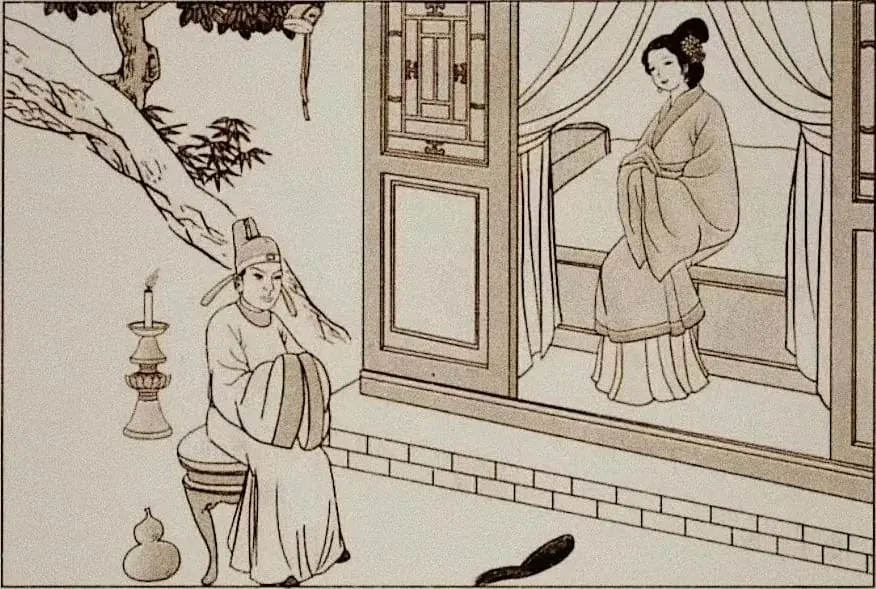
Scene Description
Image Symbolism
Reading the Picture
Bo is the time of stripping away: support is being worn down from below, and the wise response is to keep still, protect the foundation and wait for the turn.
Look first through the doorway: a woman sits on the edge of a curtained bed. The Image Symbolism takes her as yin influence in the ascendant, and the bed connects to the line statements, which strip the bed step by step: first its feet, then its frame, then down to the skin. Outside, an official sits on a stool beneath a wooded slope, hands folded in his sleeves. The slope is his backing, yet he does nothing. Above him a cap hangs from a branch, an image of wanting to leave office.
Small objects carry the warnings. A single candle burns on a stand; the description places it in the wind, a flame that could go out. A gourd on the ground is read as a hidden scheme, and a dark tangle near the steps is the knotted silk of affairs grown too many to sort. The trigrams show the structure: Mountain ☶ above Earth ☷, five yin lines beneath one yang. The Image says those above stay secure only by strengthening what lies below.
The top line holds the hope: the great fruit is not eaten, and its seed can grow again.
- Work
- If your position is being eroded, consider strengthening your base and your allies rather than pushing forward. Ask what can be quietly preserved, like the uneaten fruit.
- Relationships
- If trust has been wearing thin, notice where it started, usually in small things below the surface. Steady care matters more than grand gestures.
- Timing
- This is not a time to set out. Think of the candle: protect what is fragile, keep still, and wait for the cycle to turn.
Line Statements
Listed from the bottom line to the top line.
- First six: Stripping the bed at its feet, disregarding steadfastness. Misfortune.
- Six in the second place: Stripping the bed at its frame, disregarding steadfastness. Misfortune.
- Six in the third place: Stripping away. No blame.
- Six in the fourth place: Stripping the bed to the skin. Misfortune.
- Six in the fifth place: A string of fish; favor through palace women. Nothing is unfavorable.
- Top nine: A great fruit remains uneaten. The noble person receives a carriage; the petty person strips the dwelling.
Meaning of the Hexagram
Translated from the Chinese 人间道 commentary with AI assistance; translator notes appear in brackets.
“Bo: it is not beneficial to have somewhere to go.”
Bo (Splitting Apart) is the time when the many yin lines grow strong and strip away the yang, like a crowd of petty people stripping away and destroying the noble person; therefore it is not beneficial for the noble person to go forward.
“Bo means stripping away: the yielding changes the firm. It is not beneficial to have somewhere to go: petty people are growing.”
Bo means falling away. When the yielding is abundant, the firm is stripped away; when yin flourishes, yang must retreat. This is the way of yin and yang: the way of petty people grows and flourishes, and the noble person wanes and withdraws.
“Complying and stopping: this comes from observing the image. The noble person honours waning and waxing, fullness and emptiness: this is the course of heaven.”
In the time of Bo the noble person knows he cannot go forward; he complies with the time and stops, because he is able to observe the stripping away. So this hexagram has the image of complying and stopping, which is the way to deal with Bo.
The noble person sees affairs at their beginning. Every beginning has its principle; the noble person looks at its fullness and loss, its waning and waxing, and knows how to deal with it. To follow the time brings good fortune; to go against it brings misfortune. Therefore the noble person serves heaven. The petty person does the opposite: he does not see what is being done at the start of things, nor consider the fullness and loss in the principle of affairs, but merely goes along and flatters. Therefore the petty person serves people.
“The mountain rests on the earth: Splitting Apart. Those above accordingly strengthen those below, so that the dwelling is at peace.”
However high and great a mountain is, it still rests on the earth. The sage embodies this and knows that a ruler and those in high positions, seeing the stripping away, should strengthen those beneath them so that they can live in peace. Those below are the foundation of those above; never has a firm foundation been stripped away. So if there is stripping away above, it must begin from below. Therefore one should care for the people so as to strengthen the foundation of the state. The Book of Documents says: “The people are the foundation of the state; when the foundation is firm, the state is at peace.”
“Stripping the bed at its feet, disregarding steadfastness. Misfortune.”
Because stripping always begins from below, it speaks of stripping the feet. Yin advances from below and gradually wears away the right way: this is the height of misfortune.
“Stripping the bed at its feet: destroying what is below.”
The encroachment on and destruction of the right way must advance gradually from below upward. This is how stripping works.
“Stripping the bed at its frame, disregarding steadfastness. Misfortune.”
Here yin advances further, and the one in the position of a commander [为将者, as written] has already been stripped. The misfortune grows worse.
“Stripping the bed at its frame: there is no ally.”
When petty people encroach on and strip away the noble person, if the noble person has a corresponding ally, the petty people cannot do harm; if there is no such ally, there is the misfortune of being destroyed.
“Stripping away. No blame.”
At a time when the many yin lines below are stripping away the yang, the third line, in the minister’s position, alone responds to the firm; thus it can be without disaster. But because its position is isolated and weak, although it can avoid disaster, it may not attain great success.
“Stripping away, no blame: it parts from those above and below.”
For one serving as minister in the time of Bo, the reason there is no disaster is that it parts from its own kind and does not walk the same way as they do.
“Stripping the bed to the skin. Misfortune.”
This is the time when stripping reaches the body; its misfortune is plain. It comes from not knowing that the stripping began below, so that it advanced and grew until it reached this point.
“Stripping the bed to the skin: disaster is very close.”
The image is of stripping that reaches the skin. Because the fourth is the person at the ruler’s side, like the ruler’s own skin, it shows that calamity is close at hand.
“A string of fish; favor through palace women. Nothing is unfavorable.”
The stripping would normally reach the ruler, and the misfortune is plain. But here the sage knows that human nature follows the good as water flows downhill, and shows favour in such a way that the many yin lines are ordered like fish on a string; then nothing is unfavourable. This favour is like the even-handed treatment of a wife and concubines.
“Favor through palace women: in the end there is no fault.”
When the stripping reaches oneself, if one can treat others in the way one shows favour to wife and concubines, in the end there is no disaster.
“A great fruit remains uneaten. The noble person receives a carriage; the petty person strips the dwelling.”
If a great fruit is not eaten, there is the principle of new life coming from it. When the way of yin reaches its extreme, the world is in great disorder; but at the extreme of disorder people surely long for order. So the hearts of the many will wish to carry the noble person, as if he receives a carriage. This is yang being born from the extreme of yin. A petty person in this place will surely have nowhere to stand.
“The noble person receives a carriage: the people carry him. The petty person strips the dwelling: in the end he cannot be used.”
When the right way has been stripped away to the extreme, people will surely long for order. The top nine is a noble person of yang firmness, carried by the people. The petty person at the extreme of stripping in the end cannot be used.
Show the Chinese original (人间道)
剥:不利有攸往。 剥乃群阴长盛,剥削阳时,同众小人剥丧君子,故君子不利往。
剥,剥也,柔变刚也。不利有攸往,小人长也。 剥,落也。柔盛而刚剥,阴盛阳必退,此阴阳之道,小人道长盛,君子消退也。 顺而止之,观象也;君子尚消息盈虚,天行也。 君子处剥之时,知不可往,顺时而止,乃因能观剥也。故此卦有顺止之象,为处剥之道。 君子之人见事于始,凡事之始皆有理,君子视其盈亏消息,而知处之道。
顺时则吉,逆时则凶, 故君子事天。小人反之,不见事始之作为如何,不论事理之盈亏如何,一昧迎随奉承,故小人 事人。
山附于地,剥,上以厚下安宅。 山再高大仍依附于地,圣人体此,知人君与上位者,视剥而知厚固其下位之人,以安居也, 下者为上之本,从未有基本固而能剥者也。故上如有剥,必自下。故安养人民以厚国本。书曰 『民惟邦本,本固邦宁』。
剥床以足,蔑贞,凶。 因剥之始皆自下,故曰剥足,阴自下进, 渐消亡正道,凶之至也。
剥床以足,以灭下也。 正道之侵灭,必由下而上渐进。用剥之道 即在此。
剥床以辨,蔑贞凶。 此阴渐进,为将者已受剥也,凶益甚也。
剥床以辨,未有与也。 小人之侵剥君子,若君子有对应,则小人 不能为害,如无对应,则有被灭之凶。
剥之,无咎。 众阴在下剥阳之时,三之相位独刚应之, 则可无灾,但因势孤弱,虽可无灾,但未必能 大亨。
剥之,无咎,失上下也。 为相之人居剥之时,无灾之因乃同类而相 失,不与同道,故也。
剥床以肤,凶。 剥之及身时也,其凶可知。乃因不知始剥 于下,以致进盛至此。
剥床以肤,切近灾也。 象为剥及皮肤,因四为君侧之人,如君之 肤,示灾祸之近身也。
贯鱼,以宫人宠,无不利。 剥本及于君,凶可知,但圣人于此,知人 性之从善如流,以示宠方式,使群阴如鱼之贯 序,则可无所不利。此宠如对妻妾之同态也。
以宫人宠,终无尤也。 于剥之及身时,能以宠妻妾之方式对待, 则终无灾。
硕果不食,君子得舆,小人 剥庐。 果之大者,如不食,则有复生之理。阴道 盛极,天下大乱,但乱极则必思治,故众人之 心,必愿载君子,故如得舆。此阴极生阳也。 若为小人于此,则必无安身之地。
君子得舆,民所载也;小人 剥卢,终不可用也。 因正道消剥至极,则人必思治,上九为阳 刚之君子,为民所载也,小人处剥之极,终不 可用也。