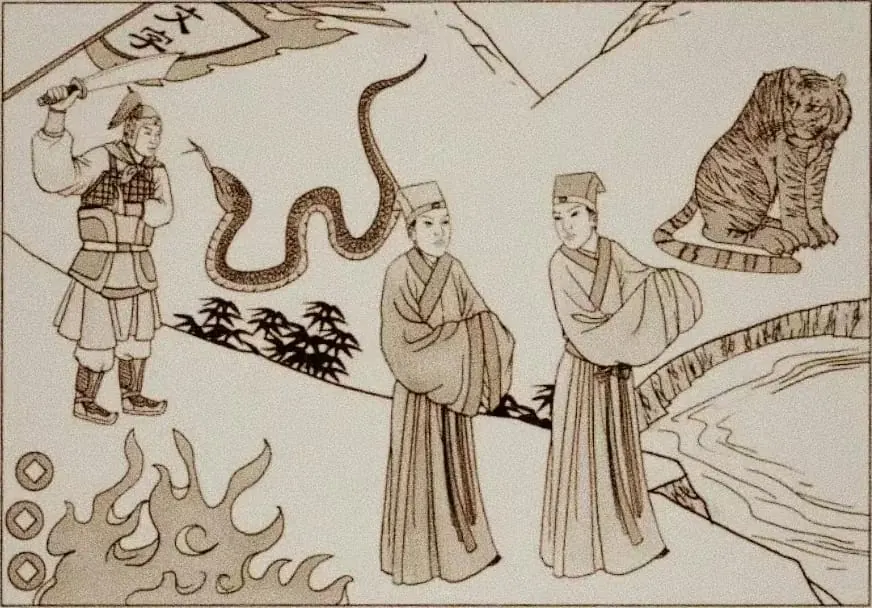
Scene Description
Image Symbolism
Reading the Picture
Guai is breakthrough: strength has built up and one last obstacle must be removed. The picture shows a road blocked by a snake and a tiger, and asks for resolve that is open and well judged rather than reckless.
Look first at the two men walking side by side: mutual support, so things can be done. Ahead of them a snake coils across the path and a tiger sits watching. The tiger is read as a person of authority, the snake as a treacherous petty person blocking the road. On the left an armoured warrior raises his sword over the snake, the brave fighter who clears the way.
There is water on one side and fire on the other: danger ahead, clarity behind, a sign to advance. Above the warrior flies a banner marked 文字, ‘writing’, read as raising the standard and setting out under a rightful name. Coins beside the flames mean action brings benefit, though the text also reads burning money as mourning.
The trigrams explain the mood: Heaven ☰ below, Lake ☱ above, five strong lines pushing up against a single weak one. The raised sword fits the judgment’s call to make the matter known openly, and the fifth line’s resolute ‘walking in the middle’. The cautious pair walking forward recalls the second line: stay alert even at night, and there is nothing to fear.
- Work
- If one problem or person is blocking progress, consider naming it openly and dealing with it fairly. Ask whether you have planned for the worst before you move.
- Relationships
- If something has to be said, consider saying it plainly and with sincerity, not in anger. A trusted companion at your side makes the step easier.
- Timing
- The moment for decision is near, but rash steps bring blame. If the situation is still unclear, waiting until it is clear may be the wiser resolve.
Line Statements
Listed from the bottom line to the top line.
- First nine: Strength in the forward toes. Going without prevailing brings blame.
- Nine in the second place: An alarmed cry. Weapons at dusk or night; do not worry.
- Nine in the third place: Strength in the cheekbones. Misfortune. The noble person, resolutely resolved, walks alone and meets rain; drenched and resented, no blame.
- Nine in the fourth place: No skin on the buttocks; walking haltingly. Leading a sheep makes regret disappear. Hearing words but not believing.
- Nine in the fifth place: Weeds uprooted with resolve. Walking in the middle brings no blame.
- Top six: No cry. Misfortune in the end.
Meaning of the Hexagram
Translated from the Chinese 人间道 commentary with AI assistance; translator notes appear in brackets.
“Breakthrough: make it known at the king’s court. Call out with sincerity; there is danger.”
The way of Guai (Breakthrough) is that the petty person is in decline and the way of the noble person is growing. It must be made plain in the public hall so that people understand good and evil; hence ‘make it known at the king’s court’. At this time, with reverence and caution and with utmost sincerity, one instructs the common people so that they are on guard, think of danger while at peace, and keep a sense of caution and awe at all times; then there will surely be no later trouble.
“Report from one’s own city. It is not beneficial to take up arms. It is beneficial to have somewhere to go.”
For the way of Breakthrough to reach the highest good, it must not prize military force. It begins with cultivating oneself; after the family is in order one can govern the state, winning over the many by the way. In this way one can go forward.
“Breakthrough means resolution: the firm resolves the soft. Strong and joyous; resolute and harmonious.”
Five yang lines remove one yin line; below is strength and above is joy. Because it is strong it can be joyous and harmonious; this is the highest good of the way of resolution.
“Make it known at the king’s court: the soft rides upon five firm lines. Call out with sincerity; there is danger: in that danger lies its brightness.”
Yin sitting above yang is not correct. When the noble person removes it, he should proclaim its offence in the public hall so that the people know good from evil. Leading the people with heartfelt sincerity, so that they know caution and awe and guard against danger to the utmost: only then can the way of the noble person show its great power.
“Report from one’s own city. It is not beneficial to take up arms: what it prizes would come to an end. It is beneficial to have somewhere to go: the growth of the firm then reaches completion.”
In a time of Breakthrough one must not exalt arms or take by force. One must begin by cultivating and ordering one’s own ground; only then is it beneficial to advance and make the yang firm way of the noble person shine. When the right way has reached its full firmness, not a single crooked or mean way may be left; this firm advance carried through to the end is fortunate.
“The lake rises up to heaven: Breakthrough. The noble person accordingly bestows his bounty on those below, and avoids resting on his virtue.”
Water gathered and risen up to heaven is the image of Breakthrough; in the end it must burst from above and irrigate what is below. The noble person, observing the image and modelling himself on heaven, knows that he must bestow bounty on the world; then the people will all turn toward him. And in times of safety he knows that he must keep guard and restraint; then there is no fear of collapse.
“Strength in the forward toes. Going without prevailing brings blame.”
A firm and strong person in a low position, in a time of resolution, will surely push forward forcefully to carry things out. If he meets resistance in carrying them out and fails, it is surely the fault of his resolution. So before acting on anything one must guard against rashness and plan for the worst; only then can one advance.
“Going without being able to prevail: this is blame.”
The noble person’s action must be measured before he advances; to strive for something he knows cannot be done will surely invite blame. Petty people have no such caution; they advance without measuring their strength and bring disgrace on themselves.
“An alarmed cry. Weapons at dusk or night; do not worry.”
When the noble person is removing petty people, he must keep watchful and prepared and never relax for a moment. Then even if armed men come at night, he will not be alarmed.
“Weapons, but do not worry: it attains the central way.”
Even if armed men come at night, he is not alarmed or worried, because he conducts himself well, can follow the central way and knows what to be wary of. So one who studies the Changes must know the time and recognise the trend of things; without this, how could one speak of mastering the Changes?
“Strength in the cheekbone. Misfortune. The noble person is resolute, resolute; walking alone he meets rain; he is soaked and resented, but there is no blame.”
The third nine is in the minister’s position, with the king above it, yet it is firm and over-decisive. This resolution is one it takes upon itself, surely not in accord with the ruler’s intent, and the result will surely invite misfortune. So the noble person in a time of Breakthrough knows that his own way is growing and the way of petty people is about to wane; he certainly does not join with petty people on his own, and he shows his displeasure in his face; then there can be no blame.
People today all think themselves important. When they see someone inviting misfortune, they give him support whatever the cause; this is a display of foolish kindness. It only lets the petty person succeed; he does not repent, but grows even stronger. This is the beginning of disaster, and it is caused by people’s foolish kindness.
“The noble person is resolute, resolute: in the end there is no blame.”
Resolution must accord with right principle. When the noble person is decisive at the moment that calls for decision, he never comes to blame in the end. Ordinary people must be careful: before the situation is clear, not deciding is a good policy. One must never decide blindly according to one’s own preferences, for that will surely harm others.
“No skin on the buttocks; walking haltingly. Leading a sheep makes regret disappear. Hearing words but not believing.”
A yang line in a yin place shows the fault of a person whose firm resolve is insufficient. When yang firmness and right principle have become fully clear, if one’s own resolve is not enough, one will surely be uneasy where one stays and find it hard to advance. If one could imitate the way sheep move together as a flock, there would be no regret. But a person lacking firm resolve cannot be made to advance with softness; so even if he is told, his nature is such that he certainly will not believe and act on it.
Since ancient times, those who can correct faults when they know them, use the good when they recognise it, and master their own desires in this way have always been people of firmness and clarity.
“Walking haltingly: the position is not proper. Hearing words but not believing: the hearing is not clear.”
This blocked and troubled conduct comes because the person in the position does not suit the post. He does not believe words of right principle because his hearing is not clear.
“Amaranth on high ground; resolute, resolute. Walking in the middle brings no blame.”
The ruler is the master of decision. In a time of Breakthrough he must decide at once to remove the way of the petty person; holding to the central and correct way, he will surely have no disaster.
“Walking in the middle brings no blame: the centre is not yet bright.”
If a person is utterly sincere at heart, his decisions will surely be without fault. But all human hearts have selfish desires, and once selfish desire is involved, the central way cannot shine out greatly.
“No cry. Misfortune in the end.”
This is the moment when yin is about to be exhausted, when the way of the noble person is manifest and the way of the petty person must wane. Only by attaching oneself to the way of the noble person is there good fortune; otherwise, even without wailing in fear, one meets misfortune in the end.
“The misfortune of no cry: in the end it cannot last.”
Even if one shows others one’s wailing and fear, one still invites misfortune; this way surely cannot last long. So the noble person thinks of removing the way of the petty person, not of wiping out petty people altogether.
Show the Chinese original (人间道)
夬 夬 夬 夬:扬于王庭,孚号,有厉。 夬之道,在小人式微,君子道长,必显于公堂,使人明善恶,故扬于王庭。于此时敬戒之 以至诚以命下民,使民戒之,居安思危,随时生戒惧之心,必无后患。 告自邑,不利即戎,利有攸往。 夬之道能于至善,必不尚武力,从修已开始,齐家后能治国,以道服众,如此则可进而往。
夬 夬 夬 夬,决也,刚决柔也。健而说,决而和。 五阳去一阴,下健而上悦,乃因健而能悦,能和,此决道之至善。 扬于王庭,柔乘五刚也。孚号有厉,其危乃光也。 阴居阳上,此不正也,君子去之,当扬其罪于公堂,使民众知善恶也。以衷心至诚带领民 众,使知戒惧,防危之至,君子之道方可显其力大。
告自邑,不利即戎,所尚乃穷也。利有攸往,刚长乃终也。 夬之时,不可崇武以力取,必须从修治本身之地起,方可有利前进光大君子阳刚之道,待 正道至刚时,决不可留一邪吝之道,此刚进至终可吉也。
泽上于天,夬 夬 夬 夬,君子以施禄及下,居德则忌。水之聚而上于天,为夬象,其终必决于上,而灌溉于下,君子观象法天,故知必施禄于天 下,则民皆向之,于安处之时,知须防禁,则无溃散之虞。
壮于前趾,往不胜爲咎。 在下位刚健之人,于决之时,必强进执行, 如执行中受阻而失败,必决之过,故凡事欲动 之前,必戒之在燥,做最坏之打算,方可行进。
不胜而往,咎也。 君子之行,必度量而进,知不可而力求, 必招咎也。小人无此之戒,不量力而进,其果 自取其辱。
惕号,莫夜有戎,勿恤。 君子去小人之时,必思怀戒备,不松懈一 时,如此即令夜有兵戎,亦不惊也。
有戎勿恤,得中道也。 衣有兵戎,不惊忧,乃因自处之善,能行 中道,知所戒惧也,故学易之人必知时识势, 不知如此,惶论精易。
壮于頄 頄 頄 頄,有凶。君子夬夬 夬夬 夬夬 夬夬, 独行遇雨,若濡有愠,无咎。 九三居相位,上有君王,却刚于果决,此 决乃自任之决,必非合君意,果必招凶。故君 子居夬之时,知己道之长,小人之道将消,必 不独与小人合,且面现愠色,必可无咎。今人 皆自以为重要,见人之招凶,不论其因为何, 一律给予支持,此愚善之表现,徒令小人得逞, 不知反悔,反更盛其势,此祸之端,乃肇因于 人之愚善。
君子夬夬 夬夬 夬夬 夬夬,终无咎也。 决必合于正理,君子于当决之时果决之, 终不至咎。常人须戒,在不明状况之前,不做 决定就是良策,切不可凭己之所好而蒙决,必 害及他人。
臀无肤,其行次且,牵羊悔 亡,闻言不信。 阳居阴位,乃示刚决不足之人所犯之过, 阳刚正理已明极时,如己之果决不足,必招居 不安,行进又难之状,若能法羊群之群行特性, 可无悔,但刚决不足之人,令其以柔进,必不 能也,故即令告之,本性如此,必不能信用。 自古以来,知过能改,知善能用,克己之欲能 如是之人,必刚明者方可做到。
其行次且,位不当也;闻言 不信,聪不明也。 此行为受阻,受难,乃居位之人不适其职 位。正理之言不信,因其聪听不明也。
苋陆夬夬 夬夬 夬夬 夬夬,中行无咎。 君为决定之主,居夬之时,必立决,以去 小人之道,禀持中正之道,必无灾。
中行无咎,中未光也。 人能中心至诚,必决之无过也,但人心皆 有私欲,一旦涉及私欲,必不能光大中道。
无号,终有凶。 此阴将尽之时,君子道显,小人道必消之 际,惟比附于君子之道方吉,否则即令不号咷 畏惧,亦终获凶。
无号之凶,终不可长也。 如示人号咷畏惧,仍招凶,此道必不久也, 故君子思去小人之道,非斩尽小人也。