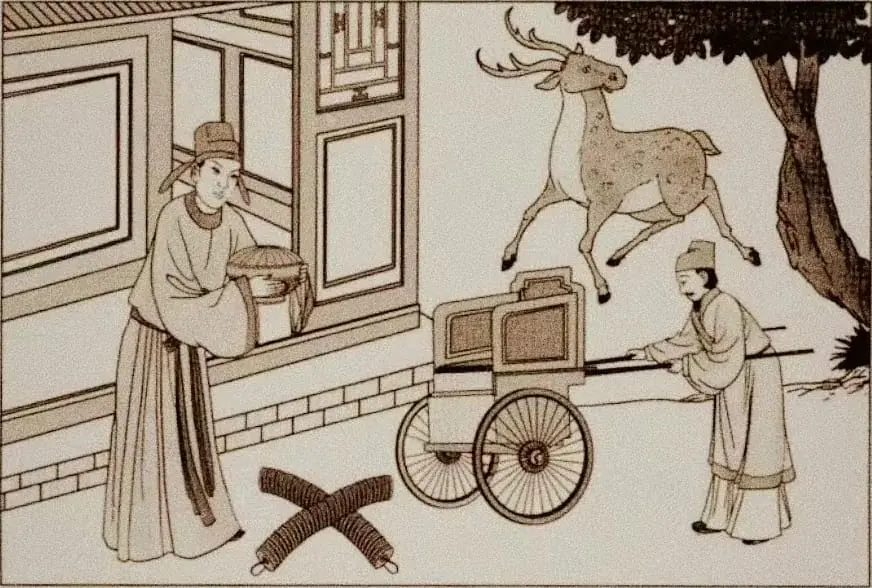
Scene Description
Image Symbolism
Reading the Picture
Yi is increase: what is taken from above flows down to benefit those below. The picture shows a gift being carried, a cart ready to move, and good fortune leaping into view, with a quiet reminder that gains need careful handling.
Begin with the official holding a round lidded box. The Image Symbolism reads 官人 (official) also as 倌人, a husband, and warns that matters may succeed first and break later. In the centre a man pushes a small cart, and its seat is empty. That is moving with the time, and an invitation: a place kept for someone asked to come.
Above the cart a deer leaps, and on the ground lie two crossed strings of coins. The deer is a pun, 鹿 lù for 禄 lù, reward or office, so deer and money together mean talent and income both arriving. The text cautions that money can also be damaged.
The trigrams show the motion: Thunder ☳ below, Wind ☴ above, two forces that strengthen each other. The cart and the carried box match the judgment’s advice that it is beneficial to go somewhere and cross the great river. The empty seat recalls the first line, where a capable person below is given a great work, and the text’s closing advice: take up the post knowing the risks, and use it to benefit others.
- Work
- If an opportunity or new role arrives, consider accepting it with a clear sense of whom it should benefit. Ask how you will keep early success from breaking later.
- Relationships
- If someone has made room for you, consider answering generosity with generosity. Notice where you could give a little more than you take.
- Timing
- This favours moving forward and undertaking things now. If gains come quickly, consider guarding them and correcting faults as you go, rather than reaching for more.
Line Statements
Listed from the bottom line to the top line.
- First nine: It is beneficial to undertake great works. Great good fortune, no blame.
- Six in the second place: Someone increases them with a tortoise worth ten pairs of shells, which cannot be refused. Lasting steadfastness brings good fortune. The king offers to the Supreme Lord. Good fortune.
- Six in the third place: Increase through inauspicious affairs. No blame. With sincerity, walking the middle way, report to the duke with a jade tablet.
- Six in the fourth place: Walking in the middle, report to the duke and he follows. It is beneficial to rely on this when relocating the state.
- Nine in the fifth place: A sincere, generous heart. Without asking, great good fortune. Sincerity blesses my virtue.
- Top nine: None increase them; someone strikes them. Establishing no constant heart. Misfortune.
Meaning of the Hexagram
Translated from the Chinese 人间道 commentary with AI assistance; translator notes appear in brackets.
“Increase: it is beneficial to have somewhere to go; it is beneficial to cross the great river.”
Yi (Increase) is the way of benefiting the world, so it can get through danger and difficulty: it is beneficial to cross the great river.
“Increase: decreasing above to increase below; the people’s joy is boundless. From above it descends to those below; its way is greatly bright.”
The root meaning of Increase is that its way lies in decreasing what is above to increase what is below. The people will surely rejoice in it without end or limit. It comes down from above, and even the lowest of those below receive it; so the way of Increase shines out and is great.
“It is beneficial to have somewhere to go: central and correct, there is blessing. It is beneficial to cross the great river: the way of wood then prevails.”
When the world is helped by the central and correct way, the world receives blessing; so going is fortunate. Of all things, wood helps humankind the most: medicines, carts and boats, the building of houses, none of these does without wood. In ordinary times wood does not show its importance, but in times of danger and hardship its help is great. The way of Increase is the same.
“Increase moves and is gentle, advancing daily without limit. Heaven gives and earth brings forth; its increase knows no bounds. The way of all increase goes along with the time.”
The movement of the way of Increase lies in compliance; if movement does not comply with principle, it surely does not become increase. The way of heaven nourishes beginnings and the way of earth completes things, transforming and nurturing all things so that each has its proper nature and life; this makes the way of Increase vast and boundless. The sage, embodying the way of heaven and earth, knows that the way that can benefit the world must accord with the time and respond to principle, doing what suits the time: this is the great way of Increase.
“Wind and thunder: Increase. The noble person accordingly, seeing good, moves toward it; having faults, corrects them.”
Wind and thunder, the two things, help and increase each other. Observing their image, the noble person knows the way to increase himself: it lies in moving toward the good when he sees it, so that he can take in all the good in the world, and in correcting his faults when he has them, so that he is without fault.
“It is beneficial to undertake great works. Great good fortune, no blame.”
The first nine is a yang firm worthy. If he meets the compliance of the fourth six in the upper position, that is, if a capable worthy in a low position can gain the compliance and support of one above, he will surely do things of great benefit to the world; this is a great work. If he cannot hold to this principle, not only will regret and blame come, he will also drag down the one above, and this becomes the fault of the one above. If he benefits the many, there will surely be no fault.
Many people today are self-satisfied and complacent, borrow others’ power to intimidate, deceive those above and hide things from those below, and seek only their own profit.
“Great good fortune, no blame: those below are not meant for weighty affairs.”
A person in a low position is not, in the first place, meant to bear great affairs. Now, having the trust of the one above and taking on a great task, he must be able to help the age and assist people; only then can the one above earn a reputation for knowing people and employing them well. If he only spoils things and resentment rises among the people on all sides, both above and below are at fault.
“Someone increases them with a tortoise worth ten pairs of shells, which cannot be refused. Lasting steadfastness brings good fortune. The king offers to the Supreme Lord. Good fortune.”
If a person can keep to the central and correct way, know to empty his centre in seeking increase, and be compliant and selfless, what in the world could he not receive? Nothing will go against him, and as time goes on there is even more good fortune. In this way he can surely reach those above and gain good fortune, and everyone will follow him.
“Someone increases them: it comes from outside.”
One who knows the way of benefiting the world and holds firmly to it will surely cause people to come from outside and turn to him.
“Increase through inauspicious affairs. No blame. With sincerity, walking in the middle, report to the duke using the jade tablet.”
The third six is the minister’s position: placed above the common people, it oversees the people’s affairs. If, being above the people, it can be firm and decisive, and its decisions are truly made to benefit the people, then even in inauspicious affairs there can be no blame. But it must still reach the one above with sincerity so that he can trust it. If what it does does not accord with the central way, then even if the one above trusts it, it must not be done.
“Increase through inauspicious affairs: this belongs to it firmly.”
One in a low position should report all affairs to the one above; only so does one win trust. But when facing danger, hardship or disaster relief, one may decide at once with firmness and will surely be without blame. This is the great principle here.
“Walking in the middle, report to the duke and he follows. It is beneficial to rely on this when relocating the state.”
Being at the ruler’s side, it follows the ruler with softness and compliance, and toward those below it responds to the firm worthy of the first yang line. In this way it can make the people comply and follow.
“Report to the duke and he follows: because the will is to benefit.”
The will behind its action is to benefit the world, so the one above will surely trust and follow it, because it acts for the common good and not for itself. That is why the ancients did not worry that those above would not follow; they worried that they themselves were not upright.
“A sincere, generous heart. Without asking, great good fortune. Sincerity blesses my virtue.”
A yang firm ruler, in the honoured place, central and sincere and upright in heart, will surely benefit the world; this is known without asking. The people of the world will surely love and honour him with utmost sincerity, because the ruler is able to bestow kindness and virtue.
“A sincere, generous heart: no need to ask. Blessing my virtue: the will is greatly fulfilled.”
When the ruler has a heart of utmost sincerity to increase the good of the world, there is no need to ask: the people of the world will surely cherish his virtue and receive his kindness; the way of Increase prevails greatly, and the ruler’s will is surely carried out.
“None increase them; someone strikes them. Establishing no constant heart. Misfortune.”
This is firmness at the extreme of Increase: it wants only to benefit itself and does not share the desires of the many, so it will surely invite resentment, or suffer attack. The sage’s warning concerns human desire: one must be firm of heart and have no selfish desire, or one invites misfortune. If one has it, one must correct it quickly.
“None increase them: these are one-sided words. Someone strikes them: it comes from outside.”
If one increases oneself for private profit, others will surely contend with one and will certainly not accept it. Whether through one-sided words or through attack, it all comes from outside. The cause in every case is that one’s heart does not accord with right principle, and selfish desire seeks to monopolise profit.
Show the Chinese original (人间道)
益:利有攸往,利涉大川。 益,乃有益于天下之道,故可济险难,利涉大川。
益,损上益下,民说无疆,自上下下,其道大光。 益之本义,其道在损于上而益于下,民必悦之且无尽无穷,从上而降,下之下亦受之,益 道乃光显而大也。 利有攸往,中正有庆。利涉大川,木道乃行。 以中正之道助益天下,天下受福,故往吉。万物中唯木助益人类最大,举凡葯材,车船, 筑室等皆不离木,木于平时尚未显其要,但于艰危困顿时,则助益乃大,益道亦如是。
益动而巽,日进无疆。天施地生,其益无方。凡益之道,与时偕行。 益道之动乃在乎顺,动不顺乎理,必不成益。天道滋始,地道成物,而化育万物,各正性 命,使益之道广大无边。圣人体天地之道,知能利乎天下之道,必须顺乎时应乎理,因时制宜, 乃益之大道。
风雷,益,君子以见善则迁,有过则改。 风与雷二物相互助益,君子观其象,而知益于己之道,乃在见善则迁,则可尽天下之善, 有过能改,则无过矣。
利用爲大作,元吉,无咎。 初九为阳刚之贤,如遇六四上位之顺时, 亦即居下位而有能力之贤才,能得上位之顺从 支持,必做大益于天下之事,此为大作,如不 能持此原则,不但悔咎来临,且又累上位,此 是上位之过也。如益众人,则必无过。今人多 志得意满,狐假虎威,欺上瞒下,唯图利自己 而已。
元吉无咎,下不厚事也。 下位之人,本就不可担重大之事,今得上 位信赖而出任大事,必须能济世助人,方可使 上位有知人善任之誉,如只会坏事,民怨四起, 则上下皆有过失也。
或益之,十朋之龟,弗克违, 永贞吉,王用享于帝,吉。 人能处于中正之道,又知中虚来求益,且 能顺从无私,天下何不能受?必不相违,日久 更吉。如此则必能通上位,获吉,人皆相从矣。
或益之,自外来也。 能知益天下之道,且坚守此道,必令众人 自外而来归矣。
益之用凶事,无咎。有孚中 行,告公用圭。 六三乃相位,居下民之上统管民事,如能 居民上而刚决,其果为益民而决,即令是凶事, 亦可无咎。但仍须以诚意通于上,使上能信任, 如所为不合中道,即令上信亦不可为也。
益用凶事,固有之也。 居下凡事当禀明于上,乃得诚信。但如遇 危难救灾之事,可立以刚决,必能无咎,此其 大义也。
中行,告公从,利用爲依迁 国。 居君侧,以柔顺从君,对下又顺应于初阳 之刚贤,如此则能令民顺而从行。
告公从,以益志也。
其动之志在益天下,上必信从,因其为公 不为私,故古人不患上之不从,患己之不正。
有孚惠心,勿问元吉,有孚 惠我德。 阳刚君王,居尊心中又诚正,必能益于天 下,不问可知,天下之人必至诚爱戴,因君之 能施恩德也。
有孚惠心,勿问之矣,惠我 德,大得志也。 人君有至诚增益天下之心,不须问,天下 之民,必怀德承恩,益道大行,人君志必行。
莫益之,或击之,立心勿恒, 凶。 以刚处益之极,此专欲利己,不与众同欲, 必招怨,或受攻撃,圣人戒之在人欲,坚心不 可有私欲,否则招凶。有则须速改。
莫益之,偏辞也,或击之, 自外来也。 若以私利增益自己,人必与争之,必不肯 之。或言辞偏,或攻击之,皆自外来。起因皆 因己心不合正理,私欲专利而成。