Scene Description
Image Symbolism
Reading the Picture
Heng is endurance: staying on a course long enough for it to bear fruit. The picture shows a road with its obstacles and signs, and asks whether you will keep walking.
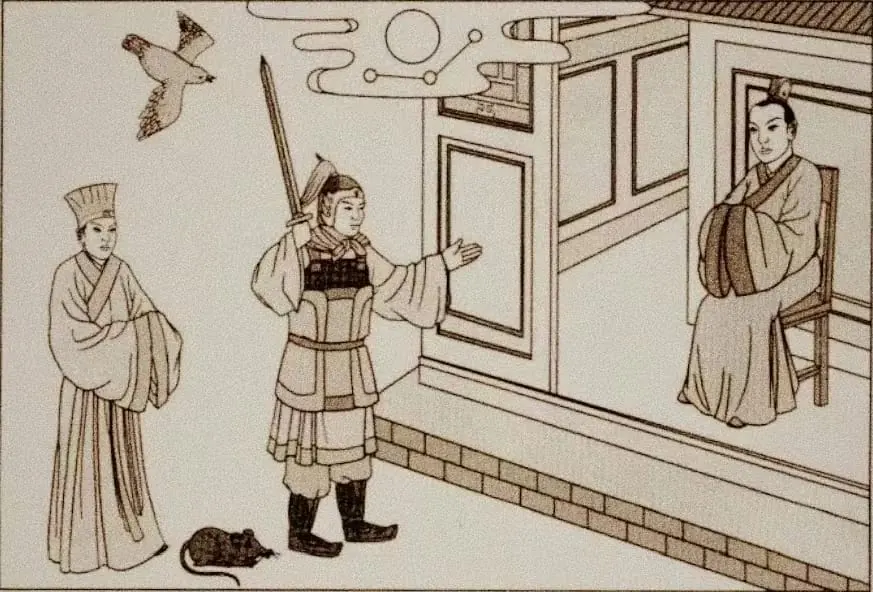
Look up first. The sun sits wrapped in cloud, which the Image Symbolism reads as a time of dimness, when those in charge do not see clearly. A bird flies in from the upper left; the description makes it a phoenix carrying a document, good news on the way, though the drawing shows a small bird carrying nothing.
Below, an official in a tall hat stands on the road, read as someone important arriving. Beside him an armoured figure raises a sword and gestures toward the house, where a man sits waiting; the description has a Daoist pointing to a gate, but here the guide is drawn as a soldier. At their feet a rat creeps along: scheming behind your back. The two mouths and the wall across the road that the text mentions are not clearly drawn.
The trigrams are Thunder ☳ above and Wind ☴ below, two moving forces that keep each other going. The symbolism’s conclusion is that persistence clears the clouds and lets the sun through. The lines add that constancy must be in the right thing: the fourth line’s field with no game is effort sustained where nothing can be caught.
- Work
- If progress has stalled, ask whether your persistence is aimed at the right field. Avoid changing your instructions between morning and evening.
- Relationships
- If a relationship feels clouded, consider which steady, everyday habits keep it going, and whether small resentments are creeping about underfoot.
- Timing
- This hexagram favours the long view. If the sun is still behind clouds, keep your direction and adjust only the details.
Line Statements
Listed from the bottom line to the top line.
- First six: Digging deeply for constancy. Steadfastness is inauspicious; nothing is beneficial.
- Nine in the second place: Regret disappears.
- Nine in the third place: No constancy in virtue; perhaps bearing shame. Steadfastness brings regret.
- Nine in the fourth place: No game in the field.
- Six in the fifth place: Constant in virtue and steadfast. Good fortune for a woman; misfortune for a man.
- Top six: Agitated constancy. Misfortune.
Meaning of the Hexagram
Translated from the Chinese 人间道 commentary with AI assistance; translator notes appear in brackets.
“Heng: success, no blame; steadfastness is beneficial; it is beneficial to have somewhere to go.”
Heng (Duration) is the way of constancy and endurance. When a person is constant in goodness, this way can endure; this is the way of the noble person. The way of the petty person is to be constant in evil, which has already lost the way that can endure. So the way of constancy can last long because what it is constant in is correct; constancy in what is not correct invites misfortune.
“Heng means enduring. The firm is above and the yielding below; thunder and wind go together; gentle and moving; firm and yielding all respond. This is Heng.”
The way of constancy and endurance lies in the firm above and the yielding below: the ruler firm and the minister yielding, the husband firm and the wife yielding. Thunder shakes and wind rises; within the wind there is thunder; they respond to each other and strengthen each other’s force. That things between heaven and earth can endure without ceasing is simply because they know how to move in accord.
“Heng: success, no blame, steadfastness is beneficial: enduring in its way.”
The way of constancy can bring success and freedom from harm, but one must take care that what one is constant in is correct; then there is good fortune. If what one is constant in is not correct, one brings disgrace on oneself instead.
“The way of heaven and earth endures and does not cease.”
If a person can constantly hold to the way that can endure, he accords with the principle of heaven and earth and can surely last long.
“It is beneficial to have somewhere to go: an end is followed by a beginning.”
All movement of things must have a beginning and an end. To move and yet be constant means there will be many changes along the way. To know how to change one’s outward form with the times while the spirit within stays unchanged: this is to grasp the spirit of the Changes.
“The sun and moon, possessing heaven, can shine for long; the four seasons change and can bring things to completion for long; the sage endures in his way and the world is transformed and completed. Observe what they are constant in, and the nature of heaven, earth and the ten thousand things can be seen.”
The sun and moon, having the way of heaven, can shine without ceasing; the four seasons come and go and bring forth the ten thousand things, and because they too have heaven, they last without ceasing. The sage uses the way of constancy and practises it unceasingly, and so can transform the world and complete its fine customs. Observing the constancy of heaven and earth, he grasps the principle by which the world endures; this is why the sage’s way can last. Which ordinary person can understand this?
“Thunder and wind: Duration. The noble person accordingly stands firm and does not change his direction.”
The talented noble person observes the image of Heng and, with the virtue of constancy and endurance, stands firm on the middle way and never changes the ground on which he takes his stand.
“Digging deeply for constancy. Steadfastness is inauspicious; nothing is beneficial.”
The first six is a soft and unenlightened person entering for the first time. He only knows to keep to the usual and does not act according to circumstances; he seeks only the favour of those above and holds firmly to this aim. This is the way to misfortune. Because his heart is set on seeking favour from above, he certainly cannot rest in his position; hence misfortune.
“The misfortune of digging deeply for constancy: seeking depth at the very beginning.”
Seeking only the favour of those above, not knowing how to act according to circumstances and rest in his position, he loses the way of constancy at the very start.
“Regret disappears.”
To be constant is to occupy one’s correct position; this is the normal way. Here a yang line is in a yin position, not in its proper place. Although it has central and correct talent, not knowing the relative weight of things causes regret. To know what weighs more and what weighs less: this is the meaning of the Changes here.
“The second nine’s regret disappears: it can endure in the middle.”
If a person knows how to endure in the middle way and knows what weighs more and less, he can surely last long.
“No constancy in virtue; perhaps bearing shame. Steadfastness brings regret.”
Having its proper position, it could endure. But when it should persevere it does not know to hold on with constancy: issuing orders in the morning and changing them by evening, it leaves people not knowing what to follow, and instead brings shame and disgrace on itself.
“No constancy in virtue: there is no place to receive him.”
One who does not know the way of constancy ends with nowhere to stand.
“No game in the field.”
Hunting in the field and catching no game is labour in vain. The fourth nine is a yang line in a yin position, not in its proper place; what use is constancy then? Human action must have a way: holding to it with constancy brings achievement, but without the way, even long effort achieves nothing.
“Long in a position that is not its own: how could it catch game?”
Being in an unsuitable position, what use is lasting long? It is like hunting in vain, with nothing to show for it.
“Constant in virtue and steadfast. Good fortune for a woman; misfortune for a man.”
Softness occupies a firm position and also receives the help and response of the yang firm second nine; this is occupying the central and correct and being answered by the central and correct. To be constant in this for long is the way of good fortune.
The way of a wife takes compliance as her constancy, and this compliance is fortunate for a wife. A husband is firm and yang; if he holds to the way of compliance as his constancy, it leads to misfortune instead. How much more so for the way of a ruler: a ruler must never take soft compliance as his constancy.
“Steadfastness is fortunate for a woman: she follows one to the end. The man decides what is right; to follow the woman’s way is misfortune.”
Softness and compliance are fortunate for a woman, for she follows one to the end. As for what is right for a king, to follow a woman’s compliance invites misfortune.
“Agitated constancy. Misfortune.”
This is the extreme position of Heng, “agitated constancy,” that is, keeping to things without regularity. Occupying the top and moving without measure, and then taking this as one’s constancy: misfortune arrives. So we must move according to right principle and not overstep the bounds. If in moving one loses what is right and does not turn back in time, but goes on persisting in it, misfortune indeed results.
“Agitated constancy at the top: great lack of achievement.”
One at the top who is restless and unsettled will surely achieve nothing. This speaks of the importance of holding to constancy, knowing constancy and using constancy. If people do not know this principle, even the greatest labour brings no result.
Show the Chinese original (人间道)
恒:亨,无咎,利贞,利有攸往。 恒为常久之道,人能恒之于善,此道可恒,君子之道。小人之道,乃恒于恶,已失可恒之 道,故恒之道能常久,乃因所恒为正,恒不正,招凶也。
恒,久也。刚上而柔下,雷风相与,巽而动,刚柔皆应,恒。 恒久之道,在于上刚下柔,君刚臣柔,夫刚妇柔,雷震风兴,风中有雷,相互交应,助长 其势,天地之间能恒久不已,乃因能知顺动而已。 恒,亨,无咎,利贞,久于其道也。 恒之道,可以令亨通,且无灾,但须注意所恒为正,吉也,所恒不正,则反招辱。
天地之道,恒久而不已也。 人如能恒持可恒之道,则合于天地之理。必可长久。 利有攸往,终则有始也。 万物之动,必有始终,今动而能恒,其间变化必多,能知随时变易其外,神在内不变,此 得易之神也。 日月得天而能久照,四时变化而能久成,圣人久于其道而天下化成, 观其所恒,而天地万物之情可见矣。
日月得天之道,能久照不已,四时往来生成万物,也因得天,故常久不已,圣人用恒之道, 行之不已,能化成天下,成其美俗。观天地之恒常,得天下常久之理,此圣人之道所以能常久 也。常人孰能知。
雷风,恒;君子以立不易方。 人才君子观恒之象,以恒久之德性,持立于中道,永不易其立足之道。
浚恒,贞凶,无攸利。 初六以柔暗之人初进,只知守常却不度势 而为,但求上之眷顾,又坚守此向,致凶之道 也。因其心志在求上眷顾,必不能安居其位, 故凶也。
浚恒之凶,始求深也。 但求上之眷顾,不知度势而行,安居其位, 失恒之道于始也。
悔亡。 恒能居其正位,常道也。今阳居阴位,处 非其位,虽中正之才,不知轻重之势,造成有 悔。人能知所轻重,易之义即此。
九二悔亡,能久中也。 人能知恒久于中道,知所轻重,必可常久。
不恒其德,或承之羞,贞吝。 得位乃可久,但于须持久时不知持之以 恒,朝令夕改,人无所适从,反招羞辱矣。
不恒其德,无所容也。 不知恒之道的人,终至无处容身也。
田无禽。 田猎又无获禽,徙劳无功也,九四阴位而 阳居之,处非其所,恒又何益?人之动必有道, 持之以恒则有功,不得道,即久亦无功也。
久非其位,安得禽也。 处不适位,虽久何益,犹徙猎而无功。
恒其德,贞,妇人吉 ,夫 子凶。 柔居刚位,又得九二之阳刚助应,此即居 中正又有应乎中正,恒此以久,吉之道。妇人 之道以顺从为恒,此顺从于妇人则吉,丈夫为 刚阳,如以顺从之道持恒,反致凶也。更何沉 人君之道,君道切不以柔顺为恒也。
妇人贞吉,从一而终也,夫 子制义,从妇凶也。 柔而顺从于妇人则吉,乃从一而终也,君 王之义,从妇人之顺从,招凶。
振恒,凶。 此恒之极位,乃振恒,即守之不常也,居 上而动无节宜,再以此为恒,凶至也。故吾人 动之必以正理,不逾矩,动如失正,又不及复, 反持恒下去,果致凶矣。
振恒在上,大无功也。 居上之道,躁动不安,必无所成,此言持 恒,知恒,用恒之重要性,人不知此即,令再 大之劳亦无功也。