Scene Description
Image Symbolism
Reading the Picture
Xian is influence: two people moved toward each other, as a lake on a mountain seeps into the rock beneath it. The picture asks what really moves people.
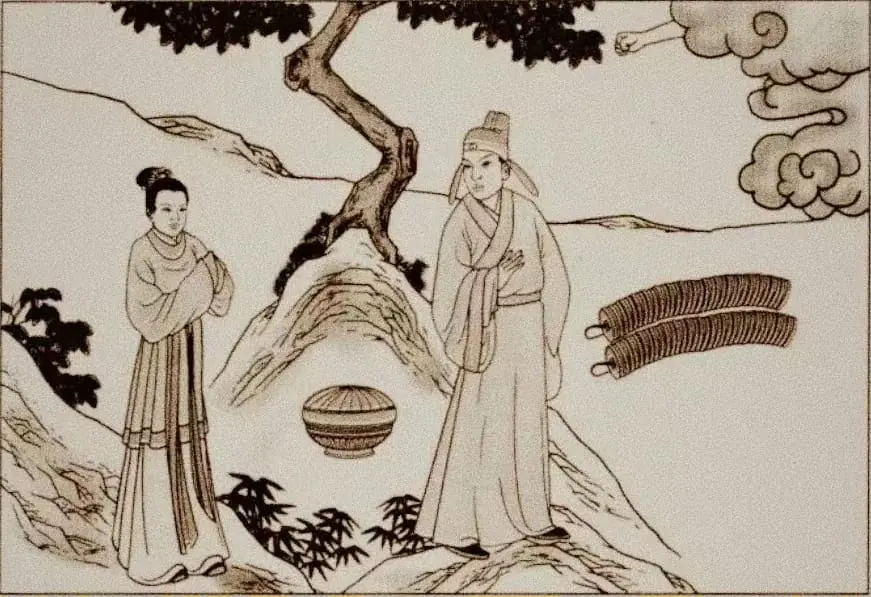
Start with the two figures on the hillside. A woman stands on the slope, hands folded; an official stands on the rise across from her, a hand at his chest. The Image Symbolism reads the woman on the mountain as harmony between partners, and the official on the heights as someone a little isolated, close to stepping down. Between them sits a lidded box, which carries the hexagram’s lesson: what is moved by sincerity holds, what is moved by objects breaks.
On the right hang two long strings of coins, wealth sought and gained, and in the upper corner a fist reaches out of the clouds: help or promotion arriving as if from nowhere. The commentary insists influence should not depend on such gifts.
The trigrams are Mountain ☶ below and Lake ☱ above: stillness inside, joy outside, though only hills are drawn, no lake. The line statements climb the body: toe, calf, thigh, heart, back, jaw. The woman waiting on the slope fits the second line: moving first is unfortunate, staying in place is fortunate.
- Work
- If an opening or sudden promotion appears, consider whether it rests on real trust or on what is being handed over. Receive colleagues with an open mind, not one already full.
- Relationships
- If you feel drawn to someone, ask whether you are moved by sincerity or by appearances and gifts. Consider letting the connection grow at its own pace.
- Timing
- Influence starts small, at the toe. If you feel the urge to act, ask whether the feeling is deep enough yet to move anything; sincerity outlasts clever talk.
Line Statements
Listed from the bottom line to the top line.
- First six: Influence in the big toe.
- Six in the second place: Influence in the calf. Misfortune; remaining brings good fortune.
- Nine in the third place: Influence in the thigh, clinging to what follows. Going brings regret.
- Nine in the fourth place: Steadfastness brings good fortune and regret disappears. Restlessly coming and going; friends follow your thoughts.
- Nine in the fifth place: Influence in the back of the neck. No regret.
- Top six: Influence in the jaws, cheeks and tongue.
Meaning of the Hexagram
Translated from the Chinese 人间道 commentary with AI assistance; translator notes appear in brackets.
“Xian: success; beneficial; steadfast. Taking a wife brings good fortune.”
Xian (Influence) means mutual feeling. Between ruler and minister, superior and inferior, husband and wife, father and son, there is always a way of mutual feeling. If everyone can move one another with the innocent delight of a young man and a young woman, with sincerity and joy, that is, if they treat one another with an ordinary, unaffected heart, there is sure to be success. People today all use flattery, and those above and below hold their places by crooked ways; all of this is influence that is not correct.
Mountain (Gen) means stopping and Lake means joy: joy outside and stillness within. To approach a woman in this spirit is to be correct and fortunate.
“Xian means influence. The yielding is above and the firm below; the two energies stir and respond to each other and join together. Stillness and joy; the man places himself below the woman. Therefore: success, beneficial, steadfast; taking a wife brings good fortune.”
The meeting of yin and yang has the same meaning as the mutual feeling of man and woman. In the union of man and woman, the man responds with a sincere, solid and wholehearted mind and the woman with a joyful heart. This is man and woman moving each other on the right way, so they can have success and be correct.
“Heaven and earth influence each other, and the ten thousand things are transformed and born. The sage influences the hearts of people, and the world is at peace. Observe what they influence, and the nature of heaven, earth and the ten thousand things can be seen.”
When the way of influence reaches its limit, the sage, with a heart of utmost sincerity, can move the hearts of millions and bring peace to the world; the greatness of this feeling can be seen. But one must know that the principle of influence and response is to be observed in silence and must not be spelled out; only then can the influence last.
“On the mountain there is a lake: Influence. The noble person accordingly receives others with emptiness.”
A lake on a mountain gradually moistens it and seeps clearly through it; this is the way of influence. The noble person, observing how mountain and lake exchange their qi, knows that he must make himself empty within in order to receive others. When a person’s heart is empty at the centre it can surely receive; if it is full, nothing can enter.
“Influence in the big toe.”
The first line responds to the fourth. At this first stage the influence is surely not yet deep and cannot move anyone. It is like the moving of a big toe: one cannot yet advance, and must recognise the circumstances before acting.
“Influence in the big toe: the will is directed outward.”
Although the will to respond has stirred, it is not yet great and is not enough to advance. The first line’s will responds to the fourth, so it is said to be “outward.”
“Influence in the calf. Misfortune; remaining brings good fortune.”
腓 is the calf of the leg. When a person moves, the feet go first and the calf moves of its own accord. The second line cannot keep to the way and rashly seeks the one above, so there is misfortune. The right way of advancing and retreating is to stay quietly in one’s place and wait for the one above to seek one out; this is good fortune.
“Although there is misfortune, remaining brings good fortune: following does no harm.”
A yin line in the second place holds a central and correct position. In the time of Xian, because its nature is soft, it must be warned against moving first: to seek is surely misfortune, and to stay still is good fortune.
“Influence in the thigh, clinging to what follows. Going brings regret.”
The thigh is below the body and above the foot; it cannot act on its own but moves with the body. The third nine has yang firm talent, yet it is stirred by what moves and follows its movement. In this it has already lost the right way, and its movement will surely bring shame.
“Influence in the thigh: it too does not stay still. Its will is to follow others; what it holds to is low.”
A person with a yang firm nature who cannot be his own master and instead moves by following others: what he holds to must be very base indeed.
“Steadfastness brings good fortune and regret disappears. Restlessly coming and going; friends follow your thoughts.”
All human movement comes from being stirred. The fourth nine is in the middle, the position of the heart, which is the master of feeling. If its influence is correct there is good fortune; if not, misfortune. People today move others with selfish hearts, and their influence is narrow. The things of heaven and earth all differ, and affairs change in countless ways; to be able to reach the same end by different roads is influence at its utmost, and it can only be done with impartial selflessness.
When people go toward something, they must bend and seek; when people come, it must be because of trust. This mutual influence of bending and trusting [屈信; in the Great Commentary 信 means ‘extending’] is where benefit arises.
“Steadfastness brings good fortune and regret disappears: not yet stirred to harm. Restlessly coming and going: not yet bright and great.”
If a person is correct there is surely good fortune; if everything is done for private ends, harm arises. To come and go and move one another with selfish hearts makes the way of influence narrow, and it is surely not yet bright and great.
“Influence in the back. No regret.”
One in the honoured position must move the world with utmost sincerity. 脢 is the flesh of the back; it faces away from the heart and is out of the eyes’ sight. This means being able to turn one’s back on one’s private heart and to be moved to joy by what one does not see; a ruler who does this can be without regret.
People today do not understand this. They are moved to delight by what they see and regard with hostility what they do not see. This influence is not correct and brings misfortune and ruin on itself.
“Influence in the back: the will is only at the surface [the source writes 未 for 末].”
When people, stirred by what they do not see, become guarded, their influence must be shallow; this is the working of the selfish heart.
“Influence in the jaws, cheeks and tongue.”
The top is the extreme position of influence, and yin softness occupies it. This means being unable to move things with utmost sincerity and seeking only to move people through the mouth and tongue. This is the ordinary manner of petty people and women, and it surely cannot move anyone; hence the word “cheeks.”
“Influence in the jaws, cheeks and tongue: flapping the mouth in talk.”
In the world only utmost sincerity can move people; if one relies on a talent for talking, one’s influence will surely not last.
Show the Chinese original (人间道)
咸:亨,利,贞,取女吉。 咸,感也,举凡君臣上下,夫妇、父子等皆有感之道,人人能以少男少女之童悦相感以诚 悦,即以平常心相待,则必有亨通之理。今人皆以媚说,上下之位处以邪僻,皆感之不正也。 艮为止,泽为悦,乃外悦内止之意,以此之意近女,乃得正而吉也。
咸,感也,柔上而刚下,二气感应以相与,止而说,男下女,是 以亨利贞,取女吉也。 阴阳相交,乃男女相感之义同,男女之交,男以笃实至诚之心,女以喜悦之心相应,此男 女之感于正道,故能亨通得正。 天地感而万物化生,圣人感人心而天下和平,观其所感,而天地万 物之情可见矣。
感之道到极限时,圣人能以至诚之心感亿兆人之心,使天下和平,其情之伟大可见,但须 知感通之理,须以默而观之,不可道破,此感方可久矣。
山上有泽,咸;君子以虚受人。 泽在山上有渐润通澈状,此感之道。君子观山泽通气知须虚其中方能受人,凡人之心能中 虚必可受,实则不能入矣。
咸其拇。 初与四相感,初之时感必未深,不能动人, 如拇指之动,不可进也,须识势而为。
咸其拇,志在外也。 感应之志虽动,但未大,不足以进。初志 之感与四相应,故曰在外。
咸其腓,凶,居吉。 腓,足肚也,人之动,足必先行,足肚自 动也。二位无法守道而妄求于上,故凶。进退 之道乃安居其位,以待上求,此吉也。
虽凶,居吉,顺不害也。 阴居二位,其得位中正,在咸之时,因质 本柔,必戒以先动,求之必凶,守居不动吉。
咸其股,执其随,往吝。
股在身之下,足之上,不能自主,随身而 动。九三阳刚之才,感于所动而随其动,如此 已失其正道,其动必羞也。
咸其股,亦不处也,志在随 人,所执下也。 人有阳刚之质,却又不能自主,反随于人 而动,此所执者必卑贱甚也。
贞吉,悔亡,憧憧往来,朋 从尔思。 人之所动皆因感也,九四在中,乃当心臓 之位,为心感之主,感之正则吉,不正则凶。 今人以私心感人,所感狭小也。天地万物各有 不同,事亦变化万千,能殊途同归,此感之极 至,必以公正无私方可行。人之向往,必有屈 求,人之来至,必因有信,此屈信相感,利之
所生处。
贞吉悔亡,未感害也。憧憧 往来,未光大也。 人能正则必吉,事皆以私,则生害也,互 相往来以私心相感,此感之道狭,必未光大也。
咸其脢 脢 脢 脢,无悔。 居尊位之人,必以至诚感于天下,脢,背 肉也,其与心相背,目所不见状,此意能背其 私心,感于非所见而能悦者,以人君可以无悔。 今人不知,皆感于所见而悦,所不见而仇视之, 此感不正,招自凶亡也。
咸其脢 脢 脢 脢,志未也。 人感于所不见而生戒,其必浅也,此私心 之用也。
咸其辅,颊,舌。 上为感之极位,阴柔居之,此即不能以至 诚感物,唯求于口舌之间感人,乃小人女子之 常态,必不能动于人,故云颊。
咸其辅颊舌,滕口说也。 世间唯至诚能感人,如靠口舌说话之才, 感人必不能长久。