Scene Description
Image Symbolism
Reading the Picture
Sun is decrease: giving up some excess so that what remains is sincere. The picture shows a pleasant drink that has already gone a little too far, and a request that will need asking twice.
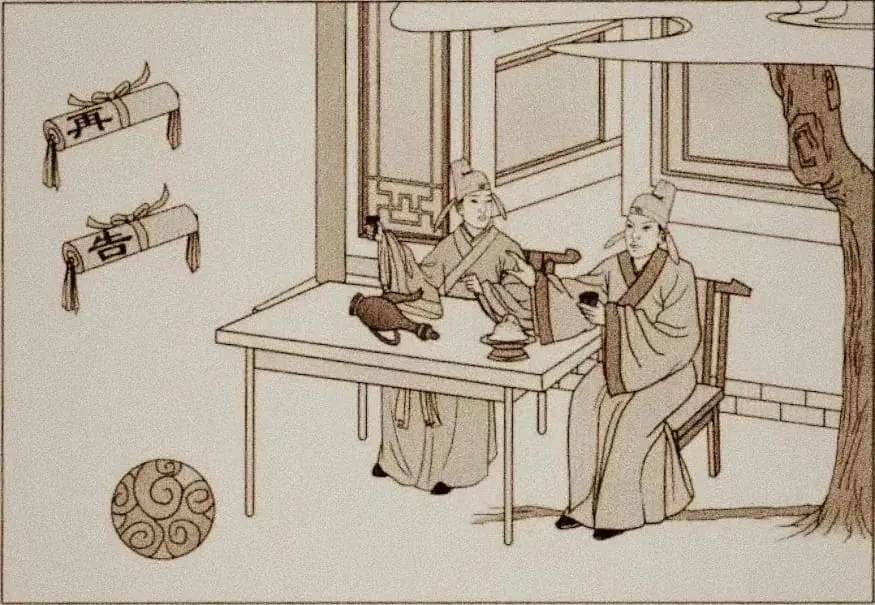
Look first at the two men drinking at a table under a tree. The Image Symbolism finds wordplay here: two people flanking wood (木) make the old form of 來 lái, ‘to come’: something is on its way. Yet on the table the wine bottle lies on its side, read as no hope for now, and on the ground lies a round ball, a sign that what is being asked for does not come through at first.
On the left hang two scrolls, one marked 再 and the other 告: ‘petition again’. Success comes on the second asking. The scene says: cut back the surplus and return with a plain, sincere request, just as the judgment says two simple bowls suffice for an offering.
The trigrams frame it: Lake ☱ below, Mountain ☶ above. The lake gives up its water to feed the mountain, decreasing below to increase above. The pair of drinkers recalls the third line: three people travel and one is decreased, while one alone finds a friend. The fourth line adds that faults, like illness, are best cut quickly.
- Work
- If a request has been turned down, consider trimming it to its essentials and asking again. Ask whether some spending or effort could be cut so that the core is stronger.
- Relationships
- If things feel crowded or tense, consider whether one commitment or expectation could be let go. Simple, sincere gestures may say more than lavish ones.
- Timing
- This is a time to reduce rather than add. If a habit is causing trouble, sooner is easier than later, and a second attempt may succeed where the first did not.
Line Statements
Listed from the bottom line to the top line.
- First nine: Finish one's affairs and hurry over. No blame. Consider how much to decrease.
- Nine in the second place: It is beneficial to be steadfast. Going forward is inauspicious. Without decreasing, increase them.
- Six in the third place: When three people travel, one is lost; when one person travels, he finds a companion.
- Six in the fourth place: Decrease the illness; hasten so there is joy. No blame.
- Six in the fifth place: Someone increases them with a tortoise worth ten pairs of shells, which cannot be refused. Great good fortune.
- Top nine: Without decreasing, increase them. No blame. Steadfastness brings good fortune. It is beneficial to go somewhere; gaining a servant without a household.
Meaning of the Hexagram
Translated from the Chinese 人间道 commentary with AI assistance; translator notes appear in brackets.
“Decrease: with sincerity, supreme good fortune, no blame. One may be steadfast. It is beneficial to have somewhere to go.”
The way of Sun (Decrease) must hold to right principle and come from sincerity and uprightness; then decrease, because it follows principle, reaches great goodness, and this is fortunate. Keep to it firmly and constantly, and it will surely be beneficial to go somewhere. The decrease of ordinary people goes too far, falls short, or is not constant; none of these accords with right principle.
“What is to be used? Two bowls may be used for the offering.”
The rites of sacrifice in the human world are elaborate in form and heavy with detail, and ordinary people prepare many offerings. The sage takes frugality as the root of ritual, showing reverence for heaven with a heart of utmost sincerity. To seek a great many offerings is to try to dress up one’s sincerity, and really shows people falseness.
So we know that whenever human desires go to excess, at the start they all arise from providing for oneself; after a long time they become palaces, towers and high walls, a lake of wine and a forest of meat. The sage saw this, and so first set frugality as the foundation. The essential meaning of Decrease, then, is simply to decrease and extinguish human desires so as to draw near to the principle of heaven.
“Decrease: decreasing below to increase above; its way moves upward.”
Decrease comes about by decreasing what is below to increase what is above; so its way moves upward.
“Decrease with sincerity: supreme good fortune, no blame. One may be steadfast. It is beneficial to have somewhere to go.”
The way of Decrease lies in utmost sincerity; with a heart firm in this, one can fulfil the way of Decrease.
“What is to be used? Two bowls may be used for the offering. The two bowls must accord with the time; decreasing the firm to increase the soft has its time.”
We should decrease outward ornament so that utmost sincerity can be seen. At the start of every undertaking there must be the order of elder and younger, honoured and humble, but by the end of it this has often become mere form. In a time of decrease one knows when it is necessary to decrease the firm to increase the soft; this way of decrease must accord with the time to be fortunate.
“Decrease and increase, fullness and emptiness, go along with the time.”
Whether to decrease or to increase, whether to seek fullness or emptiness, depends only on a single thought that follows the time. Here one can see the meaning of timing in the Changes.
“Below the mountain is the lake: Decrease. The noble person accordingly restrains his anger and curbs his desires.”
Observing the image of Decrease, the noble person takes decreasing himself as the highest thing. The way of cultivating oneself lies in anger and desire. To know how to decrease one’s own anger and desire is to grasp the true meaning of the time of Decrease.
“Finish one’s affairs and hurry over. No blame. Consider how much to decrease.”
The way of Decrease lies in decreasing the firm to increase the soft. Now a person in a low position who wants to increase the one above should give him the credit and not claim it for himself: when the work is done, he leaves quickly and does not seek credit, and so can be without fault. If he seeks to enjoy the glory of his achievement, that departs from the way of decreasing below to increase above, and is not acceptable.
“Finish one’s affairs and hurry over: his will is united with that of the one above.”
When the work is done he withdraws and does not claim credit, and so can be of one will with the one above.
“It is beneficial to be steadfast. Going forward is inauspicious. Without decreasing, increase them.”
A person of firm centrality responds to the soft nature of the ruler’s position. In a time of decrease, if he seeks to respond to the one above with a soft, pleasing manner, he loses the virtue of firm centrality, and his movement will surely be unfortunate, because he does not know to keep his heart firm in yang strength. This would be a true decrease.
“The second nine: it is beneficial to be steadfast, for it takes the centre as its will.”
If the yang firm person of the second line can keep to the way of centrality and correctness, how could there be anything unfortunate? If his will rests on the central way, he will surely set himself right.
“Three people traveling: one person is decreased. One person traveling: he finds his friend.”
In the world no one is alone; there must be two, as with the coming together of man and woman: because of their single-minded oneness they can give life. One yin and one yang leave no room for another to join, so with three people, because their wills are not single, one is bound to be lost. One person traveling alone, because his will is single, will surely find a friend who shares it. So between heaven and earth, nothing shows the meaning of decrease more clearly and greatly than this.
“One person traveling; with three, there is suspicion.”
One person traveling can find a friend; three traveling together easily give rise to suspicion. At such a time one must understand the way of decrease: removing one person is removing what is surplus.
“Decreasing the illness [the statement here writes 换, ‘change’, for 损]; hasten so there is joy. No blame.”
A person of yin softness in a time of decrease must decrease himself in order to follow the way of the yang firm, central and correct: that is, decrease what is not good and follow what is good. Then there will surely be joy and no disaster. In decreasing one’s faults, the only worry is not doing it quickly; if it is done quickly, the fault will certainly not go deep, and that is cause for joy.
“Decreasing the illness: that too is cause for joy.”
Knowing the way of decrease and finding its proper time, one quickly removes what is not good; this is cause for joy.
“Someone increases them with a tortoise worth ten pairs of shells, which cannot be refused. Great good fortune.”
The ruler, soft and compliant, occupies the honoured place. In a time of decrease he knows to empty his centre and decrease himself, following the yang firm worthy below. If a ruler can be like this, the people of the world will surely follow his virtue and all will regard decreasing themselves as admirable. So the public opinion of the whole people supports him, and because it accords with right principle, even the tortoise and the yarrow do not go against it. This can be called the good fortune of great goodness. As the ancients said: “If plans follow the many, they accord with the heart of heaven.”
“The great good fortune of the fifth six: it is blessed from above.”
If the ruler can draw fully on the views of all and accord with the principle of heaven and earth, heaven will surely send down blessing and protection.
“Without decreasing, increase them. No blame. Steadfastness brings good fortune. It is beneficial to go somewhere; gaining a servant without a household.”
At the end of the way of Decrease, if one can be above without decreasing those below, and instead increase them, then no one in the world will fail to follow and people’s hearts will turn to him, with no boundary between near and far, within and without.
“Without decreasing, increase them: the will is greatly fulfilled.”
One who is above and does not decrease those below, but can increase them, will surely carry out his will as a noble person. Put simply, the noble person’s will lies only in how to benefit others.
Show the Chinese original (人间道)
损:有孚,元吉,无咎,可贞,利有攸往。 损之道须持之正理,来自诚正,则损因顺理而至大善,此可吉也。坚固常行必利有所往。 常人之损,有过或不及或不常皆不合乎正理。 曷之用? 二簋可用享。 人间祭祀之礼,文繁节褥,常人多备祭品,圣人以俭为礼之本,示以至诚之心敬天,如求 祭物过多,乃求饰其诚,实示人伪矣。
故知凡人之欲望若有过者,其始初皆起于奉养,常久以 后则成宫楼峻墙,酒池肉林,圣人有见于此,故先制其本以俭,故损之精义在损灭人欲以近乎 天理而已。
损,损下益上,其道上行。 损之成,乃损下而益于上,故道乃上行。 损而有孚,元吉,无咎,可贞,利有攸往。 损之道在至诚,坚心如此,乃可尽损之道也。 曷之用?二簋可用享,二簋应有时,损刚益柔有时。 吾人应损去外在浮饰,使至诚见,万事之始,必有长幼尊卑,然于事之末,往往已流于形 式,损之时乃知何时须损刚益柔,此损之道必以时乃吉。
损益盈虚,与时偕行。须损须益,求盈求虚,只随时之一念而已,易之于时义于此可见。
山下有泽,损,君子以惩忿窒欲。 君子观损之象,以损己为上,修己之道在忿与欲上,能知损己之忿与欲,乃得真损之时义。
已事遄往,无咎,酌损之。 损之道,在损刚益柔也。今居下之人为益 上,当以功与之,不求己居,事毕则速去,不 求居功,乃能无过。若求享其功之美,此离损 下益上之道,不可也。
已事遄往,尚合志也。 事毕后退居不居功,能与上合志也。
利贞,征凶,弗损益之。 刚中之人与君位柔性相应,居损时,用柔 悦态度求应于上,则有失刚中之德,其动必凶, 乃因不知坚心于阳刚也。此适足以损也。
九二利贞,中以爲志也。 九二阳刚之人能守中正之道,则何有不 吉。志存乎中道,则必自正也。
三人行,则损一人。一人行, 则得其友。 天下没有独一之人,必有二者,如男女之 往,由其精一,故能生也。一阴一阳,无法加 入故三人因志不专一,必生损一人,一人独行, 由其志为专,故必有一友能同其志,故天地之 间损义之明且大哉,莫过于此。
一人行,三则疑也。 一人行而能得友,三人行则易生疑,于此 时须明损之道,损去一人,乃损多余。
换其疾,使遄有喜,无咎。 阴柔之人居损时,须自损以从阳刚中正之 道,即损不善而从善,必有喜而无灾。人之损 过失,唯患不速,如速则此过必不至深,为可 喜也。
损其疾,亦可喜也。 知损之道,得损之时,速去其不善,此可 喜也。
或益之,十朋之龟,弗克违, 元吉。 君王能柔顺居尊位,处损之时,知虚中自 损,顺从在下阳刚之贤人,人君能如此,则天 下人必从其德,咸以损己为美,故有众民之公 论助之,因合正理,即龟筮亦不相违,可谓大 善之吉也。古云:「谋能从众,则合天心。」
六五元吉,自上祐也。 人君能尽众人之见,合于天地之理,天必 降福祐也。
弗损益之,无咎,贞吉,利 有攸往,得臣无家。 损道之终极,能居上而不损其下又益增在 下之人,则天下莫不服从,人心归顺,无远近 内外之区限。
弗损益之,大得志也。 居上而不损下,又能增益之,君子必能遂 行其志,故简言之,君子之志,唯在如何益于 人而已。