Scene Description
Image Symbolism
Reading the Picture
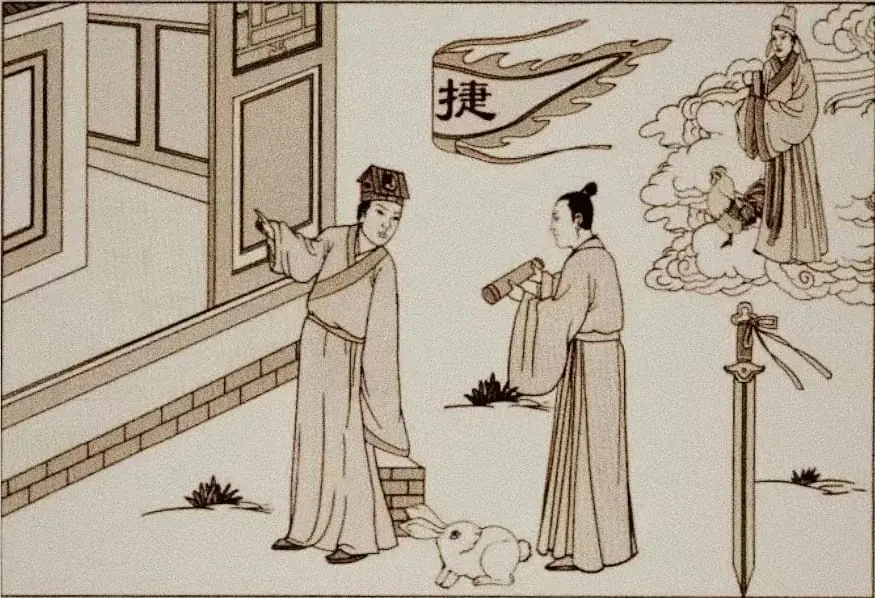
Jie is deliverance: a hardship is loosening, and the picture shows a moment of choice about which door to take and how quickly to act before the opening closes.
Start with the two men in the centre. One, in a tall hat, points firmly toward a doorway: a way out, which the Image Symbolism reads as escape or even leaving worldly life. The other holds out a rolled document, sincerity that may also be outward show. Behind them a small brick mound stands at the corner, and a rabbit sits at their feet.
Up on the right, a distinguished person stands in the clouds with a rooster at his side. The rooster means competition; the figure in the clouds, help that may arrive too late. Below, a sword stands planted in the ground, read as wanting speed. The description reads the flag’s character as 提, singling out misfortune, but the drawn flag plainly shows 捷 jié, victory or swiftness, which fits the judgment’s advice that early action brings good fortune.
The trigrams show the release: Water ☵, danger, lies below Thunder ☳, movement; by moving, one leaves the danger behind. The sword and the pointing hand recall the top line, the duke who shoots the falcon at the right moment, while the document recalls the fourth line’s call to let false companions go so that true friends can arrive.
- Work
- If a problem has just eased, consider acting on the fix early rather than waiting. Ask which tools you need, so that when you move, you move once and well.
- Relationships
- If an old strain is lifting, consider forgiving small faults generously. Ask, too, whether someone close is quietly keeping trusted people away.
- Timing
- The door is opening now. If there is somewhere to go, sooner is better; if not, a calm return to normal life is also good.
Line Statements
Listed from the bottom line to the top line.
- First six: No blame.
- Nine in the second place: Catching three foxes in the field and obtaining a yellow arrow. Steadfastness brings good fortune.
- Six in the third place: Carrying a burden while riding a carriage invites robbers. Steadfastness brings regret.
- Nine in the fourth place: Release your big toe. Friends arrive and trust follows.
- Six in the fifth place: The noble person brings release. Good fortune. Petty people show sincerity.
- Top six: A duke shoots a falcon on a high wall and catches it. Nothing is unfavorable.
Meaning of the Hexagram
Translated from the Chinese 人间道 commentary with AI assistance; translator notes appear in brackets.
“Deliverance: the southwest is beneficial. If there is nowhere to go, returning brings good fortune. If there is somewhere to go, early action brings good fortune.”
The southwest is the direction of Kun, and the body of Kun is broad, embracing, bright and great. When the world’s difficulty is first resolved and people are just leaving hardship, they should be treated with generous, simple and easy measures, and must never be burdened with harsh government; then people’s hearts will surely be at peace. After that one seeks to restore the way of governing, set up principles and order, and establish the rule of law. And one should act early; if one waits until the difficulty returns, it will be too late.
“Deliverance: danger, and movement; by moving one escapes danger: this is Deliverance.”
Danger signifies difficulty; without danger there would be no difficulty. When the time of deliverance comes, if one does not move one certainly cannot get out of danger, so this movement is what saves one from inviting danger.
“Deliverance: the southwest is beneficial, for going there one wins the multitude.”
This is the way to resolve difficulty: the people must be treated with broad, generous, level and easy measures, and then their hearts will surely turn to you.
“Returning brings good fortune, for one attains the centre.”
The way of governing the age must wait until the time of deliverance has arrived before it can be put to use; this is what is fitting.
“If there is somewhere to go, early action brings good fortune, for going brings achievement.”
If one wishes to act and go, speed is surely beneficial: the earlier one goes, the greater the achievement; if one is late, harm has already arisen.
“Heaven and earth are released, and thunder and rain arise; thunder and rain arise, and the husks of all fruits, grasses and trees split open. Great indeed is the time of Deliverance!”
When the qi of heaven and earth opens and flows in harmony, thunder and rain are produced; when thunder and rain come, the husks of all things split open. So deliverance can accomplish the work of heaven and earth, and the sage knows how great the time of deliverance is. In reading the Changes one must grasp the meaning of timing; only then does one attain the way of the Changes. The way of the Changes is one with heaven and earth and shares their virtue.
“Thunder and rain arise: Deliverance. The noble person accordingly pardons mistakes and forgives crimes.”
Heaven and earth loosen and disperse, producing thunder and rain. Observing the image of thunder and rain, the noble person understands their work of bringing things to growth, and so knows to extend kindness and benevolence and to apply lenient laws.
“No blame.”
At the first moment of deliverance, a soft line sits in a firm place: the image of softness that can be firm. It knows the proper balance of firm and soft, and so lets trouble and hardship dissolve.
“At the meeting of firm and soft, by rights there is no blame.”
Firm and soft meet each other, and at the fitting time, so there will surely be no disaster.
“Catching three foxes in the field and obtaining a yellow arrow. Steadfastness brings good fortune.”
The second line responds to the fifth in its yin place. This speaks of a time when a yin soft ruler is above and a yang firm minister is [below]. Since ancient times, when a ruler is soft, petty people easily blind him and his authority is surely damaged; he is also not decisive and is easily beguiled by petty people, and as soon as a petty person comes near, his heart is moved. In such a time, when disaster has also only just been resolved, the sage must be able to remove petty people so as to set the ruler’s heart right and practise his way of firm centrality; only then is there good fortune. The fox is a crooked, beguiling animal; yellow signifies the straight and central.
“The steadfast good fortune of the second nine: it attains the central way.”
Attaining the way of centrality and correctness and removing what is crooked and evil: this is correct and fortunate.
“Carrying a burden while riding a carriage invites robbers. Steadfastness brings regret.”
A petty person is by nature not someone who belongs above, yet here he occupies the top place of the lower trigram. It is like carrying a heavy load while riding in a carriage: it invites robbers, and in the end there will surely be regret.
“Carrying a burden while riding: that is shameful indeed. Bringing armed robbers on oneself: whom else is there to blame?”
Carrying a load while riding in a carriage, and so inviting robbers and the shame they bring, is trouble of one’s own making; whom else could one blame? When a petty person, without measuring his strength, forces his way into the noble person’s position above, he will surely end by drawing thieves who seize it from him, and he brings disgrace on himself.
“Release your big toe [the source writes 姆 for 拇]. Friends arrive and trust follows.”
When a person of yang firmness is at the side of a yin soft ruler, if, being in a high position, he draws close to petty people, he will surely drive worthy men far away. He must cast out the petty people; then noble people will surely come forward, and he can win their trust.
“Release your big toe: the position is not proper.”
If one associates with noble people in utmost sincerity, there will surely be nothing standing between them. So if a petty person can insert himself in the middle, it shows that the association is not wholly sincere.
“The noble person brings release. Good fortune. Petty people show sincerity.”
One who rules must remove petty people; then noble people will surely come forward and the right way will prevail. If petty people are not removed, the world will not be governed well. This can also be read in reverse: if the world is not governed well, it is because petty people have not been removed.
“The noble person brings release: petty people withdraw.”
Only when the noble person can loosen the petty people’s hold and make them withdraw does the way of the noble person prevail. So being able to practise the way of the noble person comes from being able to remove petty people.
“A duke shoots a falcon on a high wall and catches it. Nothing is unfavorable.”
If at the very height of deliverance something is still unresolved, there must be a hard and strong harm. So at this time one may use bow and arrow with force, like shooting a hawk or falcon in a high place, loosing the arrow when the moment comes. If one lacks a good weapon and also acts at the wrong time, the shot fails and will surely bring harm in return. So this speaks of the importance of the tool and of the timing of action: if one catches the bird there is surely good fortune; if one fails, one invites misfortune instead.
“The duke shoots a falcon: to resolve rebellion.”
If at the end of deliverance something is still unresolved, the harm must be great and entrenched. So one must be as forceful as when shooting a falcon in order to resolve rebellion and disorder; then the world can be governed.
Show the Chinese original (人间道)
解:利西南,无所往,其来复吉,有攸往,夙吉。 西南即坤方,坤之体本含弘光大,于天下之难方解时,人始离困苦,当以宽大简易之法待 之,切不可使烦于苛政,人心必安,再求重修冶道,立纲纪,建法治,且宜早动,如俟难复则 不及矣。
解,险以动,动而免乎险,解。 险则示难也,不险必不难,遇解时,如不动必不能出险,故此动是免于招险也。 解利西南,往得众也。 此即解难之道,须广大且平易之法以待民,则民心必归。 其来复吉,乃得中也。 治世之道,必待解之时来临方可往用,此为得宜。 有攸往夙吉,往有功也。
欲动而往,则必利速,愈早前往,功愈大,迟则害已生矣。 天地解而雷雨作,雷雨作而百果草木皆甲坼,解之时大矣哉! 天地之气开而和畅生雷雨,雷雨生而万物甲坼,故解能成天地之功,故圣人知解之时,大也。读易须体时之义,方成得易之道。易之道与天地合而同德。
雷雨作,解;君子以赦过宥罪。 天地解散而生雷雨,君子观雷雨之象,体会发育之功,而知施恩仁,行宽法也。
无咎。 初解之时,柔居阳刚,乃柔而能刚象,知 刚柔之合宜,使患难解散。
刚柔之际,义无咎也。 刚柔相接又得其时宜,必无灾也。
田获三狐,得黄矢,贞吉。 二与五阴位相应,此言阴柔之君在上,阳 刚之臣在之时也,古来如君柔则小人易蔽,威 必受损,又不果断且易受小人之惑,小人一近 则心动矣,处此时又逢灾难初解,圣人必以能 去小人来正君之心,行其刚中之道,方可吉, 狐为邪媚之兽,黄乃直中也。
九二贞吉,得中道也。 能得中正之道,除去邪恶乃正且吉也。
负且乘,致寇至,贞吝。 小人本非在上之物,今居下之上位,犹负 重而乘车,乃招寇至,终必悔矣。
负且乘,亦可丑也。自我致 戎,又谁咎也。 负重乘车,招寇致其之丑乃咎由自取,又 可怪谁呢。小人不量力勉居君子之位处上,必 终自招盗而夺之,自取其辱也。
解而姆,朋至斯孚。 阳刚之人居阴柔君之侧时,如居上位亲近 小人,必使贤士远矣,须斥去小人则君子必进, 能得人之信孚。
解而姆,未当位也。 如与君子至诚以交,则必无挡,故小人如 能介乎中,则示人其交必不诚至也。
君子维有解,吉,有孚于小 人。 君主之人必去小人,则君子必进,正道乃 行,如不去小人,则天下不治,此可反看,即 天下不治,乃小人不去也。
君子有解,小人退也。
君子能解退小人,则君子之道方行,故能 行君子之道,乃因能去小人也。
公用射隼于高墉之上,获之 无不利。 解之至极如仍未解,必有坚强之害也,故 于此时可强用弓矢如射鹰隼于高处,时至而 发,如无良器又动不以时,射未成,必反生害, 故此言器之重要与动之时机,获之必吉,不成
反招凶。
公用射隼以解悖也 至解之终仍未解,必害之大且坚,故须强 硬如射隼以解悖乱,天下可治也。