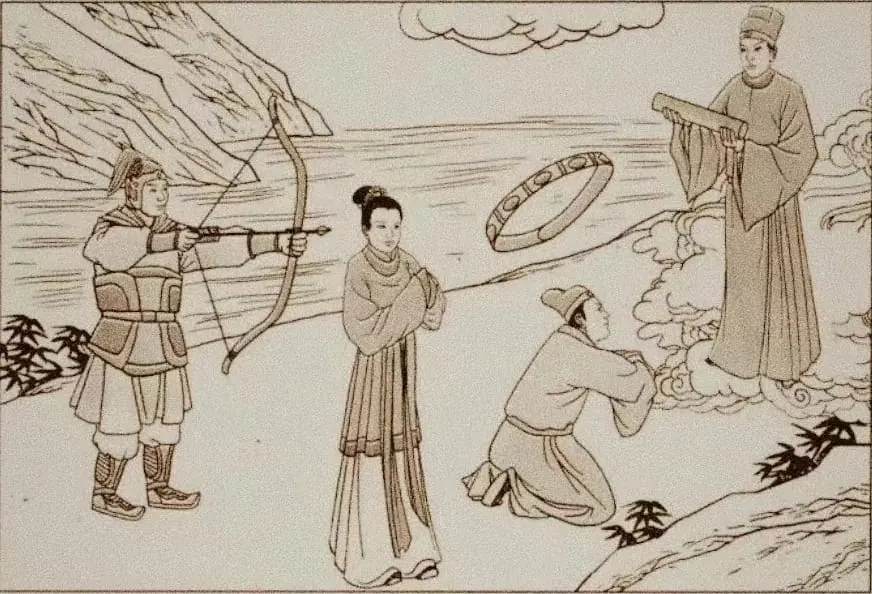
Scene Description
Image Symbolism
Reading the Picture
The Family is about order that starts inside: when the people at the centre of a household keep their word and their roles clear, harmony spreads outward, and outside trouble has less to work with.
Look first at the right. A figure on clouds holds out a document and a man kneels to receive it: sudden good news and a commission, recognition from above. In the centre a woman stands calmly, hands folded. The description speaks of women joining hands as a sign of family harmony, but only one woman is drawn; her composure carries that meaning.
On the left an armoured archer draws his bow, aiming across the scene: secret plotting or someone trying to spoil things. Between the water and the clouds floats a ring-shaped belt, the belt beside water, read as affairs stalling or an office given up. Blessing sits at the centre, threat and delay at the edges.
The trigrams frame it: Fire ☲ within, Wind ☴ without, wind rising from fire. What is warm and steady inside spreads outward. This matches the first line, setting boundaries in the household at the start, and the top line, sincerity joined with dignity. An ordered household lets the arrow fall short.
- Work
- If good news or a new role is on its way, consider whether your own team or basics are in order first. If someone seems to be working against you, steady routines are your best protection.
- Relationships
- Ask whether your words match your actions at home. Clear, agreed expectations set early cause less hurt than corrections made after habits have drifted.
- Timing
- This is a time to tend what is close at hand. If outside matters stall, consider using the pause to strengthen the household, and let recognition come in its own time.
Line Statements
Listed from the bottom line to the top line.
- First nine: Establish boundaries in the household. Regret disappears.
- Six in the second place: Pursue nothing beyond tending food within. Steadfastness brings good fortune.
- Nine in the third place: The household is stern: regret and danger, yet good fortune. Women and children giggling: regret in the end.
- Six in the fourth place: Enriching the household. Great good fortune.
- Nine in the fifth place: The king comes to his household. Do not worry. Good fortune.
- Top nine: Sincerity joined with dignity. Good fortune in the end.
Meaning of the Hexagram
Translated from the Chinese 人间道 commentary with AI assistance; translator notes appear in brackets.
“The Family: it is beneficial for the woman to be steadfast.”
In the way of the family, the benefit lies in the woman being upright and firm; if the woman is upright, the way of the family is upright.
“The Family: the woman’s proper place is within, the man’s proper place is without. That man and woman are in their proper places is the great principle of heaven and earth.”
The way of the family is to keep each in the proper place, with a firm heart. The man takes charge of affairs outside and the woman of affairs within; there is an order of rank and a proper way, and this accords with the way of yin and yang in heaven and earth.
“The family has stern rulers: these are the father and the mother.”
The father and mother are the rulers and elders of a household. Without dignity, no one will be filial; without the distinction of elder and younger, the bonds of human relationship collapse. So when the rulers are stern, the family is in order.
“When the father is a father and the son a son, the elder brother an elder brother and the younger a younger, the husband a husband and the wife a wife, the way of the family is correct. Set the family right, and the world is settled.”
When father and mother, brothers, husband and wife each fit their places, the way of the family is correct. One who can order the way of the family can extend that way to govern the world.
“Wind comes forth from fire: the Family. The noble person accordingly has substance in his words and constancy in his conduct.”
Observing the image of wind coming forth from fire, the noble person understands that the way of setting oneself right always comes from within. So his words must have substance and his conduct must have constancy; when he himself is upright, he can order his family.
“Establish boundaries in the household. Regret disappears.”
The first nine is the beginning of the way of the family. The way of the family must be established with yang firmness. Without rules and measures, human feelings will in the end run loose, and there will surely be regret.
“Establishing boundaries in the household: the will has not yet changed.”
Boundaries (闲) are rules for prevention, and they must be set at the very beginning. Before upright intentions have drifted and scattered, one acts and sets them in order with rules. Rules set at the beginning will certainly not wound affection or lose sight of what is right. If one only thinks of correcting things after intentions have changed, there will be much hurt, and surely regret.
“Pursue nothing beyond tending food within. Steadfastness brings good fortune.”
In ordinary households there are only the ties of blood and affection, so feeling often wins over propriety and kindness pushes aside what is right; partial, self-serving people are many. Only a person who can be firm will not let private affection override what is reasonable. Here a person of yin softness managing the household can accomplish nothing; only the way of the wife allows for softness and compliance. If she can keep to what is right and harmonise from the centre, there will surely be good fortune.
“The good fortune of the second six: it is compliant and gentle.”
Here yin softness is in the central place; it can be compliant and so move the hearts of others. This is the correct way of the wife.
“The household is stern and severe: regret and danger, yet good fortune. Women and children giggling: regret in the end.”
嗃嗃 means stern, strict restraint. If the way of the family is too strict in its restraint, there will surely be regret; yet because it makes people respectful and in awe, it is still better than letting the women be unruly and take their pleasures without measure, so that the family is ruined in the end. In the same way, a person who can stand firm will surely know loyalty and rightness, while one who loves play and amusement certainly cannot keep human relationships in order or know kindness and rightness.
“The household stern and severe: nothing is yet lost. Women and children giggling: the family loses its discipline.”
Although excessive strictness wounds affection, it has not yet lost the way of the family. But letting the women take their pleasures without measure loses the way of the family, and disorder will surely follow.
“Enriching the household. Great good fortune.”
To be able to have wealth is greatly fortunate for the way of the family. One who keeps his wealth and is able to preserve his family: this is great good fortune.
“Enriching the household brings great good fortune: it is compliant and in its proper place.”
Being able to preserve the family’s wealth through gentleness and compliance: this is great good fortune for the family.
“The king comes to his household. Do not worry. Good fortune.”
This line is firm and also occupies the ruler’s place; its position is honoured, central and correct, and it can also respond to the one within. This is the most correct and best way of ordering a family. Therefore one cultivates oneself in order to bring order to the family; when every family is in order, the world is well governed, and the world governs itself without the need for anxious toil.
“The king comes to his household: they love one another.”
Holding the honoured position and also having the way of the family, he does not merely make them obey; he must bring them to be transformed and united from within their hearts. The husband can love his helpmate within, and the wife can love the dignity with which he orders the household. This mutual love is the highest way of the family.
“Sincerity joined with dignity. Good fortune in the end.”
This speaks of the way of ordering a family, which cannot be done without utmost sincerity. If one keeps one’s own rules consistently, others are transformed of themselves; if one cannot keep them oneself, how could others? The trouble in a family always lies in insufficient propriety and rule: those below offend those above, and those above bully those below. If one can keep propriety and rule correctly and also has dignity, there will surely be good fortune.
“The good fortune of dignity: it means turning back to oneself.”
This says that the way of ordering a family takes setting oneself right as its root. One should first be strict with oneself, and then one will have authority with others, and they will submit. This is the meaning of ‘turning back to oneself’.
Show the Chinese original (人间道)
家人:利女贞。 家人之道,利在女正且坚,女能正,则家道正矣。
家人,女正位乎内,男正位乎外,男女正,天地之大义也。 家人之道,正位且坚心,男主外,女主内,其有尊卑有道,乃合乎天地阴阳之道。 家人有严君焉,父母之谓也。 父母为一家之君长,无尊严则无人孝,无大小,则伦理废,故君严则家正。 父父子子,兄兄弟弟,夫夫妇妇,而家道正,正家而天下定矣。
父母兄弟夫妻各适其位,则家道正矣。能治家道,其道亦可推而治天下。
风自火出,家人。君子以言有物,而行有恒。 君子观风自火出之象,知正身之道,皆由内出,故言必有物,行必有恒,身正而能治家。
闲有家,悔亡。 家人道之始为初九,须以阳刚立家道,如 无法则度量,则终至人情流放,必悔。
闲有家,志未变也。 闲即预防之法则也,闲必于始初而立。在 正志未流散之前,变动而法规之,因始立规之 时,必不伤恩,不失义,如于志变后再思治, 则多有伤,必有悔。
无攸遂,在中馈,贞吉。 常人处家,唯骨肉亲情,故常以情胜礼, 以恩去义,偏私之人多矣。独有能刚之人不以 私爱而不顾理。今以阴柔之人治家,必无可为, 唯妇人之道可以柔顺,如能处正,居中协调, 则必能吉。
六二之吉,顺以巽也。 今以阴柔居中,能顺从而动其心,此为妇 人之正道。
家人嗃嗃 嗃嗃 嗃嗃 嗃嗃,悔厉吉,妇子嘻 嘻,终吝。 嗃嗃乃严厉约束意,家人之道如约束过 严,必有悔,然能令人心敬畏,也比让妇人之 放肆,喜乐无节,终至家败而来得好。同理, 人能刚立,必知忠义,喜爱玩乐必不能正伦理, 知恩义也。
家人嗃嗃 嗃嗃 嗃嗃 嗃嗃,未失也;妇子嘻 嘻,失家节也。 虽过严厉伤恩,但犹未失家人之道。但令 妇人喜节无度,失家之道,必乱矣。
富家,大吉。 能有其富,于家道大吉,保有富之人,而 能保其家,此吉之大也。
富家大吉,顺在位也。 以巽顺之道而能保其家富,此家之大吉 也。
王假有家,勿恤,吉。 能刚又处君位,位尊而中正,又能顺应内, 此治家之至正至善。是故修身来齐家,家家能 正,则天下大治,此不须忧劳而天下自治矣。
王假有家,交相爱也。 尊位又能有家之道,不但能使其顺从而 已,必使其能从内心而化合。丈夫能爱内助, 妇能爱其威治于家,此交相爱,为家之至道。
有孚威如,终吉。 此言治家之道,非至诚之心不能也。己能 守其规如常则人自化,如己不能守,况于他人 乎?家之患必在礼法不足,下犯上,上凌下。 如能守正礼法,又有威严,则必能吉。
威如之吉,反身之谓也。 此即言治家之道,以正身为本,当先严其 身,后有威望于人,则人能服。此反身之意。