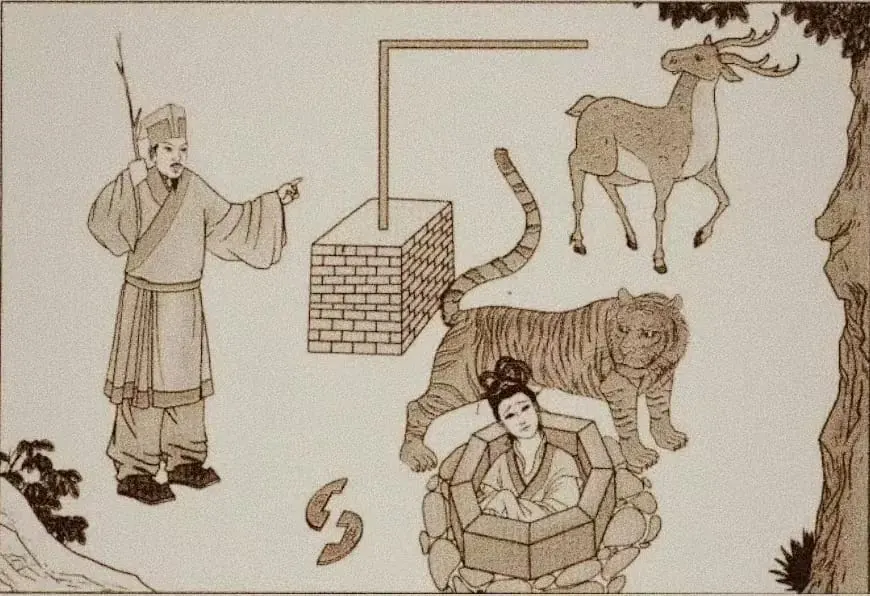
Scene Description
Image Symbolism
Reading the Picture
Ming Yi is light gone underground: a time when showing your brightness invites harm, and the wise course is to keep your clarity inside while moving carefully outside.
Start at the bottom, with the woman sitting inside a stone well, hidden away, while a tiger stands over the rim. That is the hexagram in one image: light shut inside the earth, danger prowling above. The Image Symbolism reads the tiger as outsiders watching with hostile intent. Beside the well lies a coin broken in two: money damaged.
On the left a man in an official’s hat holds a bare branch and points toward a brick watch-mound topped by a craftsman’s L-shaped ruler, with a deer beyond. The deer is a pun: 鹿 lù sounds like 禄 lù, income or reward, so chasing it means competing for gain, and the mound blocks the way. A person holding wood, 人 beside 木, forms 休, to stop. The text also mentions the deer looking back, though the drawn deer simply walks away.
The trigrams say the same: Fire ☲, brightness, lies below Earth ☷. The woman hidden in the well matches the fifth line, Jizi veiling his light to survive, and the whole scene echoes the first line’s bird with drooping wings, which withdraws as soon as it senses harm.
- Work
- If your judgement is right but unwelcome, consider keeping it steady and quiet rather than broadcasting it. Ask whether the gain you are chasing is worth the obstacle in the way.
- Relationships
- If someone around you seems watchful or unfriendly, consider gentleness on the outside while you hold to your own standards inside. Too sharp an eye for faults can leave you alone.
- Timing
- This is a dark stretch, not a time to force things. If you sense harm starting, stepping back early is wiser than waiting until you can no longer withdraw.
Line Statements
Listed from the bottom line to the top line.
- First nine: Brightness injured in flight, wings drooping. The noble person on a journey goes three days without eating. Going somewhere, the host has words.
- Six in the second place: Brightness injured in the left thigh. Rescue with a strong horse. Good fortune.
- Nine in the third place: Brightness injured during a southern hunt; gaining the great leader. Do not press for steadfastness too quickly.
- Six in the fourth place: Entering the left belly, obtaining the heart of injured brightness, then going out through the courtyard gate.
- Six in the fifth place: Jizi's injured brightness. It is beneficial to be steadfast.
- Top six: No brightness, only darkness. First ascending to heaven, then entering earth.
Meaning of the Hexagram
Translated from the Chinese 人间道 commentary with AI assistance; translator notes appear in brackets.
“Ming Yi: it is beneficial to be steadfast in hardship.”
In a time of Ming Yi (Darkening of the Light), the noble person must know how hard the times are and must not lose the right way; only then is he noble. The petty person flatters, cares only for profit, and follows whoever holds power, with no regard for the right way.
“The light enters into the earth: Darkening of the Light. Inwardly cultured and bright, outwardly gentle and yielding, and so passing through great hardship: King Wen did this.”
In a time when the light is darkened, the noble person knows that whoever shows his brightness will surely be harmed. So he seeks a stance that is bright within and yielding without, and meets the time of great hardship in that way. Then inwardly he does not lose his clarity, and outwardly he can keep far from calamity. Here lies the subtlety of the Changes: the virtue of the hexagram is also its remedy.
“It is beneficial to be steadfast in hardship: one veils one’s light. Amid difficulty within, one can keep one’s purpose upright: Jizi did this.”
In a time of hardship, one who knows to veil and hide his light is safe; one who does not know to hide it will surely bring calamity on himself, and one who cannot hold to what is right is surely no worthy person.
“The light enters into the earth: Darkening of the Light. The noble person accordingly oversees the multitude: he uses obscurity and yet remains clear.”
Observing the light entering the earth, the way of Ming Yi, the noble person understands that he should not push his clear-sightedness to the limit but should use the way of obscurity. When he oversees the multitude in this way he can surely tolerate others and live in harmony with the many, so that the people draw close and are at peace. It is like the saying: when water is perfectly clear there are no fish, and when a person is too discerning he has no followers.
“Brightness injured in flight, wings drooping. The noble person on his travels goes three days without eating. He has somewhere to go; the host has words for him.”
This is the beginning of the darkening of the light, the start of being harmed. A benighted ruler is above, and people of yang firmness cannot advance, like a bird whose wing is hurt in flight: when petty people harm the noble, they always harm the very means by which he moves forward.
The noble person can see things in their faintest beginnings. As soon as he sees harm beginning, he avoids it; even if this leaves him destitute, he still withdraws, goes to a place that suits him, and never hesitates in what he does because of the world’s opinion. Ordinary people cannot see harm at its start and do not know to withdraw; by the time they themselves are hurt, they can no longer get away.
“The noble person on his travels: by what is right he does not eat.”
Where rightness leads, he will not do what is wrong even if it leaves him destitute. That is why the noble person can be at peace amid hardship and gloom.
“Brightness injured in the left thigh. Rescue with a strong horse. Good fortune.”
The second six is a yin line in a yin place, and it has the virtue of being central and correct. It goes along with the times and knows how to conduct itself; this is the highest good. But in a time when the light is darkened it cannot avoid some injury. If it is as strong as a strong horse, it can escape harm and have good fortune; if its way of conducting itself is not strong, the injury will be deep.
“The good fortune of the second six: it is yielding, yet has principle.”
It is yielding in how it conducts itself and yet has principles, in accord with the way of the centre and correctness. So it will surely be able to live through a time when the light is injured and keep its good fortune.
“Brightness injured during a southern hunt; gaining the great leader. Do not press for steadfastness too quickly.”
The upper trigram is the extreme of darkness, while this line sits exactly at the extreme of brightness: this is the moment when light is about to clash with darkness. In this position the noble person must go forward and remove the harm, and his first task is to capture its ringleader. As for old ills and corrupt customs, these certainly cannot be changed at once. He must understand the way of gradual progress and teach people to change little by little; to demand a drastic reform would only cause unrest, and that is not the best policy.
“The purpose of the southern hunt: great is what it gains.”
The brightness of the lower position is used to remove the darkness of the upper position. The only aim is to remove the harm; otherwise it would be an act of rebellion and disorder.
“Entering the left belly, obtaining the heart of injured brightness, then going out through the courtyard gate.”
This line signifies a petty person of yin and crooked nature in a position close to the ruler. Attaching himself to the ruler with softness and compliance, and wanting to make that bond secure, he uses soft and crooked methods and forms a hidden connection with the one above. And because the ruler is himself a person of yin crookedness, his heart is sure to be beguiled, and he carries that out in his actions. Therefore the ruler must seek clarity and keep to the right way, and not let himself be stirred up and used by petty people; this is what the line means.
“Entering the left belly: obtaining the heart’s intent.”
This is using the crooked, dark way of yin to beguile the ruler’s heart and indulge one’s own selfish desires. If the ruler is a petty person, he will never wake up to it.
“Jizi’s injured brightness. It is beneficial to be steadfast.”
This line speaks of darkness and harm at their utmost. It refers to the one whose brightness is being harmed: if he shows his brightness at this time, he will surely be hurt. If he is like Jizi, who knew how to veil and hide it, he can escape the disaster; if he does not know how to hide his brightness, the harm will be great.
“Jizi’s steadfastness: his brightness cannot be extinguished.”
Jizi knew to veil and hide his brightness in a time of darkness and harm, and yet he did not lose his resolve and [did not] sink into corruption together with the people of darkness, so his brightness could not be put out. A petty person, pressed by calamity, will surely lose his integrity. [The source reads 同与阴暗之人合污, ‘joined in corruption with the people of darkness’; a negative appears to be missing and is supplied in brackets.]
“No brightness, only darkness. First ascending to heaven, then entering earth.”
This is the very height of brightness, yet harmed in this time. It could have shone far, but now its brightness is harmed; it is bound to become not bright but dim and dark, and so loses its way.
“First ascending to heaven: it lights up the four quarters. Then entering earth: it loses its rule.”
At first it rises to heaven and can light up every direction; now, harmed and darkened, it loses its way instead.
Show the Chinese original (人间道)
明夷:利艰贞。 君子处明夷之时,须知时之艰难,必求不失正道,方为君子。小人则阿谀奉承,唯利是图, 顺附势而为,不顾正道。
明入地中,明夷,内文明而外柔顺,以蒙大难,文王以之。 君子处明夷之时,知明者必见伤,故求内明外顺之态势,应对大难之时,如此可内不失明, 外又可远祸患。易之妙即在此,卦之德本亦卦之解也。 利艰贞,晦其明也,内难而能正其志.箕子以之。 处艰难时,能知晦藏其明,不知藏晦,必生祸患,不能守正,必非贤人。
明入地中,明夷,君子以莅众,用晦而明。 君子观明入地中,明夷之道,乃知不极其明察而用晦之道,于莅众之时,如此必能容物和 众,众亲而安,犹水至清则无鱼,人至明则无徒亦然。
明夷于飞,垂其翼。君子于 行,三日不食,有攸往,主人有言。 明夷之初,乃见伤之始,暗君在上,阳刚 之人不得上进,犹鸟飞而伤翼,小人害君子皆 害其所以行。君子之人能见事于微末,始见伤, 则避之,即令困穷亦退避之,取适之位而往, 絶不以世俗之见而迟疑所行也。常人无法见伤 于始,不知退避,至伤于己时,已不能退也。
君子于行,义不食也。
义之所至,即令困穷,亦不所为不正,故 君子能安之于苦闷。
明夷,夷于左股,用拯马壮, 吉。 六二乃阴居阴位,得中正之德,顺时知处, 乃至善也。但处明夷之时,亦不免有所损伤, 但须如马之壮,可获免伤而吉,如自处之道不 壮,则伤之深矣。
六二之吉,顺以则也。
顺处且有原则,合于中正之道,故必能处 明伤之时,而能保吉也。
明夷于南狩,得其大首,不 可疾贞。 因上卦暗极,而又正居明之极,明即将与 暗冲突之时也。居此,君子必前进除害,以获 之魁首,为要务,至于旧疾败俗,必不能立刻 改变,须知渐进之道,教其渐改,如求剧革必 令不安,非上策也。
南狩之志,乃大得也。
用下位之明,来除上位之暗,唯求目的在 除害而已,如不然则为背乱之事也。
入于左腹,获明夷之心,于 出门庭。 此爻意阴邪之小人,处近君之位,乃以柔 顺附于君主时,为保其固交,乃以柔邪之法, 隐敝之交而结于上。而君本阴邪之人,必受蛊 惑其心,而行之于外。故君必求明,守正道, 而不为小人所煽动,所利用也,即此。
入于左腹,获心意也。
此以邪恶之阴道惑于君心,而逞其私欲, 君为小人,必始终不悟也。
箕子之明夷,利贞。 此爻言暗伤至极,乃谓明见伤之主,若于 此时显示其明,必见伤害。要如箕子之知晦藏, 则可免于难,若不知晦藏其明,则害大矣。
箕子之贞,明不可息也。 箕子知晦藏其明于暗伤之时,且能不失意 志,同与阴暗之人合污,其明必能不灭,小人 若受祸患所逼,必失其节守也。
不明晦,初登于天,后入于 地。 明之至高而又伤于此时,本可远照,今伤 于明,必不明反昏悔,反失其道也。
初登于天,照四国也,后入 于地,失则也。 始登于天,能明照四方,今伤于昏暗,反 失其道。