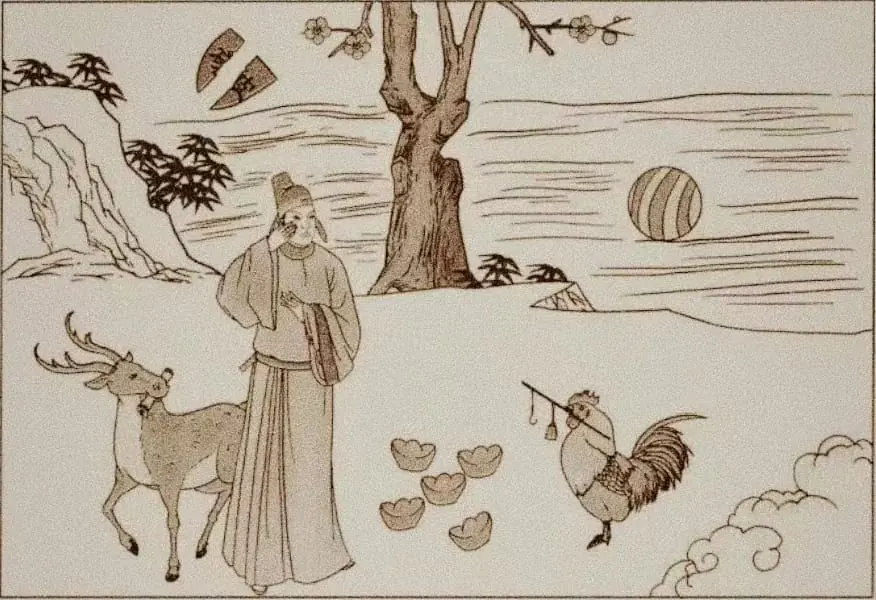
Scene Description
Image Symbolism
Reading the Picture
Jin is advance in the open, like the sun rising over the earth, but the picture shows the climb starting badly: setbacks first, recognition later than hoped.
Start with the official in the centre, hand raised to his face: the Image Symbolism reads embarrassment, and the torn document above him as a plan or appointment that has fallen through. The striped ball resting on the lined ground, called mud in the text, shows what is pursued too eagerly getting stuck. This is the first line: advancing, then checked, so stay generous until trust is given.
Then look for the turn. The bare trunk behind him puts out plum blossoms, a late flowering. The deer carries something in its mouth, read as a letter: 鹿 lù sounds like 禄 lù, reward. The rooster holds a steelyard; 秤 chèng (scales) echoes 称心 chènxīn, getting what you wished for. The gold ingots at his feet complete the turn toward reward.
Earth ☷ below and Fire ☲ above give brightness rising out of the ground. The motto, a minister meeting his ruler, matches the second and fifth lines: steady integrity is eventually noticed, and then gain and loss need not be fretted over. The text also mentions a person by water and dots on a stone; neither is drawn.
- Work
- If a proposal or promotion was just turned down, consider whether trust has not yet been built. Keep doing the work well, open-handed rather than grasping.
- Relationships
- If you feel overlooked, ask whether you are pressing for reassurance too early. The second line suggests that consistency, more than pressure, draws a response.
- Timing
- This is a rising time with a slow start. Treat early disappointments as the bare branch before the blossom, but heed the top line: do not force the final step.
Line Statements
Listed from the bottom line to the top line.
- First six: Advancing, then checked. Steadfastness brings good fortune. Without trust, remain generous; no blame.
- Six in the second place: Advancing with anxiety. Steadfastness brings good fortune. One receives this great blessing from one's grandmother.
- Six in the third place: The multitude agrees. Regret disappears.
- Nine in the fourth place: Advancing like a large rat. Steadfastness is dangerous.
- Six in the fifth place: Regret disappears. Do not worry about loss and gain. Going brings good fortune; nothing is unfavorable.
- Top nine: Advancing the horns. Use only to attack one's own town. Danger and good fortune, no blame; steadfastness brings regret.
Meaning of the Hexagram
Translated from the Chinese 人间道 commentary with AI assistance; translator notes appear in brackets.
“Jin: the marquis who brings peace is presented with horses in great numbers, and is received three times in a single day.”
There is a feudal lord able to govern and bring peace, called the Marquis Kang. Because he is clear-sighted, and those below him submit and follow, he has the image of serving the king; so he is seen with many horses drawing his carriage and receives generous gifts. This is the height of royal favour. Here there is clarity above and compliance below: it is a time of flourishing advance.
“Jin means advancing. Brightness emerges above the earth; compliant, it clings to the great brightness. The soft advances and moves upward. Therefore the marquis who brings peace is presented with horses in great numbers and is received three times in a single day.”
Jin (Progress) is brightness advancing and flourishing. Here there is brightness without and compliance within, so it can take in brightness until it becomes great brightness, like a good minister of compliant virtue who attaches himself to a bright ruler. The soft occupies the ruler’s place; it is clear-sighted and compliant, attached to the ruler above and in accord with the people below. Hence it is the Marquis Kang. This is the way of a feudal lord.
“Brightness emerges above the earth: Progress. The noble person accordingly makes his own bright virtue shine.”
Seeing brightness rise above the earth, the noble person understands that drawing near to brightness is what advance means. So he knows that only by making bright virtue shine in himself, seeking to be clear-sighted and virtuous in his own person, does he follow the way of advance.
“Advancing, then checked. Steadfastness brings good fortune. Without trust, remain generous; no blame.”
The first line is the beginning of advance. Someone who has only just begun to advance and wants to rise quickly will not get his wish, because those above cannot trust him at once. He must hold to himself and stay content in his position, generous and undemanding, and wait until he has won the trust of those above. When a petty person, at the start of his advance, seeks the trust of those above, he is bound to do harm to what is right, and he invites blame and regret. Only the noble person knows the way of advancing and withdrawing.
“Advancing, then checked: walking alone in what is right. Remain generous, no blame: one has not yet received a commission.”
Between advancing and withdrawing, only the noble person can walk the right way alone, going only where rightness leads, and only then does he take office. While he has not yet received a commission, he remains generous and asks for nothing. If, having won the trust of those above and been loyal to his duties, he nevertheless loses his post, the noble person will not stay a single day longer; he will withdraw and keep his distance.
“Advancing with anxiety. Steadfastness brings good fortune. One receives this great blessing from one’s grandmother.”
Keeping to the right way amid advance and withdrawal brings good fortune. Although the second line has no helper in its position, it keeps to what is right, and in time this becomes evident. It naturally finds a response from the one above in the ruler’s place, the six in the fifth place, and those above will seek it out of their own accord, because their virtue is the same.
“Receiving this great blessing: because one is central and correct.”
Although one is in a low position, if one holds to the way of the centre and correctness for a long time, there will in the end be success. What is more, there is a bright ruler above; although his position is distant, one is sure to receive blessing because of shared virtue.
“The multitude agrees. Regret disappears.”
A soft line in a firm position, and neither central nor correct: this is a time of occupying a position that does not suit one, and there is bound to be regret and blame. Only if, at such a time, one can plan with clarity and go along with the multitude, in accord with the heart of Heaven, is there good fortune.
“The will that the multitude agrees with: it moves upward.”
Able to go along with the will of the multitude, it stands at the top of the lower position and also follows the bright ruler above; it is in harmony with the will of the many.
“Advancing like a large rat. Steadfastness is dangerous.”
A firm yang line in a yin position occupies a place that does not suit it; it holds on to its position out of greed. One who is greedy and yet afraid of others is the large rat (鼫鼠). It is near the ruler’s position yet unsuited to it, while those below are also seeking to advance. If at such a time it harbours fear and suspicion, danger is sure to arise.
“Large rat, steadfastness is dangerous: the position is not appropriate.”
Not correct, yet in a high position, always harbouring greed and the fear of losing what it has, and clinging to it without letting go: this invites danger.
“Regret disappears. Do not worry about loss and gain. Going brings good fortune; nothing is unfavorable.”
A soft line in the place of honour is not in its correct position, and this would normally be unfortunate. But because it uses the virtue of great brightness, and those above and below all attach themselves to it and follow, it turns out fortunate instead. Because those below follow and attach themselves to it, it can entrust the talents of the many with complete sincerity and so bring relief to the whole world.
A bright ruler does not worry that his light cannot reach far; he worries that he uses his clarity too minutely, scrutinising everything, and so loses the way of entrusting others. If he relies on his own clarity and assigns tasks with partiality, according to private preference, the world can never be governed for the common good.
“Do not worry about loss and gain: going brings blessing.”
When there is a ruler of shining brightness, those below attach themselves to him and follow, and he can entrust them in good faith, he is sure to accomplish great things for the world, and going forward is sure to bring blessing.
“Advancing the horns. Use only to attack one’s own town. Danger and good fortune, no blame; steadfastness brings blame.”
A firm yang line in the very highest place has the image of horns; this speaks of the extreme of advance. Being too firm, one easily errs through haste and impatience; already firm by nature and impatient to advance, one is bound to make mistakes. Only when this is used for setting one’s own domain in order (‘attacking one’s own town’) can there be no trouble. If it is used to deal with what lies outside, it turns out unfortunate instead.
Look at how people govern themselves: a firm person holds to the way securely, and one who is impatient to advance moves toward the good all the faster. Only if this accords with the way of the centre and correctness can there be no blame.
“Use only to attack one’s own town: the way is not yet bright.”
The complete way can bring peace within and repel what is without. Here one uses it only to attack one’s own town: one can order what is within but not what is without, so the way is not yet great and bright.
Show the Chinese original (人间道)
晋:康侯用锡马蕃庶,昼日三接。 有能治安之诸侯,名康侯,其因能明,下体顺附,承王之象,则见众多之马驾,有重赐, 乃宠遇之至也,此上明下顺,乃进盛之时。
晋,进也。明出地上,顺而丽乎大明,柔进而上行,是以康侯用 锡马蕃庶,昼日三接也。 晋乃明进而盛,此外明内顺,故能包明至大明,如顺德之良臣,附丽于明主也。柔居君位, 能明而顺,上附于君,下顺于民,故为康侯,此为诸侯之道也。
明出地上,晋,君子以自昭明德。 君子观明出地上,近明为晋,故知惟昭明德于已,求己之明且有德,为晋之道。
晋如摧如,贞吉,罔孚,裕 无咎。 初爻乃晋之始时,始进而求快升,必不遂 其意,因上位未能遽信,必当自守安位,宽裕 不求,以待上位之信方可。小人始进而求上信, 则必伤于义,皆招咎悔。此君子方知进退之道。
晋如摧如,独行正也。裕无 咎,未受命也。 进退之间,惟君子能独行正道,唯义之所 趋,方可出仕,未受命时,皆宽裕无求。若能 信于上,忠职守,却反失去职务,则君子一日 不居,必退而远之。
晋如愁如,贞吉。受兹介福, 于其王母。 进退之间守正道,当吉,二爻之位虽无援, 因能守正,日久彰显,自得上六五君位之人相 应,上位自当求之,因德同也。
受兹介福,以中正也。
虽居下位之人,能永持中正之道,久必有 亨。更加有明君在上,虽位远,但必因同德受 福。
众 众 众 众允,悔亡。 柔居刚位,又不中正,此乃居不适位时, 必有悔咎,惟居此时,能明谋从众,顺应天心, 吉。
众 众 众 众允之志,上行也。 能顺从众志,居下位之上,又上从明君, 合于众志。
晋如鼫 鼫 鼫 鼫鼠,贞厉。 阳刚居阴位,非适其位而居之,乃贪据其 位,贪而畏人者,范鼠也,近君之位又不适, 下位又求上进,居此时生畏忌之心,必生危矣。
鼫 鼫 鼫 鼫鼠贞厉,位不当也。 不正又居高位,时怀贪而惧失之心,坚守 此不放,招危险也。
悔亡,失得勿恤,往吉,无 不利。 柔居尊位,乃不正位,本凶。但用大明之 德而上下皆附顺,故反吉。因下之顺附,必能 尽诚委任众人之才,以济天下。明君不患其不 能明照,患其用明之过于察察,有失委任之道, 自任其明而以私意偏任,天下必无法为公。
失得勿恤,往有庆也。
有明明之君,下又上附顺,能推诚委任, 必能成天下之大功,往必有福也。
晋其角,维用伐邑,厉吉, 无咎,贞咎。 阳刚又居最上,如角之象,此言进之极, 过刚则易失于躁急,本刚又急于求进,必有失 也。此惟有用于治内(伐邑〕可以无患。但如 用其治外,反凶。观人之自治,能刚之人守道 必固,求进燥急之人必迁善益速,唯须合中正 之道,可无咎。
维用伐邑,道未光也。
尽善之道,能安内攘外,今维用伐邑,能 治内不能治外,其道未光大也。