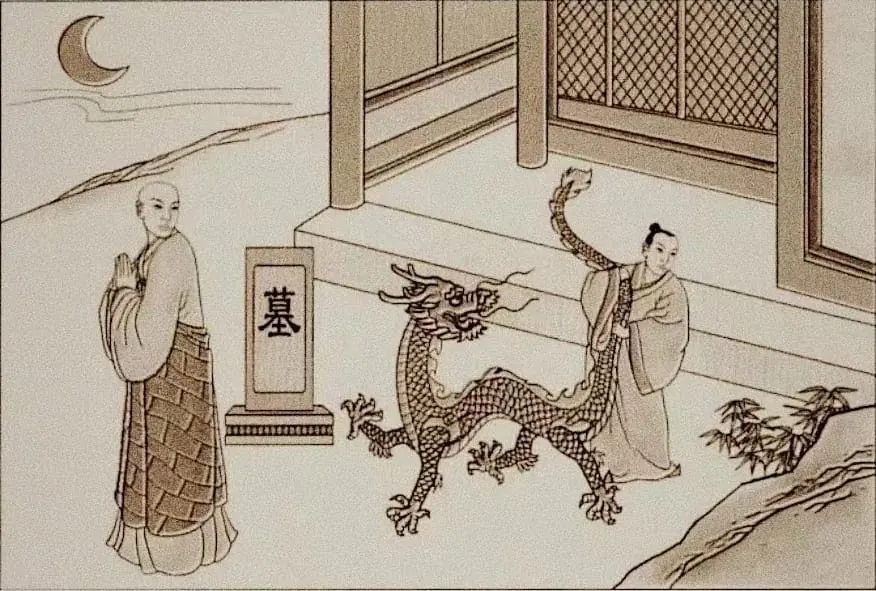
Scene Description
Image Symbolism
Reading the Picture
Xu is waiting: strength is ready, but danger lies ahead, like clouds massed in the sky that have not yet turned to rain.
Look first at the young man in front of the hall, gripping a dragon by the tail. The dragon is the image of strength and rank; the Image Symbolism reads this as attaching oneself to someone powerful in the hope of taking their place. Holding a dragon by the tail is no way to steer it, and the stone marked 墓 (tomb) standing in its path shows where a strong move made at the wrong time can lead. Opposite them, a monk stands quietly with his palms together. He is the counter-image: calm, without craving, simply waiting.
The trigrams frame the scene. Heaven ☰ below is firm strength; Water ☵ above is danger, and water high in the sky is cloud that has not yet rained. A thin crescent moon hangs in the corner, which the Image Symbolism reads as clarity for one who does not grasp for responsibility. The lines move step by step toward the danger, from the outskirts to sand to mud, and the tomb recalls the top line’s “entering the pit,” where calm, respectful reception of unexpected guests still ends well. The large gate behind them stands for a powerful household or office: the prize the hurried hand is reaching for.
- Work
- If you are pushing to get ahead by attaching yourself to someone powerful, consider whether you are steering or just holding on. Building your own ability while you wait is rarely wasted.
- Relationships
- If things are not yet settled, consider meeting people with patience and good grace instead of pressure. Small criticism can pass if you stay centred.
- Timing
- The rain has not fallen yet. If you can, wait at a safe distance and keep your ordinary routine; ask whether moving now would put you in the mud.
Line Statements
Listed from the bottom line to the top line.
- First nine: Waiting in the outskirts. It is beneficial to persevere. No blame.
- Nine in the second place: Waiting on sand. Some criticism; good fortune in the end.
- Nine in the third place: Waiting in mud brings robbers.
- Six in the fourth place: Waiting amid blood. Come out of the pit.
- Nine in the fifth place: Waiting with wine and food. Steadfastness brings good fortune.
- Top six: Entering the pit. Three uninvited guests arrive; treat them respectfully and there will be good fortune in the end.
Meaning of the Hexagram
Translated from the Chinese 人间道 commentary with AI assistance; translator notes appear in brackets.
“Xu: there is sincerity; bright success; steadfastness brings good fortune. It is beneficial to cross the great river.”
In terms of the two trigrams: Qian (The Creative) is firm and strong, and if it advances upward it meets danger; it cannot yet advance, and must wait. In terms of the lines: the fifth line is a yang line in a yang position, a person of firm, central and correct virtue occupying the ruler’s position, with sincerity and trustworthiness full within (the inner trigram is Qian). Then there is brightness and one can advance; there will surely be success, and so it is beneficial to cross the great river.
“Xu means waiting: danger lies ahead. Being firm and strong, one does not fall in; the meaning is that one will not be trapped or exhausted.”
Because danger lies ahead, one cannot rush forward but must wait before advancing. With the firm strength of Qian, if one can wait and not move lightly, one will not fall into danger and will certainly not end up trapped and exhausted. Nowadays there are many firm and strong people, and their movements are always rash; if they could wait for the right time to move, that would be the best way.
“‘Xu: there is sincerity; bright success; steadfastness brings good fortune’: it occupies the position of heaven, correct and central.”
Sincerity (孚) means being solid at the centre. The fifth position is firm and solid and in the centre; this is the image of sincerity. Occupying the position of heaven and able to be correct and central, it is bright and successful; and it must also be steadfast and correct (firm of heart): then there is good fortune.
“‘It is beneficial to cross the great river’: going forward brings achievement.”
Because one is solid within (inner learning and integrity) and steadfastly correct (firmly set on the Way), even when crossing danger and obstruction one can achieve something. So the way of Xu lies in having the firm nature of Qian while knowing the way of waiting; then what could be unfavorable?
“Clouds rise up to heaven: Waiting. The noble person accordingly eats and drinks, feasts and is joyful.”
This is an image from nature: water that has risen to the sky but has not yet become rain is cloud. It is like the noble person who has stored up talent and virtue but has not yet put them to use. Holding his great talent, he waits calmly for the right time; he eats and drinks to nourish his body, and feasts and enjoys himself to keep his mind in harmony.
“Waiting in the outskirts. It is beneficial to persevere. No blame.”
The first line is the farthest from danger, so it waits in the outskirts (an open, distant place). So when the noble person is in an open, distant place and still calmly keeps to his constant ways, there is no blame or disaster. If he advances rashly and runs into difficulty, disaster will surely come.
“Waiting in the outskirts: not setting out to run into difficulty. It is beneficial to persevere, no blame: one has not lost one’s constancy.”
The noble person stays out in the open country and does not set out into danger and difficulty; he should rest calmly where he is, not lose his constancy, and keep a steady, quiet mind that does not stir. If, though not advancing, his will is restless, he cannot rest in his constancy.
“Waiting on sand. Some criticism; good fortune in the end.”
Kan is water, and near water there is sand. This second position is near danger, hence waiting on sand. The noble person knows he is gradually approaching danger and difficulty; though it has not yet come to harm, there is already a little criticism. This shows that the injury of words is the smallest of injuries. The second position is occupied by a yang line, showing a person of firm talent in a soft position who keeps the virtue of centrality and correctness; although there is a little injury from words, there is no great harm, and in the end there is good fortune.
“Waiting on sand: there is ease at the centre. Though there is some criticism, it ends in good fortune.”
This implies that although the second position is near danger, if one stays in the centre with a generous ease, then even with a little injury from words, one obtains good fortune in the end.
“Waiting in mud brings robbers.”
Mud is right up against the water. Because it presses close to danger, it brings on robbers and trouble. This line sits at the top of the strong trigram and has the image of pressing forward; unless it is careful, it will in the end meet loss and defeat.
“Waiting in mud: disaster is outside. One brings the robbers on oneself; with reverent caution one will not be defeated.”
The third position is the closest to the danger above, so it says that disaster is outside. The cause of the robbers’ coming is really one’s own pressing forward. One must be reverent, cautious and careful, and advance only as far as is fitting; then there will be no loss or defeat. The meaning lies in watching for the right moment to move; the warning is a strong one. It is the image of needing to be on guard even in times of strength.
“Waiting amid blood. Come out of the pit.”
The fourth line, with a soft yin nature, sits within danger, and below it the three yang lines are advancing; it is bound to be hurt by danger and difficulty. Because it is hurt, it cannot stay settled and loses its dwelling; hence “come out of the pit.” If it yields to the times and complies, and does not contend with danger and difficulty, it will not come to misfortune. Lacking the virtue of centrality and correctness, if it simply contended with the danger by force, that would be precisely the way to bring misfortune.
“Waiting amid blood: yielding and listening.”
The meaning is that a soft yin nature in a position near danger, unable to stay, withdraws; by yielding and listening to the times, it does not come to misfortune.
“Waiting with wine and food. Steadfastness brings good fortune.”
This is the fifth position, the ruler’s. A firm yang person is in the centre and need only wait at ease with wine and food; what he waits for will surely come. Firm of heart, he will surely have good fortune.
“Wine and food, steadfastness brings good fortune: because it is central and correct.”
Firm, yang, central and correct, in the ruler’s fifth position: with wine and food alone it can fulfil its way.
“Entering the pit. Three uninvited guests arrive; treat them respectfully and there will be good fortune in the end.”
A soft yin line in the sixth place is the limit of waiting; it must be at peace where it is. This is the meaning of entering the pit. If it is at peace and stays put, the three yang lines below will surely come. “Uninvited” means they come of themselves without being urged. At this time one must receive them with utmost sincerity and full respect; then, however firm and fierce they may be, there is no reason for them to bully or humiliate. This is because the sixth is a yin position, not [a rival to] the three yang lines of the Qian trigram, whose will is set on seizing; so treating them respectfully brings good fortune. [The last sentence is compressed in the source.]
“Uninvited guests come; treat them respectfully and there will be good fortune in the end. Though not in its proper place, it has not greatly erred.”
“Not in its proper place” means that danger is at the top. The sage makes clear that yin ought to be below but is now above; this is not being in its proper place. But if one conducts oneself with care, then however firm the yang may be, it cannot bully, and in the end there is good fortune.
Show the Chinese original (人间道)
需:有孚,光亨贞吉,利涉大川。 以二卦体而言,干以刚健,如上进而遇险,此未可进也。需待之。以卦之爻言,五爻阳居 阳位,乃阳刚中正之德人,居君位,而诚信充实于内(内卦为干),则光明而可进,必亨,故 利涉大川。
需,须也,险在前也,刚健而不陷,其义不困穷矣。 因险在前,未可遽进,须待而进,以干之刚健,能待而不轻动,则不陷险中,则必不至困 穷。时下刚健之人颇多,其动必躁,如能待时而动,则为至善之道。 需:有孚,光亨贞吉,位乎天位以正中也。 孚,中实之义。五位因刚实居中,此孚之象,此居天位而能正中,光明而亨通,且须贞正 (坚心),吉也。
利涉大川,往有功也。 因中实(内之学问、操守)而贞正(坚心向道),即涉险阻,亦可有功也。故需之道在以 干刚之性而知待之道,何所不利。
云上于天,需,君子以饮食宴乐。 此自然之象,水上于天未成雨,为云。犹君子积蓄其才德,而未施于用也,怀其大才,安 以待时,饮食以养身体,宴乐和其心志也。
需于郊,利用恒,无咎。
初爻因最远于险,故于郊(旷远之地), 故君子处于旷远之地,仍安守其常,则无咎灾 也。如躁进犯难,则必灾至矣。
需于郊,不犯难行也,利用 恒,无咎,未失常也。 君子处下野,不冒犯险难而行,复宜安处, 不失其常,保持恒静心亦不动,如虽不进而志 动,则不能安其常也。
需于沙,小有言,终吉。
坎为水,水近则有沙,此二爻之位近险, 故需于沙。君子知渐近于险难,虽未至于害, 已小有言矣。此示言语之伤,至小者也。二爻 以阳爻居之,示人阳刚之才居阴柔位,守中正 之德,虽小有言语之伤,而无大害,终也吉。
需于沙,衍在中也;虽小有 言,以吉终也。 此寓,二位虽近险,而如以宽裕居中,即 小有言语之伤,及终得吉。
需于泥,致寇至。
泥,逼近于水也。因逼近于险,而致寇难 之至,此居健体之上,有进动之象,苟非谨慎, 终致丧败也。
需于泥,灾在外也。自我致 寇,敬愼不败也。 三位居上险之最近,故云灾在外。此寇致 之因,实乃己之逼也。须敬慎小心,量宜而进, 则无丧败。义在相时机而动,戒之盛也。即盛 时须戒之象。
需于血,出自穴。 第四爻位以阴柔之质居于险,下又有三阳 之进,必伤于险难。因伤于险难,必不可安居, 而失其居所,故出自穴。此顺时以从,不竞于 险难,则不至凶也。又无中正之德,只以刚竞 于险,此适足以致凶之道也。
需于血,顺以听也。 意为阴柔之性居近险之位,不能处,则退, 以顺从而听于时,不至凶也。
需于酒食,贞吉。 此五君位,阳刚之人居中,只需宴安酒食 以待之,所需必得也。坚心,必吉。
酒食贞吉,以中正也。 阳刚中正居五之君位,只需酒食,即可尽 其道也。
入于穴,有不速之客三人来, 敬之终吉。 阴柔于六位,乃需之极限,须安其处,此 入于穴之义。安而止居,则下之三阳必来。不 速,不促之而自来也。此时须以至诚尽敬之心 以待之,虽再刚暴,必无欺凌之理也,此因六 位阴位,非三阳干体之人,志在必夺,故敬之 则吉。
不速之客来,敬之终吉;虽 不当位,未大失也。 此不当位,意为以险而在上也。圣人明示 阴宜居下而今居上,此不当位也。但如能谨慎 自处,则阳再刚亦不能欺,终得其吉。