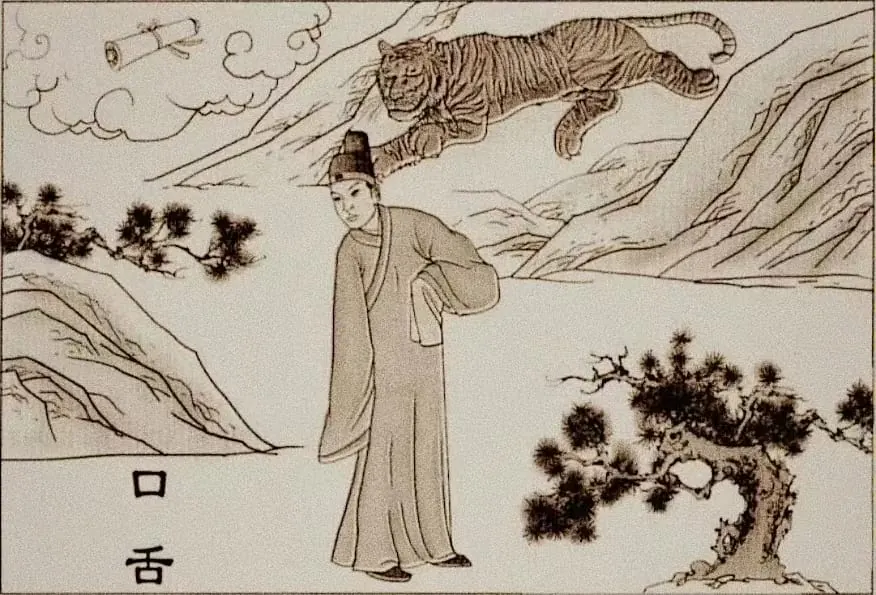
Scene Description
Image Symbolism
Reading the Picture
Song is conflict: two forces pulling in opposite directions, and a person standing close to danger while words fly.
Start with the large characters 口舌 at the lower left, literally “mouth and tongue,” the usual phrase for quarrels and gossip. The man in the centre is looking down toward them, while just above his head a tiger lies stretched along the mountain ridge. The description calls it a sleeping tiger: a danger you can walk under without noticing. That is the situation of conflict, where an argument draws you closer to real risk than you realise. Up in the clouds floats a rolled document, which the Image Symbolism reads as a hoped-for outcome that stays out of reach.
The trigrams explain why this is a picture of conflict. Heaven ☰ above rises, Water ☵ below sinks; the two move apart, just as the Image says heaven and water go contrary ways. The text names a willow, a tree that bends in the wind without breaking; the artist has drawn pine-like trees instead, but the lesson of bending still applies. It fits the second line, which retreats from a contest it cannot win and so keeps its town free of harm, and the top line, whose prize won by fighting is stripped away three times.
- Work
- If a dispute at work is escalating, consider whether winning it is worth the cost. Settling early, or asking a fair third party to judge, may protect more than it gives up.
- Relationships
- If you and someone close keep pulling in opposite directions, ask whether you can bend first and reason afterward. A quarrel pushed to the very end rarely leaves either side better off.
- Timing
- This is not the moment for bold crossings. If the outcome is still floating in the clouds, plan carefully at the beginning and stay on safe ground.
Line Statements
Listed from the bottom line to the top line.
- First six: Do not prolong the matter. Some criticism; good fortune in the end.
- Nine in the second place: Unable to win the lawsuit, return and flee. The three hundred households of one's town suffer no harm.
- Six in the third place: Live on former virtue. Steadfastness amid danger brings good fortune in the end. If you serve in the king's affairs, claim no achievement.
- Nine in the fourth place: Unable to win the lawsuit, return to the mandate, change and rest in steadfastness. Good fortune.
- Nine in the fifth place: Litigation. Great good fortune.
- Top nine: Perhaps granted a ceremonial belt, only to have it stripped away three times before morning ends.
Meaning of the Hexagram
Translated from the Chinese 人间道 commentary with AI assistance; translator notes appear in brackets.
“Song: there is sincerity, but it is obstructed; be wary. Halfway, good fortune; carried to the end, misfortune.”
The way of conflict requires being solid at the centre; if there is nothing solid within, it is false accusation, the way to misfortune. Conflict means disputing with others and waiting for someone else to decide; even with sincerity, one will still meet obstruction. So if one has inner solidity there is good fortune, but pushing the matter to its very end brings misfortune.
“It is beneficial to see a great person. It is not beneficial to cross the great river.”
Because those in conflict seek to have right and wrong argued out, it is beneficial to see a great person; if the great person can settle the dispute with firm, clear-sighted centrality and correctness, there is good fortune. Because conflict is not an auspicious affair, one must choose a safe place to stay and must not fall into danger; therefore it is not beneficial to cross the great river.
“Song: firm above and dangerous below; danger joined to strength: this is Conflict.”
Here there is danger within and strength without; this is where conflict arises. If there were strength without danger, conflict would not arise; if there were danger without strength, one could not engage in conflict. It is like a person who cares only for outward show and has no real substance within; this is the source of conflict.
“‘Song: there is sincerity, but it is obstructed; be wary. Halfway, good fortune’: the firm comes and attains the centre.”
In conflict there is inner solidity and firm strength; but in a time of conflict, even with inner solidity there are still obstacles, and one must be wary and fearful; then there is good fortune.
“‘Carried to the end, misfortune’: conflict cannot be brought to completion.”
Because conflict is not a good thing in itself but something one is forced into, pushing it to its end brings misfortune.
“‘It is beneficial to see a great person’: what is valued is centrality and correctness. ‘It is not beneficial to cross the great river’: one would fall into the abyss.”
If one meets a great person who is central and correct, there is good fortune. In a dispute with others, one must first stand on safe ground; to walk into danger at will is to be trapped.
“Heaven and water go contrary ways: Conflict. The noble person accordingly, in undertaking affairs, plans carefully at the beginning.”
This is because heaven is above and water below; the two trigrams go against each other, and this is the origin of conflict. Observing this image, the noble person knows how disputes arise among people, so in undertaking affairs he is always “careful at the beginning,” cutting off the roots of conflict at the start of a matter; then conflict does not arise.
“Do not prolong the matter. Some criticism; good fortune in the end.”
This soft yin line is in the lowest position; it must never push its dispute to the end. If it does not push the dispute to the end, then although there is a little hurt from words, in the end it obtains good fortune.
“Do not prolong the matter: conflict must not be drawn out. Though there is some criticism, the argument is made clear.”
This is a warning against conflict at its very beginning: being weak and in a low position, it cannot keep it up for long. Once there is a dispute, some small trouble is inevitable; if the reasoning is made clear, in the end there is good fortune.
“Unable to win the lawsuit, return and flee. The three hundred households of one’s town suffer no harm.”
The second and fifth lines are corresponding positions. The second nine is in the position of a general; with firmness it sits in danger and stands opposed to the ruler in the fifth position. Knowing it cannot win against him, it returns and avoids the contest, and lives modestly and simply; then there is no fault. Three hundred households is the smallest of towns; if it held a strong and large position, that would be competing, and there would surely be fault.
“Unable to win the lawsuit, return and flee into hiding. For one below to bring a suit against one above invites trouble as easily as picking something up.”
Because it is not a match in right, it cannot win the dispute and must withdraw from its place. When one below brings a suit against one above, the cause is not right and the strength is insufficient; this invites disaster very easily.
“Live on former virtue. Steadfastness amid danger brings good fortune in the end. Perhaps one serves in the king’s affairs; there is no accomplishment [of one’s own].”
A yin line occupies the third, a firm position; it is a soft yin line between two firm ones. It must understand that although it is in a dangerous place, if it knows danger and is wary, it will surely obtain good fortune in the end. If it keeps to its original station and seeks nothing, conflict does not arise. Or it may accomplish things by following its superior; because it is serving in the king’s affairs, the accomplishment is not its own. Conflict is a matter for the firm and strong, so the first line does not prolong it and the third follows others; both can be made good.
“Live on former virtue: following one’s superior brings good fortune.”
Keeping to one’s station and complying with what the superior does, not acting on one’s own ideas, brings good fortune in the end.
“Unable to win the lawsuit, return to the mandate, change and rest in steadfastness. Good fortune.”
This firm yang line is at the bottom of the Qian (The Creative) trigram; because it is not central or correct, it is inclined to dispute. The fourth position is firm and occupied by a yang line, so although it is strong and wants to dispute, no one opposes it, and the conflict has no way to start. That is, if it can restrain its firm, angry wish to dispute, return to its mandate, change its heart and calm its temper, and turn to resting in steadfastness, there is good fortune.
Mencius speaks of those who “go against the mandate and oppress the people.” [The source’s quotation continues, but what follows is commentary:] One who is firm and strong but not central and correct is restless, so he is not at ease; he is not in a central and correct place, so he is not steadfast; not resting in steadfastness, he is fond of disputes. Fang (方) means not complying.
“Return to the mandate, change and rest in steadfastness: nothing is lost.”
If one can act as described above, nothing is lost, and there is good fortune.
“Litigation. Great good fortune.”
The fifth nine occupies the place of honour; if it settles disputes with centrality and correctness, there is great good fortune and all is well.
“Litigation, great good fortune: because it is central and correct.”
This says that the way of centrality and correctness, when applied, is sure to bring good fortune.
“Perhaps granted a ceremonial belt, only to have it stripped away three times before morning ends.”
This is the extreme of firm strength, at the very end of conflict. Because of their hard strength, people push disputes to the limit, bring disaster on themselves and ruin their lives. Even if one is good at disputes and wins and is rewarded, the reward comes from enmity and quarrels with others; can it be kept? In the course of a single day it is stripped away three times.
“To receive robes of office through litigation is not worthy of respect.”
If one pushes disputes to the limit, then even if one receives the favour of an appointment, it is not worthy of respect but rather contemptible, and disaster follows close behind.
Show the Chinese original (人间道)
讼:有孚,窒惕,中吉,终凶。 讼之道,必中实,如中无有实,乃诬妄,凶之道也。讼,乃与人争辩,而待决于他人,虽 有孚,仍会窒塞。故有得中实则吉,但终极其事则凶也。
利见大人,不利涉大川。 因讼者求辩曲直,故利见大人,如大人能以刚明中正决其讼,吉。因讼非吉事,须择安地 而居,不可陷于险难,故不利涉大川也。
讼,上刚下险,险而健,讼。 此内险外健,讼之所起。若健而不险,不生讼也。险而不健,不能讼也。犹如一人,只重 外饰,内无真实材料,此为讼之源也。 讼,有孚,窒惕,中吉,刚来而得中也。 讼之,有中实刚健,但处讼之时,虽有中实,仍有阻碍而须惕惧,则吉。 终凶,讼不可成也。
因讼本非善事,乃不得已也,终极其事,则凶矣。利见大人,尚中正也。不利涉大川,入于渊也。 如见中正之大人,吉。与人讼必先居于平安之地,任意行险,则身陷。
天与水违行,讼,君子以作事谋始。 此因天上水下,二卦体相违,讼之由也。君子观象,知人有争讼之道,故行事必「慎始」, 絶讼端于事之始,则讼不生矣。
不永所事,小有言,终吉。
此阴柔居下位,必不可终极其讼也。若不 终极其讼,虽小有言伤,而终得吉。
不永所事,讼不可长也。虽 小有言,其辩明也。 此即于讼之初,即戒讼,因柔弱而居下, 不可长久。因既讼,必有小灾,应辩理之明, 终得其吉。
不克讼,归而逋,其邑人三 百户,无眚。 二爻与五爻为相应之地,九二乃将位,以 刚处险,与五之君位为敌,知不可敌,归而避 之,俭朴自处,则无过矣。三百户,乃邑之至 小者,如处强大,此竞也,则必过也。
不克讼,归逋窜也。自下讼 上,患至掇也。 因义不敌,故不能讼,须避去其所。自下 讼上,义不正,且气势不足,此招祸患之至易 也。
食旧德,贞厉终吉。或从王 事,无成。 阴爻居三阳刚位,乃阴柔居二刚之间,须 知虽处危地,能知危惧,终必获吉。守原之本 分而无所求,则不生讼矣。或从上而成,因从 王事,故不在己也。讼乃刚健之事,故始则不 永,三则从之,皆可使善也。
食旧德,从上吉也。
守其本分,顺从上之所为,非由己意,终 也吉。
不克讼,复即命,渝安贞, 吉。 此阳刚居干下,因不得中正,本必讼。故 四爻刚位阳居之,虽刚健欲讼,而无与对敌, 则讼无由而兴。此即若能克制刚忿欲讼之心, 就于命,革其心,平其气,而变为安贞,吉矣。 孟子云:「方命虐民,夫刚健而不中正,则躁 动,故不安,处非中正,故不贞,不安贞,所 以好讼也。
」方,不顺也。
复即命,渝安贞,不失也。
能如上,则无失,吉也。
讼,元吉。 九五居尊位,治讼得中正,则大吉而尽善。
讼元吉,以中正也。 此云中正之道,施必吉也。
或锡之鞶带,终朝三褫之。 刚健之极,处讼之终极,人因其刚强,穷 极于讼,取祸丧身,即使善讼能胜,即赏,亦 来自与人仇争所得,其能保乎。终一日而见三 次褫夺也。
以讼受服,亦不足敬也。 穷极讼事,即有受命之宠,亦不足以敬, 而可贱恶,祸患随至也。