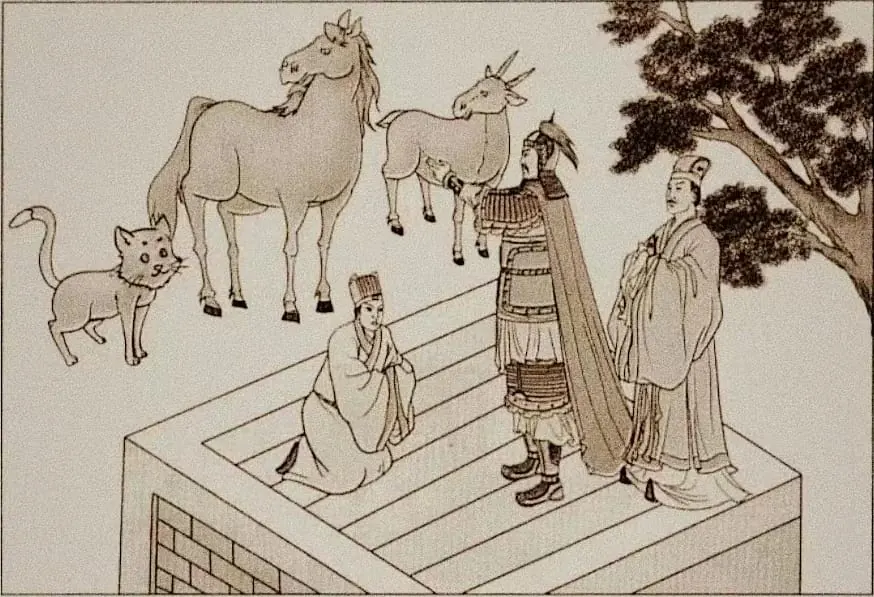
Scene Description
Image Symbolism
Reading the Picture
Shi is the army: a large force gathered and put in order, which succeeds only under a rightful cause and a commander everyone trusts.
Begin with the platform. An armoured general stands on it beside a civil official, and a third man kneels before them. The description says a seal of command is being conferred, though no seal is actually drawn. Either way, the scene is about appointing one leader and giving him real authority, which is the heart of the second line, where the king grants his commission three times. Note that the civil and the military stand together: force is meant to serve a legitimate order.
Behind them wait a horse, a goat-like sheep and a small, cat-like tiger, read as allies of different kinds joined in one purpose. The trigrams show the same thing in nature: Water ☵ below gathers inside Earth ☷ above, the many held and contained by something larger and steadier. The description also mentions a game board below; it is not drawn as a separate object, although the lined top of the platform suggests one. The Image Symbolism uses it to say that numbers alone do not win: strategy does. That echoes the first line, discipline before marching, and the fifth line’s warning that divided command leads to failure.
- Work
- If you lead a team, consider whether everyone knows who decides and why the work is worth doing. If authority is split among too many voices, settle it before you push forward.
- Relationships
- If a family or group must act together, ask whether the cause is shared and fair, not just imposed. Strength used without care for people loses their goodwill.
- Timing
- Move only when you have both a clear reason and clear order. If the way ahead is blocked, a well-judged pullback, like the fourth line’s camp to the left, is no failure.
Line Statements
Listed from the bottom line to the top line.
- First six: The army sets out under discipline. Without good order, misfortune.
- Nine in the second place: In the army's midst. Good fortune, no blame. The king grants a commission three times.
- Six in the third place: The army may carry corpses in its wagons. Misfortune.
- Six in the fourth place: The army camps to the left. No blame.
- Six in the fifth place: Game in the fields. It is beneficial to speak and take action. No blame. Let the eldest son lead the army; if the younger son carts corpses, steadfastness brings misfortune.
- Top six: The great ruler issues a mandate, founding states and houses. Do not employ petty people.
Meaning of the Hexagram
Translated from the Chinese 人间道 commentary with AI assistance; translator notes appear in brackets.
“Shi: steadfastness. A mature leader brings good fortune; no blame.”
This says that the way of the army requires a rightful cause, because when an army is raised, the many people of the realm are bound to be hurt. If it is not done rightly, the hearts of the people will not follow, and this is the way to misfortune.
The “mature leader” is a person of honour and standing, trusted by the many. So when an army goes out, a commander must be appointed, and he must be someone the people listen to and agree with. If he cannot win the obedience of the many, how could he win the hearts of the people? Done in this way, there is no disaster. So raising an army requires two things: a rightful cause and a commanding general.
“Shi means the multitude; steadfastness means correctness. One who can make the multitude correct can become king.”
The army is the way of leading the many, and it must be done correctly. If one can make all the people correct, one can become king of the realm. This is the correct way of using an army.
“Firm and central, and it is responded to; it walks in danger, yet with compliance.”
The general who leads the army out must have the ruler’s undivided trust. This is a king’s commander; the hearts of the people follow him, so even in danger things go smoothly.
“With this he harshly afflicts the realm, and yet the people follow him; there is good fortune, and how could there be blame?”
If one sets about it according to the way of the army discussed above, then even though sending out the army hurts the common people below, the people still follow, so there is good fortune and no disaster.
“Within the earth there is water: The Army. The noble person accordingly embraces the people and nurtures the multitude.”
Water gathering beneath the ground is the image of the many gathered together. The noble person must embrace the people with tolerance; this is the way to make the people willingly follow.
“The army sets out under discipline. Without good order, misfortune.”
An army must set out only to punish disorder and restrain violence. The way of conducting a campaign must follow laws and regulations that accord with what is right. If this rule is not followed, even victory brings misfortune.
“The army sets out under discipline: losing discipline brings misfortune.”
When the army sets out there must be laws and regulations; losing them is the way to misfortune.
“In the army’s midst. Good fortune, no blame. The king grants a commission three times.”
This speaks of the way of the second nine, which is the way of a general. In the affairs of the ruler, a minister must never dare to seize power for himself; but when the army is out at war, a general in the field may decline some of the ruler’s orders, and the ruler should go along with his decisions and trust him completely.
“In the army’s midst, good fortune: it receives the favour of heaven. The king grants a commission three times: he cares for the ten thousand states.”
If a minister does not have the ruler’s undivided favour, he will not have the authority to command on his own, let alone achieve success.
“The army may carry corpses in its wagons. Misfortune.”
“Yu shi” (舆尸) here means letting the many be in charge. This says that in military affairs, command must be undivided; someone with firm, central talent must be placed above and trusted, and then success is possible. If not, and the opinions of the crowd are made the master, it is the way to misfortune.
“The army may carry corpses in its wagons: there is no achievement at all.”
If one relies on more than two or three people, the moment will surely be mishandled; not only is there no achievement, but disaster arrives.
“The army camps to the left. No blame.”
“Camping to the left” means knowing one cannot advance and so retreating. This states the ordinary rule of the army: advance when it is possible, retreat when it is difficult; when advance and retreat have good grounds, there is safety and no disaster. The fourth six is a yin line and governs softness; an army must be strong and brave, but having softness within it is the same idea as the military strategists’ “wind, forest, fire and mountain.”
“Camping to the left, no blame: it has not lost the normal course.”
This says that in the way of the army, retreat is not necessarily a departure from the way; if one retreats appropriately, there is no disaster.
“Game in the fields. It is beneficial to speak and take action. No blame. The eldest son leads the army; the younger son carries corpses in the wagons. Steadfastness brings misfortune.”
The fifth is the ruler’s position; this is the one who raises the army, and the line describes the ruler’s way of raising an army and appointing generals. An army is raised when the people suffer calamity from barbarians, bandits and robbers; then one punishes them under a rightful cause. It is like wild animals entering the fields and damaging the crops: it is right to hunt them, so one hunts them, and action of this kind brings good fortune. If no animals have entered the fields and one goes out anyway, not on account of game, there is misfortune. This is the meaning of “there is game.”
“The eldest son leads the army: he acts from the centre. The younger son carries corpses in the wagons: the appointment is improper.”
The way of appointing a general and handing him the army requires that the eldest son lead it. “Eldest son” here does not necessarily mean a real eldest son; it means that someone who can be trusted like an eldest son may be made commander. Because the authority he holds after being given sole command is necessarily great, there must be trust; only then will it work. If the army is run by the many, without a commanding general, then even if the cause is right and the army goes out justly, it is still the way to misfortune.
“The great ruler issues a mandate, founding states and houses. Do not employ petty people.”
This is the end of the army; it speaks of the achievement completed. At this time the ruler rewards those who have merit with rank, wealth and emoluments, and employs them. But petty people discovered during the campaign must not be employed just because they have merit; that is the way to misfortune.
“The great ruler issues a mandate: so as to reward merit rightly. Do not employ petty people: they would surely bring disorder to the state.”
The ruler holds the power of favour and reward to honour the army’s achievements. Petty people may also be rewarded, but to employ them will surely bring disorder to the state. History has all too many cases of petty people using their merit to throw a state into disorder.
Show the Chinese original (人间道)
师:贞,丈人吉,无咎。 此言,师之道必有正名,因师之与,天下万民必伤,如不以正,则民心不从,致凶之道。 丈人,即尊贵有众望之人,故出师必立帅将,此人必民所听从顺同,不能服众人,安得民心。 如此则无灾。故兴师必有二道:正名与主将。
师,众也;贞,正也,能以众正,可以王矣。 师为带众之道,必以正,如能使众人皆正,即可王天下。此用师之正道。 刚中而应,行险而顺。 出师之将帅,须得君王之专信也。此王者之帅,民心从之,虽有险必顺矣。 以此毒天下,而民从之,吉又何咎矣。 如从前面所论之师道下手,则虽因出师伤下之百姓,民仍从之,故吉而无灾。
地中有水,师,君子以容民畜众。 水在地下相聚,为众聚之象,君子之人须以包容民众,为使民顺从之法。
师出以律,否臧凶。 师之出,必以诛乱制暴而动,行师之道, 须以律法,合于义理,如不按此法,即致胜亦 凶。
师出以律,失律凶也。 师出必有律法,失律法,致凶之道。
在师中,吉,无咎,王三锡 命。 此言九二之道,为为将之道,君之事为人 臣絶无敢专权,但出师作战之时,则将在外君 命有所不从,君王须顺从其命,以专信任之。
在师中吉,承天宠也。王三 锡命,怀万邦也。 人臣如无君之专宠,则不得专制之权,更 何论成功。
师或舆尸,凶。 舆尸,众人为主也。此言师旅之事,任当 专一,须以刚中之才居上为信,乃得成功。如 不这样,而以众之意见为主,凶之道也。
师或舆尸,大无功也。 如倚二三人以上,必误之时也,不但无功, 凶祸至矣。
师左次,无咎。 左次,乃知不可进而退。此言,师之常法, 见可而进,知难而退,进退有据,平安无灾。 六四为阴爻,主阴柔,而师必以强勇,中有阴 柔,即兵家之风、林、火、山同义。
左次,无咎,未失常也。 言师之道,退亦未必为失道,退须得宜, 无灾。
田有禽,利执言,无咎。长 子帅师,弟子舆尸,贞凶。 五为君之位,此为兴师之主,此君主兴师 任将之道。师之兴,必以生民受灾,蛮夷贼寇, 此正名以诛之。如禽兽之入于田中,害五谷, 于义宜猎取,则猎取之,如此之动,则吉。如 无禽兽入田,则出不因禽,凶。此有禽之义。
长子帅师,以中行也,弟子 舆尸,使不当也 任将授师之道,必以长子帅师。此长子义, 非定为真长子,而示意为任用可信任之如长子 者,可以为帅,以其专任后之权必大,故必有 信:方可。若以众人主之,无主将帅之师,虽 名正出师于义,亦凶道也。
大君有命,开国成家,小人 勿用。 师之终极,言功之成也。此时君主以爵位 财禄赏赐有功之人,并任用之。但于军旅征战 中,查觉出之小人,不能因其有功而任用之, 致凶之道。
大君有命,以正功也。小人 勿用,必乱邦也。 君王有持恩赏之权柄,来表扬军旅之功, 小人虽亦有赏,用之必乱邦,史上小人持功而 乱邦,有太多案例了 。