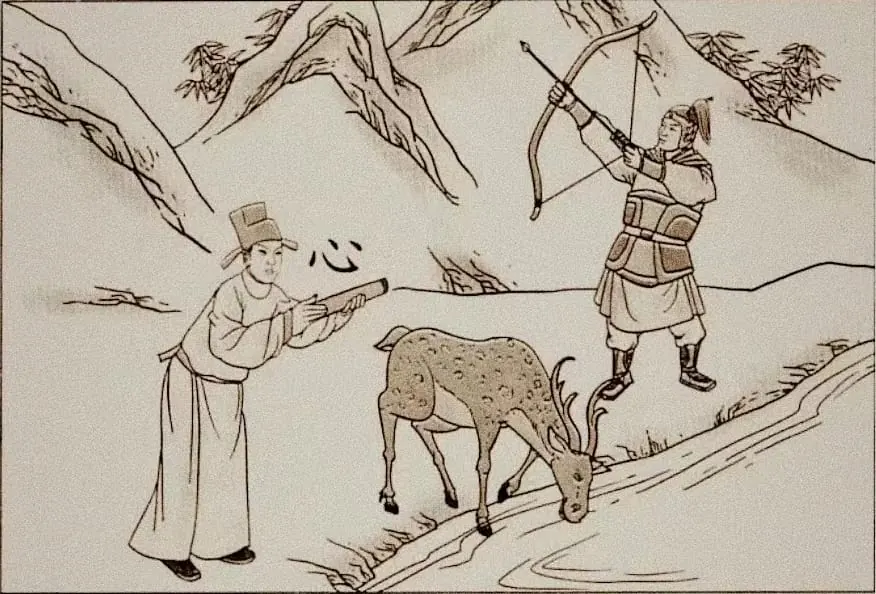
Scene Description
Image Symbolism
Reading the Picture
Tong Ren is fellowship that reaches past your own circle: people united by a shared principle rather than private ties, with a clear heart that others can recognise and trust.
Start with the official on the left holding out a document, with the character 心 (heart) beside it. The Image Symbolism reads this as winning hearts and working with one mind. In front of him a spotted deer bends to drink from a stream. The deer is a pun, 鹿 lù for 禄 lù, reward and livelihood, and the source also reads it as a worthy person outside officialdom, quick in motion and gentle at rest.
On the slope above, an armoured archer draws his bow, but he aims up the mountain, not at the deer. The source reads this as aiming high and succeeding; it also recalls the third and fourth lines, troops hidden on the high hill and a man on the wall who decides not to attack. Fellowship survives when force holds back.
The trigrams frame the scene: Fire ☲ below, clear and bright, rising toward Heaven ☰ above, strong and open. The deer and the stream lie in open country, echoing the judgment’s “fellowship in the open country.” The fifth line tells the emotional arc: those of one heart may first cry out at being kept apart, then laugh when they meet.
- Work
- If you are building a team, ask whether you are recruiting for shared purpose or only from your own circle.
- Relationships
- If someone you trust feels kept at a distance, consider what stands between you, and whether patience and plain sincerity can close the gap.
- Timing
- If you are tempted to force an outcome, ask whether holding back, like the archer on the wall, would serve the larger fellowship better.
Line Statements
Listed from the bottom line to the top line.
- First nine: Fellowship at the gate. No blame.
- Six in the second place: Fellowship within one's clan. Regret.
- Nine in the third place: Hiding troops in the thickets and climbing the high hill; for three years no rising.
- Nine in the fourth place: Mounting the wall, unable to attack. Good fortune.
- Nine in the fifth place: Fellowship, first crying aloud and then laughing. Great armies prevail and meet.
- Top nine: Fellowship in the outskirts. No regret.
Meaning of the Hexagram
Translated from the Chinese 人间道 commentary with AI assistance; translator notes appear in brackets.
“Fellowship in the open country: success. It is beneficial to cross the great river; the steadfastness of the noble person is beneficial.”
“The open country” means what is distant and outside. Through the way of great unity under heaven and the wholly public-spirited heart of sages and worthies, there is no one so distant that they are not brought into fellowship. The fellowship of ordinary people is a union based on private intentions; this is the feeling of intimacy among those close to one. Therefore only fellowship “in the open country” can be called great unity.
When the whole realm is united, what danger can obstruct it, and what hardship can endanger it? Hence “it is beneficial to cross the great river,” and the noble person must hold firmly to this. Petty people act only on private intentions, and those they draw close to are also petty people; this is the beginning of factions, and their hearts are not upright.
“Fellowship: the soft obtains its position, obtains the centre and responds to Qian. This is called Fellowship.”
The second line is yin in a yin position, which is its correct place; it has the virtue of centrality and correctness and responds to Qian (The Creative) above. The fifth is the ruler’s position, firm, strong, central and correct, and the second answers it with soft compliance. Above and below are of one heart and one virtue; hence it is called Fellowship.
“‘Fellowship in the open country: success; it is beneficial to cross the great river’: this is the action of Qian.”
The action of Qian is utterly sincere and without selfishness, so it can cross danger and hardship and have good fortune. Selflessness is the virtue of heaven.
“Cultured and bright, and thereby strong; central and correct, and responding: this is the correctness of the noble person. Only the noble person can understand the aspirations of all under heaven.”
The lower trigram has the virtue of cultured brightness, and the upper trigram has the nature of firm strength; this is the correct way of the noble person. The aspirations of the realm are of ten thousand kinds and all different, but the principle is one. Because the noble person understands principle, he can understand the aspirations of all under heaven. The sage regards the hearts of millions of people as one heart, because there is only one principle. Cultured brightness makes people understand principle better, so they can grasp the true meaning of great unity; firm strength is sure to master the self, and so it is sure to bring about the way of great unity.
“Heaven together with fire: Fellowship. The noble person accordingly groups clans and distinguishes things.”
Heaven is above, and the nature of fire is to blaze upward: this is Fellowship. The noble person observes the image of Fellowship and sorts groups and clans, distinguishing each according to what its nature shares, such as noble people and petty people, good and evil, right and wrong. The outward forms of things certainly differ, but the principles of affairs are the same, and the noble person can discern them clearly.
“Fellowship at the gate. No blame.”
The first advance is firm and strong. Because it has no partiality or selfishness, going out of the gate into the world without selfishness, there is no blame.
“Going out of the gate to fellowship: who would blame him?”
Out in the world he follows the way of fellowship without selfishness. Those who share this way are many, and he does not favour some and slight others, so no one blames him.
“Fellowship within one’s clan. Regret!”
“Clan” means one’s faction. Fellowship confined to one’s own faction is partial, and so there is cause for regret. Using only people from one’s own faction is partiality and selfishness; this is a mean and petty person.
“Fellowship within one’s clan: the way of regret.”
When the way of fellowship is applied only to one’s kin, there is selfishness. Because it is selfish favouritism, it is not the way of a ruler; hence this is the way of regret. People today are all like this; none can match Emperor Taizong in employing people.
“Hiding troops in the thickets and climbing the high hill; for three years no rising.”
The second shares the same aims as the ruler in the fifth through the way of centrality and correctness. The third, a hard and violent person, sits between the second and the fifth and wants to seize [the second]. But his principle is not straight and his cause cannot prevail, so he dares not act. He can only hide troops in the thick woods and from time to time climb a high hill to look around. Even after three years there is still no opening to exploit. This is the condition of a petty person.
“Hiding troops in the thickets: the opponent is firm. For three years no rising: how could he act?”
Because the third line is a hard and violent person, and the ruler in the fifth position is firm and correct, he is afraid and dares not engage; even in three years he does not engage.
“Mounting the wall, unable to attack. Good fortune.”
The fourth is a yin position occupied by a firm yang line, so it is firmness in a soft position. Being close to the ruler’s position, it knows its cause is not straight and is able to return to the correct way, so there is also good fortune. The third is firmness in a firm position, so it stays hard to the end and cannot turn back. This shows that one who fears what is right and can change will have good fortune in the end.
“Mounting the wall: by right he cannot attack. His good fortune: being in straits, he returns to the rule.”
In Fellowship there is a single yin line, which all the yang lines desire. Only the third and fourth lines have the intention of contending for it. But wickedness does not overcome what is right; his being in straits causes him to return to the rule, and so there is good fortune.
“Fellowship, first crying aloud and then laughing. Great armies prevail and meet.”
A ruler should be in great fellowship with the whole realm; if he privately favours a single person, that is not the way of a ruler. His companion in purpose is the second line, but the firm third and fourth lie between them. So before they meet he is angry and cries aloud, and once they meet he laughs heartily.
So when two people are of one heart, their sharpness can cut metal. When they are united in inner sincerity, there is nothing in which they are not united; no one in the realm can drive them apart, and there is nowhere they cannot enter. That is why the sage praised it, saying: “Words spoken from one heart are fragrant as orchids.”
“The first stage of Fellowship: because he is central and straight. Great armies meet: this means they prevail.”
The first stage of Fellowship is centred on sincerity and straight in principle, so the strength of a united heart is great. Although the opponent is firm and strong, as when great armies meet, because his cause is just and his principle prevails, he is finally able to overcome.
“Fellowship in the outskirts. No regret.”
Seeking the way of great unity requires drawing close and joining together. Even though the outer and distant places are not united, there is never any regret.
“Fellowship in the outskirts: the aim has not yet been attained.”
This makes clear that in the way of fellowship, the aim of seeking unity in outer and distant places has not succeeded. There is no regret, but it is not the best way.
Show the Chinese original (人间道)
同人:于野,亨。利涉大川,利君子贞。 野即远与外之意,以天下大同之道,圣贤大公之心,使之无远不同。常人之同,以私意所 合,此暱亲之情。故必于野,方可谓大同。天下皆同时,何险阻能阻碍?何艰困能致危?故利 涉大川,君子须坚心于此。小人唯用私意,所亲比者亦为小人,朋党之始,其心不正也。
同人,柔得位,得中而应乎干,曰同人。 二爻以阴居阴位,此为正位,得中正之德,应乎干上,五为君位,以刚健中正,二以柔顺 对应,上下同心同德,故曰:同人。 同人于野,亨,利涉大川,干行也。 干之行,必至诚无私,故可以涉险难,而吉。无私,天德也。 文明以健,中正而应,君子正也。
唯君子爲能通天下之志。 下体为有文明之德,上卦为刚健之性,此君子之正道。天下之志万殊且异,但理则一也。 君子因明理,故能通天下之志。圣人视亿万人之心为一心,因只一理而已。文明能使人更明理, 故能明大同之真义,刚健必能克已,则必能致大同之道。
天与火,同人,君子以类族辨物。 天在上,火之性炎上,此为同人,君子观同人之象,以分类群族各以其性同来区分,如君 子小人,善恶是非,物之外形固异,但事理皆同,君子能辨明。
同人于门,无咎。 初进为刚健,此因无所偏私,出门在外因 无私,而无咎也。
出门同人,又谁咎也。 出门在外,因同人之道而无私,同此道之 人又广,无厚此薄彼之异,则无人归咎也。
同人于宗,吝! 宗为宗党也,同于所派系,此有所偏,故 可吝。故只用宗党之人则有偏私,此为鄙吝之 人。
同人于宗,吝道也。 同人之道用于宗亲,乃有所私,因私比, 非人君之道,故此为吝道。今人皆如是,莫若 太宗之用人。
伏戎于莽,升其高陵,三岁 不兴。 二以中正之道与君五位相同志,三以刚暴 之人居二五之间,欲夺,然理不直,义不胜, 不敢发动,故只能藏兵戎于莽林间,时升高陵 顾望,至三年之久,仍无机可乘,此小人之情 状。
伏戎于莽,敌刚也;三岁不 兴,安行也。 因三爻乃刚暴之人,其五君位为刚且正, 故畏忌而不敢与,即三年亦不与。
乘其墉,弗克攻,吉。
九四乃阴位,阳刚居之,故以刚居柔位, 其近君位,知义不直而能复返正道,亦吉也。 三以刚居刚,故终其强而不可能反。此示 人畏义能改则终吉。
乘其墉,义弗克也;其吉, 则困而反则也。 因同人乃一阴,而众阳所同欲也。今独三 四爻有争夺之意,乃邪不胜义,其困穷乃因反 于法则,故吉。
同人,先号咷而后笑,大师 克相遇。 人君当与天下大同,如独私一人,则非君 道也。其同志为二爻,间隔有三四之刚,故未 遇之前愤怒而号咷,即遇则大笑,故二人同心, 其利断金,中诚所同,无所不同,天下莫能离 间,则无所不入,故圣人赞之曰:『同心之言, 其臭如兰』。
同人之先,以中直也;大师 相遇,言相克也。 同人之先以中诚理直,故同心之力大,虽 敌刚强,如大师相遇,由其义直理胜,终能克 之也。
同人于郊,无悔。 求大同之道,必相亲相与,即在外又远之 地不同,但亦永无悔矣。
同人于郊,志未得也。 此申明同人之道,在外及远之地求同之志 不成,即无悔,但非最善之道。