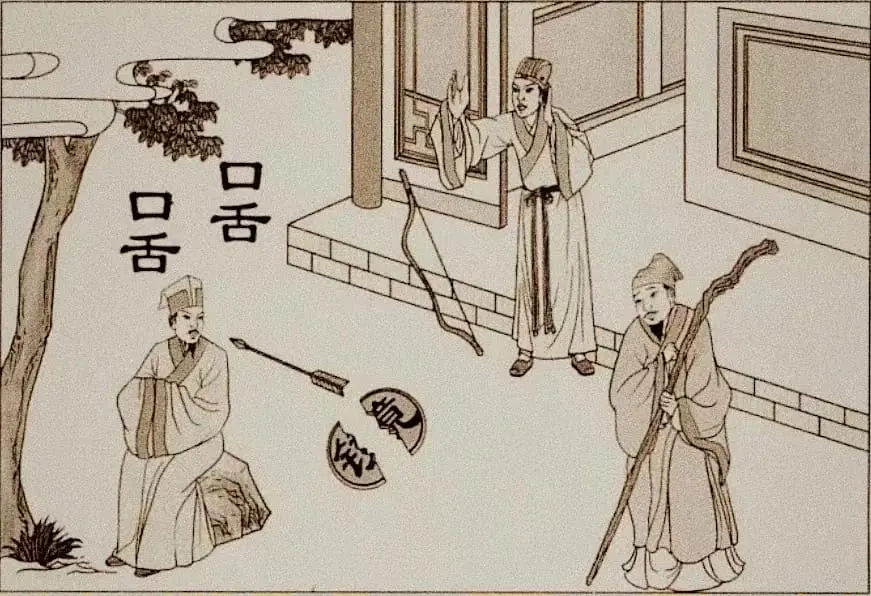
Scene Description
Image Symbolism
Reading the Picture
Pi is the time when heaven and earth stop speaking to each other: those above and those below drift apart, small-minded voices grow loud, and the wise course is to step back without giving up your principles.
Begin with the man seated on a rock beside the road. The Image Symbolism reads him as someone blocking the road. An arrow has dropped short near him, and the bow leans unused against the steps: the bow put away once the birds are gone. Between them a round mirror lies split in two. Its character 镜 jìng combines 金 (metal, money) and 竞 (to compete): rivalry over gain, and bonds hard to mend.
On the steps a man raises his hand and calls out, like the gloating onlooker the description mentions. The two 口舌 labels float in the air: talk, quarrels, rumour. The description also mentions a man lying ill, read as feigning illness to withdraw; no one is drawn lying down.
The trigrams explain why nothing connects: Heaven ☰ sits above and keeps rising, Earth ☷ sits below and keeps sinking. The scene shows the second line most clearly: petty people flourish by going along, while the great person stays apart. The fifth and top lines add hope: obstruction ends and is overturned.
- Work
- If channels to decision-makers feel blocked and credit goes to the loudest, consider keeping your work clean and your head down rather than competing for position.
- Relationships
- If gossip or third-party talk is stirring trouble, ask what you have heard first-hand. Rumours tend to stop with someone who checks before believing.
- Timing
- This is a time to conserve and wait. If you hold on, consider what would make your footing firm, like mulberry roots, so you are ready when things turn.
Line Statements
Listed from the bottom line to the top line.
- First six: Pulling up clumped grass with its intertwined roots. Steadfastness brings good fortune and success.
- Six in the second place: Encompassing and accepting. Good fortune for petty people; obstruction for the great person, with success.
- Six in the third place: Bearing shame.
- Nine in the fourth place: A mandate. No blame. Companions share the blessing.
- Nine in the fifth place: Obstruction ceases. Good fortune for the great person. It may perish, it may perish: bind it to a clump of mulberry roots.
- Top nine: Obstruction overturned. First obstruction, then joy.
Meaning of the Hexagram
Translated from the Chinese 人间道 commentary with AI assistance; translator notes appear in brackets.
“Standstill: not the way of humans. Unfavorable to the noble person’s steadfastness; the great departs, the small arrives.”
All that lies between heaven and earth is the human way. Now heaven and earth do not interact and the myriad things are not born; there is no human way, hence “not the way of humans.” At such a time the noble person should not hold stubbornly to his purpose, because the correct way is not practised and the way of petty people is growing.
“‘Standstill: it is not the way of humans. It does not favor the steadfastness of the noble person; the great departs and the small arrives.’ This means that heaven and earth do not interact, and the myriad things do not communicate. Above and below do not interact, and there are no states under heaven. Yin within and yang without, soft within and firm without, petty people within and noble people without: the way of petty people grows and the way of the noble person wanes.”
When heaven and earth do not interact, the myriad things are not born. When above and below are not in harmony, the realm has no way of governing the state. In a well-ordered age, those above govern the people through their administration, and the people support the ruler and willingly follow his commands; above and below interact, and this is the way of governing a state. Now the noble people dwell outside in the wilds and the petty people are inside the court, and so it is a time when the way of petty people grows and the way of the noble person wanes.
“Heaven and earth do not interact: Standstill. The noble person accordingly falls back on frugal virtue to avoid difficulty, and must not seek honour through emolument.”
The noble person observes the image of obstruction: strong outside, compliant (soft) inside. In a time of obstruction he should reduce and restrain himself and keep away from disorder and calamity. He must on no account cling to a post of honour and emolument and refuse to leave. For when petty people have their way, if the noble person still holds a prominent position, disaster will surely reach him. Conversely, one who still clings to a prominent position and will not let it go is a true petty person: this is the meaning of “petty people within, noble people without.”
“Pulling up clumped grass with its intertwined roots. Steadfastness brings good fortune and success.”
The one at the very bottom in Standstill is the noble person. Those who cannot advance because of the obstruction are noble people; those who can advance in a time of obstruction are petty people. Being in a low position and holding steadfastly to his principles and resolve, he gathers with those of his own kind; although he does not advance or rise, there is still good fortune.
“Pulling up the grass, steadfastness brings good fortune: his resolve is set on the ruler.”
When the noble person is in a low position in a time of obstruction, he hopes to advance together with those of his own kind. If he meets petty people, he holds firmly to his principles, but his heart remains with the realm.
“Encompassing and accepting. Good fortune for petty people; obstruction for the great person, with success.”
The second line is by nature a yin position, and now a soft yin line occupies it. Speaking of the petty person: all that his heart takes in is compliance with the wishes of those above, in order to seek his own advantage; this is the petty person’s good fortune. The great person, in obstruction, spurs himself on with the firmness of the way and never bends the correct way to flatter those above. Although he himself is obstructed, the way still has success.
“The great person is obstructed yet has success: he does not join the disorder of the crowd.”
One who keeps to his proper principles in obstruction is a great person. He does not form a crowd with petty people in their disorder. Though his outward circumstances are blocked, his way is fortunate, and this way is sure to become great.
“Bearing shame.”
A person who is neither central nor correct, in a time of obstruction, holds the position of a chief minister. He cannot keep to the way and accept his lot, but does everything a petty person can do, plotting wicked things every day and leaving nothing out; this is the greatest of shames.
“Bearing shame: the position is not appropriate.”
In a time of obstruction, what he does is wicked and mean, and he is ashamed before what is fair and upright. He is unfit to occupy this ministerial position; this cannot be taken as the correct way.
“A mandate. No blame. Companions share the blessing.”
What a person beside the ruler must most avoid is claiming credit and provoking jealousy. Because in a time of obstruction the ruler’s way is not upright, even someone with great talent to save the age cannot be put to use.
If he can make everything proceed from the ruler’s command, so that all authority returns to the one above, then there is no disaster and he can realise his great aims. When the way of the noble person prevails, those of the same kind are sure to advance and withdraw together, thinking of the welfare of the common people of the realm. Petty people, too, advance and withdraw together.
“A mandate, no blame: his resolve is carried out.”
When everything proceeds from the ruler’s command, there is no disaster, and great aims can be carried out.
“Obstruction ceases. Good fortune for the great person. It may perish, it may perish: bind it to a clump of mulberry roots.”
In a time of obstruction, only a person of firm, central and correct character occupying the ruler’s position can remove the obstruction of the realm; that is, good fortune for the great person. Even when the cycle comes round to Tai (Peace), one must guard against fullness and stay alert to the return of obstruction; this is the meaning of “it may perish, it may perish.” This caution must be like the clump of mulberry: the mulberry has deep roots and a firm base, and a clump grows thickly together, so it is firmer still. This is the way of security, and it is the sage’s profound warning.
The Great Commentary (Xici) says: “Danger comes to one who rests secure in his position; ruin comes to one who is sure of his survival; disorder comes to one who has everything in order. Therefore the noble person, when secure, does not forget danger; when surviving, does not forget ruin; when in good order, does not forget disorder. In this way his person is safe and the state can be preserved.”
“The good fortune of the great person: his position is correct and appropriate.”
Because he has the virtue and talent of firmness, centrality and correctness, and occupies the noble person’s position, he can remove the obstruction of the realm; therefore there is good fortune.
“Obstruction overturned. First obstruction, then joy.”
When things reach their extreme they turn back. When Peace reaches its extreme, Standstill follows; when Standstill reaches its extreme, Peace follows. So at the extreme of Standstill, the way of obstruction is about to be overturned and Peace arrives; hence “then joy.”
“When obstruction ends, it is overturned. How could it last long?”
At its end, obstruction must topple; there is no principle by which obstruction lasts for ever. But turning danger into security and disorder into order requires a person of firm talent. That is why the top nine of Standstill can overturn obstruction, whereas the top six of Zhun (Difficulty at the Beginning) cannot remove its difficulty; the idea is the same.
Show the Chinese original (人间道)
否之匪人。不利君子贞,大往小来。 举凡天地之间皆为人道,今天地不交,不生万物,是无人道,故曰匪人。处此之时,君子 不可坚心,因正道不行,小人道长之时。
否之匪人,不利君子贞,大往小来,则是天地不交,而万物不通 也。上下不交,而天下无邦也。内阴而外阳,内柔而外刚,内小 人而外君子,小人道长,君子道消也。 天地不交,万物不生。上下不和,则天下无治国之道。治世乃上位施政来治民,人民拥戴 君王而愿从命,上下相交,此治国之道。
今君子居于外野,小人处于朝内,故为小人道长,君 子道消之时也。
天地不交,否。君子以俭德辟难,不可荣以禄。 君子观否塞之象为外健内顺(柔)。处否之时,损俭自己,避开祸乱。千万不可荣居禄位, 恋栈不去。因小人得志之时,君子仍居显位,则祸必及己身。反之,仍居显位不放,乃真小人 也。即内小人,外君子之意。
拔茅如,以其汇,贞吉,亨。 否之在最下者,为君子也。因否而不能进 者,君子也。处否而能进者,小人也。因在下 位,又贞固其节志,同类而聚,虽不进升,但 亦吉矣。
拔茅贞吉,志在君也。 君子处否时而居下位,冀得同类而进,如 遇小人,则坚守其节,但心仍在天下。
包承,小人吉,大人否,亨。 六二本阴爻位,今阴柔居之,以小人而言, 其心所包容的,皆承顺上位之意,以求本身之 利,此小人之吉。大人处否,则以道之阳刚自 勉,絶不枉屈正道,奉承上位,虽身处否,但 道仍亨也。
大人否亨,不乱群也。 处否而守其正节,乃为大人,不与小人同 乱为群体,形虽否,但其道吉,此道必大。
包羞。 不中不正之人居否之时,位居相位,不能 守道安命,极尽小人之能事,每日谋虑邪事, 无所不包,此羞耻之大也。
包羞,位不当也。 居否时,所为邪吝,羞于公正,居此相位 而不适,此不可以为正道。
有命,无咎,畴离祉。 居君侧之人,最忌有居功招忌之事,因否 时君道不正,即令有济世之大才,亦不堪用。 如能使事事出于君令,威柄皆归于上,则 无灾而可实现大志。当君子道行,同类必同进 同出为天下黎民福祉着想。小人亦同进退也。
有命,无咎,志行也。 凡事皆由君命而出,则无灾,且大志得行。
休否,大人吉,其亡,其亡, 繋于苞桑。 处否之时,惟有阳刚中正之人居君位,能 去天下之否,即大人吉。如循环至泰,亦须戒 盛警惕否之复来,此其亡,其亡之意。此戒须 如同苞桑,桑为根深蒂固之物,苞乃丛生之物, 其固更强,此为安固之道。此为圣人之深戒也。 系辞:『危者安其位者也,亡者保其存者也, 乱者有其治者也。
是故君子安而不忘危,存而 不忘亡,治而不忘乱,是以身安而国家可保 也。』
大人之吉,位正当也。 因有阳刚中正之德才,又居君子之位,能 去天下之否,故吉也。
倾否,先否后喜。 物极必反,泰极则否,否极则泰,故否之 极,即否道将覆,则泰矣,故曰后喜。
否终则倾,何可长也。 否之终必倾危,絶无永否之理,但反危为 安,易乱而治,必有阳刚之才,乃能做也,故 否卦之上九能倾否,如屯之上六则不能去屯同 意也。