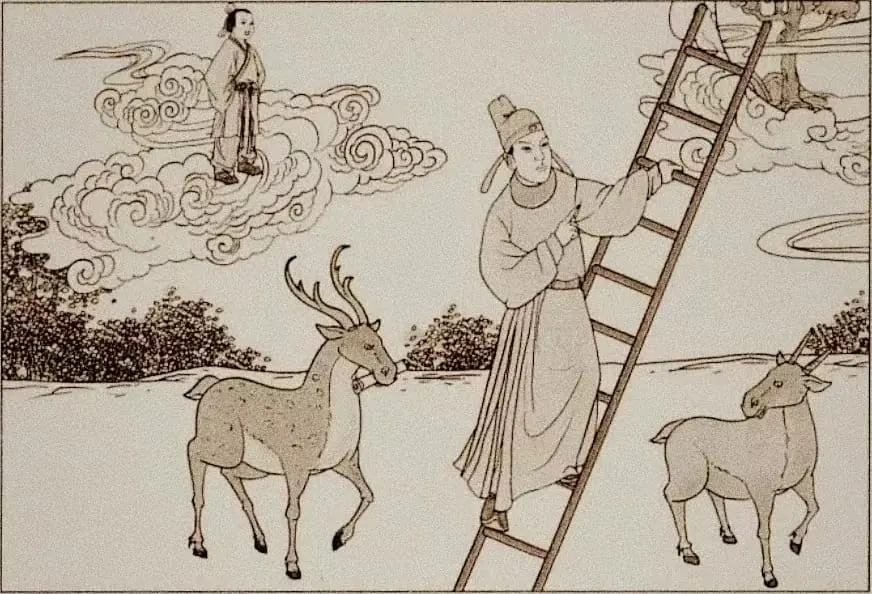
Scene Description
Image Symbolism
Reading the Picture
Tai is peace: heaven and earth meet, the energy above and below flows freely, and the way up is open, as long as you remember that every high point has a slope.
Start with the official on the ladder. He climbs toward a tree resting on clouds at the top right. The description calls it cassia blossoming in the moon, an image of examination success and enlightened government, though no clear moon is drawn. A ladder is the simplest picture of smooth promotion. Above on the left, a child stands on a cloud, read as early success with help from above.
On the ground a deer carries a scroll in its mouth: 鹿 lù sounds like 禄 lù, official salary, so this is a reward delivered. At the right a sheep turns its head; 羊 yáng puns on 阳 yáng, and the symbolism reads it as a return to life and strength. The trigrams explain the openness: Heaven ☰ below and Earth ☷ above, so what rises and what sinks meet instead of drifting apart. The first line fits the climb, grass pulled up with its roots, people rising together; the third adds the caution: no level ground without a slope. The scattered dots the description mentions are not drawn.
- Work
- If doors are opening at work, consider who is rising with you. Use the calm to fix small problems that comfort tempts you to ignore.
- Relationships
- If things feel easy and harmonious, ask whether both sides are still giving as much as they receive. Peace is kept by sincerity, not by assuming it will last.
- Timing
- This is a favorable time to advance. If you are near a peak, think of safety while things are safe; the top line shows how walls return to the moat when care lapses.
Line Statements
Listed from the bottom line to the top line.
- First nine: Pull up clumped grass with its intertwined roots. Going forward brings good fortune.
- Nine in the second place: Embrace the uncultivated, cross the river on foot, neglect not the distant, let factions fall away; gain esteem through the middle course.
- Nine in the third place: No level ground without a slope, no departure without return. Steadfastness in hardship brings no blame. Do not worry over sincerity; there is blessing in sustenance.
- Six in the fourth place: Fluttering down, not relying on wealth, with one's neighbors; sincerity without admonition.
- Six in the fifth place: Emperor Yi gives his younger sister in marriage. Blessing and great good fortune.
- Top six: The city wall falls into the moat. Do not use the army. Announce the command from one's own town. Steadfastness brings regret.
Meaning of the Hexagram
Translated from the Chinese 人间道 commentary with AI assistance; translator notes appear in brackets.
“Tai: the small departs and the great arrives. Good fortune and success.”
The yang energy descends and the yin energy rises; yin and yang are in harmony and flow freely, and all things are born: this is the peace of heaven and earth. Peace in the human world means that the great are above and the small are ministers below; the ruler entrusts those below with sincerity, and ministers serve the ruler with full sincerity; above and below share one purpose: this is the peace of the court. It is the same with noble people and petty people: when noble people occupy the positions of rule and petty people are in low positions, the whole realm is at peace.
“Tai: the small departs and the great arrives; good fortune and success. That is, heaven and earth unite and all things flow freely; above and below unite and their purpose is the same.”
Yin departs and yang arrives; the energies of heaven and earth meet, and all things pass through freely. Among people, those above and below share the same purpose and communicate with each other: this is human peace.
“Yang within and yin without; strength within and compliance without; noble people within and petty people without. The way of the noble person grows; the way of the petty person wanes.”
It is a time when yang advances and yin retreats, so there is strength within and compliance without; this is the way of the noble person. Noble people are within and petty people without; this is why it is Peace.
“Heaven and earth unite: Peace. The ruler accordingly shapes and completes the way of heaven and earth, assists what heaven and earth make fitting, and so helps the people.”
This shows that the ruler must grasp the way of union and peace and make it into laws and institutions, so that the people make use of what each season of heaven makes fitting. He assists the work of educating the people and lets them have wealth, helping them; the people will then rely on the laws and institutions of the ruler, and because the rule of law is fitting, they obtain their livelihood and nourishment.
“Pull up clumped grass with its intertwined roots. Going forward brings good fortune.”
A firm, clear-sighted talent in a low position meets the time of Peace. Its will is to advance upward; meeting those of the same mind and walking the same road, it advances together with its own kind, and there is good fortune. Noble people and petty people alike must rely on the help of their own kind; no one has ever been able to stand alone without needing the help of companions.
“Pulling up the grass, going forward brings good fortune: its will is directed outward.”
Those of the same kind gather together, like the roots of grass that pull each other up when one is pulled, all wishing to advance upward.
“Embrace the uncultivated, cross the river on foot, neglect not the distant, let factions fall away; gain esteem through the middle course.”
The second nine is the position of a general, with firm, clear-sighted talent, while the fifth is soft and compliant and holds the ruler’s position. Undivided trust between above and below is established, and this position is the one that governs the time of Peace. So the way of governing in Peace rests on the general, who is able to “embrace the uncultivated.” When people’s feelings run loose and they act as they please, government orders grow slack and laws and standards fall into disuse. The way to deal with this requires the breadth to embrace even what is overgrown and foul, and careful, thorough government that removes the abuses; then people will be at peace.
In a time of peace, it is human nature to grow used to long security, to become lazy and follow old routine, and not dare to change anything. “Cross the river on foot” means bold, vigorous reform; even the smallest and slightest matters must not be overlooked. Since ancient times, many laws and measures have been held back by personal ties and in the end could not be carried out. Forbidding extravagance hurts close relatives; limiting land and houses gets in the way of noble families: this is the difficulty of governing in Peace. When governing in Peace, one must hold to a fair and impartial attitude; this is the meaning of the middle course.
“Embrace the uncultivated, gain esteem through the middle course: so as to be bright and great.”
Having the breadth to embrace what is overgrown and foul, joined with the virtue of the middle course, its way becomes clear, bright and great.
“No level ground without a slope, no departure without return. Steadfastness in hardship brings no blame. Do not worry over sincerity; there is blessing in sustenance.”
The third line sits above all the yang lines; this is the height of Peace. The sage gives a warning here: what is below must rise, what is above must descend, and Peace that lasts long must turn to Obstruction; so he warns of it. At such a time, therefore, one must not dare to take one’s ease; if one thinks of danger in times of safety, there will be no disaster. So the way to live in Peace is to be firm and steadfast; then Peace can be kept for a long time. Since ancient times, every flourishing age has declined and fallen because it lost the Way from within.
“No departure without return: this is the boundary of heaven and earth.”
Yang that descends below must return upward; yin that rises above must return downward. This shows people the principle that the way of union and peace between heaven and earth does not last forever; the sage warns of it.
“Fluttering down, not relying on wealth, with one’s neighbors; sincerity without admonition.”
“Fluttering” (翩翩) describes swift flight. When people are rich and others follow them, it is for profit; when they are not rich and others still follow them, it is because their aims are the same. The upper three lines are all yin; yin above loses the way of inner solidity, and all wish to come down and follow; hence “not rich, yet followed.” This is a meeting of sincere intentions. If one waits until the fourth position to be on guard, it is already late; the third position is the right point, where knowing to be on guard can preserve peace. By the fourth position it is already past, and change is bound to arise.
“Fluttering down, not relying on wealth: all have lost their solidity. Sincerity without admonition: it is the wish of their hearts.”
Because the three yin lines are above and have lost their solid substance, they wish to go downward; the neighbours follow without waiting for anyone to be rich, all because they have lost their solidity. Only when this is already lost does one understand the meaning of being on guard. At this time they treat each other with sincerity without waiting to be admonished; this comes from the wish of their hearts.
“Emperor Yi gives his younger sister in marriage. Blessing and great good fortune.”
[The fifth line] occupies the ruler’s position. In ancient times the daughters of emperors all married beneath them, and Emperor Yi set down rites requiring them to lower their noble rank and defer to their husbands. Now the fifth six, with yin softness, occupies the ruler’s position, and the second nine that corresponds to it is yang and firm; it can trust it, employ its worth and defer to it, just as an emperor’s daughter marries beneath her. This achieves the work of governing in Peace.
“Blessing and great good fortune: acting from the centre to fulfil its wish.”
It is able to employ a firm and central worthy because it itself has the way of centrality that accords with him; sharing the same purpose, they come together.
“The city wall falls into the moat. Do not use the army. Announce the command from one’s own town. Steadfastness brings regret.”
This is the end of Peace; if petty people hold this place, things will surely turn to Obstruction. Earth dug from the moat is piled up to build the city wall, just as the work of good government accumulates to produce Peace; now the earth of the wall collapses and returns to the moat. “Do not use the army”: the way of using an army requires the hearts of the people; now the people’s hearts do not follow, and using the army would surely bring chaos. At this time, even if one has heaven’s mandate on one’s side, one will meet shame and misfortune.
“The city wall falls into the moat: its mandate is in disorder.”
This means that the wall has collapsed and returned to the earth of the moat; even if the command is correct, the disorder can no longer be stopped.
Show the Chinese original (人间道)
泰,小往大来,吉亨。 阳气下降,阴气上升,阴阳和畅,万物生焉,此天地之泰。人间之泰,大则居上,小则臣 下,君王推诚任下,臣尽诚以事君,上下同志,朝廷之泰。君子,小人亦如是,君子处君位, 小人居下位,天下之泰也。
泰,小往大来,吉亨。则是天地交而万物通也,上下交而其志同也。 阴往而阳来,天地气相交,万物通泰。人则上下之志相同,互相交通,人之泰也。「内阳 而外阴,内健而外顺,内君子而外小人,君子道长,小人道消也。」阳进阴退之时,故内健外 顺,君子之道也,君子在内,小人在外,此所以为泰。
天地交,泰。后以财成天地之道,辅相天地之宜,以左右民。 此示人君须体会交泰之道而为法制,使民用天时之宜,辅助教育人民之功,使民有财,辅 助于民,民则必赖君上之法制,因法治之宜也,得其生养。
拔茅茹,以其汇,征吉。 刚明之才,居于下位,遇泰之时,志而上 进,遇同志而行同道,因同类而进,吉。凡君 子小人都须赖同类以助,未有人能独立而不须 朋类之助。
拔茅征吉,志在外也。 同类相聚,如拔茅之根相牵连,同欲上进。
包荒,用冯河,不遐遗,朋 亡,得尚于中行。 九二为将位,以刚明之才,五为柔顺而得 君位,上下之专信建立,此位乃治泰者,故治 泰之道,主将位而能包荒,如人情放肆所为, 则政令缓,法度废弛,治此之道,必有包含荒 秽之量,详密施政,去其弊端,则人安之。处 泰之道,人之常情习于久安,惰于因循,不敢 变更,用冯河,乃奋发改革之意,虽至小至微 之事亦不可遗漏,自古立法治事,牵于人情, 卒不能行者多矣。
如禁奢侈则害近戚,限田宅, 则防碍贵族之家,此治泰之难。遇治泰,须禀 持公正之态度,即中行意。
包荒,得尚于中行,以光大 也。 有包含荒秽之量,又配合中行之德,其道 则明显光大。
无平不陂,无往不复,艰贞 无咎,勿恤其孚,于食有福。 三居诸阳之上,乃泰之盛时。圣人为之戒, 在下者必升,居上者必降,泰久而必否,故戒 之。故当此时,不敢安逸,居安思危,则无灾。 故处泰之道须能坚贞,可常保泰。自古以来隆 盛皆因内失道而丧败下来。
无不复,天地际也。
阳降于下,必复上,阴升于上,必复下, 此示人明天地交泰之道不常存之理也,圣人戒 之。
翩翩不富,以其邻,不戒以 孚。 翩翩,疾飞之貌,人富而从其类,为利也。 不富而从其者;志同也。上三爻皆为阴,阴在 上而失其中实之道,皆欲下从,故为不富而从, 此诚意相合也。如至六四位方戒已晚,居三为 适中,知戒可保,四位则已过,必生变化。
翩翩不富,皆失实也;不戒 以孚,中心愿也。 因三阴在上,失其实才,欲行往下,不待 其人富而邻从,皆因失实故也。此已失乃方知 戒之意,此时不待告诫而诚意相待,乃出于中 心所愿也。
帝乙归妹,以祉元吉。 为居君位,古之帝女皆向下嫁,帝乙制礼 法,须降其尊贵,以顺从其夫也。今六五以阴 柔居君位,对应之九二为阳刚,乃能信之,而 任用其贤且顺从之,犹帝女之下嫁亦然,此成 治泰之功也。
以祉元吉,中以行愿也。 其能任用刚中之贤,乃因已有中道与之 合,志同相交也。
城复于隍,勿用师,自邑告 命,贞吝。 此致泰之终也,小人处之,行必否矣。掘 隍土累积成城,如治道累积以成泰,今城土颓 圮,又复返于隍也。勿用师,夫用师之道,必 得民心,今民心不从,用师必乱,此时即自有 天命任之,亦逄羞而凶矣。
城复于隍,其命乱也。 此意城倾圮,又回归隍土 ,即令命为正, 但乱已不可止矣。