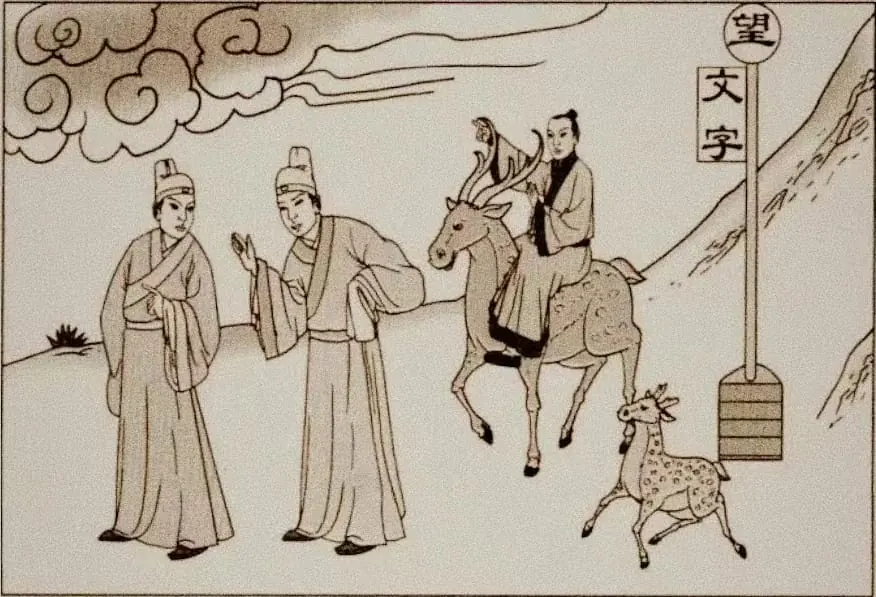
Scene Description
Image Symbolism
Reading the Picture
Gui Mei is about moving because something pleases you, not because the position is right. In the picture, a rider presses ahead under gathering clouds before the way forward is clear.
Start with the man riding a deer, one arm raised. The deer, 鹿 lù, puns on 禄 lù, reward or salary: he is riding toward gain. The Image Symbolism says he points at clouds hiding the sun: trying to advance while things are unclear. The clouds fill the upper left; no sun is drawn. A fawn trots behind, a follower tagging along.
Beside him stands a lookout pole marked 望 and 文字, ‘writing’. The Image Symbolism links it to rectifying names: being clear what a thing really is before acting. On the left, two officials stand talking. The written description also mentions a person fallen among thorns and another pulling him out; that scene is not drawn here.
The trigrams are Lake ☱ below and Thunder ☳ above: thunder stirs and the lake moves with it, movement driven by delight, which the judgment says brings misfortune. The fourth line offers a better path, a delay that has its proper time, and the fifth prefers plain sleeves to fine ones. The Image adds: keep the end in view.
- Work
- If an opportunity excites you, consider whether your position in it is sound, or whether you are riding toward reward while the view is still clouded. Get the names and terms clear first.
- Relationships
- If you are drawn to someone mainly by delight, consider what will hold the bond together over time. Ask whether modesty and steadiness, rather than display, are guiding you.
- Timing
- This is not a time to push ahead. If something is delayed, consider that the wait may have its own right moment, and that keeping the end in mind from the start prevents wear later.
Line Statements
Listed from the bottom line to the top line.
- First nine: The marrying maiden as a secondary wife. The lame can walk. Going brings good fortune.
- Nine in the second place: The one-eyed can see. The secluded person's steadfastness is beneficial.
- Six in the third place: The marrying maiden waits, then returns as a secondary wife.
- Nine in the fourth place: The marrying maiden passes the appointed time; delayed marriage has its time.
- Six in the fifth place: Emperor Yi gives his younger sister in marriage. Her ruler's sleeves are not as fine as her secondary wife's. The moon almost full. Good fortune.
- Top six: A woman holds an empty basket; a man cuts a sheep with no blood. Nothing is beneficial.
Meaning of the Hexagram
Translated from the Chinese 人间道 commentary with AI assistance; translator notes appear in brackets.
“The Marrying Maiden: setting forth brings misfortune; nothing is beneficial.”
Here movement arises from pleasure, and something is bound to be improper. If one moves, one invites misfortune instead; wherever one goes, it will surely be unfavourable.
“The Marrying Maiden is the great principle of heaven and earth.”
This speaks of the way of yin and yang: the pairing of man and woman is the constant principle between heaven and earth. The man is above and the woman below; yin follows the movement of yang.
“If heaven and earth did not unite, the myriad things would not flourish. The Marrying Maiden is the end and the beginning of humankind.”
If heaven and earth did not unite, the myriad things would surely not be born. A woman following a man is the way of continual generation; humankind is born from the union of man and woman, and in the end it will never be exhausted.
“Moving out of delight: that is the marrying maiden. Setting forth brings misfortune, because the positions are not appropriate. Nothing is beneficial, because the soft rides upon the firm.”
Here the movement arises because one is delighted that the other is a young girl. If a person moves only out of delight, he will lose the way of clear judgment, and his movement will surely bring misfortune. This is acting not by the correct way but by the way of pleasure, and so the positions are not appropriate. The distinction of honour and humility between man and woman, with the husband leading and the wife following, is the constant principle of human life. If one does not follow the constant way and acts only from selfish desire, the soft overcomes the firm, and so there is misfortune; going forward will surely be unfavourable.
“Thunder above the lake: The Marrying Maiden. The noble person accordingly keeps the lasting end in view and understands what wears things out.”
The noble person observes thunder shaking above the lake and the lake moving with the thunder. It is like the pairing of man and woman, the image of ceaseless generation. It carries the warning about a lasting end: because things inevitably decay and break down after a long time, the noble person understands at the very beginning the principle of guarding against decay. So whenever something is to be long-lasting and fortunate, the warning must arise at the very start; that is why it is called the warning of the lasting end.
“The marrying maiden as a secondary wife. The lame can walk. Going brings good fortune.”
娣 (the secondary wife) here carries the sense of worthiness, goodness and correct virtue. A woman who can be like this when she marries also knows how to keep a humble and compliant place. But because her position is low, even if she has worthy talents she can only help her husband and keep herself good. It is like a lame person who can walk but surely cannot go far; yet if she goes forward, she obtains good fortune.
“The marrying maiden as a secondary wife: because of constancy. The lame can walk; good fortune: because they support each other.”
When a woman marries a man and can keep herself humble and compliant, glad at heart, and holds to this with constancy, then even like a lame person walking a road she can have good fortune. The reason is that they can support and help each other.
“The one-eyed can see. The secluded person’s steadfastness is beneficial.”
The ninth in the second place is a firm yang worthy in a correct position. In the time of the Marrying Maiden, it signifies a worthy and capable woman matched with an unworthy person. Like someone blind in one eye, whose sight surely cannot reach far, at this time she can benefit only by hiding her worth and holding firmly to correct propriety.
“The secluded person’s steadfastness is beneficial: she has not changed the constant way.”
She keeps her talents hidden within, with a firm and unchanging heart; in this she does not lose the long-lasting way of husband and wife.
“The marrying maiden waits, then returns as a secondary wife.”
The sixth in the third place is a soft yin person in a minister’s position. In the time of the Marrying Maiden, she seeks a response from above out of delight and not by the correct way, so she surely cannot be married and has no one to follow. She must go back and seek a humble place; then there will be good fortune.
“The marrying maiden waits: it is not appropriate.”
When a woman marries a man, if she seeks only what she herself needs, she cannot find a response from outside; this is surely not appropriate.
“The marrying maiden passes the appointed time; delayed marriage has its time.”
The fourth is a soft position occupied by a firm yang line. This means that dwelling in softness is the constant way of a woman, but within she has firm and clear worth. In the time of the Marrying Maiden, because she is worthy and clear-sighted and holds a high position, people wish to marry her; yet there is the image of marrying late. It is not that she will not marry: she waits for the right time to act, and goes only once there is a good match. This is ‘delayed marriage has its time’.
“The intention in passing the appointed time: she waits before acting.”
The reason for this delay lies entirely with herself, not with others; because she has worth, she is able to do this.
“Emperor Yi gives his younger sister in marriage. Her ruler’s sleeves are not as fine as her secondary wife’s. The moon almost full. Good fortune.”
The sixth in the fifth place is a person in the honoured position; its soft nature is the image of a woman, showing a woman of high nobility. Now, in the time of the Marrying Maiden, although she is an emperor’s daughter, when she marries she must bend and humble herself. So in a woman’s marriage, being able to humble herself is a virtue; she seeks propriety, not outward adornment. She is like the moon, whose yin is at its height yet does not reach complete fullness; this is why there can be good fortune. This is the way of a woman’s true nobility.
“Emperor Yi gives his younger sister in marriage; her sleeves are not as fine as her secondary wife’s: her position is central, and she acts with nobility.”
Valuing propriety rather than outward adornment is the way of Emperor Yi’s giving of his sister in marriage. The fifth line is soft and holds the honoured position: a person who is noble and also knows how to practise the middle way.
“A woman holds an empty basket; a man cuts a sheep with no blood. Nothing is beneficial.”
When a woman’s marriage reaches its utmost end, she takes on the duty of continuing the ancestral sacrifices. But at the extreme there is nothing real to offer, just as a scholar cuts a sheep to take its blood for the sacrificial rite: if the sheep is cut and there is no blood, there is nothing to sacrifice with, and it will surely be unfavourable to carry on what came before.
“The top six has nothing real: she holds an empty basket.”
At the extreme of a woman’s marriage, a soft line occupies the place. It is like an empty basket with nothing in it: she surely cannot take on the sacrifices, and in the end the woman cannot carry on the line. It surely signifies that people will part and be cut off from one another.
Show the Chinese original (人间道)
归妹,征凶,无攸利。 此动之以悦,必有不当,如动反招凶,所往必不利。
归妹,天地之大义也。 此言阴阳之道,男女之配,乃天地间之常理也。有男居上女在下,阴从阳动。 天地不交而万物不兴,归妹,人之终始也。 天地如不交则万物必不生,女之从男,为生生之道,人类从男女之交而生,其终必不穷 说以动,所归妹也,征凶,位不当也。无攸利,柔乘刚也。
此动之因喜悦对方为少女,人如只因悦而动,必失明之道,动必凶至。此不以正道,而以 悦道,故位不当也。男女尊卑,夫唱妇随,人之常理,如不以常道,惟私欲作与,柔胜于刚, 所以凶也,往必不利矣。
泽上有雷,归妹,君子以永终知敝。 君子观雷震于泽上,泽随雷而动,犹男女相配,生生不息之象,其有永终之戒,因物久后 必生敝坏,君子于始初乃知戒敝坏之理,故凡事之长久而吉,必于初始即生戒故谓永终之戒。
归妹以娣,跛能履,征吉。
娣,有贤良正德之义,女之嫁归能如此, 又知处卑顺,然因其位卑,即令有贤才亦只能 助夫而已,独善其身,犹跛之能行,必无法及 远,但往乃得吉。
归妹以娣,以恒也。跛能履 吉,相承也。 女嫁归男,能自处卑顺,且悦于内,持之 以恒,即令跛者行路,亦可以有吉,其因乃其 能相承相助也。
眇能视,利幽人之贞。 九二乃阳刚之贤居正位,于归妹之时,乃 意女之贤能所配不良之人,犹如目眇之人,其 视必不能及远,此时惟隐藏其贤,且坚心以正 礼,可利也。
利幽人之贞,未变常也。 守其隐于内之才,坚心不变,此不失夫妇 常久之道也。
归妹以须,反归以娣。 六三乃相位居阴柔之人,于归妹时,以悦 而求上应,不以正道,故必不得其归,无所适 从。必当反归求处卑下,则可吉矣。
归妹以须,未当也。 女归嫁男,如求己之须,无法求外应合, 必不当也。
归妹愆期,迟归有时。 四柔阳刚居之,即意处柔乃妇人之常道, 但内有刚明之贤,处归妹之时,因贤明又居高 位,人所愿娶,但却有迟嫁之象,非不嫁也, 乃待时而动,有佳配而后行也,此迟归有时。
愆期之志,有待而行也。 此之延期所由皆己,不由他人,因己之有 贤,故能如是。
帝乙归妹,其君之袂,不如 其娣之袂良,月几望,吉 。 六五居尊位之人,柔性象女,示女之高贵 者,今居归妹之期,虽为帝女,于归时,乃得 屈而谦降,故女之归以能谦降为美德,但求于 礼,不求于外饰,故犹月阴之盛,而不至于盈 满,此乃能为吉。女子尊贵之道即此。
帝乙归妹,不如其娣之袂良 也,其位在中,以贵行也。 此尚礼而不尚外饰,为帝乙归妹之道,五 为柔而居尊位,乃有尊贵而又知能行中道之人 也。
女承筐无实,士刲羊无血, 无攸利。 女归之终至极时,乃承继祖先祭祀之职, 但至极则无实可祭,犹士人之割取羊血以祭 礼,如割羊无血无以祭,必不利继往也。
上六无实,承虚筐也。
女归嫁之极处,以柔居之,犹空筐之无实, 必不可以承祭祀,女终不可承继也,必主人人 离絶也。