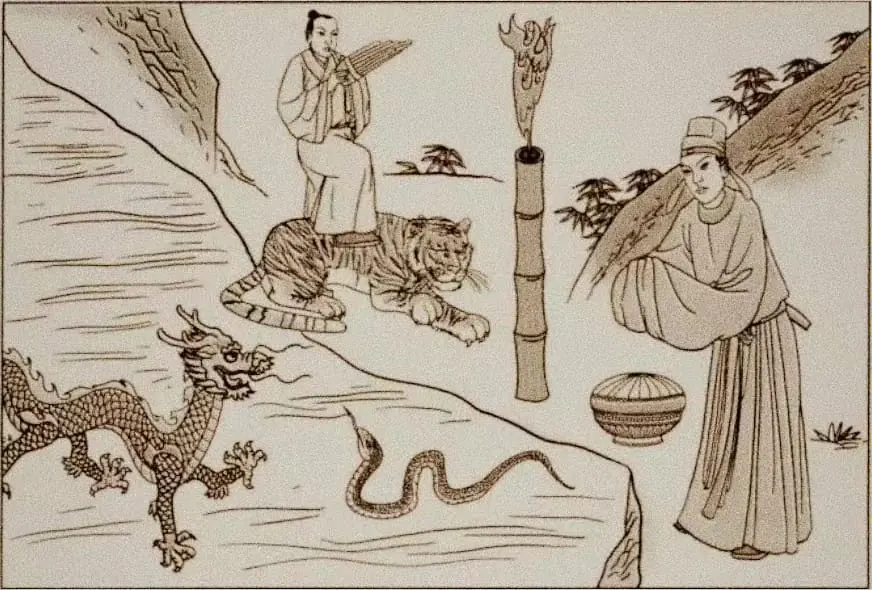
Scene Description
Image Symbolism
Reading the Picture
Feng is abundance at its height, like the sun at noon. The picture lets you enjoy that fullness while showing the hollowness and contention that can grow inside it.
Begin at the centre, with the bamboo stalk and the smoke or ash rising from its top. The Image Symbolism reads bamboo as firm, unchanging joints, and the rising ash as being hollow within: an impressive show with emptiness inside. Abundance is real, but at its height it can turn hollow, like the top line’s great house with no one in it.
Next, the man playing a sheng pipe while seated on a tiger. The music means leisure and happy news; the tiger, staying calm with danger beneath you. The text says he treads on it; the drawing has him sitting on it. Below, a dragon and a snake face each other, the upright and the crooked in contention. On the right an official stands beside a lidded box, read as something completed first and broken later. The dry pond and pearls the text mentions are not drawn.
The trigrams are Fire ☲ below and Thunder ☳ above: brightness that moves, thunder and lightning arriving together. The commentary adds that the noon sun begins to sink and the full moon wanes. The second and fourth lines, seeing the Dipper at noon, show brightness overshadowed, and sincerity, not display, is what clears it.
- Work
- If things are going well, consider what fills the centre of your success: substance or show. Ask whether capable people around you are being used, as the fifth line advises.
- Relationships
- If life feels full and busy, consider whether anyone is really at home behind the door. Sincerity opens more than display does.
- Timing
- This is a high point. If you are at your peak, enjoy it calmly, as the piper does, while remembering that noon is followed by afternoon.
Line Statements
Listed from the bottom line to the top line.
- First nine: Meeting the matching master. Though ten days, no blame. Going wins esteem.
- Six in the second place: Abundant covering; seeing the Dipper at noon. Going brings suspicion and affliction. Sincerity that opens understanding brings good fortune.
- Nine in the third place: Abundant screen; seeing small stars at noon. Breaking the right arm. No blame.
- Nine in the fourth place: Abundant covering; seeing the Dipper at noon. Meeting the equal master. Good fortune.
- Six in the fifth place: Brilliance comes, with celebration and praise. Good fortune.
- Top six: A great house, the household screened. Peering through its door, empty of people. Not seen for three years. Misfortune.
Meaning of the Hexagram
Translated from the Chinese 人间道 commentary with AI assistance; translator notes appear in brackets.
“Abundance: success. The king attains it. Do not worry; be like the sun at noon.”
The way of Feng (Abundance) lies in being able to bring about success and free flow; only a king can bring abundance to all the people under heaven. The way of Abundance is to make the people flourish and things grow abundantly, like the brightness of the sun at noon that shines on everything; then there can be no worry.
“Feng means great. Clarity in movement: hence abundance. The king attains it: he values greatness.”
The way of Abundance discusses how to become flourishing and great: if one is clear and then acts, one will surely achieve flourishing and greatness. What the king pursues is to reach the greatness of all under heaven and bring abundance to the people; then he can surely preserve his way of governing a peaceful age forever.
“Do not worry; be like the sun at noon: it is fitting to shine on all under heaven.”
The way to bring about abundance is to be like the full brightness of the noon sun, shining everywhere under heaven and reaching every place. Then there can be no worry, and one can preserve abundance and greatness for a long time.
“When the sun is at noon, it begins to decline; when the moon is full, it wanes. Heaven and earth fill and empty, increasing and decreasing with the times. How much more so humans! How much more so ghosts and spirits!”
Even the sun at its zenith has its time of darkness; after the moon is full, it also wanes. The filling and emptying of heaven and earth follows time in its increase and decrease; how much more so for humans, and how much more so for ghosts and spirits! This is why the noble person is warned about prosperity: only by knowing that one must be cautious at a time of prosperity can one last long.
“Thunder and lightning arrive together: Abundance. The noble person accordingly decides lawsuits and carries out punishments.”
Lightning and thunder go together: clarity and movement assist each other, forming the image of Abundance. The noble person observes the image of clarity and movement and knows that in applying punishments and establishing laws he must seek to have clarity and authority go together. If the noble person is clear-sighted, there will be no lawsuits left to decide, and he will be careful in using punishment. If he can establish authority, the people will submit without resentment.
“Meeting the matching master. Though ten days, no blame. Going wins esteem.”
This is a firm yang line just beginning to advance. In the time of Abundance, it knows that going forward brings abundance. Although it has no corresponding ruler, there are people in high positions around it who share its aims, so going forward can be fortunate. As the saying goes, ‘those in the same boat can cross the river together.’ In the time of Abundance, one can be without blame.
“Though ten days, no blame: beyond ten days, disaster.”
The sage knows what the time has brought and acts in accord with it; he is able to humble himself in order to seek others. If one harbours private intentions, one will surely invite trouble.
“Abundant covering; seeing the Dipper at noon. Going brings suspicion and affliction. Sincerity that opens understanding brings good fortune.”
The sixth in the second place is a soft line in its proper position, and it sits at the centre of the trigram of brightness: a talent of the utmost clarity. But because the ruler it meets is not clear-sighted, he cannot come down to seek it out. If, in the time of Abundance, it goes forward intending to make the ruler recognise its talent, it will surely provoke suspicion, jealousy and doubt. Only by giving its utmost sincerity, seeking to move him and awaken him, can the ruler’s darkness be opened; then there is good fortune.
“Sincerity that opens understanding: trust brings forth purpose.”
Use your utmost sincerity and genuineness to seek to awaken the understanding and trust of the one above. If this can be achieved, good fortune will surely come.
“Abundant screen; seeing small stars at noon. Breaking the right arm. No blame.”
The ninth in the third place is a person of worthy talent in a minister’s position. In the time of Abundance, however, he finds no response from an enlightened ruler, and the darkening of his sun is even greater than for the sixth in the second place. So he is like a man who has broken his arm and cannot act. The worthy person has talent but cannot use it because the ruler is not clear-sighted, and so no blame attaches to him.
“Abundant screen: great affairs are not possible. Breaking the right arm: in the end he cannot be used.”
In the time of Abundance, not being employed by the one above, he cannot accomplish great affairs; like a man who has broken his arm, he can never be given heavy responsibility.
“Abundant covering; seeing the Dipper at noon. Meeting the equal master. Good fortune.”
The ninth in the fourth place is a firm yang person in the position of a high minister at the ruler’s side. Meeting a ruler who is not clear-sighted, his worth, ability and firmness are hemmed in, as when the noon sun is dimmed and darkened. He cannot be used, and so he is of no use. Therefore the noble person’s talent must meet an enlightened ruler before it can be of use and achieve the work of rescuing the age.
“Abundant covering: the position is not appropriate. Seeing the Dipper at noon: it is dark and not bright. Meeting the equal master: good fortune in acting.”
Having talent but being hemmed in and unable to bring about abundance: this is because the position is not appropriate. In the time of Abundance there are still dark places, surely caused by the ruler’s lack of clarity and the minister’s inappropriate position. Only by seeking to meet an enlightened ruler can good fortune be put into practice.
“Brilliance comes, with celebration and praise. Good fortune.”
A soft yin line occupies the ruler’s honoured position. Its own talent is insufficient, but it knows how to use the fine talents of those in the positions below. There will surely be blessings and celebration, and a fine reputation as well; so there is good fortune.
“The good fortune of the six in the fifth place: there is celebration.”
If the ruler’s position can be fortunate in the time of Abundance, good fortune and celebration will surely reach all under heaven. This is because the ruler is able to use talent.
“A great house, the household screened. Peering through its door, empty of people. Not seen for three years. Misfortune.”
The top six is at the extreme of Abundance. Because it is at the end of movement, it is bound to be restless. When people are at the height of abundance, they must rely on humility to be fortunate. If one does not know to be cautious in prosperity, making one’s dwelling grand outside while being unclear within, hiding one’s household away in darkness, treating others as if they did not exist, and for three years still not knowing how to change but stubbornly going one’s own way, in the end one brings misfortune on oneself.
“A great house: soaring at the edge of heaven. Peering through its door, empty of people: he hides himself away.”
A person at the extreme of Abundance who does not know humility and treats others as if they were nobody is like a bird soaring at the edge of the sky. Not knowing that his own talent is insufficient, he sits high and is proud, and he will surely be abandoned and cut off by others. That it comes to this is because he does not know how to keep himself out of view.
Show the Chinese original (人间道)
丰:亨,王假之,勿忧,宣日中。 丰之道,在能致亨通,能令天下百姓致丰,唯王者能。丰之道在令人民繁盛,事物丰发, 有如日中之明,无所不照,则可以无忧。
丰,大也,明以动,故丰。王假之,尚大也。 丰之道,在论如何盛大,能明而动,必能成丰盛且大也。王者所追求之,为能及天下之大, 致人民以丰,必可永保其治世之道。 勿忧宜日中,宜照天下也。 致丰之道,能如日中之盛明,普照天下,无所不及,如此则可无忧,而能保其丰大及永久 也。
日中则昃,月盈则食,天地盈虚,与时消息,而况于人乎?况于鬼 神乎? 日正当中,也有暗时,月满之后亦有缺亏,天地之盈虚,靠时为消息,更何况乎人?何沉乎鬼神?此君子戒之在盛,知盛时须戒,方可长久。
雷电皆至,丰,君子以折狱致刑。 电雷并行,乃明动相济,成丰之象,君子观明动之象,知用刑制法,在求明与威并行,君 子能明则无折狱,慎于用刑。能立威则民服无怨。
遇其配主,虽旬无咎,往有 尚。 初进之阳刚,居丰之时,知往有丰,虽非 有君之对应,但有其左右高位之人能与同志, 此往可吉也,所谓「同舟能共济也」,此于丰 之时,可得无咎也。
虽旬无咎,过旬灾也。 圣人知时之所至,顺时而为,能知降己以 相求,若怀己之私意,必招患至。
丰其藓,日中见斗,往得疑 疾,有孚发若,吉 。 六二乃柔将其位,又居明卦之中,为至明 之才,但因所遇之君不明,而无法下求于己, 若居丰时,意往而求其君能明己才,必招致猜 妒疑惑。惟有尽己之至诚,以求其感而能发, 则君之昏蒙可开,如此则吉矣。
有孚发君,信以发志也。 用己之至诚孚实,以求发上之知信,如可 成,则吉必至矣。
丰其沛,日中见沫,折其右 肱,无咎。 九三乃居相位有贤才之人,于丰时,却不 见明主之相应,其日之晦更甚于六二将位,故 有如人之折肱无法于行,贤能之人有才,但无 法发挥乃因君之不明,故无可归咎也。
丰其沛,不可大事也,折其 右肱,终不可用也。 丰之时,不见上用,无法成大事,犹人折 其肱,终无法受重用。
丰其薜,日中见斗,遇其夷 主,吉。 九四为阳刚之人居君侧大臣之位,遇君不 明,其贤能阳刚受围,如日中有缺晦,不得其 用,亦无用也,故君子之才须得遇明主,方可 有用能成济世之功。
丰其蔀,位不当也。日中见 斗,幽不明也。遇其夷主,吉行也。 有才能却受围困,无法致丰,乃位不适当 也。丰之时,又有幽暗之处必因君不明,臣位 又不适当而造成。惟求遇明主,吉乃可行。
来章,有庆誉,吉。 阴柔居君之尊位,己之才不足,但知用下 位章美之才,必有福庆,且有美誉故吉。
六五之吉,有庆也。 君位能吉,于丰之时,必可有吉庆及于天 下。此因君能用才也。
丰其屋,蔀其家,窥其户, 阕其无人,三岁不觌,凶。 上六居丰极之时,因处动之终,必燥动, 人于丰盛之时,必假谦虚方吉。如不知戒盛, 外丰其居,内不明,暗藏其家,又目中无人, 三年又不知变,一意孤行,终自招凶。
丰其屋,天际翔也,窥其户, 阒其无人,自藏也。 人处丰之极,不知谦卑,目中无人,犹鸟 之翔于天际,不知己才之不足,居高自傲,必 招人弃絶,其致如此,乃不知自藏也。