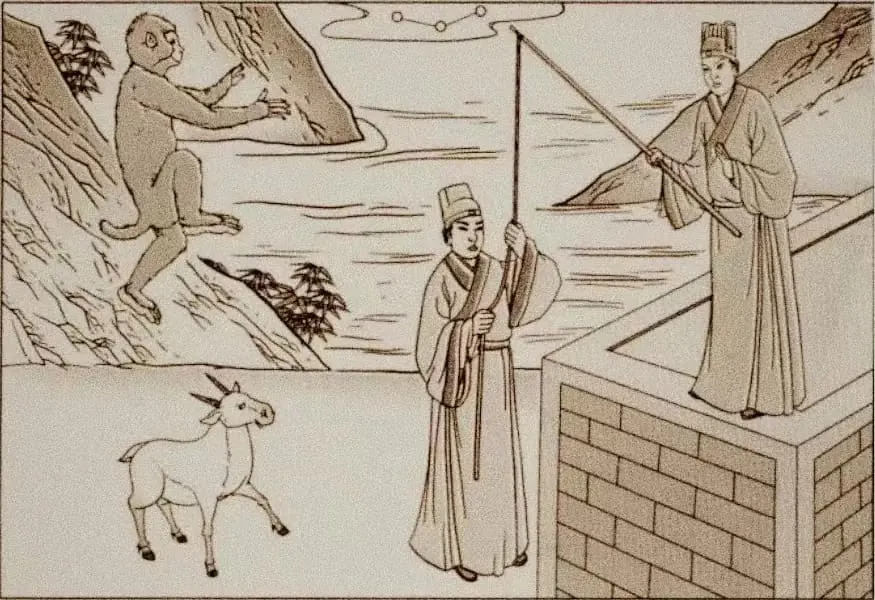
Scene Description
Image Symbolism
Reading the Picture
Lv is the traveller’s condition: away from home and dependent on others. The picture shows its hopeful side, someone above reaching down to draw a capable person in.
Look first at the figure on the brick platform, holding a long fishing rod. The Image Symbolism reads him as a ruler or employer seeking talent. His line does not drop into the water; it runs down to a man by the stream, who holds it in his hand. He is the one being drawn up: a worthy person leaving the margins for a post, or, as the text warns, someone tempted to bend his principles for power. Above them, three stars in a cloud stand for high-ranking patrons.
The trigrams are Mountain ☶ below and Fire ☲ above. Fire on a mountain burns, moves on and does not stay, which is the traveller’s lot. The stream behind the figures, which the Image Symbolism also reads as escape from danger or a harbour, is the road still ahead. A monkey sits on the cliff and a goat stands below.
The man holding the line fits the second line: the traveller who finds lodging, keeps his resources and wins loyal help by staying central and modest. The burning nest in the lesson’s title belongs to the top line, the traveller who sets himself too high.
- Work
- If you are new somewhere, or someone senior offers you a way in, consider accepting with modesty. Ask whether the terms would require you to change your principles.
- Relationships
- If you are far from home or in a temporary arrangement, consider whom you rely on and how you treat them; the third line loses its helpers through harshness.
- Timing
- Small success is possible. If things feel provisional, keep plans modest; one well-aimed effort, like the fifth line’s arrow, is worth more than many hasty ones.
Line Statements
Listed from the bottom line to the top line.
- First six: Petty, petty conduct while traveling; this is how one brings disaster upon oneself.
- Six in the second place: The traveler reaches lodging, holds resources, and gains a faithful young servant.
- Nine in the third place: The lodging burns and the young servant is lost. Steadfastness is dangerous.
- Nine in the fourth place: The traveler rests, gaining resources and an axe. My heart is unhappy.
- Six in the fifth place: Shooting a pheasant, losing one arrow; ultimately gaining praise and a commission.
- Top nine: A bird's nest burns. The traveler first laughs, then cries aloud. Losing the ox in ease. Misfortune.
Meaning of the Hexagram
Translated from the Chinese 人间道 commentary with AI assistance; translator notes appear in brackets.
“The Wanderer: small success. Steadfastness in travel brings good fortune.”
In the time of Lv (The Wanderer), one travels because one does not go along with the common current, and so there is small success; and if one holds firm in heart, there will surely be good fortune. One must never use the way of travel as a cover for harbouring selfish desire.
“The Wanderer: small success. The soft attains the centre outside and is compliant toward the firm; it stops and clings to brightness. Therefore small success, and steadfastness in travel brings good fortune. Great indeed is the meaning of the time of the Wanderer!”
When the time for travel comes and one travels, there is success. A person knows when to advance and when to withdraw; he holds the middle way within and knows how to comply with the firm without; his stopping lies in being able to cling to brightness outwardly while being clear within. Therefore there is small success. He travels while holding firmly and steadfastly to his purpose; therefore there is good fortune. If one ought to travel and does not, one brings blame upon oneself. So all affairs under heaven have what suits their time, and acting according to the time has great meaning.
“Fire on the mountain: The Wanderer. The noble person accordingly is clear and careful in applying punishments, and does not let cases linger.”
Fire high on a mountain, whose light reaches far, is the way of the Wanderer. The noble person observes this image of bright illumination and knows to be clear and careful in applying punishment. He never relies on his own cleverness, but applies punishment with a cautious and reverent heart. Because fire moves on and does not stay, he resolves not to let cases linger. Prisons are set up only because it cannot be avoided, so one does not seek to keep cases pending. This is understood by observing how fire moves.
“Petty, petty conduct while traveling; this is how one brings disaster upon oneself.”
This is a soft yin person without talent, in a low place, in the time of travel. Because his talent and nature are like this, he is surely timid and petty, and in the end he will surely bring disgrace upon himself.
“Petty, petty conduct while traveling: the will is exhausted, and there is disaster.”
When the will changes under hardship and exhaustion, one brings disaster upon oneself.
“The traveler reaches lodging, holds resources, and gains a faithful young servant.”
The sixth in the second place is a capable talent in a fitting position in the time of travel. Because it knows how to hold the central and correct place without impropriety, it can surely keep and store up resources and also win the loyalty of servants; so there is good fortune.
“Gaining a faithful young servant: in the end there is no fault.”
What a traveller relies on is his young servants. If he can win their loyalty, he can surely be without disaster.
“The lodging burns and the young servant is lost. Steadfastness is dangerous.”
In the time of travel, gentleness, compliance and humility are surely what bring good fortune. Here, though, he conducts himself too firmly and also holds a high place, and so he brings disaster and hardship on himself. He will surely lose the loyalty of his servants, and in the end danger will arrive.
“The lodging burns: he too is harmed by it. Treating those below this way while travelling, his rightful bond with them is lost.”
In the time of travel, being too firm and exalting himself, he will surely lose the loyalty of those under him; this is danger at its height.
“The traveler rests, gaining resources and an axe. My heart is unhappy.”
A firm yang line in a soft position has the image of using softness. When a person in the time of travel can be soft, he grasps the way of travel and will surely have good fortune. In this way he can obtain help with goods and money while travelling, but he cannot fulfil his great ambition, so his heart is surely unhappy.
“The traveler rests: he has not attained his position. Gaining resources and an axe: the heart is still not glad.”
Being firm in a soft place fits the way of travel, so it is good in a time of travel; but though he wishes to carry out his ambition, he cannot. His heart is surely unhappy.
“Shooting a pheasant, losing one arrow; ultimately gaining praise and a commission.”
When travelling, one must not make mistakes; once one does, disaster arrives at once. It is like shooting a pheasant: if one can hit it with a single arrow and never shoot in vain, there is no fault. If one can do this, then in the time of travel one can surely establish one’s name and spread one’s reputation.
“Ultimately gaining praise and a commission: it reaches up to those above.”
In the time of travel, if one can make both those above and those below respond, there can be good fortune. The reason is that the time of travel is a time of hardship, when one has not yet found peace; that is what travel is.
“A bird’s nest burns. The traveler first laughs, then cries aloud. Losing the ox in ease. Misfortune.”
In the time of travel he conducts himself with excessive yang firmness and sets himself high, not knowing humility. He is like a bird that flies high and burns its own nest, so in the end he has nowhere safe to dwell. Proud and overly firm in the time of travel, at first he can indulge himself to his heart’s content, and so he laughs. Then he loses his safety and has no dwelling, and so afterwards he wails. The ox is a creature of compliant nature, yet it is also easily lost, through just a single moment of carelessness. Therefore there is misfortune.
“Being at the top while travelling: by rights it burns. Losing the ox in ease: in the end no one hears of it.”
Placing himself high in the time of travel, he surely cannot keep himself safe, like the bird that burns its nest. It is very easy to lose the virtue of compliance, and when misfortune arrives he still does not realise it himself.
Show the Chinese original (人间道)
旅:小亨、旅贞吉。 旅之时,此因不同流而旅,故有小亨,且得之坚心,必吉。切不可假旅之道而有私欲其中。
旅,小亨,柔得中乎外而顺乎刚,止而丽乎明,是以小亨,旅贞 吉也。旅之时义大矣哉! 旅之时至而旅,乃有亨,人能知所进退,内有中道外又知顺于刚,止之在能外丽而内明, 是故有小亨,旅而坚贞其志,是故吉也。当旅不旅乃自求咎。故天下之事,当有时宜,因时而 动,其义大也。
山上有火,旅。君子以明慎用刑,而不留狱。 火在山高处,其明及远,旅之道也。君子观此明照之象,知明慎以用刑,絶不依持己之明, 必有戒慎恐惧之心而施于用刑。因火行不留,故有不留狱之志,狱乃不得已而设,故不求留狱, 此观火之行而体悟之。
旅琐琐,斯其所取灾。 阴柔无才之人,居卑下,居旅之时,因才 质如此,故必畏畏琐琐,其必终自取其辱。
旅琐琐,志穷灾也。 意志因困穷时,而生变,乃自取其灾也。
旅即次,怀其资,得童仆贞。 六二乃得适位之将才居旅时,因知中正处 不失当,必能怀蓄财资,又能得仆人之忠心, 故吉。
得童仆贞,终无尤也。 旅行之人,所赖者为童仆,能得其忠心, 必可无灾。
旅焚其次,丧其童仆,贞厉。
旅之时,必以柔顺谦下为吉,如今自处过 刚,又居高,乃招致灾困。必失仆人之忠,终 有危厉来临。
旅焚其次,亦以伤矣,以旅 与下,其义丧也。 居旅时以过刚自高,手下必丧失忠心,危 之至矣。
旅于处,得其资斧,我心不 快。 阳刚又居柔位,有用柔之象。人居旅时, 能柔,得旅之道,必吉。此法居旅时可得财货 之资助,但不能伸其大志,其心必不快。
旅于处,未得位也,得其资 斧,必未快也。 以刚居柔,合于旅之道,故旅时为善,但 欲得行其志,却不能也。心必不快。
射雉,一矢亡,终以誉命。 人于旅时,不可有错,一但犯之,灾祸立 至。就如射雉,能一箭而中,不虚发即无过失, 能如此,则于旅时,必可立名扬誉。
终以誉命,上逮也。 旅之时,能令上下皆应,则可吉。其因旅 之时乃困而未得其安之时为旅。
鸟焚其巢,旅人先笑后号 咷 咷 咷 咷,丧牛于易,凶。 旅时以过阳刚自处以高,不知谦卑,就如 鸟高飞而自焚其巢,故终居无所安处,自负过 刚,居旅时,始则可快意尽情,故生笑。继而 失安无居所,故后号咷。牛为顺性之物,但也
易于丧失,只一疏忽而己。故凶。
以旅在上,其义焚也。丧牛 于易,终莫之闻也。 旅时以居高自处,必不能保安,犹鸟之焚 巢,丧失顺德极易,待凶至,乃不知自闻知也。