Scene Description
Image Symbolism
Reading the Picture
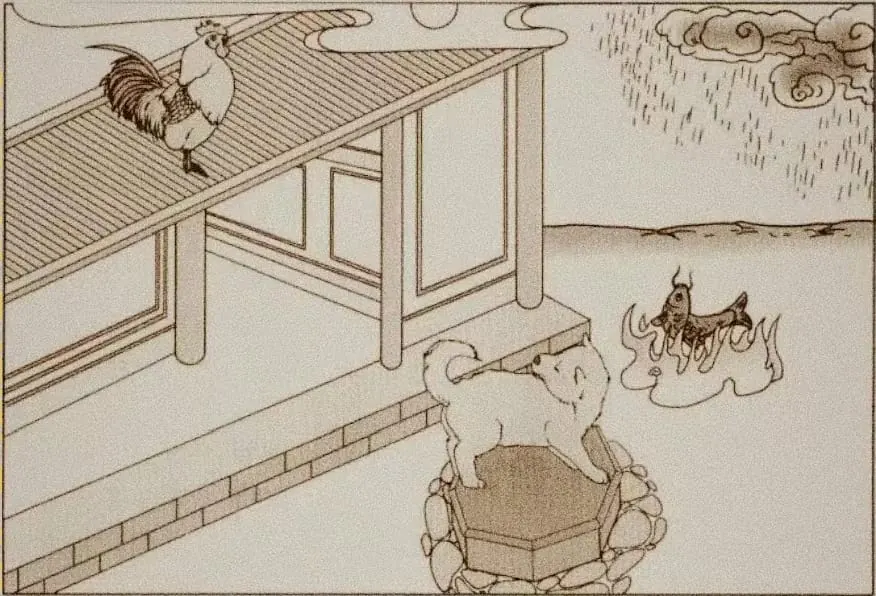
Jie is limitation: a lake can hold only so much water, and the picture contrasts a creature that knows its place with one that has gone where it cannot easily get out.
Begin with the dog. The description places it in a well, a picture of being stuck because one did not know where to stop; here it is drawn standing on the well’s covered mouth, right at the edge of that trap. Compare the rooster on the roof, perched calmly high up. The symbolism treats it as the helper or the moment of rescue, and the video note adds a sound pun: 鸡 jī, chicken, echoes 机 jī, opportunity.
Rain falls from a dark cloud at the upper right, which the symbolism reads as an obscure, unclear time. Beside the well a fish leaps out of flames: great effort that goes nowhere. The house beside it stands open to the yard, a reminder that business can still go on.
The trigrams make the theme literal: Lake ☱ below, Water ☵ above, water collecting in a basin with banks. The first two lines are about the courtyard: staying in is blameless at first, but staying in when the time calls for going out brings misfortune. The fifth line praises restraint that feels sweet, the top line warns against restraint that has become bitter.
- Work
- If you are spending without margin or taking risks to catch up, consider what limits would keep you out of the well. Ask, too, whether a limit you keep has become a reason never to step out.
- Relationships
- Healthy boundaries help both people. If a rule has turned bitter for either of you, consider loosening it rather than enforcing it harder.
- Timing
- The question is when to stay in and when to go out. If you have waited a long time, watch for the rooster’s moment rather than leaping like the fish.
Line Statements
Listed from the bottom line to the top line.
- First nine: Not leaving the inner courtyard. No blame.
- Nine in the second place: Not leaving the outer courtyard. Misfortune.
- Six in the third place: Without restraint, there are sighs. No blame.
- Six in the fourth place: Peaceful restraint. Success.
- Nine in the fifth place: Sweet restraint. Good fortune. Going wins esteem.
- Top six: Bitter restraint. Steadfastness is inauspicious; regret disappears.
Meaning of the Hexagram
Translated from the Chinese 人间道 commentary with AI assistance; translator notes appear in brackets.
“Jie: success. Bitter restraint cannot be held to steadfastly.”
The way of Jie (Limitation) lies in having measure. If in all things one knows restraint, there will surely be success. What is precious in restraint is the mean. If the limits are too severe, they become bitter, and restraint that has reached the point of bitterness certainly cannot last long. So it is in human affairs.
“Jie, success: the firm and the yielding are divided, and the firm holds the center.”
The way of restraint can bring success because it knows how to combine firmness and softness, and can be firm and yet keep to the mean. That is why restraint can succeed.
“Bitter restraint cannot be held to steadfastly: its way is exhausted.”
If restraint is carried to the extreme of bitterness, one will surely be unable to hold firmly to one’s resolve, and the way of restraint will then lead to hardship and exhaustion.
“Joyful in going through danger; restraining from the proper position; central and correct, and so getting through.”
This speaks of the qualities of the hexagram: danger outside, joy within. To be joyful and yet know when to stop is the great meaning of restraint. Ordinary people do not know when to stop while they are enjoying themselves, and think of stopping only when they meet hardship and danger. If a person who holds a fitting and honoured position understands the way of restraint, he will surely be central and correct and succeed. People today have an endless desire for power; holding high position, they do not think of stopping, and their enjoyment knows no limit. In the end this surely leads to misfortune. Clearly, it is because they do not know the way of restraint.
“Heaven and earth have their divisions, and the four seasons are completed. Restraint through institutions: then wealth is not wasted and the people are not harmed.”
Because there is a way of division between heaven and earth, the four seasons are distinct. Observing this, the sage knew to establish institutions as the way of restraint, so that wealth would not be wasted and the people would not be harmed. This is the beginning of the idea of rule by law. The sage established this way because he knew that human desires are limitless, and so he restrained them with measures, to avoid sliding into rule by persons, which, being driven by private desire, ends by exhausting the people and wasting wealth.
“Above the lake there is water: Limitation. The noble person accordingly establishes number and measure and deliberates on virtue and conduct.”
A lake can hold only a limited amount of water; hence limitation. Observing this, the noble person knows that limits are set by institutions, and he lays down definitions to distinguish the conduct of the noble person from that of the petty person.
“Not leaving the inner courtyard. No blame.”
A yang, firm nature at the beginning of Jie will surely be unable to restrain itself. If it stays within the gate and courtyard, it can be without blame.
“Not leaving the inner courtyard: knowing what is open and what is blocked.”
Not leaving the courtyard can be without blame, but one must still know the words and actions of the world outside, and must let the time decide the moment to advance or withdraw.
“Not leaving the outer courtyard. Misfortune.”
Here a firm yang nature occupies a soft yin position. The meaning of the line is this: a person in a yin place, and not correct, lives at a time when restraint is called for, but does not know that restraint must accord with the middle way, and that neither excess nor deficiency is true restraint. Such a person, even without leaving the gate and courtyard, will bring on misfortune.
“Not leaving the outer courtyard, misfortune: missing the time completely.”
The meaning of time is the most important thing in the Changes. To not know the meaning of restraint while living in a time of restraint is to miss the time. Because one’s restraint does not accord with the middle way, and both excess and deficiency are wrong, there is misfortune even without leaving the gate and courtyard.
“Without restraint, there are sighs. No blame.”
The third place is by nature firm, yet now a soft yin line occupies it: a position that calls for firm decisiveness is held by a person of soft nature. Because it is soft and compliant, and knows to restrain itself, it can follow what is right in its conduct and can also be without fault.
“The sighs of not restraining oneself: whom else is there to blame?”
Knowing restraint lets one avoid faults. So if one does not know how to restrain oneself and brings disaster on oneself, whom can one blame?
“Peaceful restraint. Success.”
A yin line in a yin position is in its correct place. In a time of restraint it is the image of holding high position and yet practising restraint. If it can rest content in this, there is success.
“The success of peaceful restraint: it carries on the way of the one above.”
If one can practise the middle way of restraint and rest content in it, there will surely be success.
“Restraint. Good fortune. Going wins esteem.”
The nine in the fifth place is the honoured position, the ruling place in a time of restraint. If it can find restraint as sweet as honey and carry the way of restraint to the full, there will surely be good fortune, and its achievement will be great.
“The good fortune of sweet restraint: it occupies the central position.”
If the ruler knows the way of restraint and practises it, finding it as sweet as honey, he will surely achieve great things, because he occupies the honoured position.
“Bitter restraint. Steadfastness is inauspicious; regret disappears.”
The top six is at the extreme of restraint, and it will surely suffer bitterness because of restraint. If it holds firm and does not change, there will surely be misfortune, and in the end it comes to ruin and regret. The words 悔亡 (‘regret disappears’) in Jie are the same as in other hexagrams, but here the meaning is different.
“Bitter restraint, steadfastness inauspicious: its way is exhausted.”
To suffer bitterness through restraint and not know how to change is to lose the spirit of the Changes. The misfortune comes because the way has been exhausted.
Show the Chinese original (人间道)
节:亨,苦节,不可贞。 节之道,在有制,万事如知节,必可亨。节之贵在中庸,如限制太过则苦,如节至于苦, 必不可常久也,人事如此。
节亨,刚柔分,而刚得中。 节之道能致亨通,乃因知刚柔并济,能刚又且能适中,此节之能亨。 苦节不可贞,其道穷也。 如节之致于苦极,必无法坚固守志,则节道必招困穷也。 说以行险,当位以节,中正以通。 此以卦才言,外险内悦,以能悦且又知止,此为节之大义,常人于悦时不知止,遇艰险方 思止。
当位居尊之人如明节之道,必能中正且亨通矣。今人之权力欲望无尽,居尊不思止,悦 而无限,终必至凶,乃不知节之道,明矣。 天地节而四时成,节以制度,不伤财,不害民。 天地之间有节道故四季分明,圣人观之知立制度,以为节道,所以必不伤财害民,此法治 观念之始,圣人立此道,即因知人之欲望无限,故以节制之,免流于人治,必因私欲,而终致 劳民伤财。
泽上有水,节,君子以制数度,议德行。 泽之容水有限,故节。君子观之,知节以制度来限制,下定义来区分君子小人之行为。
不出户庭,无咎。 阳刚之性居节之初,必不能节,如居门庭 之内,则可无咎。
不出户庭,知通塞也。 不出户庭可以无咎,但须知外之言与行, 必以时来定进退之机。
不出门庭,凶。 刚阳之性,居阴柔之位,爻义为,处阴且 不正之人居当节之时,不知节必合于中道,过 与不及皆非节,如此即令不出门庭,亦会招凶。
不出门庭凶,失时极也。 时之义在易中最为重要,不知节之义,又 居节之时,失其时,因不合中道之节,过与不 及皆不对,即令不出门庭,亦有凶矣。
不节若,则嗟若,无咎。 三爻本刚,今阴柔居之,须刚断而柔性之 人居其位,因其柔顺,且知自节乃可顺于义行, 亦可以无过。
不节之嗟,又谁咎也? 知节可以免过失,故不知自节而招祸,又 能怪谁呢?
安节,亨。 阴居阴位,其正位,于节时,即居高位且 有节之象,能安于此,则亨通。
安节之亨,承上道也。 能行节之中道,且安居于此,必亨通义。
节,吉,往有尚。 九五尊位,乃居节时之主位,能甘之如饴, 尽节之道,必吉,功大矣。
甘节之吉,居位中也。 君王能知节道,用节且甘如饴,必成大功, 因其居尊位故也。
苦节,贞凶,悔亡。 上六乃居节之极,其必因节致苦,如坚守 不改则必凶,终致亡而悔,易之节卦悔亡,与 他卦之悔亡,辞同但意不同也。
苦节贞凶,其道穷也。 因节致苦,不知变,失易之神,其凶乃因 道之穷尽。