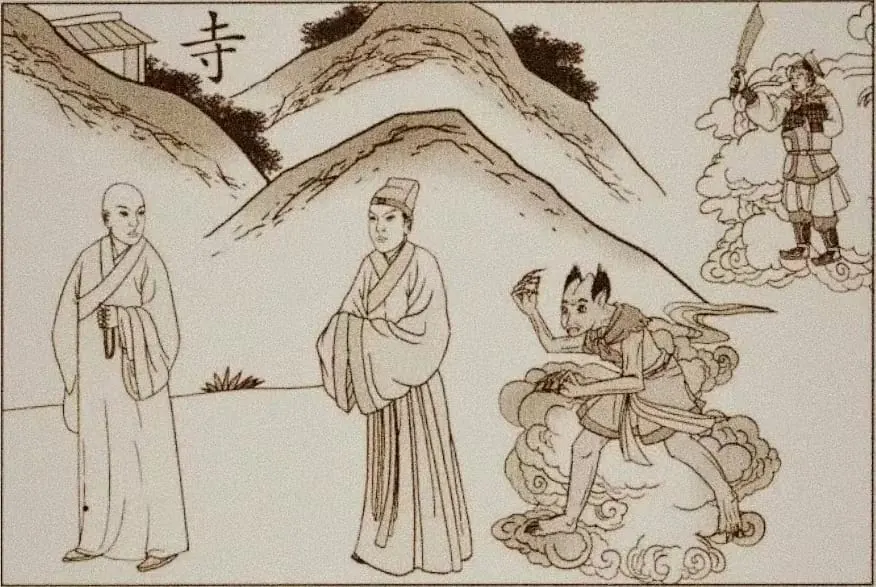
Scene Description
Image Symbolism
Reading the Picture
Huan is dispersion: things are coming apart and something is chasing you, and the picture asks where you will turn to gather yourself again.
Start in the middle with the man in the official’s hat. Behind him a ghost rides a cloud, crouched and reaching; ahead of him stands a calm monk holding prayer beads. The Image Symbolism reads the ghost as trouble in pursuit, or as a guilty conscience that clouds judgement, and the man as someone stepping away from it to seek help from a person outside worldly affairs. That is the second line in motion: running toward support, and regret disappears.
Above, on the mountain, is a temple marked 寺. The Image says the former kings built temples to pull scattered hearts back together, so the building is a center to return to. The character itself is a small puzzle: 寺 is made of 土 (earth) over 寸 (an inch), recalling the saying that every inch of land is worth gold, and the symbolism also reads it as waiting for the right moment. At the upper right, a golden-armored warrior stands on clouds with a raised sword: a righteous force with popular support, set against the ghost.
The trigrams are Water ☵ below, danger, and Wind ☴ above, gentle movement. Wind across water scatters, but it can also carry a boat downstream.
- Work
- If a team or plan is falling apart, ask what common purpose could draw people back together, and which steady, trustworthy person you can turn to first.
- Relationships
- If worry or an uneasy conscience is driving you, consider naming it honestly rather than running from it. Look for the calm presence in your life, not the loudest one.
- Timing
- Act early, as the first line does, while the scattering is still small. If things have already gone far, step back from the danger instead of fighting it head-on.
Line Statements
Listed from the bottom line to the top line.
- First six: Rescue with a strong horse. Good fortune.
- Nine in the second place: Dispersion; running toward support. Regret disappears.
- Six in the third place: Disperse one's self. No regret.
- Six in the fourth place: Disperse one's group. Great good fortune. Dispersal gathers into a hill, beyond what ordinary people imagine.
- Nine in the fifth place: Disperse the great proclamation like sweat; disperse the king's dwelling. No blame.
- Top nine: Disperse blood; depart and go far away. No blame.
Meaning of the Hexagram
Translated from the Chinese 人间道 commentary with AI assistance; translator notes appear in brackets.
“Huan: success. The king approaches his temple. It is beneficial to cross the great river. It is beneficial to be steadfast.”
Huan (Dispersion) means scattering. When people drift apart and scatter, it begins with a single thought at the center of the heart: when hearts part, people scatter. So whoever would remedy scattering must begin from the center. If one can gather in people’s hearts, what has scattered can be brought together again. The way of Huan, then, is about how to deal with scattering, and that is why there can be success. If the ruler knows to establish an ancestral temple to gather in people’s hearts, he will surely be able to advance without obstruction; therefore he must keep his heart firm to the end.
“Huan, success: the firm comes and is not exhausted; the yielding gains its place outside and is in accord with what is above.”
Speaking from the hexagram, the reason the way of Huan can bring success is that it uses a yang, firm method, yet must not go to the extreme of firmness. The firm line occupies a lower position and yet holds the middle way, while the yielding line, in a soft position, finds correspondence with the ruler’s place of the fifth. So in a time of dispersion, one who can hold to the center will never come to scattering and separation, and therefore can succeed.
“The king approaches his temple: the king is at the center. It is beneficial to cross the great river: riding on wood brings achievement.”
When the ruler can use the ancestral temple to gather in people’s hearts, he understands the subtle use of the middle way. If he can do this, he can go anywhere under heaven and meet no obstruction. Since ancient times, whoever has won the people has surely won their hearts; only then can he truly be said to have won the people.
“Wind moves over the water: Dispersion. Thus the former kings made offerings to the Lord on High and established temples.”
Wind moving over water is the image of dispersal. Observing the image of Huan, the former kings understood that to remedy the scattering of the world there is nothing but sacrifice at the ancestral temple, gathering and uniting people’s hearts. Of all the ways of uniting hearts, none is greater than this.
“Rescue with a strong horse. Good fortune.”
The first line is the beginning of dispersion. It is yin and soft, not in its correct position, and in a low place. So if, at the very beginning, one notices and comes to the rescue, one need only rely on a person of yang firmness to put the dispersion in order; hence good fortune.
“The good fortune of the first six: it is compliant.”
The first six can have good fortune because it notices at the very start of dispersion and rescues at the start. This is acting at the right time, and so there is good fortune.
“Dispersion; running toward support. Regret disappears.”
Outwardly it puts on compliance, but inwardly there is danger and worry: the heart has already scattered. The nine in the second place sits in the central place of the Water trigram, the trigram of danger. In a time of dispersion it also lies in the midst of danger, so how great its danger is can be imagined. Only if it recognizes the crucial moment and runs toward it without hesitation need it not fear ruin.
“Dispersion; running toward support: one obtains what one wishes.”
In a time of dispersion one is in danger. One must recognize the crucial moment and draw close to it; then one can obtain what one wishes.
“Disperse one’s self. No regret.”
The third six is in a minister’s position, but its talent is of a yin quality and unsuited to holding the post. In a time of dispersion it certainly cannot rescue others; it can only confine itself to its own person, and so it can be without regret.
“Disperse one’s self: the will is directed outward.”
In a time of dispersion, one compliantly seeks to be in accord with those above, and so can avoid disaster for oneself.
“Disperse one’s group. Great good fortune. In dispersion there is a gathering like a hill; this is not what ordinary people would think of.”
The fourth six is the position of a high minister. Now the ruler, the nine in the fifth place, comes to join and respond to it, so ruler and minister combine their strength to relieve the scattering of the world. If they can do this, there will be great achievement.
At the height of dispersion, firmness certainly cannot make people cherish and attach themselves, and softness is not enough to make them return and rely on one. So to bring about a great gathering is surely difficult, and it must use extraordinary methods. Who but a sage or a worthy could accomplish so great a deed?
“Disperse one’s group, great good fortune: it is shining and great.”
“Great good fortune” means great merit and virtue. When ruler and minister join forces in a time of dispersion and can gather the people together, their achievement can shine far and wide.
“Disperse the great proclamation like sweat; disperse the king’s dwelling. No blame.”
The nine in the fifth place is the ruler’s position. In a time of dispersion it has yang firmness and correct virtue, and also the outward compliance of the Wind trigram. This is to have deeply grasped the way of dealing with dispersion. It will surely be able to issue commands to the people, and the people will trust, submit and follow, as sweat comes out through the body, bound up with every breath. If the relation between people and ruler can be like this, he can surely occupy the royal position without blame.
“The king’s dwelling is without blame: it is the correct position.”
The ruler’s position is honoured, and his talent and virtue suit it; he can be called king without blame, because this accords with the correct position.
“Disperse blood; depart and go far away. No blame.”
When dispersion reaches its extreme, if one can still keep to the way of gentle compliance, then even if there is injury one can still come out of danger and stay far from harm, and so be without disaster.
“Disperse blood: keeping far from harm.”
When dispersion reaches its extreme, even if blood is shed and harm is done, by firmly keeping to the way of gentle compliance one will surely stay far from calamity.
Show the Chinese original (人间道)
涣:亨。王假有庙,利涉大川,利贞。 涣,散也。人会离散,本于中心一念,心离则散矣。故能治散,必从中入手,有能收拾人 心,散可聚矣,故散之道论如何用散,故可以亨。君王能知立宗庙收人心,则必可前进无阻, 故须坚心到底。
涣,亨。刚来而不穷,柔得位乎外而上同。 涣之道所以可致亨,以卦来言,用阳刚之法,不可致极刚,以居下位,又得中道,柔位而 得五君位之相应,故居涣时,能守其中,必不至于离散,所以能亨。 王假有庙,王乃在中也。利涉大川,乘木有功也。 君王能利用宗庙收拾人心,乃知用中道之妙,能如此可往天下,无处不阻也,自古以来, 能得民者,必得其心,方可谓得民矣。
风行水上,涣。先王以享于帝立庙。 风行水上,涣散之象。先王观涣之象知,救天下之散,惟有祭祀宗庙,收合人心,合心之 道,莫大于此。
用拯马壮,吉。 初爻,为涣之始,阴柔居不正,又处卑下, 故于始时即察知而拯,只须托于阳刚之人,即 可整涣,故吉。
初六之吉,顺也。 初六之能吉,乃因于涣始即察知,始而拯, 此得时也故吉。
涣奔其机,悔亡。 外饰顺,内实险忧,心已散。九二居坎险 中位,乃意于涣散时,又居险中,其险可知, 如能知机而奔往不犹豫,方可不虑亡也。
涣本汁其机,得愿也。 涣之时居险,必以知机而亲近之,乃可得 愿矣。
涣其躬,无悔。 六三相位,今才为阴质,不适居位,于涣 散之时,必无法拯救他人,只能止于其身,可 以无悔矣。
涣其躬,志在外也。 涣时,以躬顺求上同。可免己之灾。
涣其群,元吉。涣有丘,匪 夷所思。 六四乃大臣之位,今有九五君来同应,有 君臣合力,以济天下之涣散,能如此则有大功。 方涣散之时,用刚则必不能使之怀附,用柔又 不足使其依归,故如能使大聚,此事必难,用 必非常法,能成此大功,非圣贤何能如是乎?
涣其群,元吉,光大也。
元吉谓大功德也,君臣合力于涣时,能群 聚民众,其功可光大也。
涣汗其大号,涣王居,无咎。 九五君位,居涣之时,以阳刚正德又得巽 之外顺,此深得处涣之道,必能号令人民,民 心信服而从矣,如汗之于体外,息息相关,民 与君之关系能如此,则必能居王位而无咎。
王居无咎,正位也。 君位尊,而其才德又适其位,称王可无咎, 因合于正位。
涣其血,去逖出,无咎。 涣至极时,仍能守巽顺之道,即令有伤, 亦仍可出险,远离灾害而无灾矣。
涣其血,远害也。 涣散至极,即令血出伤害。以坚守巽顺之 道,必远离祸害也。