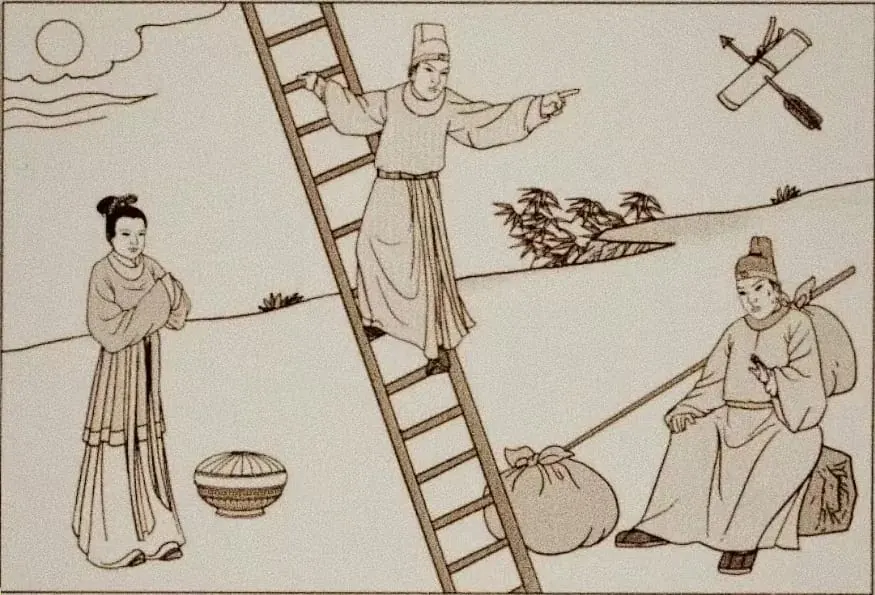
Scene Description
Image Symbolism
Reading the Picture
Dui is joy that grows out of sincerity and shared effort: the picture is full of tasks done, help given and chances taken, with one reminder that pleasure pursued for its own sake can undo what was gained.
Begin with the seated official on the right, resting beside a carrying pole and two tied bundles. The Image Symbolism reads this as a task completed, with help close at hand: a benefactor who enjoys helping others. In the centre a scholar climbs a tall ladder and points ahead, the traditional picture of success in the examinations. At the upper right an arrow crosses a rolled document; shooting stands for launching, acting when the opportunity comes. The moon at the upper left, among clouds, stands for clear and orderly rule.
At the left a woman stands beside a round lidded box. The text writes 合, which also means coming together, for 盒, box, and the symbolism reads this corner as outside involvement: things come together first and come apart later. Both trigrams are Lake ☱, two lakes nourishing each other, which the Image turns into friends studying together. The seated helper and the climbing scholar fit the first two lines, harmonious joy and sincere joy, while the warning in the box echoes the third line: coming for joy brings misfortune.
- Work
- If a stretch of work is finished, consider who helped you carry it and whom you might help in turn. When a clear opening appears, it may be the moment to act.
- Relationships
- If a connection rests on shared pleasure alone, ask whether there is sincerity underneath. Consider whether you are seeking the other person or simply the feeling.
- Timing
- Conditions look bright and open. If things feel easy, enjoy them, but watch for the point where enjoyment turns into chasing more of it.
Line Statements
Listed from the bottom line to the top line.
- First nine: Harmonious joy. Good fortune.
- Nine in the second place: Sincere joy. Good fortune, regret disappears.
- Six in the third place: Coming for joy. Misfortune.
- Nine in the fourth place: Considering joy, not yet at peace. Separating from affliction brings happiness.
- Nine in the fifth place: Trusting what strips away. Danger.
- Top six: Drawn into joy.
Meaning of the Hexagram
Translated from the Chinese 人间道 commentary with AI assistance; translator notes appear in brackets.
“Dui: success; it is beneficial to be steadfast.”
The way of Dui (The Joyous) can bring success. If a person can take delight in others, others will delight in him in turn, and this is surely enough for success. Yet the way of Dui lies in steadfast correctness: to seek delight by an incorrect way is bound to become wrongful and shameful, and leads in the end to regret and blame.
“Dui means joy. Firm at the centre and soft on the outside, joy benefits through steadfastness; thus it accords with heaven and responds to people. When joy goes before the people, they forget their toil; when joy leads them into hardship, they forget death. Great is joy: by it the people are encouraged!”
Dui is delight. Soft outside and firm inside, it is the image of a heart that is sincere and true at its centre. The way of joy can bring success because it is steadfast and correct. Above, it follows the principle of heaven; below, it responds to the hearts of the people. If one can lead the people through joy, they forget toil and hardship and gladly face difficulty for the state, forgetting life and death. This is the utmost of the way of joy, and there are none among the people who do not trust it.
“Lakes resting one upon another: Dui. The noble person accordingly joins with friends for discussion and practice.”
Two Dui trigrams are doubled, that is, two lakes cling to each other and soak into each other: an image of mutual nourishment and benefit. Observing it, the noble person knows that friends who discuss and practise together, adding to each other’s growth, are the great joy of the world; it is an image of enlightening and benefiting one another.
“Harmonious joy. Good fortune.”
Although the first line is yang and firm, because it dwells in a low place it knows to be humble, harmonious and compliant. Such joy has no partiality or selfishness; this is the correct way of Dui, and so there is good fortune.
“The good fortune of harmonious joy: its conduct is not yet doubted.”
The first place must follow the times and accept its situation; its heart has no desires and seeks only harmony, and so there is good fortune. Its conduct will certainly give no cause for suspicion.
“Sincere joy. Good fortune, regret disappears.”
The second place has the virtue of firm centrality and is full of trustworthiness within. Although it is close to a petty person, it does not lose the way of the noble person; it is joyful without losing the virtue of firm centrality, and so it can have good fortune and need not worry about loss.
“The good fortune of sincere joy: its will is trustworthy.”
The joy of the noble person comes from the utmost sincerity of the heart, so he never strays from the way. The joy of the petty person makes him forget himself, and he loses himself without knowing it.
“Coming for joy. Misfortune.”
A yin line occupies a firm yang position, which does not suit it. Its way of gaining joy is neither central nor correct: it seeks delight for delight’s sake. When people seek something in this way, it is always out of private desire; having already left the correct way, there is misfortune.
“The misfortune of coming for joy: the position is not appropriate.”
The soft occupies a firm place and cannot conduct itself with centrality and correctness. Seeking joy by following desire is sure to invite misfortune.
“Considering joy, not yet at peace. Separating from affliction brings happiness.”
A yang firm line in a yin place is neither central nor correct, so it is undecided and cannot settle. In a time of joy, if it is not led astray by delight, knows its lot and keeps to firm correctness, hates wrongdoing and removes its enemies, it is sure to gain the ruler’s trust and have happiness.
“The happiness of the nine in the fourth place: there is cause for celebration.”
That the nine in the fourth place, the one at the ruler’s side, can enjoy happiness and celebration must come from the ruler’s trust, which lets it carry out its yang firm aims.
“Trusting what strips away. Danger.”
The nine in the fifth place, the ruler’s position, has the way of centrality and correctness; in a time of joy it can be wholly good. Yet the sage still sets a warning that there is danger: even when a central, correct sage is above, there are still petty people in the world. Lest one be beguiled by joy and let petty people in without realising it, the warning is set here.
“Trusting what strips away: the position is correct and fitting.”
Dwelling in joy yet heeding the warning about stripping away: if one is wary from the very start of an affair, one can be without disaster or blame.
“Drawing joy.”
When joy reaches its extreme, it seeks ever more joy; hence the text says “drawing joy”. In all the affairs of the world, going too far is never fitting, and misfortune arrives.
“The drawing joy of the top six: it is not yet shining.”
Joy at its extreme has already gone too far beyond what reason allows, and its outcome cannot become any brighter.
Show the Chinese original (人间道)
兑:亨,利、贞。 兑之道,可以致亨。人能悦于物,物亦相悦,必足以亨。然兑之道在贞正,求悦不以正道, 必成邪吝,终致悔咎。
兑,说也,刚中而柔外,说以利贞,是以顺乎天而应乎人,说以 先民,民忘其劳,说以犯难,民忘其死,说之大,民劝矣哉。 兑,悦也。外柔内刚,中心诚实之象,悦之道可亨,乃因其能贞正。上顺天理,下应人心, 能使民以悦,则民忘劳苦,且欣然为国犯难。忘其生死,此悦之道至极矣,民莫不信之。
丽泽,兑,君子以朋友讲习。 两兑相重,即两泽互丽,交相浸润,互有滋益之象,君子观之乃知朋友讲习,互相增益, 为天下之大悦,有互相明益之象。
和兑,吉。 初虽阳刚,但因居卑下,乃知卑下和顺, 此悦必无所偏私,此兑之正道,故吉。
和兑之吉,行未疑也。 初位必随时顺处,心无所欲,惟求能和而 已,是以吉也。其行必未有可疑。
孚兑,吉,悔亡。 二位有刚中之德,内实孚信,虽近小人, 但不失君子之道,悦而不失刚中之德,所以能 吉而不虑亡矣。
孚兑之吉,信志也。 君子之悦,自心中之至诚,故必不失道, 小人之悦,必忘形而自失不知。
来兑,凶。 阴弃居阳刚之位,不适也,比得兑之道不 以中正,为悦而求悦,人之有求必因私欲,己 离正道,故凶。
来兑之凶,位不当也。 柔居阳刚,自处必不中正,和欲而求悦, 必招凶。
商兑未宁,介疾有喜。 阳刚处阴位,居不中正,故有未决,未能 定也。居兑之时,不为悦所惑,能知命守刚正, 疾恶去仇,必能得君之信,而有喜也。
九四之喜,有庆也。 九四君侧之人能有喜庆,必来自君之信 孚,得遂行其阳刚之志也。
孚于剥,有厉。 九五君位得中正之道,居悦时,乃可尽善, 但圣人复设戒于有厉,即虽中正圣贤在上,天 下仍有小人,为免惑于悦,小人之入而不自知,
故于此设戒。
孚于剥,位正当也。 居悦知剥之戒,人于事始知戒,可以无灾咎也。
引兑 悦之至极则愈悦,故言引兑。天下万事过 之皆不宜,有凶至。
上六引兑,未光也。 悦之至极,已太过于事理,其果必不能更 光也。