Scene Description
Image Symbolism
Reading the Picture
Gen is the art of stopping in the right place. The picture is full of waiting, and its warning is about people who are tied together and cannot stop on their own.
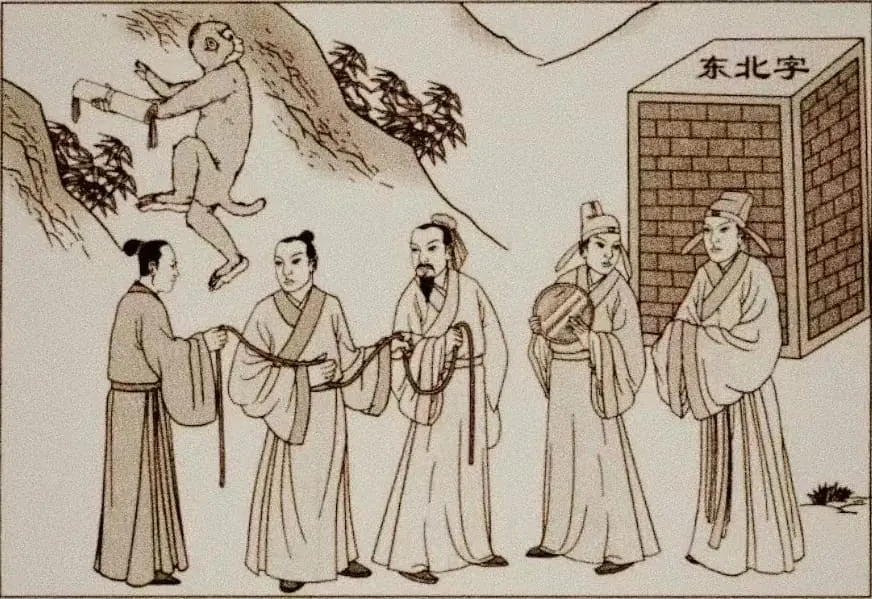
Start with the brick structure on the right, marked 东北字, ‘northeast’. The Image Symbolism calls it a watch-mound, 堠 hòu, which sounds like 候 hòu, to wait. The written description puts these characters above the monkey; in the drawing they sit on the structure. Up on the slope, the monkey, 猴 hóu, another echo of waiting, holds a document: wait for the right time, and for word to come.
Below, three men are joined by a single rope. The Image Symbolism reads this as people drawn into a dispute together. It also fits the second line: the calf cannot stop by itself when the leg moves, so it follows unwillingly and the heart is unhappy. Beside them an official holds up a round mirror, the image of a clear and impartial judge. Seeing a situation plainly is what shows you where to stop.
Both trigrams are Mountain, ☶ over ☶, and the hills behind the figures repeat that doubled stillness. The Image says the noble person keeps his thoughts within his own position, and the top line promises good fortune to stillness that is kept to the end.
- Work
- If you are waiting on a decision or a document, consider whether waiting is the right move for now. Ask whether you are stepping beyond your role, or being pulled into someone else’s dispute.
- Relationships
- If you feel dragged along by another person’s choices, consider where your own stopping point is, and say so calmly and in order, as the fifth line advises.
- Timing
- The picture favours stopping and waiting. If you are eager to move, ask whether the time has really come, or whether stopping early, at the toes, would spare you trouble later.
Line Statements
Listed from the bottom line to the top line.
- First six: Stillness in the toes. No blame. Lasting steadfastness is beneficial.
- Six in the second place: Stillness in the calves, unable to rescue what follows. The heart is unhappy.
- Nine in the third place: Stillness at the waist, splitting the back muscles. Danger smolders in the heart.
- Six in the fourth place: Stillness in the body. No blame.
- Six in the fifth place: Stillness in the jaws. Ordered speech; regret disappears.
- Top nine: Generous stillness. Good fortune.
Meaning of the Hexagram
Translated from the Chinese 人间道 commentary with AI assistance; translator notes appear in brackets.
“Keeping still the back, one does not grasp the self; walking in one’s courtyard, one does not see the person. No blame.”
Gen (Keeping Still) is the way of stopping. When people do not know how to stop, it is because selfish desire is at work. The back is the part that cannot be seen; if one does not see, there is no desire to disturb one’s heart and will. If a person can forget the self, then he can stop. People today, as soon as they see profit, want to seize it for themselves, and so they lose the way of stopping. If one knows the way of stopping, one can be without blame.
“Gen means stopping. When it is time to stop, stop; when it is time to move, move. When movement and rest do not miss their time, the way is bright and clear.”
The way of Gen speaks of stopping. If, between movement and rest, one does not act according to the time, one loses the meaning of stopping. The noble person values timing: when the time allows action, he acts. The noble person takes the significance of time seriously. If a person does not miss the time and knows when to advance and when to withdraw, his way becomes bright.
“Keeping still in stopping means stopping in one’s proper place. Above and below answer each other as rivals and do not associate.”
The achievement of Gen’s way of stopping lies in being able to stop at the place where it is fitting to stop; only the sage can fully accomplish this. In this hexagram both the upper and lower trigrams are Mountain. Because they are the same, they answer each other as rivals; they turn their backs on each other and do not associate.
“Therefore one does not grasp the self; one walks in the courtyard and does not see the person; there is no blame.”
When people stand back to back and do not see, and walk without seeing the person, desire has nowhere to arise, and so one can stop. Being able to stop, one is without blame.
“Mountains joined together: Keeping Still. The noble person accordingly does not let his thoughts go beyond his position.”
Above and below are both mountains, so it is called ‘mountains joined’, the image of Gen doubled. The noble person observes the way of Gen’s stopping and knows to keep his thoughts at rest where they should stop, without overstepping his own position.
“Stillness in the toes. No blame. Lasting steadfastness is beneficial.”
The first six is at the very bottom, the image of the toes. The toes are the first part of a person to move. To know how to stop at the very start of movement will surely bring no blame. Yet one must be wary that one’s own nature is yin and soft, and so the warning is to keep a firm heart and hold to the way.
“Stillness in the toes: one has not lost what is correct.”
To stop at the very beginning is surely easy, and so one does not lose correctness.
“Stillness in the calves, unable to rescue what follows. The heart is unhappy.”
A yin line in a yin position has the correct way of stopping. But the second place is like the muscle of a person’s leg: when the thigh moves, the muscle moves with it. Although the second line is on the correct path, it is influenced by the third line; that is, the central and correct way cannot rescue the one above it, and can only reluctantly follow along. Because its words are not heeded and its way is not followed, its heart is unhappy.
“Unable to rescue what follows: the other has not stepped back to listen.”
The person above has not been willing to follow the intentions of the one below. There is no need to try to rescue him; one can only follow.
“Stillness at the waist, splitting the back muscles. Danger smolders in the heart.”
The ninth in the third place is yang and firm in a yang position. Its firmness is extreme, so that it cuts off the upper from the lower and can no longer advance or retreat. Being this rigid, it inevitably ends up confined alone in a corner, and the people of the world will not associate with it, so it cannot set its heart at peace. Therefore the way of stopping values what suits the time: if moving and stopping always follow the time, there is good fortune.
“Stillness at the waist: danger smolders in the heart.”
If one hardens one’s own firmness and cannot advance or withdraw according to the time, danger and fear will surely arise within the heart.
“Stillness in the body. No blame.”
This is a person at the ruler’s side, of high rank and great power. Yet in the time of Keeping Still, when he ought to stop others he cannot, because the ruler’s position is too yang and firm and does not trust the person in the minister’s place. At such a juncture, only by keeping his own person still can he be without blame; but if he were to take charge of government, blame would arise. This means that a person in a high position can only keep himself good, and there is certainly nothing in this to commend.
“Stillness in the body: he stops within his own person.”
He holds the position of a high minister, yet can only keep himself good and cannot carry out the way of stopping; he is not suited to his position.
“Stillness in the jaws. Ordered speech; regret disappears.”
What a person ought to restrain is simply speech and action. Here a soft yin line occupies the ruler’s position; in the time of stopping, its ability is not adequate to the position. In that case speech and action must be consistent and must not fall out of order. The old saying ‘a ruler does not speak in jest’ means exactly this. So although one’s ability is not adequate to the position, by being careful in speech and prudent in action, one need not fear failure and ruin.
“Stillness in the jaws: because it is central and correct.”
If the person in the ruler’s position can stop at the middle way, and his speech and actions do not stray from what is central and correct, then even without sufficient ability he can avoid disaster. This is how important the Changes shows speech and action to be.
“Generous stillness. Good fortune.”
A firm yang nature stands at the very end of Gen, and here one sees how solid its way of stopping is. Ordinary people find it hard to sustain stopping for long; failing to keep one’s integrity in later years and the like are common. If a person can be generous and steady, know how to stop, and keep a heart this firm, that is why there is good fortune.
“The good fortune of generous stillness: because it is steadfast to the end.”
People often practise the way of stopping at the start but cannot hold to it to the very end. To be the same from beginning to end is the spirit of the Changes. Gen arrives at good fortune in the end because it can keep to its course unchanged to the last.
Show the Chinese original (人间道)
艮其背,不获其身,行其庭,不见其人,无咎。 艮为止之道,人之不知止,乃私欲作为,背为不见之处,如不能见,则无欲以乱其心志人 能忘我,则止矣,今人见利则欲据为己有,失止之道。知止之道,则可无咎也。
艮,止也,时止则止,时行则行,动静不失其时,其道光明。 艮之道,言止也,动静之间不以时,失止之义也,君子贵乎时,时可行则行,时之义于君 子,则重视之,人能不失时,知所进退,道乃光明。 艮其止,止其所也。上下敌应,不相与也。 艮止之道,其功在能止于适止之所,此唯圣人能成之。
此卦上下二体皆为山,有因同而相 敌应也,互相背而不相与也。 是以不获其身,行其庭不见其人,无咎也。 相背而不见,行不见其人,则欲无处生则能止,能止则无咎也。
兼山,艮,君子以思不出其位。 上下皆山,故为兼山,乃重艮之象,君子观艮止之道,知思安于所止,不越其本位。
艮其趾,无咎,利永贞。 初六居最下,乃足趾之象,趾乃人动之最 先,于始动即知止,必可无咎,且须患己之性 阴柔,故戒之在坚心守道。
艮其趾 ,未失正也。 能止于始初,必易,乃不失正也。
艮其腓,不拯其随,其心不 快。 阴居阴位,得止之正道,然居二位为犹人 之腿肌位,股动则肌动,二虽正道,然受三爻 之影响,即中正之道,无法救助于上位时,唯 勉而随之,因言不听道不随,故其心不快。
不拯其随,未退听也。
上位之人,未能从下意,不须救助之,唯 随之可也。
艮其限,列其夤,厉薰心。 九三阳刚居阳位,乃意其刚极而使上下分 隔,不复进退,其坚强如此,则必造成独限一 隅,而世人不相与,故无法安定其心。故止之 道,贵在时宜,行止之间必以时,则吉。
艮其限,危薰心也。 坚固己之刚性,不能因时知进退,必有危 惧生其心内也。
艮其身,无咎。 居君侧之人,位高权重,然于艮止之时, 当止而不能止,乃因君位过阳刚,不能信孚于 臣位之人,居此际,惟自止其身,可无咎,但 如临施政,则生咎矣。意即在上位之人只能独
善其身,必无可取也。
艮其身,止诸躬也。 居大臣之位,却只能独善其身,不能行止 之道,乃不适其位也。
艮其辅,言有序,悔亡。 人之所当止者,唯言与行,今阴柔居君位, 于止之时,其才不足任此位,如此则须言行一 致,不可脱序,古言:君无戏言,即此,故虽 己之才不足任此位,但谨言慎行,亦可无虑于 败亡。
艮其辅,以中正也。 君位之人能止于中道,言行不脱序于中正 之道,即令无足之才能,亦可免祸故易示人之 言行之重要如是。
敦艮,吉。 以刚阳之性居艮之终极,可见其止之道, 性之坚实如此。常人于止之时,难于持久,晚 节不保等事常见,人能敦厚知止,如此坚心, 此所以吉也。
敦艮之吉 ,以厚终也。 人常于始能行止之道,至终则无法坚持到 底,始终如一是易之神,艮致终能吉,乃因其 能终守不变。