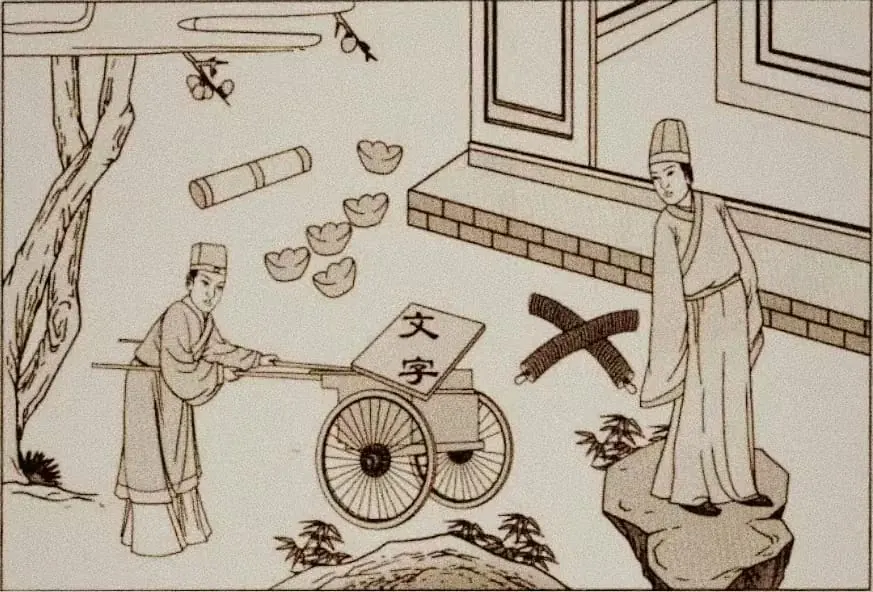
Scene Description
Image Symbolism
Reading the Picture
Zhen is the shock of thunder: something sudden arrives, everyone is shaken, and what matters is whether the fright turns into care and steadiness or into loss.
Start with the official standing on the rock at the right. The Image Symbolism reads him as someone in an independent but precarious position: he stands upright and composed, yet the ground under him is a narrow crag. Across from him a man pushes a cart whose board reads 文字, “writing”, an image of change in motion and of orders being carried out. Between them a rolled document hangs in the air, news or an official notice arriving, while silver ingots lie scattered on the ground beside two crossed bundles that look like strings of cash.
Both trigrams are Thunder ☳, one shock following another, which the Image calls repeated thunder. The flowering tree at the left promises results, but the symbolism notes that such blossoms are brief. The scattered money echoes the second line: a great loss of shells, the advice not to chase it, and the promise that it returns in seven days. The composed figure on the rock recalls the first line, fear at the start and laughter afterwards, because the warning was taken seriously.
- Work
- If news or a new instruction suddenly lands on you, consider steadying yourself before reacting. Ask what it really requires you to change, and carry it out carefully rather than in a panic.
- Relationships
- If a quarrel or a shock has shaken things between you, consider treating it as an early warning rather than a disaster. The top line suggests heeding trouble while it is still at the neighbour’s door.
- Timing
- This is a time of sudden movement. If you have just lost something, consider not chasing it at once; when the noise settles, what is truly yours may come back.
Line Statements
Listed from the bottom line to the top line.
- First nine: Thunder comes, fearful and wary; afterward laughing and talking cheerfully. Good fortune.
- Six in the second place: Thunder comes with danger; great loss of shells. Climb nine hills. Do not pursue; in seven days they are regained.
- Six in the third place: Thunder leaves one shaken. Acting amid thunder brings no harm.
- Nine in the fourth place: Thunder sinks in mud.
- Six in the fifth place: Thunder coming and going is dangerous. Consider no loss; there are affairs.
- Top six: Thunder leaves one trembling and looking fearfully around. Going forward is inauspicious. If the thunder does not strike one's own body but one's neighbor, no blame. A marriage brings talk.
The line diagram follows Zhen over Zhen, 100100 from bottom to top.
Meaning of the Hexagram
Translated from the Chinese 人间道 commentary with AI assistance; translator notes appear in brackets.
“Zhen: success. Thunder comes, fearful, fearful; laughing words, ha ha. The thunder startles for a hundred li, but one does not let fall the ladle or the sacrificial wine.”
The way of Zhen (The Arousing) is to be able to rouse oneself, to move and advance, and to know fear and so advance in self-cultivation; each of these is enough to bring success. When the shock of thunder comes, one is fearful, restless and uneasy; but if one knows what to be wary of, one can keep oneself safe, and so one laughs and talks at ease. The sound of thunder reaches a hundred li, and there is no one who is not frightened and does not lose hold of things; only the one holding the vessels of the ancestral temple sacrifice does not lose them and is not afraid. In human life, nothing is more perfectly sincere than the firm heart and upright constancy kept during a sacrifice.
“Zhen, success. Thunder comes, fearful, fearful: fear brings good fortune. Laughing words, ha ha: afterwards there is a rule.”
If one can know fear when the thunder comes, there will be no trouble and one can succeed. Because one is wary, the fear turns into good fortune. One must be afraid and so know to cultivate oneself, not daring to go against regular principles and laws. Out of the shock, order and measure are born, and this is sure to bring good fortune and peace; therefore one can laugh and talk without worry.
“It startles for a hundred li: it startles those far away and frightens those near. One can then go out and guard the ancestral temple and the altars of the land and grain, and act as master of the sacrifice.”
The thunder resounds for a hundred li: those far away are startled and those near are frightened. If people know to be wary and do not act recklessly, then when they go out they can long guard the ancestral temple and the altars of the state. One who can do this can surely uphold and carry on the state.
“Repeated thunder: Zhen. The noble person accordingly cultivates and examines himself in fear and trembling.”
洊 (jian) means repeated. The upper and lower trigrams are the same, hence repeated thunder, which describes the greatness of its awesome shock. Observing it, the noble person knows to cultivate himself in fear, to stand in awe of Heaven’s might, and to reflect on his faults and correct them. Only the noble person can do this.
“Thunder comes, fearful, fearful; afterward laughing and talking cheerfully. Good fortune.”
This line stands at the beginning of Zhen and knows that the thunder is coming. Able from the very start to be wary, fearful and careful, and not daring to take things lightly, it is sure in the end to be safe and fortunate.
“Thunder comes, fearful, fearful: fear brings good fortune. Laughing words, ha ha: afterwards there is a rule.”
When the thunder comes, one knows fear and advances in self-cultivation; because of this fear there is good fortune in the end. If one does not go against the regular laws, one can keep safe.
“Thunder comes with danger; great loss of shells. Climb nine hills. Do not pursue; in seven days they are regained.”
The second line is soft and occupies its correct place; it knows how to conduct itself well in a time of thunder. Thunder is firm and moves upward, and no one can withstand its fierce force. Weighing the situation, this line knows that it is bound to lose the whole of its wealth, so it is able to withdraw far away and keep to its central correctness. By not chasing what was lost, it regains it. Although it cannot defend itself immediately, once the time has passed it is sure to regain it. [The source sentence ends here without closing punctuation.]
“Thunder comes with danger: it rides upon the firm.”
The thunder arrives with the utmost firmness; to try to ride on top of it is to bring danger and distress on oneself.
“Thunder leaves one shaken. Acting amid thunder brings no harm.”
The third place is a yang position, and a yin line occupies it, so it is not in its proper place. A person who is not in their proper place is uneasy even in ordinary times, let alone in a time of thunder. If, in this position, one can recognise that one’s strength is insufficient and seek to leave, one can still be without blame.
“Thunder leaves one shaken: the position is not appropriate.”
Being in an inappropriate position, one does not know to be wary when the thunder comes, and does not know fear.
“Thunder sinks in mud.”
A firm line in a soft place does not suit its position and loses the way of firm strength. It cannot rouse itself, and is stuck as if in mud.
“Thunder sinks in mud: it is not yet shining.”
The movement of thunder must take firmness as its root. Now its movement is as if stuck in mud; it has already lost the way of firmness, and so the meaning of Zhen cannot be made great and bright.
“Thunder coming and going is dangerous. Consider no loss; there are affairs.”
When the one in the ruler’s position meets a time of thunder and shock, if he does not lose the middle way, then even in danger there will be no misfortune. The middle way is superior to the correct way: one who has the middle way will certainly not go against correctness, but correctness is not necessarily the middle way. This is where the difference lies.
“Thunder coming and going is dangerous: one moves amid danger. Its affairs lie in the centre; there is no great loss.”
When thunder moves without centrality, both going and coming are dangerous; the danger arises from losing the middle way. At such a time, to suffer no loss is the highest good.
“Thunder leaves one trembling and looking fearfully around. Going forward is inauspicious. The thunder does not reach one’s own person but one’s neighbour: no blame. In marriage there is talk.”
A soft, yin person at the extreme of Zhen is frightened in the extreme, trembling and without resolve, and cannot look about with a steady, clear gaze. If one acts at this time, one is sure to invite misfortune; this is a warning against acting without clarity. The lesson of Zhen is to become wary when the shock has not yet reached oneself but has reached one’s neighbour; then in the end there is no blame. It is like quarrelsome words at the start of a marriage: one should become wary at once, for if one waits until it reaches oneself, it is already too late.
Show the Chinese original (人间道)
震:亨。震来虩虩 虩虩 虩虩 虩虩,笑言哑哑。震惊百里,不丧匕鬯。 震之道,能奋发,动而进,知惧而进修,皆足以亨。当震动之来,恐惧不宁不安状,知所 戒惧,则可保安,故笑言和适貌。震声远及百里,人无不惧而丧失,唯执宗庙祭祀之器者,不 丧失不惧也。人间之至诚,莫如于祭祀时之坚心守正。
震亨,震来虩虩 虩虩 虩虩 虩虩,恐致福也。笑言哑哑,后有则也。 震来时能知恐惧,则无患而能亨矣。此因能有戒惧反为福也,必恐而知自修,不敢违于常 理法规,因震而生法度,必能致福安,故可笑言无忧。 震惊百里,惊远而惧迩也。出可以守宗庙社稷,以爲祭主也。 雷之向震百里,远受惊而近受惧,人能知戒惧不妄为,则出可以长守宗庙社稷,能如是, 则必可守承国家。
洊 洊 洊 洊雷,震。君子以恐惧修省。 洊为重意,上下同卦故为洊雷,形容威震之大也,君子观之乃知恐惧自修,畏天威省思已 过而改之,唯君子能如是。
震来虩虩 虩虩 虩虩 虩虩,后笑言哑哑,吉。
居震之始,知震之来,能于始即知 戒惧恐慎,不敢掉以轻心,终必安吉。
震来虩虩 虩虩 虩虩 虩虩,恐致福也,笑言 哑哑,后有则也。 雷震之来知惧进修,此因知恐而终有福 吉。不违于常法,则可保平安也。
震来厉,亿丧贝,跻于九陵, 勿逐,七日得。 六ニ乃柔居正位,善处震时之道也,雷震 乃刚动而上,无人能御其威猛,度量知其必丧 全数之资,故能远避以自守其中正,以不追随 而得,虽不能立,即防御,但时过后,必可得
震来厉,乘刚也。
震之至刚而来,如欲驾乘,乃自招危厄。
震苏苏,震行无眚。 三位为阳位,阴居之,乃不正位也。不正 位之人于平日,尚且不安,更何况处于震时居
此如能知己力之不足而求去,亦可无咎。
震苏苏,位不当也。 处不当位,即震来而不知戒,不知恐惧也。
震遂泥。 以刚居柔,不适位而失去刚健之道,无法 震奋也,如泥之滞也。
震遂泥,未光也。 震之动必以刚为本,今动如滞泥,已失刚 道,震之义,必无法光大也。
震往来厉,亿无丧有事。
君位之人居震动之时,必不失中道,即令 危亦不为凶矣。中道胜于正道,有中道之人必 不违于正道,正道却不必一定为中道。此其差 异所在也。
震往来厉,危行也,其事在 中,大无丧也。 震之动不以中,往来皆有危,其危之生, 乃因失中之道,居此时,以无丧失为至善。
震索索,视矍矍,征凶。震不于其躬,于其邻,无咎,婚媾有言。 阴柔之人居震之极,惊惧至甚,无志抖索状,其视瞻亦不能安定而明,其于此时,若动, 必招凶。乃不明而动之戒。震之戒在不及身而及于邻时己生戒心,则终无咎,如婚事之初有争 言,则己生戒心,莫俟及于身,已不及矣。