Scene Description
Image Symbolism
Reading the Picture
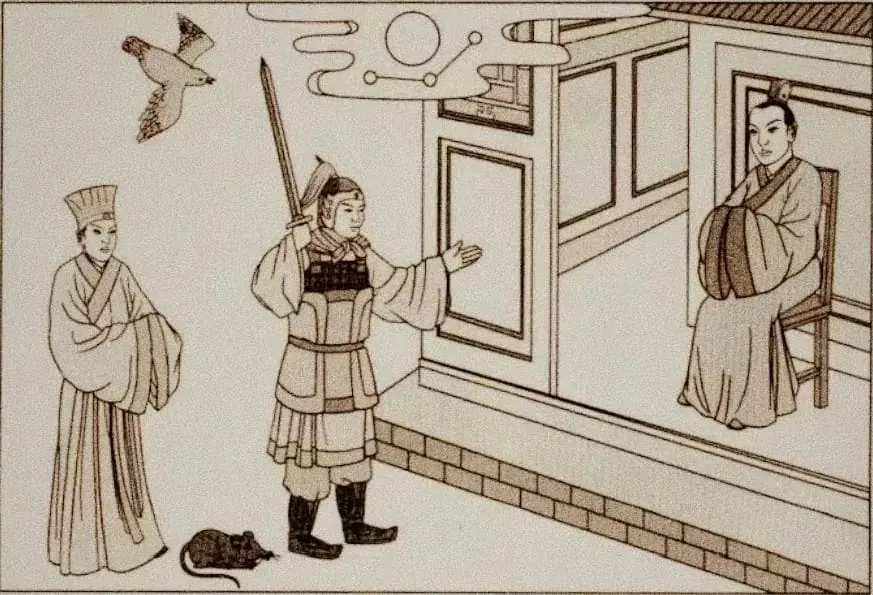
Ding is the cauldron, where raw ingredients become a meal and the old gives way to the new. The picture shows an orderly hall with one small threat at ground level.
Begin with the noble seated in the hall, hands folded, unhurried. The Image Symbolism calls him fearless and impartial, the steady centre that keeps everything balanced, as three feet steady a cauldron. Before him an armed guard raises a sword and gestures toward him: strength serving that centre. At the far left stands a figure in a tall hat, whom the text calls a child in a mat hat, someone not yet in the know.
Look up and the moon shows through parting clouds, a sign that things are becoming clear; a small cluster of linked dots beside it goes unexplained. A bird flies overhead, the magpie the text links to a turning season. Look down and a rat crouches at the guard’s feet: a hidden schemer in an orderly scene.
Wind ☴ below also stands for wood, and Fire ☲ above burns on it; wood feeding fire beneath a vessel is cooking, the hexagram’s core image, though no cauldron is actually drawn. The rat recalls the fourth line, where the wrong person is trusted and the cauldron breaks a foot. The composed noble recalls the fifth: yellow handles by which the whole vessel is carried.
- Work
- If you are building or reorganising something, ask who holds the handles and whether each role fits the person in it. One poor appointment can spill the whole pot.
- Relationships
- Consider what you are cooking together and what should be left behind. If something feels hidden, bring it into the light calmly rather than suspiciously.
- Timing
- The picture favours renewal on a stable footing. If the moment feels right for change, steady the base first.
Line Statements
Listed from the bottom line to the top line.
- First six: The cauldron's feet overturn. It is beneficial to expel what is spoiled. Taking a concubine for the sake of her son, no blame.
- Nine in the second place: The cauldron is full. My adversary is ill and cannot approach me. Good fortune.
- Nine in the third place: The cauldron's handles change; movement blocked and pheasant fat uneaten. Rain comes, regret lessens; good fortune in the end.
- Nine in the fourth place: The cauldron breaks a foot and spills the duke's food; its form is soiled. Misfortune.
- Six in the fifth place: Yellow handles and a metal carrying bar. It is beneficial to be steadfast.
- Top nine: A jade carrying bar. Great good fortune; nothing is unfavorable.
Meaning of the Hexagram
Translated from the Chinese 人间道 commentary with AI assistance; translator notes appear in brackets.
“Ding: supreme good fortune, success.”
The way of the cauldron can bring together things that would not otherwise combine; therefore there is surely good fortune and success.
“Ding is an image.”
The cauldron as a vessel takes its form from an image. The ancients used the square to represent what is solid and correct. Two handles face each other at the top and three feet stand apart below; its round body, inside and out, is made everywhere according to rule and is correct, forming an image of stability and weight.
“Wood submitting to fire: cooking. The sage cooks to make offerings to the Lord on High, and cooks on a large scale to nourish the sages and worthies.”
Wood put to the fire is the image of cooking. People depend on the cauldron to live; therefore the sage uses the cauldron to make offerings to the Lord on High, and cooks on a large scale to make offerings to the sages.
“Gentle, with ears and eyes keen and bright; the soft advances and moves upward, attains the centre and responds to the firm. Therefore there is supreme success.”
If a person can match the capacities of the hexagram, bright without and compliant within, then the head and face above, empty in the middle, are bright: this is the image of keen ears and bright eyes. The soft is what lies below, yet it can advance to the upper position, occupy the place of honour with brightness and attain the middle way, and the way of yang firmness responds to it. This is the reason for supreme success.
“Fire above wood: the Cauldron. The noble person accordingly makes his position correct and secures his mandate.”
Fire above wood, the image of lighting a fire to cook, is the cauldron. Observing this image, the noble person learns from the form of the vessel, upright in shape, stable and weighty, and so makes his own position correct. [The source ends here, without comment on ‘securing his mandate’.]
“The cauldron’s feet overturn. It is beneficial to expel what is spoiled. One takes a concubine for the sake of her son; no blame.”
The first six is the lowest position and corresponds with the fourth line. Now, in the time of the cauldron, it is as if the feet were turned upward: this is overturning. When the cauldron tips over, its feet turn up. This is not the compliant way but the principle of acting against the usual course; it is beneficial when the world has fallen into ruin, and only then may it be done. Being low and humble and following the yang line, it is like a concubine; when a concubine follows her husband, there can be no blame.
“The cauldron’s feet overturn: this is not yet contrary to what is right. It is beneficial to expel what is spoiled: in order to follow what is noble.”
When the cauldron is overturned and its feet are upward, it goes against the usual course. This is beneficial only when the world has fallen into ruin: one casts out what is bad and follows what is noble.
“The cauldron is full. My adversary is ill and cannot approach me. Good fortune.”
The second place is a central position. A firm line in the centre is the image of a cauldron with real contents inside. But it is in a yin position, and it has ability while being closely attached to the yin line beside it. In this place one should seek to keep oneself correct and not seek after others, so that they come to seek one out; then even the one who is not correct will in the end come to one. This is good fortune.
“The cauldron is full: be careful where one goes. My adversary is ill: in the end there is no fault.”
A cauldron with contents is like a person with talent: one must choose one’s direction with care. If one goes without care, conflict is sure to follow. If at this point one can keep oneself correct, the other cannot affect one, and there will be no fault.
“The cauldron’s handles change; movement blocked and pheasant fat uneaten. Rain comes, regret lessens; good fortune in the end.”
The third nine is the minister’s position. Yang firmness occupies it, so it is in its correct place; yet the soft ruler in the fifth place cannot unite with it and does not trust or employ it, so its movement is bound to be blocked and its way cannot be carried out. At a time when one has talent but cannot obtain the ruler’s commission and employment, the noble person must cultivate his virtue inwardly and keep to the right way; in the end there will surely be good fortune.
“The cauldron’s handles change: it loses its proper meaning.”
Someone of talent in the minister’s position whose thinking does not accord with the ruler’s has lost its proper meaning. But when the one above comes to see clearly, the talent below will surely be put to use; therefore there is good fortune.
“The cauldron breaks a foot and spills the duke’s food; its form is soiled. Misfortune.”
The fourth is the position beside the ruler, and it corresponds with the first, lowest line. This shows that the soft yin petty person of the first line cannot be employed: being unequal to the task and ruining the matter is like the cauldron’s foot breaking. To occupy a great minister’s position and employ the wrong people, to the point of overturning and ruin, is to be unequal to the task, and its misfortune is plain. The cause lies in appointing unsuitable talent, which surely comes from the working of self-interest.
“Spilling the duke’s food: how can one be trusted?”
One who serves as a great minister must bring order to the world. If he employs people wrongly and so forfeits trust, it is a mistake.
“Yellow handles and a metal carrying bar. It is beneficial to be steadfast.”
The cauldron is governed by its handles, which is to say, by holding the handles. It has the substance of yang firmness and also holds its position, so its talent is surely full and solid; thus it can be put to great use. This is the height of goodness.
“Yellow handles: the centre is its substance.”
The talent to grasp the cauldron’s handles comes from attaining the middle way.
“A jade carrying bar. Great good fortune; nothing is unfavorable.”
The end of the cauldron is the completion of its work. Jade is firm yet warm. At the summit of success, only by being careful and handling things well, applying firmness and softness each where it fits, and going too far in neither action nor rest, does great good fortune arise. Nothing is unfavorable.
“The jade carrying bar is above: firmness and softness in measure.”
The cauldron’s achievement lies in being able to finish. Having reached the place of success, it uses firmness and softness together, governed by rule and measure, so nothing is unfavorable.
Show the Chinese original (人间道)
鼎:元吉、亨。 鼎之道,能使不合之物相合,故必吉亨。
鼎,象也。 鼎之为器,法自象也。古人以方代表实且正之象。两耳对峙在上,三足分峙于下,周圆内 外,皆有法而正,成安重之象。 以木巽火,烹饪也。圣人亨以享上帝,而大亨以养圣贤。 用木就火,烹饪之象,鼎器人赖以生,故圣人以鼎享上帝,用大亨以享圣人。 巽而耳目聪明,柔进而上行,得中而应乎刚,是以元亨。
人能如卦才,外明内顺,上之头面能中虚为明,乃耳聪目明之象,柔乃在下之物,能进上 位,以明居尊,得乎中道,而阳刚之道相应,此乃元亨之因也。
木上有火,鼎,君子以正位凝命。 木之上有火,生火烹饪之象为鼎,君子观象,知法象器,形体端正且安重,以正其位也
鼎顚趾,利出否。得妾以其 子,无咎。 初六乃最下之位,与四爻相应,今居鼎时, 有如趾之向上,颠也。鼎覆则趾颠,此非顺道, 反道而行之理,利于天下败坏之时,乃可为也。 居卑下而从阳如妾,妾之从夫,则可无咎。
鼎顚趾,未悖也。利出否, 以从贵也。 鼎颠覆趾在上时,背道而行,只利天下败 坏之际,弃恶而从贵也。
鼎有实,我仇有疾,不我能 即,吉。 二位为中位,以刚居中,乃鼎中有物之实 象,但于阴位,有能才而密比于阴之意,居此 当求己之守正,不求于人,使之能求于我,则 不正亦终就之,此吉也。
鼎有实,慎所之也。我仇有 疾,终无尤也。 鼎之有实,犹人之有才,必慎择趋向,如 往之不慎,必有对立之事,于此能自求守正, 则彼必不能影响我,亦可无过矣。
鼎耳革,其行塞,雉膏不食, 方雨亏悔,终吉。 九三相位,阳刚居之,乃正位,然五位之 柔君不能与合,不信用之,其行必阻塞,道必 不行。有才而不能得君禄命任用之时,君子必 内其德,守其正道,终必吉。
鼎耳革,失其义也。
有才居相位,与君之念不合,乃失其义也, 但上能明时,下之才必有能用,故吉。
鼎折足,覆公餗 餗 餗 餗,其形渥, 凶。 四为君侧之位,与初下爻相应,乃示初阴 柔之小人不可用;其不胜任而败事,犹鼎足折 也。居大臣之位,所用非人,至于覆败,此不 胜任,其凶可知。成因在于任不适之才,必来
自私心作用。
覆公餗,信如何也。
当大臣之人,须成天下之治,如任人之不 当,以招不信,乃误也。
鼎黄耳,金铉,利贞。 鼎之主在耳,执耳之意,有阳刚之体,又 得其位,才必充实,乃能为大用,至善矣。
鼎黄耳,中以爲实也。 能执鼎耳之才,乃由其得中道也。
鼎玉铉,大吉,无不利。 鼎之终,功成也,玉为刚而温,居成功之 项,唯小心善处,刚柔适用,动静不可过,乃 生大吉。无所不利也。
玉铉在上,刚柔节也。 鼎以能终为功成,致成功之地,以刚柔之 并用,有法度之,无不利也。