Scene Description
Image Symbolism
Reading the Picture
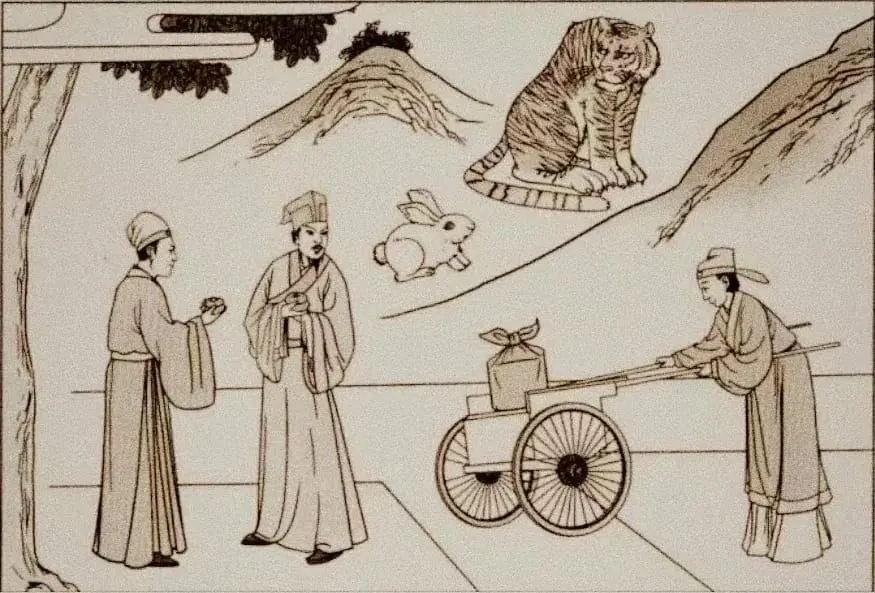
Ge is change at the root, the old giving way to the new; the picture sets that change on an open road, with a cart already rolling.
Look first at the official on the right pushing a two-wheeled cart along a paved road. On it sits a wrapped bundle, which the description calls a seal: a civil official carrying a seal is given command, so press for reform and it will succeed. The broad road is the change itself, turning into something new and smooth.
On the hillside behind, a tiger sits with a rabbit crouched below it. The tiger is authority, matching the fifth line, the great person changes like a tiger; the rabbit stands for leaping forward. The description has them heading toward the mountain; in the drawing they rest on the slope, and the four dots it mentions on the peak are not drawn. On the left, two men each hold a small persimmon. The text says one is whole and one is not: heartfelt words beside half-truths.
The trigrams are Lake ☱ above Fire ☲: fire inside a lake, two forces that cannot stay as they are. The judgment says trust comes only when the day arrives, and the third line adds that talk of change must go round three times before it is believed.
- Work
- If you are pushing for a change, consider whether its time has come and whether people trust its motives. The third line asks you to consult widely before acting.
- Relationships
- If something between you needs to change, listen for whole truths and half-truths, your own included. Sincere change tends to be believed in time.
- Timing
- Change is favoured once its day has come. At the start, the first line counsels holding steady; at the end, the top line counsels consolidating rather than pushing further.
Line Statements
Listed from the bottom line to the top line.
- First nine: Bind firmly with yellow oxhide.
- Six in the second place: On the Si day, make the change. Going forward brings good fortune, no blame.
- Nine in the third place: Going forward is inauspicious; steadfastness is dangerous. When talk of change has been considered three times, there is trust.
- Nine in the fourth place: Regret disappears. With sincerity, change the mandate. Good fortune.
- Nine in the fifth place: The great person changes like a tiger. Sincerity exists before divination.
- Top six: The noble person changes like a leopard; the petty person changes the face. Going forward is inauspicious; remaining steadfast brings good fortune.
Meaning of the Hexagram
Translated from the Chinese 人间道 commentary with AI assistance; translator notes appear in brackets.
“Ge: on the Si day there is trust. Supreme success; beneficial to be steadfast; regret vanishes.”
The way of Ge (Revolution) lies in changing what is old. At first people surely cannot believe in it at once; one must wait until the Si day, and then people’s hearts trust and follow. The way of revolution seeks success after the old has been changed, but it must be sincere, correct and beneficial to the world; only then can one discard the old and follow the new, and no regret arises from the great change.
“Ge: water and fire extinguish each other; two women live together, but their wills do not agree: this is called Revolution.”
Water and fire quench and destroy each other. The second and the youngest daughters live in one room, but their wills differ and each will marry into a different home. This is like revolution: it carries the image of change arising.
“On the Si day there is trust: one changes and is then trusted. Civilized and clear, and thereby joyous; great success through correctness. When the change is fitting, regret vanishes.”
Although revolution is change, at first it does not win people’s trust; but if it follows the correct way, in time it is trusted. Being clear and joyous, one can fully grasp the principles of affairs and leave nothing unexamined; people’s hearts are harmonious and compliant, and there is sure to be great success. This is revolution at its most fitting, and no regret will arise.
“Heaven and earth change, and the four seasons are completed. Tang and Wu changed the mandate, in accord with heaven and in response to the people. Great indeed is the time of Revolution!”
Only after heaven and earth undergo change can the four seasons of cold and heat come about, and all things are born according to their seasons. The rise of a king lies in complying with heaven’s mandate above and responding to the people’s hearts below, changing the old and clearing it away for the new; this grasps the spirit of the Changes. This is the great meaning of the time of revolution.
“Within the lake there is fire: Revolution. The noble person accordingly sets the calendar in order and makes the seasons clear.”
Water and fire consume each other: this is the way of revolution, removing the old and laying out the new. Observing the image of revolution, the noble person knows to calculate the calendar and understand the changes of the sun, moon and stars, so as to make clear the order of the four seasons; then in the end he can be in accord with heaven and earth.
“Bind firmly with yellow oxhide.”
Revolution is a great matter. There must be the right moment, the right people and the right position, and one acts only after careful planning; then there can be no regret. It is like binding oneself with yellow oxhide: the meaning is to seek only to make oneself secure and hold one’s ground, not to act at will or rashly.
“Bind firmly with yellow oxhide: one should not undertake anything.”
At the beginning of revolution, one seeks only to hold one’s position securely and must not rashly seek achievement.
“On the Si day, make the change. Going forward brings good fortune, no blame.”
A yin line in a yin place: this is the time when talent fits its use. At this point it is enough to remove the ills of the world, assisting the ruler above and carrying out the correct way to make the change. There is good fortune and no disaster.
“On the Si day make the change: action brings praise.”
When the time has come and people trust, one makes the change, and acting brings joy and celebration. If the time has come and one does not act, one surely lacks the heart to help the world, and regret will arise from missing the moment.
“Going forward is inauspicious; steadfastness dangerous. When talk of change has gone round three times, there is trust.”
The third nine is in the minister’s position, at the top of the lower trigram, with the ruler above. If here one forces revolution with the power of yang firmness, it is too hasty and restless, and acting is sure to bring misfortune. But if one is cautious, reverent and wary, holds to the way of steadfast correctness, knows to follow public opinion, and carries out the change so that no one suspects it comes from private gain, there is good fortune, for the many will surely trust, submit and follow.
“When talk of change has gone round three times: where else is there to go?”
When the way of revolution has been examined and confirmed again and again and is known to accord with the principle of heaven, it is the most fitting course in affairs. What need is there to go further?
“Regret disappears. With sincerity, change the mandate. Good fortune.”
This is firmness in a soft place: a person close to the ruler’s side, in whom firmness and softness complement each other. In the time of revolution he acts with utmost sincerity, so that those above trust him and those below comply; good fortune is certain.
“The good fortune of changing the mandate: the will is trusted.”
Changing the mandate and bringing good fortune can succeed only when those above and below follow and trust; this comes about because utmost sincerity moves them.
“The great person changes like a tiger. Sincerity exists before divination.”
The fifth nine, the most honoured ruler, uses the way of centrality and correctness in the time of revolution and so can carry it out vigorously. It is sure to be plain to the whole world; there is no need for divination, for knowing that his conduct is most fitting, the world will surely trust him.
“The great person changes like a tiger: his pattern is brilliant.”
When the principles of affairs are as clear as the bright, bold stripes of a tiger, there is no one in the world who does not trust and submit.
“The noble person changes like a leopard; the petty person changes the face. Going forward is inauspicious; remaining steadfast brings good fortune.”
At the end of revolution, the noble person, following the revolution, is sure to change greatly, toward the highest good. Petty people are benighted and slow to change; even if their minds are not yet transformed, their faces have already changed, and they follow the guidance of those above.
In the affairs of the world, the beginning of revolution is sure to be hard; once the revolution is complete, the worry is that one cannot hold on to it. So here one must take care to keep steadfast and firm of will, and the outcome is sure to be good fortune.
“The noble person changes like a leopard: his pattern is rich. The petty person changes his face: he complies in order to follow the ruler.”
After the revolution, the noble person advances further still, like patterns growing rich and full. Because of the revolution, petty people dare not do evil; they only submit outwardly and follow the ruler’s way. Here the way of revolution has succeeded.
Show the Chinese original (人间道)
革:巳日乃孚,元亨利贞,悔亡。 革之道,在变其故旧,始初人必未能遽信,必俟至巳日乃人心信从。革之道在求变故后能 亨通,但须诚正利于天下,乃能去故从新,不因有大变而生悔。
革,水火相息,二女同居,其志不相得,曰革。 水火互息互灭,次女少女同居一室,其志不同,其所归各异,如革也,有生变异之象。 巳日乃孚,革而信之。文明以说,大亨以正,革而当,其悔乃亡。 革之虽变,始初不令人信,但如以正道,日久乃信。能明且悦,则能尽事之理,无事不察, 人心和顺,必致大亨,此革之至当,必不生悔。
天地革而四时成,汤武革命,顺乎天而应乎人,革之时大矣哉! 天地有变革后,乃能生成四时寒暑,万物因其时节而生。王者之与,能上顺天命,下应人 心,改旧去新,得易之神,此革之时义大也。
泽中有火。革,君子以治历明时。水火相消灭,为革道,除旧布新,君子观革之象,乃知推演历数,知日月星辰之变,以明 四时之序,则终能合于天地。
巩用黄牛之革。 变革之事为大事,必有时机,有人才,有 其地位,谋虑而后动,则可无侮矣。犹如用黄 牛之皮来侷束,但求自固而守,不求任意妄动 之义。
巩用黄牛,不可以有爲也。 初革之时,但求能自固守其位,不可妄求 有功。
巳日乃革之,征吉 ,无咎。 阴居阴位,乃得才适用之时,此际足以去 天下之弊乃上辅于君,行其正道而革之,吉而 无灾也。
己日革之,行有嘉也。 时至人信乃革之,动则有喜庆。如时至而 不动,则必无济世之心,必因失时而生悔矣。
征凶,贞厉。革言三就,有 孚。 九三相位,居下卦之上,上有君,于此以 阳刚之势而力革时,乃过于燥动,行之必有凶。 但如慎戒敬惧,守贞正之道,知顺从公论,行 革不为人疑出于私利,则吉,因众必孚服而顺。
革言三就,又何之矣。 革之道经再三察合,知顺乎天理,乃事之 至当,何须再往呢?
悔亡,有孚,改命,吉。 此即以刚处柔位,近君侧之人,刚柔互济, 于革之时,行以至诚,致令上信下顺,其吉必 矣。
改命之吉 ,信志也。 能改命致吉,必上下能顺从信服方成,因 至诚感召也。
大人虎变,未占有孚。 九五至尊之君,能以中正之道,居革之时, 乃能力革之,其必昭著天下,不须占决,知其 行为之至当,天下必信。
大人虎变,其文炳也。 事理之明如虎纹之明盛,则天下无不信 服。
君子豹变,小人革面,征凶, 居贞吉。 革之终时,君子必从革后而大变,于至善, 小人昏愚难变,即令心智未化,但其面已改, 从上之教导。天下之事于始革必艰难,至革成, 则患无法自守,故于此须戒之守贞坚志,则果 必吉 。
君子豹变,其文蔚也。小人 革面,顺以从君也。 君子变革后,其更精进,如文采之蔚盛。 小人因于革,不敢为恶,唯外饰臣服,以从君 道,此革道成功矣。