Scene Description
Image Symbolism
Reading the Picture
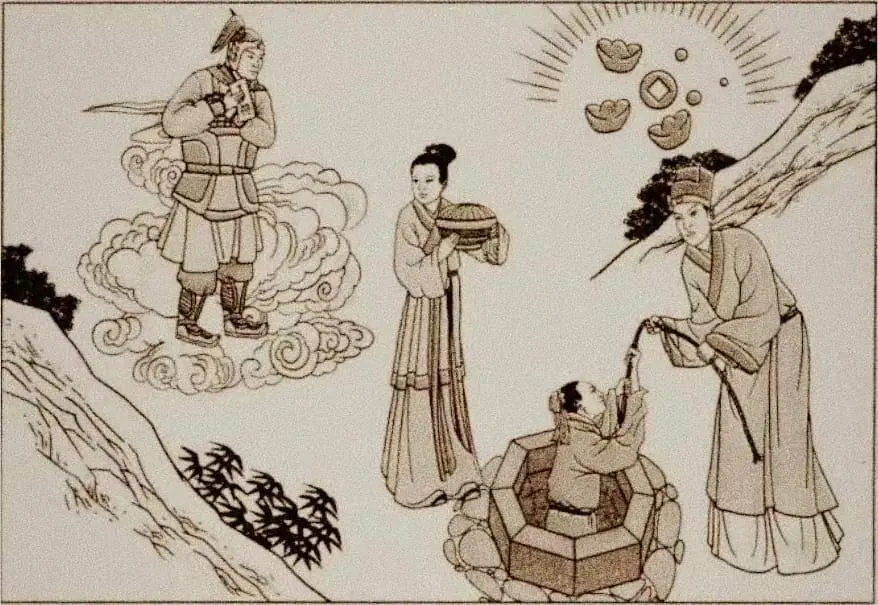
The Well is a steady source that serves everyone who comes to it, and the picture centres on a rescue: someone has fallen in and is being pulled out.
Start at the stone well in the foreground. A man has fallen in, and an official at the rim hauls him up with a rope. The Image Symbolism reads the fall as sinking into serious trouble and the official as a benefactor who wants to help. The rope matters in another way too: the judgment warns of a rope that does not reach the water, a well that does no good.
Above on the left, an armoured deity on a cloud holds a talisman, read as help from above, though the symbolism adds that a talisman can mean a plan someone beside you opposes. In the centre a woman holds a lidded box: 合 hé means both a box and coming together, read as good, but liable to break later. At the upper right, ingots and coins radiate light: wealth not lost, kept out of view.
The trigrams are Water ☵ above Wind ☴, and Wind is also wood: a wooden bucket lowered into water and drawn back up. The scene recalls the third line, a cleaned well no one drinks from, which waits for someone clear-sighted to draw on it.
- Work
- If your abilities feel unused, consider whether the rope is what is missing: who could draw on what you offer, and how would they find it? Keep the well in repair meanwhile, as the fourth line advises.
- Relationships
- If someone close to you has fallen into difficulty, you may be the one holding the rope. Ask what steady, practical help you can give.
- Timing
- Towns move, but wells stay. If you are tempted to abandon a reliable source for something new, consider first whether it simply needs cleaning.
Line Statements
Listed from the bottom line to the top line.
- First six: Mud in the well cannot be drunk. No creatures at the old well.
- Nine in the second place: In the well's hollow, shooting at small fish; the jar is broken and leaks.
- Nine in the third place: A cleaned well not drunk from grieves my heart. It can be drawn from. An enlightened king lets all share the blessing.
- Six in the fourth place: Lining the well. No blame.
- Nine in the fifth place: A clear well; cold spring water is drunk.
- Top six: The well is drawn from; do not cover it. Sincerity brings great good fortune.
Meaning of the Hexagram
Translated from the Chinese 人间道 commentary with AI assistance; translator notes appear in brackets.
“Jing: the town may be changed, but the well is not changed. It neither loses nor gains. People come and go and draw from the well.”
The well is something that is seldom changed. One often sees cities and markets change, but the well cannot be moved. It is the nature of a well that drawing from it does not exhaust it and leaving it alone does not make it overflow; so it is said to neither lose nor gain. Everyone who comes to the side of the well benefits from it. This is its constant, unchanging virtue, and this is the way of Jing (The Well).
“Nearly there, but the rope has not yet reached down into the well; the jug is broken: misfortune.”
The way of the well lies in providing for people’s use; that is its goodness. If someone comes but does not use the well and still drinks from the spring, then having it is as good as not having it. In the way of the noble person, achievement is what is valued. Even if his way is correct, if it is not put to use it amounts to nothing, and he only brings misfortune on himself.
“Penetrating into the water and raising the water up: this is the Well. The well nourishes and is never exhausted. ‘The town may be changed but the well is not changed’: because the firm is central.”
Wood enters the water and then raises the water up: this is the well. The well can nourish things without being used up or running dry; this is the constancy of the well’s virtue. Cities and markets can be changed, but the well cannot be moved, just as the noble person, with the virtue of firm centrality, never changes his will however hard and dangerous things become.
“Nearly there, but the rope has not yet reached into the well: there is no achievement yet. The jug is broken: therefore there is misfortune.”
The well’s achievement is to provide for people’s use. If people come to the side of the well but do not use it, then having a well is the same as having none, and it cannot fulfil its function. A jug must hold water; now it is broken, and so it is useless and leads to misfortune.
“Above wood there is water: the Well. The noble person accordingly encourages the people at their work and urges them to help one another.”
Observing the image of the well, the noble person imitates its nature: he takes on toil to help the people and teaches them the value of helping one another. This is imitating the well’s selfless giving.
“Mud in the well cannot be drunk. No creatures at the old well.”
In the way of the well, when a well is first made it is not yet usable: at first there is no water in it and its bottom is mud, which cannot be drunk. The virtue of a well, its ability to nourish people, comes from its having water. If it is a disused old well with no water, no creatures will come to it. It is like a person without talent who cannot help others: he will surely be discarded by the times.
Teachers today must heed the warning of the old well. Thus Mencius said: “Of people’s afflictions, none is greater than being a teacher.” This is the warning of the old well.
“Mud in the well cannot be drunk: it is low. No creatures at the old well: the time has abandoned it.”
The first line is yin and soft and sits at the bottom of the well: this is the image of mud. People will surely not drink mud without water, and a well without water draws no creatures; such a thing is surely abandoned by its time.
“In the well’s hollow, shooting at small fish; the jar is broken and leaks.”
A yang firm line in the general’s position, in the time of the well. Having no response above, it tends downward and loses the way of the well; sinking toward the mud, it becomes something insignificant, like a broken, leaking jar. In the end it is sure to achieve nothing.
“In the well’s hollow, shooting at small fish: there is no partner.”
The function of a well is to bring forth water to help people, so being able to bring it forth is its success. Here is a talent of yang firmness that could have served the world, but because those above do not use it, it becomes useless.
“A cleaned well not drunk from grieves my heart. It can be drawn from. An enlightened king lets all share the blessing.”
The talent of the third nine is in the minister’s position: yang and firm, and in a high place, his talent can surely help the world, just as the clear water of a well rises and can be of great help to people. Now no one is seen drinking from it; this means that the ruler is aware of his worth but does not use his talent, and the heart of the worthy talent is sure to be grieved. If the ruler can use his talent and let it serve the people, it is a blessing shared by those above and below.
“A cleaned well not drunk from: those who pass grieve. Seeking an enlightened king: receiving blessing.”
The water in the well is clear yet not drunk: a person of talent and wisdom who is not employed grieves that he cannot carry out his will. He only hopes to meet an enlightened ruler, so that the world may receive the blessing.
“Lining the well. No blame.”
A person of yin softness at the king’s side holds the post without sufficient talent. If he seeks only to repair the brickwork of the well’s mouth and keep to himself, he can still be without blame.
“Lining the well, no blame: repairing the well.”
Repairing the mouth of the well achieves nothing for the world, but because by keeping to it one avoids being abandoned, it too can count as merit.
“A clear well; cold spring water is drunk.”
The one in the ruler’s position, the fifth nine, can be like the spring in a well, sweet, cold and clean, gladly used by the people. This is the highest good of the way of the well.
“Cold spring water is drunk: it is central and correct.”
Cold, clear, sweet and clean spring water is gladly used by people; so it is when the way of centrality and correctness is put to use.
“The well is drawn from; do not cover it. Sincerity brings great good fortune.”
The well’s merit lies in its water rising up to be used by people. It lets people draw from it without running dry, so its benefit is surely endless. Its nature is constant and unchanging, the same from beginning to end, spreading its virtue widely to all the people. This is the completion of the way of the well.
“Great good fortune at the top: great completion.”
To be able to occupy the end of the hexagram with the highest good is great completion.
Show the Chinese original (人间道)
井:改邑不改井,无丧无得,往来井井。 井,为不常改之处,常见都巿已改,但井无法迁动,井之性,汲之不竭,存之不盈,故曰 无丧无得,凡人至井侧,皆受其用,此不变之常德也,此为井之道。 汔至,亦未繘 繘 繘 繘井,赢其瓶,凶。 井之道在乎供人用为善,如人至而未用井,仍饮泉,则有亦若无。
君子之道,以有成为贵, 如道即令正,但不为所用,亦等于无也。徒自招凶。
巽乎水而上水,井,井养而不穷也,改邑不改井,乃以刚中也。 木入水中,而又上于水,此井也,井能养物,不尽不竭,此井德之常也。城巿可改,而井 不能迁,犹君子刚中之德,即令再艰险,却永不改变其志。 汔至亦未繘 繘 繘 繘井,未有功也,羸其瓶,是以凶也。 井以供人使用为功,今人至井侧,而不用井,则有井亦同于无井,无法发挥井之功用。
瓶 须盛水,今破坏,是以无用而致凶也。
木上有水,井,君子以劳民劝相。 君子观井象,效法井之性,为助民而任劳,且教其互助之功,此效法井之布施无私也。
井泥不食,旧井无禽。
井之道,始为井之时,仍不适用也,井内 初无水,其底为泥,不可食,井之德能养人, 乃其有水也。今若为废弃之旧井,其无水,故 必无禽至,犹人之无才无法济物,必为时代淘 汰。今之师即须有旧井之戒,故孟子曰:人之
患,莫过于为师,即有旧井之戒。
井泥不食,下也,旧井无禽, 时舍也。 初为阴柔,而居井之底,乃泥象,无水之 泥,人必不食,无水之井亦无禽聚,此必为时 所舍之也。
井谷射鲋,瓮敝漏。 阳刚居将位,居井之时,上不对应,因而 趋下,失井之道,降下而趋泥,而成微不足道 之物,如破漏之瓮也,终必无功。
井谷射鲋,无与也。 井,能出水助人为功用,故以能出为成功, 今阳刚之才,本可济用于世,因上不用故成无 用。
井渫不食,爲我心恻,可用 汲,王明并受其福。 九三之才居相位,阳刚又居高位,才必能 济世,如井之清水升而上,可助人之力大也, 今不见人食,乃谓君明其贤不用其才,贤才之 心必忧,如君能用其才,使其才能济民,乃上 下之共福也。
井渫不食,行恻也,求王明, 受福也。 井中水清澈而不食用,乃有才智之人,不 见用,其无法遂行其志而忧怀,但求得遇明君 而天下受其福泽。
井甃,无咎。 阴柔之人居君王身侧,才不足而任其位, 若但求修治井口之砖砌,自守之,亦可无咎。
井甃无咎,脩井也。 修治井口 ,即令无功于天下,亦因其能 守而不致招废弃,亦可为功矣。
井洌,寒泉食。 九五君位之人,能如井中之泉,甘寒洁净, 为民所喜用,此井道之至善也。
寒泉之食,中正也。 寒洌甘洁之泉水受人喜用,乃中正之道得 用亦同。
井收勿幕,有孚元吉。 井以水能上出为人所用为居功,使人汲取 而不竭,其利必无穷无尽,其间之性为常此不 变,始终如一,广施其德于万民,此乃井道之 成也。
元吉在上,大成也。 能以至善而居卦终,乃大成也。