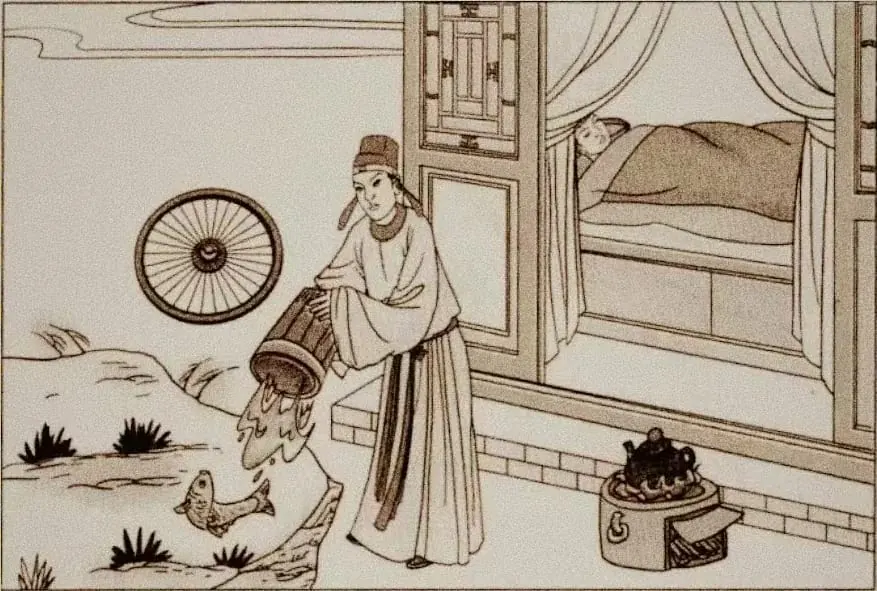
Scene Description
Image Symbolism
Reading the Picture
Kun is being hemmed in, like a pond that has lost its water; yet the picture places help and life right beside the hardship.
The eye lands first on the official tipping a bucket of water onto a fish stranded in a dried-out pond. The Image Symbolism reads the dry pond as lack of means and the pouring as a benefactor supplying resources, and the tufts of green grass on the bank show that life has not left the place. Beside him a single cartwheel stands on its own, read as travelling alone, without support or clear direction.
On the right, through an open window, someone lies ill in bed, and on the step outside a pot sits on a medicine stove. The illness stands for hardship; the stove for help that is on its way, so the advice is to wait and recover slowly rather than rush.
The trigrams are Lake ☱ above Water ☵: the water has drained away beneath the lake and left it dry, which is exactly the stranded fish. The Image says the noble person stakes his life to fulfil his will: do what can be done, accept what cannot, and keep your principles. The slow cure echoes the fifth line, slowly release comes, and the judgment warns that in such a time words are not believed.
- Work
- If resources have dried up, consider who might pour in fresh water, and what you can do meanwhile to keep the essentials alive. Arguments alone may not persuade now; let steady conduct speak.
- Relationships
- If you feel as isolated as the lone wheel, ask whether you have been carrying everything by yourself. Accepting help can be part of holding to your principles.
- Timing
- This is a time to wait and recover rather than force a way out. Relief tends to come slowly, but if only fear of regret is keeping you stuck, the top line suggests moving on.
Line Statements
Listed from the bottom line to the top line.
- First six: Buttocks confined by a stump; entering a dark valley, not seen for three years.
- Nine in the second place: Confined amid wine and food. Vermilion ceremonial garments are arriving. It is beneficial to make sacrificial offerings. Going forward is inauspicious, no blame.
- Six in the third place: Confined by stone, resting on thorns. Entering the palace, not seeing the wife. Misfortune.
- Nine in the fourth place: Coming slowly, confined by a metal carriage. Regret, but an ending.
- Nine in the fifth place: Nose and feet cut off, confined by red ceremonial garments; slowly release comes. It is beneficial to offer sacrifice.
- Top six: Confined by vines, on an unstable height. Saying that moving brings regret. Having regret, advancing brings good fortune.
Meaning of the Hexagram
Translated from the Chinese 人间道 commentary with AI assistance; translator notes appear in brackets.
“Kun: success; steadfastness; for the great person, good fortune; no blame. When there are words, they are not believed.”
How to use the way of oppression in a time of Kun (Oppression) is the spirit of the Changes. When the great person is in a time of oppression, he rejoices in heaven and accepts his lot, deals well with whatever the time brings, and finds his own contentment; there is sure to be good fortune. When foolish and stubborn people are oppressed, they strain to talk their way out, and people will surely not believe them.
“Kun: the firm is covered over. Danger, yet joy; oppressed, yet not losing the means of success: is this not the noble person alone?”
Oppression arises because the firm is hidden and covered by the yielding; specifically, this says that the way of the noble person is covered over by petty people. In a time of oppression and exhaustion, the noble person understands the way of oppression: joyous outside, dangerous within. Living in oppression, he can bear it with a joyous breadth of mind and not lose the correct way, so his way will naturally find success. A person who can do this is surely a noble person.
“Steadfastness; for the great person, good fortune: because the firm is central. When there are words they are not believed: relying on the mouth leads to exhaustion.”
In a time of oppression the noble person can have good fortune because he holds firmly to the way of firm centrality and does not change his principles. In a time of oppression, what one says will surely not be believed. If one instead relies on one’s own eloquence to escape the oppression, one will surely be oppressed all the more. This is the warning against relying on the mouth.
“The lake has no water: Oppression. The noble person accordingly stakes his life to fulfil his will.”
A lake with no water in it is the image of oppression. At such a time the noble person uses every means to guard against trouble; if it still cannot be avoided, he accepts it as fate, meets it calmly, and never changes his will and principles because of oppression and hardship. When the petty person meets oppression, his principles are sure to change; he seeks only to attach himself to others to escape it, and in the end there is sure to be misfortune.
“Buttocks confined by a stump; entering a dark valley, not seen for three years.”
A person of yin softness occupies a low and humble position and has no help from above. He is like a tree without leaves, which cannot shade what lies beneath it. Having no shelter, he cannot live at ease here; it is like entering a dark valley from which one cannot get out alone, and for three years one cannot find a way through.
“Entering a dark valley: it is dark and without clarity.”
Falling into a deep valley oneself comes from one’s own lack of clarity.
“Confined amid wine and food. Vermilion ceremonial garments are arriving. It is beneficial to make sacrificial offerings. Going forward is inauspicious, no blame.”
Ordinary people are all troubled by wine and food, not knowing that the offering of wine and food arises from someone wanting something; as the saying goes, no banquet is given for nothing. The drinking of the noble person is different from that of the petty person. What can oppress the noble person must be that his firm and correct way is not enough to relieve the oppression of the world; this is what troubles him.
At this time the noble person must hold to utmost sincerity and wait for the right moment. He can use sacrifice to show his utmost sincerity, wait until the honoured person arrives, and only then seek him out; that is fortunate. If he cannot rest in his oppression and goes out seeking on his own, the misfortune he invites is entirely his own doing.
“Confined amid wine and food: in the centre there is cause for celebration.”
In a time of oppression, although one cannot yet bestow benefits on others, if one can keep the virtue of firm centrality, one is sure to find success, and there is good fortune and celebration.
“Confined by stone, resting on thorns. Entering the palace, not seeing the wife. Misfortune.”
In a shameful time of oppression, this person uses outward firmness to cover the danger within, and so adds all the more to his own oppression. It is sure to weigh on him as heavily as stone, and his unease is like grasping a thorny plant: there are so many thorns that he cannot hold on. He can go neither forward nor back, and is sure to lose his place: misfortune.
“Resting on thorns: it rides upon the firm. Entering the palace and not seeing the wife: this is inauspicious.”
This speaks of unease within and the wish to cover it with outward firmness. That is using firmness incorrectly; in the end one is sure to lose one’s security, and the result is sure to be inauspicious.
“Coming slowly, confined by a metal carriage. Regret, but an ending.”
A person at the ruler’s side does not use the way of centrality and correctness in the time of oppression, and his ability is not enough to relieve it, so his coming and his movements are sure to be slow. Confined within a metal carriage, he will surely not be accepted by the world; this is shameful. If he comes to know the central and correct way to relieve oppression, then there is a place to return to.
“Coming slowly: the will is directed below. Although the position is not appropriate, there is a partner.”
He occupies an unsuitable position, and his will is set on seeking those below. Although he comes slowly, and even if it is not yet good, because he corresponds with what is correct there is sure to be a result.
“Nose and feet cut off, confined by red ceremonial garments; slowly release comes. It is beneficial to offer sacrifice.”
Cutting off the nose is an injury above; cutting off the feet is an injury below. The ruler’s oppression is that neither those above nor those below respond, and the people of the world do not come. He must raise up worthy talents who are firm and correct and treat them with utmost sincerity, and use sacrifice to show heaven the utmost sincerity of his way; then the people are sure to come, gradually.
“Nose and feet cut off: the will is not yet achieved. Slowly release comes: because he is central and upright. It is beneficial to offer sacrifice: he receives blessings.”
When those above and below do not respond, this is the king’s oppression, and his aims are not fulfilled. At such a time he must offer sacrifice with utmost sincerity and seek out the worthy of the world; then he can surely relieve the oppression of the world and in the end enjoy blessing and celebration.
“Confined by vines, on an unstable height. Saying: ‘Movement brings regret.’ If there is regret, going forward is fortunate.”
When oppression reaches its extreme, change must arise. It is like something wrapped and bound around the body: moving brings regret, and there is nothing that is not oppressive; that is, both moving and keeping still are oppressive. Only by seeking to advance does one find a place of good fortune.
“Confined by vines: it is not yet appropriate. Movement brings regret, and there is regret: going is fortunate.”
To be bound up by oppression and unable to seek change is not yet to understand the way of oppression. Knowing that movement brings regret, if one acts on that regret and leaves, one can surely get out of oppression, and one’s going is sure to be fortunate.
Show the Chinese original (人间道)
困:亨,贞,大人士口,无咎,有言口不信。 困之时,如何用困之道,乃易之精神,大人居困时,以乐天安命,随时善处,自得其乐, 必吉。有愚顽之人,居困而力求言,人必不信也。
困,刚揜 揜 揜 揜也。险以说,困而不失其所亨,其唯君子乎? 困之生乃因刚为柔所掩蔽,专言君子之道为小人所掩蔽,而困穷之时君子知困之道,外悦 内险,处困而能以悦之度量居之,不失正道,则其道必自然亨通,能如此之人,必为君子贞, 大人吉,以刚中也。有言不信,尚口乃穷也。
处困时,君子能吉,乃因坚守刚中之道,不变节。于困之时,所言人必不信,如反求己之 口才以脱困,必更致困,此即为尚口之戒。
泽无水,困。君子以致命遂志。 泽中无水,困之象。居此时君子以力尽防患之法,如仍难免,则归之于命,泰然处之,絶 不因困穷而变其志节。小人遇困,志节必变,但求附于他人,以求脱困,其终必凶。
臀困于株木,入于幽谷,三 岁不觌。 阴柔之人位居卑下,又无上位救助,犹如 无叶之木,无法荫庇下物,因无庇荫,故不能 安居于此,如进入幽暗之谷,无法自出,有三 年的时间无法入亨。
入于幽谷,幽不明也。
自陷于深谷,乃出自己之不明也。
困于酒食,朱绂方来,利用 享祀:征凶,无咎。 常人无不为酒食所困,不知酒食之施,乃 生于人有所欲,常言:宴无好宴。君子之饮与 小人不同,能困君子的,必是其刚正之道不足 以济天下之困,此其困扰也。居此时君子必求 至诚以守,等待时机,可利用祭祀以示至诚, 俟贵人至,求之方吉。
若不安居困,自往求之,
其招凶皆自取也。
困于酒食,中有庆也。
居困时,虽未能施惠于人,如能守其刚中 之德,必能亨。而有吉庆也。
困于石,据于蒺藜,入于其 宫,不见其妻,凶。 处困可羞之时,却用外刚来饰内险,益增 自困,必坚重如石,而不安之情如手握蒺藜之 物,因刺多而不能握,进退不得状,必失所居, 凶。
据于蒺藜,乘刚也。入于其 宫,不见其妻,不祥也。 此言内之不安,欲求外刚来饰,乃用刚之 不正,必终失所安,果必不祥也
来徐徐,困于金车,吝,有 终。 居君侧之人,不以中正之道处困时,而才 能又不足济困,其来动必迟迟,困于金车之内, 必不见容于世,可羞也,如知济困得中正之道, 乃有归也。
来徐徐,志在下也,虽不当 位,有与也。 居不适位,志在求下,其虽徐徐而来,即 令未善,但因与正相应,必有果矣。
劓刖,困于赤绂,乃徐有说, 利用祭祀。 劓,乃上有伤,刖,乃下有伤,人君之困, 乃上下无应,天下之民不来也,必起用刚正之 贤才,以至诚待之,并利用祭祀,示道之至诚 于天,则民必徐来。
劓刖,志未得也,乃徐有说, 以中直也,利用祭祀,受福也。 上下不应,君王之困,其志不遂,于此必 用祭祀以至诚,求得天下之贤,必能济天下之 困,终享其福庆也。
困于葛藟 藟 藟 藟,于臲卼 臲卼 臲卼 臲卼,曰动悔。 有悔,征吉。 困至极,必生变,如物之缠束于身,动则 有悔,无所不困,即动静皆困,必求进,方有 吉处。
困于葛藟 藟 藟 藟,未当也,动悔有 悔,吉行也。 为困缠身,无法求变,乃未知困之道,知 动有悔,求悔而去,必可出困,其行必吉矣。