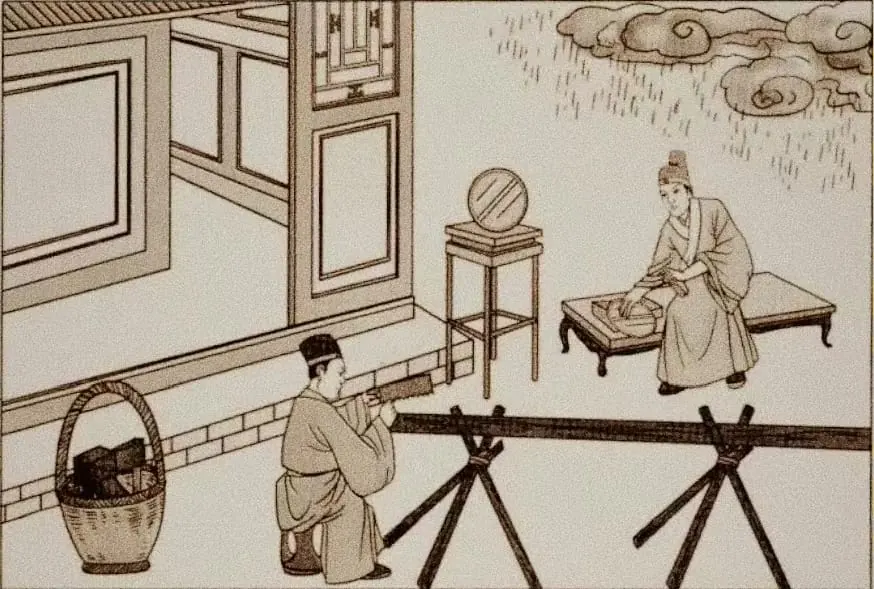
Scene Description
Image Symbolism
Reading the Picture
Sheng is steady upward growth, like a tree rising out of the earth, and the picture shows it as patient, measured work rather than a sudden leap.
Start with the carpenter in front. He kneels at a long timber laid across two trestles and sights along it, checking the line before he cuts. The Image Symbolism reads his marking as having measures and rules, a sound basis for action, and plays on 匠 jiàng, craftsman, and 将 jiàng, general. The great timber on its frame is read as considerable wealth.
Behind him a man sits at a bench beside a round mirror on a stand; the symbolism reads polishing a mirror as something that can be completed and gained, and a clear mirror as fairness, though in business also competition. At the top right, rain falls from the clouds: grace that wets the clothes, a sign that a dark time is passing. The basket at the lower left is wordplay: the text writes 蓝, but the drawing shows a basket, 篮 lán, which sounds like 难 nán, difficulty: neglected work waiting to be taken up.
The trigrams are Earth ☷ above Wind ☴, and Wind is also wood: a tree pushing up through the soil. The Image speaks of piling up small things until they become great, which is what the carpenter’s careful measuring shows. The open courtyard recalls the third line, ascending into an empty town, with nothing in the way.
- Work
- If advancement is within reach, consider whether your groundwork is measured and true, as the carpenter checks his timber. Progress built on real merit tends to hold.
- Relationships
- If a relationship is growing, let it deepen through small, sincere acts rather than grand gestures; the second line favours sincerity over display.
- Timing
- The time favours rising step by step. If you have already climbed far, the top line asks whether you still know when to stop.
Line Statements
Listed from the bottom line to the top line.
- First six: Trusted ascent. Great good fortune.
- Nine in the second place: With sincerity, even a simple offering is beneficial. No blame.
- Nine in the third place: Ascending into an empty town.
- Six in the fourth place: The king offers at Mount Qi. Good fortune, no blame.
- Six in the fifth place: Steadfastness, good fortune. Ascending the steps.
- Top six: Ascending in darkness. It is beneficial to maintain unceasing steadfastness.
Meaning of the Hexagram
Translated from the Chinese 人间道 commentary with AI assistance; translator notes appear in brackets.
“Sheng: supreme success. Use this to see the great person; do not worry. Setting out to the south brings good fortune.”
The way of Sheng (Pushing Upward) lies in success and free passage. Using this way to see the great person, one can advance without relying on anyone’s indulgence, and there is sure to be good fortune.
“The yielding rises in accord with the time. Gentle and compliant, the firm is central and has a response; therefore there is great success.”
The yielding means the compliant: rising in accord with the time, advancing by yielding. This is rising at the right time. The second line, a position of firm yang, receives the response of the yielding, compliant ruler in the fifth place, and so there can be great success.
“Use this to see the great person; do not worry: there will be cause for celebration. Setting out to the south brings good fortune: the will is carried out.”
Using the way of gentleness and compliance, together with firm, yang centrality and correctness, to see the great person, one is sure to fulfil one’s aims and rise, and never needs to worry that the rise will fail. This is the good fortune and celebration. Going forward, one is sure to rise and sure to carry out one’s will.
“Within the earth grows wood: Pushing Upward. The noble person accordingly follows virtue, accumulating small things to become high and great.”
Wood grows within the earth and grows tall: this is rising. Observing the image of rising, the noble person understands that the virtue of self-cultivation proceeds from accumulating the small until it becomes high and great. So if one does not accumulate goodness, it is not enough to make a name. All loftiness of learning and virtue is built up through accumulation: this is the meaning of rising.
“Trusted ascent. Great good fortune.”
At its first advance, the yielding line complies with the firmness of the second nine, and because it gains trust it rises. This rising is fortunate.
“Trusted ascent, great good fortune: it is in accord with the will of those above.”
Its will accords with that of the position above; it gains trust and rises. It can have great good fortune because it is trusted by the worthy one who is firm and central.
“Sincerity makes even the simple offering beneficial. No blame.”
The second nine is a minister of yang firmness in the time of rising. Because the ruler above is soft, he must never contrive to seek outward show; he must seek to move and reach the one above through the utmost sincerity of his inner heart. In this way there can be no blame.
“The sincerity of the second nine: there is joy.”
In the way of ruler and minister, if the minister serves the ruler with the utmost sincerity of heart, not only does he escape calamity as a minister, he can also carry out his great aims. This is cause for joy.
“Ascending into an empty town.”
The third nine is a minister of yang firmness who can be correct and comply with those above. Rising in this way is like entering a market with no one in it: there is no one to resist.
“Ascending into an empty town: there is nothing to doubt.”
If rising is like entering an empty town, then this advance is surely free of any doubt or worry.
“The king offers at Mount Qi. Good fortune, no blame.”
Occupying the position of the feudal lords, this line can be yielding and compliant toward the king above, and compliant toward the worthy people of the world below, recommending them and advancing them. In itself it is soft, compliant, modest and respectful, and does not seek to leave its own position. With such virtue there is sure to be good fortune, and no disaster.
A warning for people: always remember that one must not rise without having accomplished anything, and that in rising one must advance according to one’s strength; only this accords with the way of the noble person. People today no longer act like this; rising without merit is seen everywhere. If the way of rising comes from private desire, it will surely bring the state to poverty and hardship.
“The king offers at Mount Qi: compliance in serving.”
The person at the ruler’s side knows to comply with the time and with affairs and can conduct himself compliantly. Having the nature of Kun (the Receptive), he can be without blame.
“Steadfastness, good fortune. Ascending the steps.”
The person in the ruler’s position is soft by nature. He must have the virtue of being steadfast and correct and of holding firmly to it; then everyone trusts him and the worthy come. Knowing people and using them well, he is sure, through employing the worthy, to rise further, and his bounty reaches the whole world.
“Steadfastness, good fortune, ascending the steps: he greatly achieves his aims.”
If a ruler can employ worthy talent, the world can be brought to great order. So the way of rising for a king lies simply in being able to use the worthy; then he is sure to achieve his aims.
“Ascending in darkness. It is beneficial to maintain unceasing steadfastness.”
At the extreme of rising, one becomes blind in one’s rising, knowing only to advance and not to stop; this is a lack of clarity. The noble person works diligently all day, always keeping watch over himself, and knows when to advance and when to withdraw. The petty person’s heart of greedy private desire is strong, and so he acts without knowing when to advance or withdraw: misfortune.
“Ascending in darkness at the top: diminishing, no longer rich.”
A benighted person who has already reached the very top and still seeks to rise without end: the result is only decline and loss, never any further gain.
Show the Chinese original (人间道)
升:元亨,用见大人,勿恤,南征吉。 升之道,在于亨通,用此道来见大人,不靠体恤而能进,必吉。
柔以时升,巽而顺,刚中而应,是以大亨。 柔即顺也,顺时而升,以柔而进,此升之得时矣,二刚阳之位,得五柔顺之君应则能大亨 也。 用见大人,勿恤,有庆也。南征吉,志行也。 用巽顺刚阳中正之道来见大人,必遂心志得升,从不去忧升之不遂,此吉庆也,前进则必 升,必能遂行其志也。
地中生木,升;君子以顺德,积小以高大。 地中生木,木长而高,此升也。君子观升象,乃知修身之德,由积累微小,乃至高大,故 积不善,则不足以成名,凡学问道德之高,皆由累积而成,升之义也。
允升,大吉。 初进时柔顺于九二之刚,因得信而升,此 升吉也。
允升大吉,上合志也。 与上位之志合,得信而升,此因信于刚中 之贤而能大吉也。
孚乃利用禴 禴 禴 禴,无咎。 九二阳刚之臣,处升之时,因上位君柔, 絶不可矫求外饰,必求以中心之至诚来感通于 上,如此则可无咎。
九二之孚,有喜也。 君臣之道,臣之事君能中心至诚,不但为 臣无祸,又可遂行其大志,此可喜也。
升虚邑。 九三阳刚之相,能正而顺上,如此而升, 就如入无人之巿,无人抵御。
升虚邑,无所疑也。 升而如入无人之邑,则此进,必无可疑虑 也。
王用享于岐山,吉 ,无咎。 居诸候之位,能上柔顺于君王,下又顺天 下之贤,举之升进,于已则柔顺谦恭,不求离 本位,有德如是,必吉,且无灾矣。人之戒, 切记在不可无事而升,升又必量力而进,方合 君子之道。今人已不复如此,无功而升,比比
皆是,升之道,如出私欲,必令国致穷困矣。
王用享于岐山,顺事也。 居君侧之人,因知顺时顺事,能顺处之, 得坤之性,可以无咎也。
贞,吉,升阶。 君位之人性柔,必得贞正且固守之德,则 人皆信而贤至,能知人善用,必因用贤而能再 升,泽及天下也。
贞吉升阶,大得志也。 君能任用贤才,如此可致天下大治,故君 王升之道在能用贤耳,必遂其志。
冥升,利于不息之贞。 升之极乃致昏昧于升,只知进不知止,此 为不明,君子之人终日干干,无时不警惕自己, 知所进退。小人贪求私欲之心盛,乃生不知进 退之行为,凶也。
冥升在上,消不富也。 昏昧之人已至极上,犹求升之不已,其果 唯消亡而已,无复增益也。