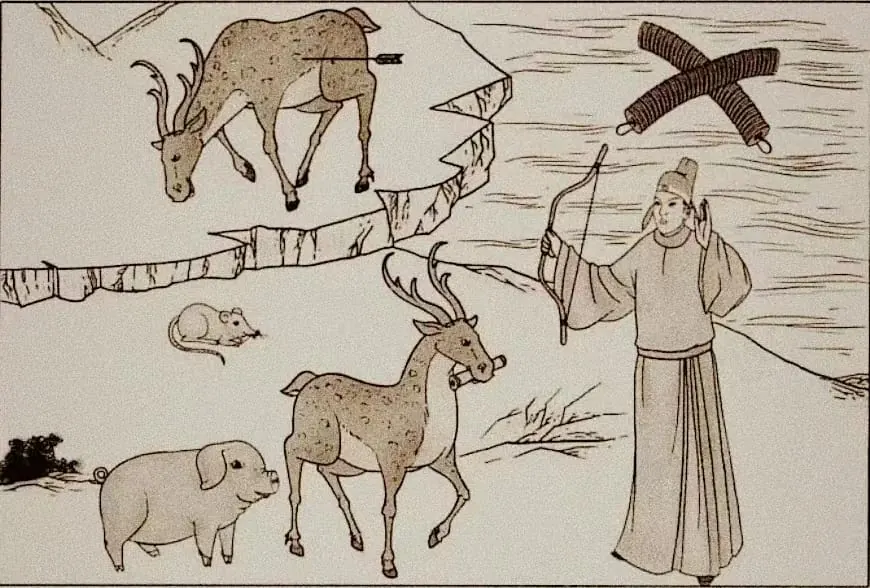
Scene Description
Image Symbolism
Reading the Picture
Wu Wang is about acting without falsity: things go well when you move with what is natural and right, and go wrong when desire makes you reach and grab.
Start with the official holding a bow. He has already shot: an arrow sticks in the back of a deer on the rocky ledge above. The Image Symbolism reads this as throwing your own ranks into disorder, a hasty move made out of wanting. Below, a second deer walks toward him with a document in its mouth, read as news of money on its way. The deer is a pun, 鹿 lù for 禄 lù, reward: one reward was already coming to him, and he shot at another.
Above the water at the top right hang two crossed strings of coins, money that can only be reached through risk and worry. A rat and a pig stand in the foreground. The trigrams set the frame: Thunder ☳ moving below Heaven ☰. Movement that follows heaven’s pattern is innocent and fortunate; movement driven by private desire meets calamity. The picture most clearly illustrates the third line, the unexpected disaster of the tied ox taken by a passer-by, and the top line, where acting further brings harm.
- Work
- If an opportunity promises quick gain, ask whether you are chasing it or whether it has come to you naturally. Consider doing the work in front of you without counting the harvest, as the second line says.
- Relationships
- Sincerity is the core of this hexagram. If you notice yourself calculating, consider speaking plainly instead.
- Timing
- Act only when the action is honest and fitting. If things are already sound, the fifth line suggests leaving well alone rather than reaching for a cure.
Line Statements
Listed from the bottom line to the top line.
- First nine: Without falsity. Going forward brings good fortune.
- Six in the second place: Not counting on harvest while plowing, nor on a mature field while clearing new ground; then it is beneficial to go somewhere.
- Six in the third place: Unexpected disaster. An ox is tied; a traveler gains it and the townspeople suffer.
- Nine in the fourth place: One can remain steadfast. No blame.
- Nine in the fifth place: An illness that comes without fault. Without medicine, there is joy.
- Top nine: Without falsity, yet action brings harm. Nothing is beneficial.
Meaning of the Hexagram
Translated from the Chinese 人间道 commentary with AI assistance; translator notes appear in brackets.
“Wu Wang: origin, success, benefit, steadfastness. If one is not correct, there is calamity; it is not beneficial to have somewhere to go.”
Wu Wang (Innocence) is perfect sincerity, and perfect sincerity is the way of heaven. Heaven transforms and nurtures all things, giving life without ceasing, and each thing is made correct in its nature: this is being without falsity. If people can accord with the way of being without falsity, they share in the virtue of heaven and earth; hence great good fortune. The noble person who walks the way of Wu Wang can bring about great good fortune, but must take care to keep his heart firm; if he loses his steadfastness, disaster follows. People today may have no wicked intent at root, but if they do not accord with right principle, their falsity is itself a wicked intent.
“Wu Wang: the firm comes from outside and becomes master within. Moving and strong, the firm is central and responded to; great success through correctness: this is the mandate of heaven.”
To move by heaven is to be without falsity; people today move by human desire. The firm coming from outside to become master within is the image of removing falsity by correctness. Strong above and moving below, moving within and strong without: its movement is firm, its principle correct and its spirit vigorous, and so the way has great success. This is the way of heaven. People today move from desire and cannot show sincerity outwardly; they are not firm and clear enough because they are not solid within, and this leads to falsity.
“If one is not correct there is calamity, and it is not beneficial to have somewhere to go. When innocence goes forth, where can it go? If heaven’s mandate does not protect it, can it act?”
Wu Wang is correctness; a slight departure from correctness is falsity. Having entered into falsity, if one does not know to return but goes on further, one will surely violate heavenly principle and not be tolerated by the way of heaven. One cannot act.
“Under heaven thunder rolls; all things are given innocence. The former kings accordingly, in abundance, matched the seasons and nurtured all things.”
Thunder rolls under heaven; yin and yang are in harmony and make sound, bringing forth all things, each correct in its nature and life, and their emergence is without falsity. The former kings observed this image, embodied the way of heaven and nurtured the people, so that each was correct in nature and life. This is the way of matching the seasons and nurturing things.
“Without falsity. Going forward brings good fortune.”
The first line is yang firmness entering within; it acts outwardly by the heavenly principle of being without falsity, and so going forward brings good fortune.
“Going forward without falsity: one attains one’s aim.”
Wu Wang is sincerity. When a person is perfectly sincere, there is nothing that is not moved. If the noble person cultivates himself by it, he becomes upright; if he manages affairs by it, he grasps their principle; if he treats people by it, they are transformed. There is nowhere it does not go well.
“Not counting on harvest while plowing, nor on a mature field while clearing new ground; then it is beneficial to go somewhere.”
Human desire is falsity; what follows naturally from principle is not falsity. Here plowing and harvest serve as the comparison: the harvest after plowing comes naturally by principle. A field in its first year is called zi, and in its third year yu. There is plowing and then harvest, clearing and then a mature field. The sage acts in accord with the season, and that is what makes him a sage. One who reads the Changes and can understand the time and follow its trend has grasped the way of the Changes.
“Not counting on harvest while plowing: it is not yet about wealth.”
If, at the time of first plowing and clearing, one’s mind is set on the mature field, that is what is meant by seeking wealth. To act with desire in one’s heart is falsity. So the Changes says that human action should seek only to accord with what is natural and not be moved by human desire; to be able to overcome one’s own desires is the greatest courage.
“Unexpected disaster. An ox is tied; a traveler gains it and the townspeople suffer.”
People’s reckless actions come from their own desires. Reckless action that brings gain must also bring loss. This yin soft line occupies the minister’s position; its movement comes from falsity, and its great loss lies in desire. So disaster follows the fortune that is falsely gained, and loss comes with the gain that is falsely won; none of it is true gain.
“The traveler gains the ox; the townspeople suffer.”
Where there is both gain and loss, it is not worth calling gain. The sage’s gain is gained without desire, and no loss is spoken of.
“One can remain steadfast. No blame.”
The fourth place is occupied by firmness; being firm, it is surely without selfishness and never gives rise to falsity.
“One can remain steadfast, no blame: one holds to it firmly.”
Keeping the heart firm and holding to the way of Wu Wang, firm and without desire, there is no disaster.
“Illness without fault. Without medicine, there is joy.”
The fifth nine is the place of honour, filled by yang firmness, and below it a line of yang firmness, central and correct, responds in compliance [as written; the responding second line is in fact yin]; this leads to good. Even if there is a small flaw, it needs no treatment and heals of itself. If this is maintained with constancy, there is peace and no disaster. The caution is against moving: one movement gives rise to falsity. Thus the ruler’s way of Wu Wang lies here.
“Medicine for innocence: it must not be tried.”
If a person has falsity, he must correct it, and then he will be without falsity. To treat it instead with medicine would itself become falsity. Therefore it must not be tried.
“Without falsity, yet action brings harm. Nothing is beneficial.”
This place is the extreme of the hexagram, where Wu Wang has already reached perfect goodness. When a person has reached freedom from falsity and still acts further, he must go beyond principle; going beyond principle gives rise to falsity.
“Action in innocence: the disaster of exhaustion.”
Wu Wang has already reached its peak; to push further now gives rise to falsity, and so at the end of the road disaster arises.
Show the Chinese original (人间道)
无妄:元,亨,利,贞,其匪正有眚,不利有攸往。 无妄即至诚也。至诚为天道。天能化育万物,生生不息,且各正其性,此无妄也。人如能 合于无妄之道,则能与天地合德,故大吉,君子行无妄之道,能致大吉,须戒在坚心,如失贞, 则致灾。今人本无邪心,但如不合正理,则妄亦邪心也。
无妄,刚自外来而爲主于内。动而健,刚中而应,大亨以正,天 之命也。 动以天则无妄,今人动以人欲。刚自外而入主于内,乃以正去妄之象。上健而下动,内动 而外健,其动乃刚,理正气壮,道乃大亨,此天道也。今人动之以欲,而无法示诚于外,不够 刚明,乃因内不实,此致妄矣。
其匪正有眚,不利有攸往,无妄之往,何之矣。天命不祐,行矣哉? 无妄,即正也,小失于正,乃妄。入于妄,不知复,乃更往,则必悖天理,为天道所不容, 不可行也。
天下雷行,物与无妄,先王以茂对时育万物。 雷行天下,阴阳和而成声,生发万物,各正性命,其发而无妄,先王观此象,体天之道, 养育人民,使各正性命,乃对时育物之道也。
无妄,往吉。 初进阳刚在内,以无妄之天理行之于外, 故往吉。
无妄之往,得志也。 无妄乃诚也,人之至诚,物无不动,君子 以之修身则身正,以之治事则得理,以之待人 则人化,无往不利也。
不耕获,不菑畬,则利有攸 往。 人之欲即妄,理之自然者,非妄,今以耕 获喻之,农耕后之获,乃理之自然也。田一岁 为『菑』 ,三岁曰『畬』 ,有耕而有获,有菑而 有畬,圣人顺时而作,乃为圣也,读易之人, 能知时顺势,得易之道矣。
不耕获,未富也。 心念于始耕菑之时,乃为求畬,此所以为 富。心有欲而为,则妄。故易言人之行但求合 于自然,不为人欲所动,故能胜己之欲为大勇 也。
无妄之灾,或系之牛,行人 之得,邑人之灾。 人之妄动,由己之欲也,妄动有得,亦必 有失,阴柔居相位,动乃因妄,失之大在欲, 故妄得之福,灾亦随之,妄得之得,失亦来之, 皆非真得也。
行人得牛,邑人灾也。 有得有失,不足言得。圣人之得,乃无欲 而得,不言有失。
可贞,无咎。 四位刚而居之,刚则必无私,永不生妄。
可贞无咎,固有之也。 坚心守无妄之道,刚而无欲,则无灾。
无亡之疾,勿药有喜。 九五为尊位,以阳刚应之,下又以阳刚中 正顺应,则致善也。即令有小疵,不须去治而 自愈,如持之以恒,则平安无灾,戒之在动, 一动生妄,故人君之无妄道即在此。
无妄之药,不可试也。 人有妄必改,则致无妄,今反以药治之, 反成妄矣。故不可试。
无妄,行有眚,无攸利。 此位为卦之极,无妄已至善,人至无妄, 又复行,理必过也。过于理,则生妄。
无妄之行,穷之灾也。 无妄已为极点,今又复加进,乃生妄矣, 故穷极而生灾也。