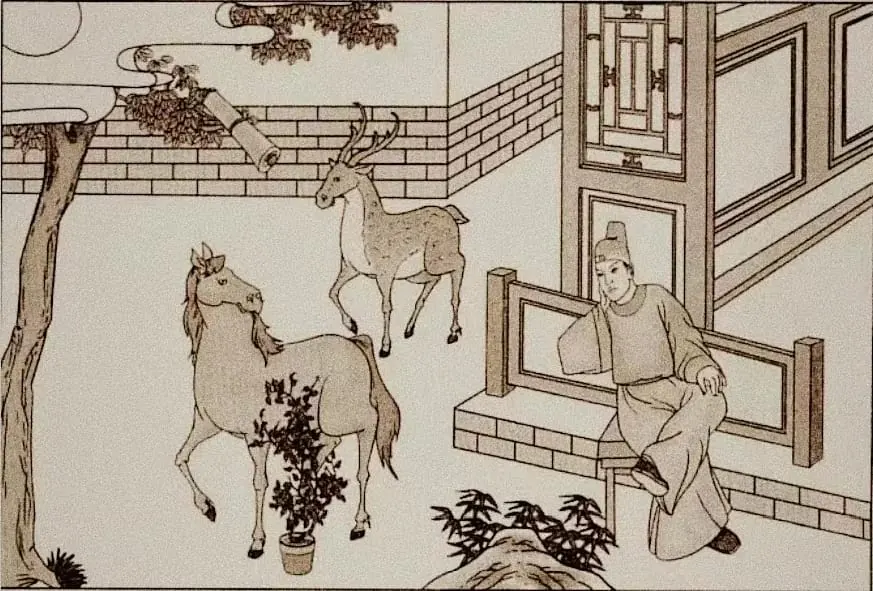
Scene Description
Described from the picture. The source text for this hexagram repeats hexagram 3's scene, so it is not shown here.
Image Symbolism
The source repeats hexagram 3's text in this section; it is shown on Hexagram 3: Zhun — Difficulty at the Beginning.
Reading the Picture
Da Chu is great strength held in reserve: power, learning and resources are gathered inside firm boundaries and allowed to build up until the right moment to use them.
Start with the horse in the middle of the courtyard. It is a strong animal standing free, with no cart, inside brick walls. That is the hexagram in one image: Heaven ☰, the strongest trigram, sits below, and Mountain ☶, the trigram of stopping, holds it in from above, as the walls do here. The unharnessed horse also echoes the second line, where the carriage’s axle fastening comes loose: for now, the strength is hitched to nothing. Its time comes in the third line, “fine horses pursue.”
Now look at the official on the right, seated at ease, one foot drawn up, watching the animals rather than driving them. This is the first line’s counsel: there is danger in pushing ahead, and it is beneficial to stop. Above the wall, a scroll hangs in the branches of the tree, a fitting sign for the Image’s call to learn from the words and deeds of the past and so store up virtue. The stag is wordplay: 鹿 lù (deer) sounds like 禄 lù, an official’s stipend, reward that accumulates when strength is stored rather than spent.
- Work
- If your skills or savings feel underused, consider whether this is a season for building rather than spending. What do you still need to learn before the horses can run?
- Relationships
- If you are tempted to push a relationship forward, ask first what you are bringing to it. Steadiness and restraint now may give it more to stand on later.
- Timing
- Early in Da Chu, holding back is wiser; only the top line opens onto a highway of Heaven. Until the way clears, keep preparing.
Line Statements
Listed from the bottom line to the top line.
- First nine: There is danger. It is beneficial to stop.
- Nine in the second place: The carriage's axle fastening comes loose.
- Nine in the third place: Fine horses pursue. It is beneficial to be steadfast in hardship. Practice carriage driving and defense daily; it is beneficial to go somewhere.
- Six in the fourth place: A young ox's horn guard. Great good fortune.
- Six in the fifth place: A castrated boar's tusk. Good fortune.
- Top nine: What a highway of Heaven! Success.
Meaning of the Hexagram
Translated from the Chinese 人间道 commentary with AI assistance; translator notes appear in brackets.
“Da Chu: it is beneficial to be steadfast. Not eating at home is fortunate. It is beneficial to cross the great river.”
Da Chu (Great Taming) applies to people in the same way. A person’s store lies in learning and moral virtue accumulated within; that is the greatest kind of store. If what one stores up is heterodox and deviant teaching, what use is the store? People today put great weight on storing up money and wealth and do not value the cultivation of learning. What use is such a store? It is not a great store.
“Da Chu: firm and strong, genuine and solid, radiant with light; daily it renews its virtue.”
A person must be firm and strong, sincere and solid; then the store becomes great. And because it is full and solid it shines, and virtue is surely renewed day by day.
“The firm is above and honours the worthy; it is able to restrain the strong. This is great correctness.”
To occupy the place of honour, to be firm and clear-sighted in employing the worthy, and to be able to sustain this for ever: this is the way of great correctness. Rulers today are firm but not clear-sighted; they employ people out of private desire rather than by the standard of worth and ability, so theirs is not the way of great correctness.
“Not eating at home is fortunate: this nourishes the worthy. It is beneficial to cross the great river: this accords with Heaven.”
People who have stored up learning and virtue apply what they have stored to benefit the whole realm; therefore they do not eat at home, and this is fortunate. To be able to cross the great river without danger is to be in accord with Heaven and Earth.
“Heaven within the mountain: Great Taming. The noble person accordingly comes to know many words and deeds of the past, so as to store up his virtue.”
The noble person observes that Heaven, the greatest of all things, is stored within the mountain, and so understands that a person’s capacity to store up greatness comes through learning. The way of learning lies in hearing much of the words and deeds of the ancient sages and worthies, taking their strengths for one’s own use, and examining their words to seek out what was in their hearts. This is the true meaning of Great Taming.
“There is danger. It is beneficial to stop.”
The first line is yang and firm and will surely press upward without ceasing; then there is danger. At this time the benefit lies in keeping one’s own store and not advancing, waiting until one shares a common purpose with those above before moving.
“There is danger; it is beneficial to stop: do not run into disaster.”
This means that to advance without weighing the situation does not benefit oneself, and disaster arrives. It is a warning not to court danger by acting.
“The carriage’s axle fastening comes loose.”
The second line is matched with the six in the fifth place. Although it is yang and firm, it too must not push forward by force; if it advanced, it would be like a cart whose wheels have come off the axle, unable to move.
“The carriage’s axle fastening comes loose: being central, there is no fault.”
The highest good is to be firm and central; softness must not become excessive softness. Because its position is low, it is still not in a position to advance. The way of the Changes is to know when to advance and when to withdraw.
“Fine horses pursue. It is beneficial to be steadfast in hardship. Practice carriage driving and defense daily; it is beneficial to go somewhere.”
The third line is the place of a chief minister. With firm and strong talent it can share a common purpose with the line above and advance together with it, as swiftly as fine horses galloping. But although the pace is swift, one must above all not rely on the strength of one’s talent and forget preparedness and caution.
“It is beneficial to go somewhere: the one above shares its purpose.”
Because it can share a common purpose with the one above, going forward is beneficial.
“A young ox’s horn guard. Great good fortune.”
This speaks of a person close to the ruler’s position, who must restrain the ruler’s wayward heart above and restrain the evil of the realm below. Whenever a person’s evil can be stopped at its very beginning, it is as easy as fitting a guard to the horns of a young ox. If one waits until the evil is flourishing before forbidding it, the two will surely be at odds and it will be hard to overcome. Therefore the sage stops evil at its beginning.
“The great good fortune of the six in the fourth place: there is joy.”
The way of Great Taming lies in stopping evil at its beginning. This is great goodness and fortunate; it surely allows things to be governed easily, without toil.
“A castrated boar’s tusk. Good fortune.”
When a boar is gelded, then even though it still has its tusks, its fierce restlessness stops of itself. The noble person takes this to heart and understands that the evil of the realm cannot be suppressed by force; one must examine its root. Evil can be stopped without relying on harsh punishments and laws. The sage teaches the cultivation of government and instruction, so that everyone has enough for their needs and has a sense of integrity and shame; only this is the highest good.
“The good fortune of the six in the fifth place: there is blessing.”
When those above have the right way of stopping evil, it is a blessing and good fortune for the whole realm. To do the opposite, using force and severe punishments and making an enemy of the people, does harm and achieves nothing.
“What a highway of Heaven! Success.”
When the way of Great Taming can move as if through open sky, unobstructed in every direction, it will surely spread throughout the realm; this is fortunate.
“What a highway of Heaven: the way moves on a grand scale.”
The road is wide open and one can move on a grand scale: this is the culmination of Great Taming.
Show the Chinese original (人间道)
大畜:利贞,不家食,吉,利涉大川。 大畜于人亦同,人之畜在学术道德充积于内,乃至大之畜,若为邪端异说畜又何用?今人 重大畜于钱财,不重视学术修养,所畜何用?不为大畜。
大畜刚健,笃实辉光,日新其德。 人须能刚健笃实,其畜乃大,又因充实而光辉,德必日新。 刚上而尚贤,能止健,大正也。 居尊位能刚明用贤,又能持之永恒,此大正之道。今之君王刚而不明,用人乃因私欲,而 不以贤能为基准,故非大正之道。 不家食吉,养贤也;利涉大川,应乎天也。
大畜学术道德之人,施其所畜,利于天下,因而不在家食,乃吉。能涉大川而无险,乃应 乎天地也。
天在山中,大畜,君子以多识前言往行,以畜其德。 君子观天之至大而畜山中,故知人之能畜大,乃由学而大,学之道在多闻古圣贤之言行, 取长为己用,察言以求其内心,乃大畜之真义。
有厉,利己。 初爻为阳刚,必上进不已,则有危厉,此 时,利在己之畜而不进,待与上合志乃动。
有厉利己,不犯灾也。 此即不度局势而进,不利己,乃灾至。戒 不可犯危而行。
舆说輹。 二为六五位所对应,虽阳刚但亦不可力 进,进则如车轮脱轴,不得行也。
舆说輹,中无尤也。 至善为刚中,柔不可过柔,因位居下,仍 不足以进。易之道,乃知所进退也。
良马逐,利艰贞,曰闲舆卫, 利有攸往。 三为相位,以刚健之才,能与上位合志而 同进,就如良马之驰,速也。唯虽速,但须切
忌不可持才之健,而忘戒备与谨慎也。
利有攸往,上合志也。 因能与上合志,故往而利也。
童牛之牿,元吉。 此言近君位之人,须上畜止人君之邪心, 下畜止天下之恶。凡人之恶能止于初始,则易 如童牛加桎梏。俟恶盛而后禁,必相隔而难胜。 故圣人止恶于初。
六四元吉,有喜也。 大畜之道在止恶于初,此大善而吉,必能 不劳而易治。
豶豕之牙,吉。 猪之去势,则虽有牙,而刚躁必自止。君 子体之,知天下之恶,不可力制之,须査其根 本,不靠刑法严峻而能止恶。圣人教修政教, 使人人足用,知廉耻之心,方为至善。
六五之吉,有庆也。 在上者止恶有道,乃天下福庆也。反用强 力严刑与民为敌,伤又无功矣。
何天之衢,亨。 大畜之道,能如行空中,横行无阻,必散 之天下,吉也。
何天之衢,道大行也。 道路空旷,而能大行,乃大畜之极也。
Career, Family & Home
Birth & Annual Fortune
Historical Story
The source repeats hexagram 3's text in this section; it is shown on Hexagram 3: Zhun — Difficulty at the Beginning.