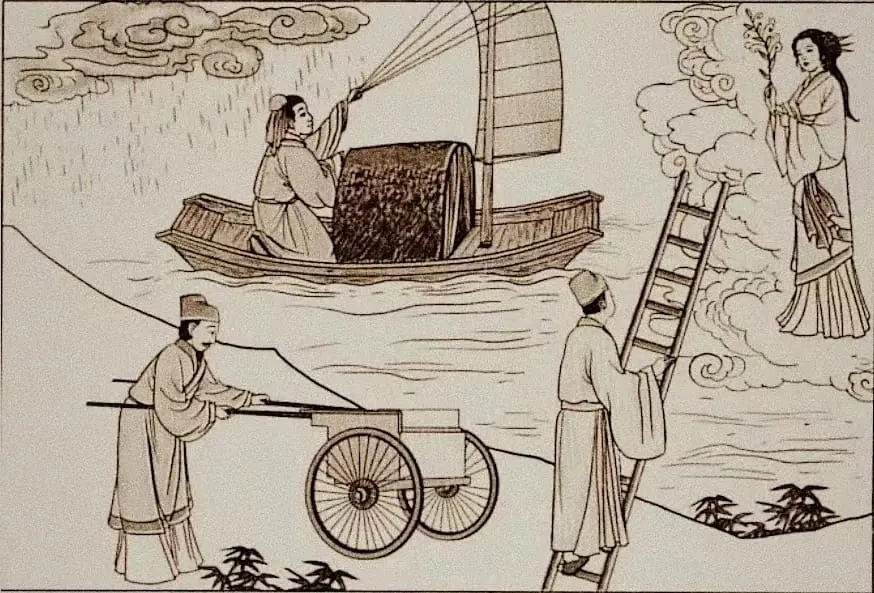
Scene Description
Image Symbolism
Reading the Picture
Bi is about grace and adornment: everything in the picture is moving well and looking its best, and the question is whether the substance underneath matches the shine.
Start with the official at the foot of the ladder. In formal robes, he is about to climb toward the clouds, where a celestial woman stands. The Image Symbolism reads the climb as promotion in another place, and the woman as help from a supportive person. The description has her holding a jade tablet; in the drawing she holds a flowering sprig. Everything else is travelling: a boat runs under full sail, and a man pushes a cart along the road.
Rain falls from the clouds on the left, read as nourishment and completion. It also recalls the third line, adorned and glistening: things look fresh when wet, but the line asks for lasting steadfastness, not a passing sheen. The man walking behind his cart echoes the first line, leave the carriage and walk: he moves on foot by choice. The trigrams frame it: Fire ☲ beneath Mountain ☶ is light at the foot of a hill, making its trees and rocks glow: beauty that reveals what is already there rather than covering it.
The top line, plain white adornment, quietly balances so much good fortune.
- Work
- If a move or promotion is on offer, consider whether your skills are ready for the new post, not only how it looks. Small, steady steps suit this time better than bold ventures.
- Relationships
- Ask whether you are drawn to the person or to the polish. The fourth line’s suitor arrives on a white horse; a match that lasts rests on shared aims.
- Timing
- Conditions favour travel and modest advances. If things are going smoothly, keep them simple and do not overdecorate what is already good.
Line Statements
Listed from the bottom line to the top line.
- First nine: Adorn the toes. Leave the carriage and walk.
- Six in the second place: Adorn the beard.
- Nine in the third place: Adorned and glistening. Lasting steadfastness brings good fortune.
- Six in the fourth place: Adornment in whiteness; a white horse flying. Not robbers but suitors.
- Six in the fifth place: Adornment in hills and gardens; small bundles of silk. Regret, but good fortune in the end.
- Top nine: Plain white adornment. No blame.
Meaning of the Hexagram
Translated from the Chinese 人间道 commentary with AI assistance; translator notes appear in brackets.
“Bi: success. It is beneficial in small matters to have somewhere to go.”
Things can stand only once they have outward adornment; but there must first be inner substance, and adornment added to it, and then there can be success. Because the way of adornment adds lustre, it is surely beneficial for small advances.
“Bi (Grace), success: the yielding comes and adorns the firm, hence success. The firm divides and goes up to adorn the yielding, hence it is beneficial in small matters to have somewhere to go. This is the pattern of heaven. Culture and clarity, held within limits: this is the pattern of humankind.”
That the way of Bi can bring success truly comes from adornment. The way of adornment requires that one come and go with softness and seek adornment with firmness, and that the name be correct; hence it is beneficial, with small good fortune. The way of adornment cannot increase inner substance; it only adds outward colour. People today seek only outward adornment and not inner substance: rich and extravagant on the surface, with no real talent within, they are everywhere. When those in high positions employ only the wealthy, this is the first sign of ruin.
“Observe the pattern of heaven to discern the changes of the seasons; observe the pattern of humankind to transform and complete all under heaven.”
The pattern of heaven is the arrangement of the sun, moon and stars and the changes of the four seasons, cold and heat. The pattern of humankind is the ordering of human relationships. To observe the pattern of humankind and so teach and transform the world: this is how the sage uses the way of Bi.
“Fire beneath the mountain: Grace. The noble person accordingly brings clarity to the many affairs of government, and does not dare to decide lawsuits by it.”
With fire beneath the mountain, the grasses and trees are lit by its brightness and gain lustre: this is adornment. The sage observes this image of bright illumination in order to cultivate clarity in the many affairs of government and achieve an enlightened rule. He does not dare to use adornment to cover up the facts and bend the law without regard; therefore the noble person makes clarity his caution.
“Adorn the toes. Leave the carriage and walk.”
The first nine is a noble person with firm and clear virtue who lives in a low place. Because he holds no position, he has no way to help the world; he only seeks to adorn himself. The noble person’s way of adorning himself lies in making his conduct correct, keeping to his principles and abiding by what is right. Whatever is not right, he would rather not go along with.
“Leaving the carriage and walking: it is right not to ride.”
When it is not right to go along together, he would rather leave the carriage and walk.
“Adorn the beard.”
Outward adornment of a thing cannot change its nature; adornment must be added according to what that nature is. This is the way of Bi.
“Adorning the beard: it rises together with the one above.”
The way of adorning the beard is that it must follow what is above it: it moves as what is above moves, and in moving and resting it depends on what it belongs to.
“Adorned and glistening. Lasting steadfastness brings good fortune.”
At the height of adornment one must take care to stay correct for ever, and then there is good fortune, because a heart and conduct that stay correct for ever are very hard to maintain.
“The good fortune of lasting steadfastness: in the end no one insults it.”
If adornment changes often and is not correct, people will insult and slight it; hence the warning that lasting correctness brings good fortune.
“Adornment in whiteness; a white horse flying. Not robbers but suitors.”
The adornment is white and the white horse is white too, but their aims differ. Because their outward adornment is the same, in the end a marriage comes about and they respond to each other. This is like people today seeking a match of equal standing.
“The six in the fourth place is in its proper place, yet in doubt. Not robbers but suitors: in the end there is no blame.”
The fourth and first lines correspond. Although the fourth six is in its proper place, the second and third lines stand between them as a barrier; hence there is doubt. But because the first and fourth are a proper correspondence, with reason and right on their side, in the end there will surely be no disaster.
“Adornment in hills and gardens; small bundles of silk. Regret, but good fortune in the end.”
Although this is the ruler’s position, its nature is yin and soft and not enough to hold its own. It seeks only outward adornment by setting up defences to guard the state: fields and gardens near the city, hills outside, holding the strong points. Even though a yin soft nature has its outside shaped by others, and the noble person finds this regrettable, in the end there is peace.
“The good fortune of the fifth six: there is joy.”
If the ruler can follow others to accomplish the work of adornment, this good fortune brings joy.
“Plain white adornment. No blame.”
At the extreme of adornment one errs into outward falseness; only by keeping to plain white within adornment does one avoid the disaster of over-adornment. So value plainness and do not lose your original truth. On no account let outward adornment become so splendid that you lose your substance. This is the warning of Bi.
“Plain white adornment, no blame: the one above achieves his aim.”
At the extreme of adornment there is the danger of excessive show, falseness and loss of substance; hence the warning. With plainness one can avoid disaster: adornment must not be excessive.
Show the Chinese original (人间道)
贲:亨,小利有攸往。 物有外饰而后有立,但须有内实而加外饰,则可以亨。因文饰之道可以增加光彩,故必利 于小进。
贲亨,柔来而文刚,故亨。分刚上而文柔,故小利有攸往,天文 也;文明以止,人文也。 贲之道能亨,实由饰而来,饰之道,须来往以柔,求文饰以刚,名须正,故利小吉。贲饰 之道,并非能增其内实,只外加文彩而已。今人但求外饰,不求内实,富侈表面,内无实才, 比比皆是,上位者所用皆富有之人,此败亡之初始象也。
观乎天文以察时变,观乎人文以化成天下。 天文,为日月星辰之错列,四时寒暑之变化。人文为人理之伦序,观人文以教化天下,此 圣人用贲之道也。
山下有火,贲。君子以明庶政,无敢折狱。 山下有火,草木为其明照而有光彩,此贲饰也。圣人观此明照之象,以修明庶政,成文明 之治,无敢于用文饰,掩饰实情,枉法不顾,故君子以用明为戒。
贲其趾,舍车而徒。 初九乃君子有刚明之德,居于下也。因其 无位,无法施济天下,唯求贲饰自己而已。君 子修饰之道,在正其所行,守节处义,凡不正 则宁不与同行。
舍车而徒,义弗乘也。 于义不可同行,宁舍车而步行。
贲其须。 外饰于物,无法改变其本质,须因其本质 如何加饰,乃贲之道。
贲其须,与上兴也。 须贲之道,须与上随,随上而动,动静归 依于所主。
贲如濡如,永贞,吉。 贲之盛,须戒永正,则吉,因永正之心及 行,很难维持。
永贞之吉,终莫之陵也。 如饰之变化多且非正,人所陵侮也,故戒 之永正则吉。
贲如皤如,白马翰如,匪寇 婚媾。 贲外饰为白色,白马亦为白色,但志不同, 由外饰同,而终有婚遂相应也。今人之求门当 户对也。
六四当位,疑也;匪寇婚媾, 终无尤也。 四与一为应爻,六四当位时,中离间隔二 三位,故疑也,但因一与四为正应,理直义胜, 终必无灾也。
贲于丘园,束帛戋戋,吝, 终吉。 此虽君位,但本质阴柔,不足自守,但求 外贲于设险守国,田园近城,山丘在外,据险 而守,即令阴柔之质,受人裁制其外,虽君子 吝之,但终平安。
六五之吉,有喜也。 君能从人以成贲之功,此吉有喜也。
白贲,无咎。 贲饰之极,则失于外伪,唯能质白于贲, 则无过饰之灾。故尚质素,不失其本真,千万 不可外饰过于华美而失其本质,此戒贲也。
白贲无咎,上得志也。 处贲之极,则有过华伪失实之虑,故戒之, 以质素则可无灾,饰不可过也。