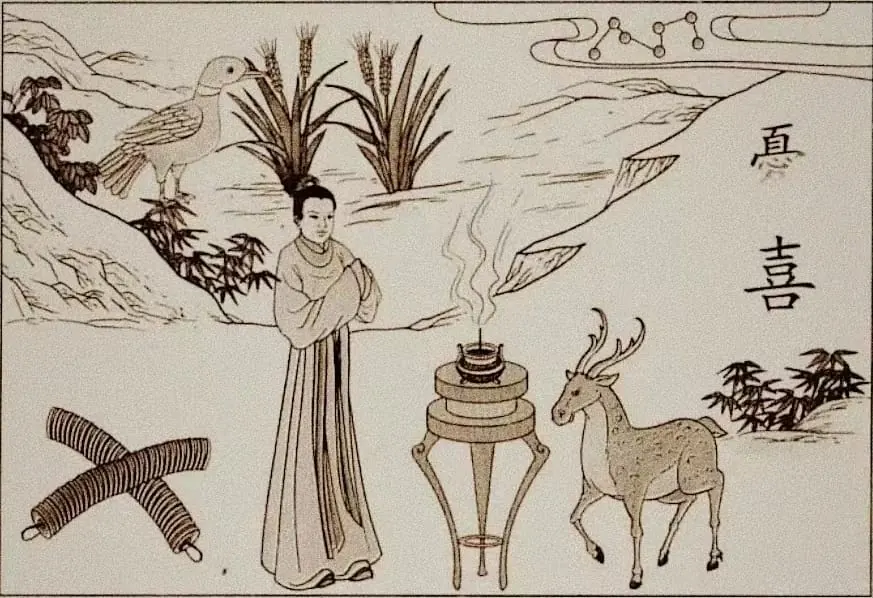
Scene Description
Image Symbolism
Reading the Picture
Shi He is about something stuck between the jaws: a matter that will not resolve until it is bitten through, clearly and firmly.
Begin with the two characters on the right. 喜, joy, is written whole, while 忧, worry, is drawn incomplete, as if part of it had been bitten away. The Image Symbolism reads it as worry giving way to joy. Below, a woman stands with hands folded beside a smoking incense stand. The description has her worshipping, though she is drawn standing rather than bowing; either way, she turns to heaven because ordinary help has not cleared the obstacle. Overhead, the seven stars of the Northern Dipper stand for authority and office.
The rest carries the worry. A bird stands by ripe grain that may be eaten before harvest. Two strings of coins lie crossed on the ground, and a deer, 鹿 lù for 禄 lù, an official’s reward, stands by the incense: money and position are what the mind keeps chewing on. The trigrams supply the method. Thunder ☳ below is decisive movement; Fire ☲ above is clear sight, like a bite guided by the eyes.
The first line fits the picture’s hope: a small correction early, feet in the stocks, prevents a larger wrong. The top line warns of problems left until they are too big to bite.
- Work
- If a project is blocked by one stubborn problem, consider naming it plainly and dealing with it rather than working around it; firm action grounded in clear facts beats force alone.
- Relationships
- If the same friction keeps returning, ask whether one small, honest conversation now could spare a harder one later.
- Timing
- Deal with obstacles while they are still small. If you are waiting for things to sort themselves out, consider which part you could bite through yourself.
Line Statements
Listed from the bottom line to the top line.
- First nine: Feet in stocks, toes hidden. No blame.
- Six in the second place: Biting through skin, nose hidden. No blame.
- Six in the third place: Biting dried meat and meeting poison. Some regret, no blame.
- Nine in the fourth place: Biting dried meat on the bone and obtaining a metal arrow. It is beneficial to be steadfast in hardship. Good fortune.
- Six in the fifth place: Biting dried meat and obtaining yellow gold. Steadfastness in danger; no blame.
- Top nine: Wearing a cangue that hides the ears. Misfortune.
Meaning of the Hexagram
Translated from the Chinese 人间道 commentary with AI assistance; translator notes appear in brackets.
“Shi He: success. It is beneficial to use legal proceedings.”
This means that when the affairs of the world cannot go through smoothly, it is because something obstructs them; without punishment and legal proceedings, how could the obstruction be removed?
“There is something between the jaws: this is called Shi He (Biting Through). Biting through brings success.”
It is like something blocking the mouth: one must bite down hard on it, and then comes the image of getting through. The way of using legal proceedings is the means of examining what is true and what is false. When one grasps the facts, one knows how the obstruction came about, and can then set up safeguards and apply punishment. To know the way of biting through is to know the way of removing obstruction, and then all under heaven goes smoothly.
“The firm and the yielding are distinct; there is movement with clarity; thunder and lightning unite and shine.”
The capacities of this hexagram include both the firm and the yielding, distinct and not mixed: an image of clear discernment. The basis of examining cases is clear discernment, and one acts with clarity. Thunder is above and Fire below [sic: in this hexagram Fire is above and Thunder below]; its movement comes from clarity. Illumination and awe go together; this is the way of using legal proceedings. If one can illuminate, nothing is concealed; if one has awe, there is no one who does not fear. Therefore illumination and awe are used together.
“The yielding attains the centre and moves upward; although it is not in its proper place, it is beneficial to use legal proceedings.”
This speaks of the way of administering justice. If it is wholly firm, it errs toward severity and harshness; if it is too soft, it errs toward leniency and indulgence. Occupying a firm position with benevolence and attaining centrality and correctness, one attains the way of using legal proceedings.
“Thunder and lightning: Biting Through. The former kings accordingly made penalties clear and set the laws in order.”
Thunder is awe and lightning is clarity. The sage observes the image of thunder and lightning, imitates its clarity and its awe, and establishes punishments and laws. The spirit of law lies in teaching people to understand what is right, and in setting up safeguards.
“Feet in stocks, toes hidden. No blame.”
The lowest position is the image of the common people, of one who receives punishment. At the beginning of punishment the crime is small and the penalty light: wooden stocks injure the toes, and the person will not dare to go further into wrongdoing. This is a great warning given through a small punishment. Herein lies the good fortune of the petty person.
“Feet in stocks, toes hidden: he does not walk on.”
For a small crime the wooden stocks are applied lightly and injure the toes; because of this punishment he does not go further into wrongdoing.
“Biting through skin, nose hidden. No blame.”
The second line is central and correct: the image of applying punishment with centrality and correctness. In this way crimes are readily acknowledged. But when one meets a hard and strong person, the punishment must cut deep and hurt; hence it goes as far as the nose disappearing, and yet there is no disaster.
“Biting through skin, nose hidden: it rides upon the firm.”
This is applying punishment to a hard and strong person: it cannot but cut deep and hurt, and so it serves as a warning.
“Biting dried meat and meeting poison. Some regret, no blame.”
If one is not correct oneself and yet punishes others, they will not submit but will resent it and argue back. It is like eating dried meat and meeting poison, which harms one’s own mouth instead. Although there is some criticism, there is no great disaster.
“Meeting poison: the position is not appropriate.”
Those who are punished find it hard to submit because the one who punishes is not in an appropriate position. This can be seen today when people from another country commit crimes in this country.
“Biting dried meat on the bone and obtaining a metal arrow. It is beneficial to be steadfast in hardship. Good fortune.”
The fourth nine is in the position close to the ruler; the greater the matter [乃意愈大, unclear in the source], the heavier the punishment must be. Here it attains the way of firmness and uprightness and can overcome the difficulty of its task; and because it is steadfast, holds firmly to its own principles and carries things through with resolve, there is no blame.
“It is beneficial to be steadfast in hardship; good fortune: it is not yet shining.”
At this time something is still lacking; so although the resolve is firm, it is not yet great and shining. This steadfastness, too, is hard.
“Biting dried meat and obtaining yellow gold. Steadfastness in danger; no blame.”
Because the fifth line is in the ruler’s position, supremely honoured and therefore powerful, punishing those below from here is comparatively easy, like eating dried meat. Hence this is the way of the ruler: at this time the obstructions in the world are great, and one must be central and firm, keep a sense of danger and fear in one’s heart, and persevere; only then is there good fortune.
“Steadfastness in danger, no blame: it is fitting.”
Being in the correct position, firm, able to keep to what is right and mindful of danger, there is no disaster.
“Wearing a cangue that hides the ears. Misfortune.”
The extreme of punishment arises from accumulated wrongdoing; its misfortune is plain to see. If small wrongs are not punished, they will surely become great wrongs.
“Wearing a cangue that hides the ears: hearing is not clear.”
When people do wrong without realising it and pile up their wrongs until they become enormous, how can they be taught at this point? People today are clever but not clear-sighted: they do not know to stop wrongdoing at the start and to correct it through punishment, and so they come to great wrongs.
Show the Chinese original (人间道)
噬嗑:亨,利用狱。 此即天下之事不能亨通,乃因有间阻,非刑狱何以除之。
颐中有物,曰噬嗑,噬嗑而亨。 如口中有物阻,必用力嗑之,乃能亨通象。用狱之道,所以察情伪,得其情,则知为间之 道,而后可以设防与致刑。知噬嗑之道,乃知去间之道,而天下亨通。 刚柔分,动而明,雷电合而章。 此卦才有刚有柔,分而不杂,为明辨之象。察狱之本即明辨,以明而动,上震下离,其动 因明也。
照与威并行,为用狱之道。人能照,则无隐情,有威则无人不畏,故照与明并用也。 柔得中而上行,虽不当位,利用狱也。 此言治狱之道,如全刚则伤于严暴,过柔则失于宽纵。以仁而居刚得中正,则得用狱之道。
雷电,噬嗑,先王以明罚敕法。雷威而电明,圣人观雷电之象,效法其明与威,而立刑罚法令。法之精神乃在教明事理而 设防也。
屦校灭趾,无咎。 最下位,下民之象,为受刑之人,用刑之 始,罪小刑轻,以木械伤其趾,则不敢进恶矣。 此即因小惩而有大戒。小人之福,即在此。
履校灭趾,不行也。 因小罪而小用木械伤其趾,则因惩而不再 进为恶也。
噬肤灭鼻,无咎也。 二居中而得正,是用刑得中正象。如此罪 恶易服,然遇刚强之人,刑之必须深痛,故致 灭鼻而无灾。
噬肤灭鼻,乘刚也。 此用刑于刚强之人,不得不深痛,乃有戒 也。
噬腊肉遇毒,小吝,无咎。 本身不正又用刑于人,则人不服而怨对反 驳,如食腊肉遇毒,反伤于口。此虽有小议, 但无大灾也。
遇毒,位不当也。 受刑之人难服,乃因其用刑之人位不当 也。今之他国人在本国犯罪,即见之。
噬干胏,得金矢,利艰贞, 吉。 九四乃居近君之位,乃意愈大,则用刑必 重。至此得刚直之道,可克艰其事,又因贞固 本身操守,且执意行之,则无咎。
利艰贞吉,未光也。 此时,乃有不足,故虽坚心,但仍未光大 也。此贞亦艰也。
噬干肉,得黄金,贞厉,无 咎。 因五乃居君位,至尊故势大,以此刑下, 较易如吃干肉,故为君之道,时天下之间阻物 大,须得中而刚,心怀危惧,持续下去,方吉。
贞厉无咎,得当也。 当正位,以刚而能守正又虑危,故无灾。
何校灭耳,凶。 受刑之极,乃起因于恶之积也,其凶可知。 小恶不惩,必成大恶。
何校灭耳,聪不明也。 人之为恶不悟,积其恶以致极大,至此何 教之?今之人聪而不明,不知止恶于初,教正 以刑,乃至大恶。